


PVC Paste Resin Viscosity Control for Coated Fabrics and Artificial Leather
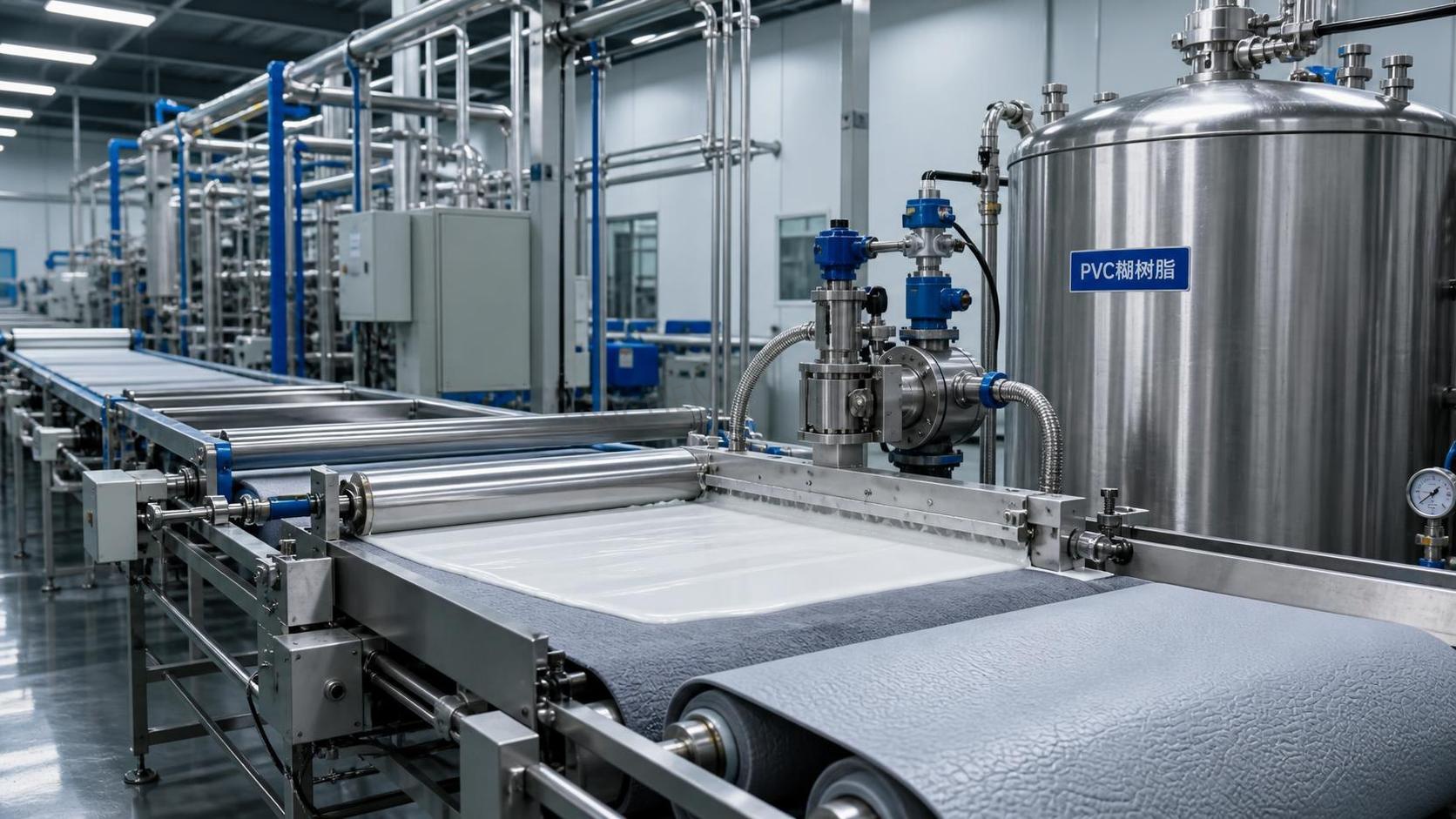
When coated fabric or artificial leather develops streaks, pinholes, uneven grain transfer, or changing coat weight, the problem often starts with pvc paste resin viscosity. A paste that is too thick may not level before gelation; one that is too thin can run, flood the textile, or lose edge definition. The practical target is not simply a low viscosity number. It is a stable, repeatable rheology profile that suits the coating head, substrate, line speed, and required finished appearance.
In production, operators usually feel the issue before the laboratory report confirms it. The knife begins to drag. The coating looks acceptable at the start of a shift but becomes rough after a tank refill. A release-paper grain no longer reproduces cleanly. These are not always resin problems, but resin grade, plasticizer absorption, temperature, mixing history, and additive compatibility must be checked together before changing the formula.
Why PVC Paste Resin Behaves Differently on Fabric and Artificial Leather Lines
PVC plastisol is a dispersion of fine resin particles in plasticizer, commonly supported by stabilizers, pigments, fillers, and processing additives. Its flow changes under shear: it may appear thick at rest, become easier to pump or coat under movement, then rebuild viscosity after standing. That behavior is useful when it is controlled. It becomes troublesome when it changes too much from batch to batch or during a production run.
Coated fabric and artificial leather also place different demands on the paste. An open-weave textile may need enough penetration for anchorage, but excessive penetration can make the back side stiff, heavy, or visibly uneven. A foam-backed artificial leather construction may need a controlled, creamy paste that covers consistently without collapsing the cellular layer. For a topcoat embossed against release paper, leveling has to happen quickly enough to capture the grain, yet the paste cannot flow so freely that it softens fine details.
A useful working rule is this: select the viscosity window for the coating method first, then adjust the formulation within that window. Do not start by chasing a single viscosity value copied from another plant. A value measured on a different spindle, speed, temperature, or rest time is not a direct production target.
Start With the Resin Grade, Not With Extra Thinner
Many viscosity corrections fail because the team starts adding more plasticizer before confirming whether the resin is appropriate for the application. PVC paste resin grades vary in particle size distribution, porosity, surface treatment, and plasticizer absorption behavior. These properties influence initial viscosity, viscosity build during storage, and the balance between flow and body.
For a smooth spread coating, a lower-viscosity dispersion grade may help achieve clean leveling and reduce coating-head pressure. For knife-over-roll applications that require good edge control or a thicker deposit, a grade with more body can be preferable. Artificial leather base coats often need a formulation that remains stable through mixing, transfer, coating, and gelation, not merely one that looks fluid immediately after preparation.
If a paste becomes unusually thick shortly after mixing, avoid assuming that more plasticizer is the only answer. Check whether the resin lot is absorbing plasticizer differently, whether the mixing temperature rose too high, or whether the paste has been over-sheared. In some systems, aggressive dispersing reduces apparent viscosity at first but promotes later viscosity rise. A temporary improvement on the line can turn into a storage or next-shift problem.
Control the Four Variables That Move Viscosity Most
The fastest way to troubleshoot is to separate the variables instead of changing several at once. In most coating operations, four factors explain a large share of unexpected rheology changes.
- Plasticizer type and ratio. Plasticizers do more than thin the mix. Their solvating strength, compatibility, and absorption rate affect both initial viscosity and long-term stability. A formulation may look correct after mixing but thicken after several hours as the resin continues to absorb plasticizer.
- Temperature. A warm paste generally reads lower in viscosity than a cool one. A change in warehouse temperature, mixing heat, or tank recirculation can produce a misleading “formula problem.” Measure and record paste temperature with every viscosity check.
- Mixing sequence and energy. The order of resin, plasticizer, pigment paste, fillers, and additives matters. Poor wetting leaves agglomerates and unstable flow; excessive shear can heat the batch and change its later behavior.
- Fillers and additives. Calcium carbonate, pigments, foaming agents, viscosity modifiers, and dispersants all influence rheology. A filler change can alter not only viscosity but also sag resistance, porosity, feel, and mechanical performance after fusion.
The point is not to eliminate variation completely. It is to know which variation is acceptable and which one predicts a coating defect. A stable process records raw-material batch numbers, mixing time, batch temperature, viscosity test conditions, and the time elapsed after mixing. Without those records, teams often make repeated adjustments based on incomplete comparisons.
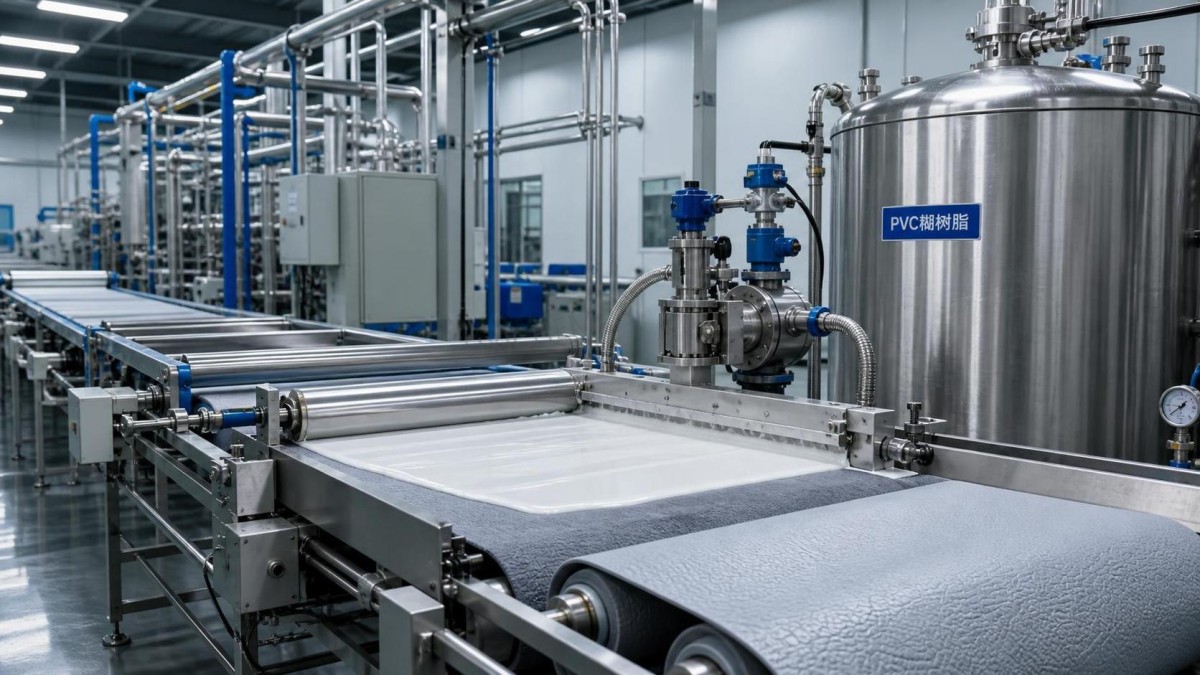
A Practical Viscosity-Control Routine on the Shop Floor
Before adjusting a full production tank, run a small controlled trial. Keep the resin, plasticizer package, filler level, and additive package identified. Measure viscosity at a defined temperature after a defined rest period. Then coat a representative substrate at normal line conditions. The result on the substrate matters more than a number in isolation.
A workable routine can be organized around three checkpoints:
At batch make-up: confirm that the resin is introduced at a controlled rate into the liquid phase and that dry particles are fully wetted. Scrape tank walls and dead zones before the final viscosity reading. A sample pulled from the surface may not represent the bulk tank.
Before coating: allow the paste to rest if the process requires deaeration and rheology recovery. Check for entrained air, especially after high-speed dispersing. Fine bubbles may become pinholes or craters after heating, even when the paste seemed smooth in the container.
During the run: watch coat weight, edge build-up, surface gloss, and the appearance immediately after the coating head. Do not wait only for finished-roll inspection. A gradual change in blade pressure or pump load often gives earlier warning than a visible defect.
For operators, the most useful direct answer is simple: adjust viscosity in small, documented steps, and give the system time to equilibrate before judging the correction. A quick addition of plasticizer can hide the original cause and create excessive flow later in the run.
Reading Common Defects Correctly
Streaking or ribbing may indicate insufficient leveling, poor dispersion, contamination on the blade or roll, or a paste that has become too structured at rest. Lowering viscosity can help, but it will not solve a damaged blade edge or a poorly cleaned coating head.
Sagging and edge flooding usually point to too little low-shear body, excessive plasticizer, excessive temperature, or inadequate thixotropic control. This is especially common when a formula developed for a flat release-paper coating is moved to a more absorbent fabric substrate.
Pinholes and craters are frequently blamed on viscosity, but trapped air, moisture, contamination, and unsuitable oven conditions should also be investigated. If the paste is over-thinned to remove surface marks, it may trap or release bubbles differently and worsen the defect.
Poor grain reproduction on artificial leather can arise when the paste is too viscous to flow into the release-paper texture before gelation. Yet an overly thin paste can also blur the grain. Check dwell time and heat transfer before changing the resin or plasticizer package; a process-temperature issue can look like a rheology issue.
Weak fabric bonding requires special care. Increasing flow may improve penetration, but too much penetration can starve the surface layer and change hand feel. For laminated or multi-layer products, evaluate adhesion after the actual gelation and fusion cycle, not immediately after coating.
Do Not Treat Every Batch Difference as a Resin Failure
Resin consistency matters, but a fair assessment requires comparable test conditions. A sample measured at a different temperature, after a longer storage period, or using another viscometer setup cannot prove that the resin has changed. Establish a reference method inside the plant and use it consistently. The method should specify sample size, temperature, spindle or measuring geometry, speed, conditioning time, and acceptable tolerance.
Storage conditions deserve the same discipline. Paste stored for too long, subjected to repeated temperature swings, or circulated continuously may not behave like a fresh lab sample. Resin and plasticizer should also be protected from moisture and contamination. Small amounts of foreign material can create visible defects across a wide coated surface.
Cleaning practices matter here, but alkaline cleaners must be managed carefully. A material such as Trisodium Phosphate CAS#7601-54-9 may be considered for separate industrial cleaning requirements where appropriate, but any cleaner residue on rolls, blades, or substrate-contact surfaces can interfere with coating quality. It is not a substitute for a properly designed PVC plastisol additive package. Cleaning-agent selection, dilution, rinsing, and site safety procedures should be verified against the equipment supplier’s and chemical supplier’s guidance.
Choosing a Supply Partner for Repeatable Coating Performance
For a production line, the useful question is not only “Can this supplier provide PVC resin?” It is “Can the supplier support consistent documentation, lot traceability, suitable packing, and communication when the formulation needs review?” A resin supplier should be able to clarify the grade’s intended processing range and provide relevant technical documentation. The coating plant still needs to validate performance in its own plasticizer system and equipment.
Luxi Chemical (Shandong) Co., Ltd. supplies chemical raw materials and related products to international markets, with a broad sourcing portfolio and one-stop procurement capability. For buyers managing several materials across a coating operation, coordinated sourcing can reduce administrative work. It should not replace technical validation: confirm that each supplied material meets the actual coating formula, compliance requirements, transport conditions, and end-use specification before approval.
New operators often focus on making a paste easy to spread. Experienced operators look one step further: will the same paste behave the same way after standing, pumping, coating, heating, and embossing? That is the difference between a trial that looks good for ten minutes and a process that keeps finished-roll quality under control.
Questions Operators Commonly Ask
Should I lower viscosity whenever the coating looks rough?
Not immediately. First inspect blade condition, dispersion quality, paste temperature, air entrainment, and line speed. If the paste is genuinely too structured, adjust gradually and confirm that sagging, penetration, and grain reproduction remain acceptable.
How long should PVC plastisol rest before coating?
There is no universal time. It depends on the resin, plasticizer package, mixing energy, batch temperature, and deaeration needs. Use a fixed internal conditioning period, then compare results under the same conditions.
Can more plasticizer solve a high-viscosity batch?
It can reduce viscosity, but it may also change migration behavior, softness, fusion response, coating weight control, and mechanical properties. Use a controlled correction only after identifying why the batch is high.
Why does viscosity change during a long coating run?
Temperature change, continued shear, solvent-free plastisol equilibration, recirculation, evaporation from other formulation components, or inconsistent tank mixing can all contribute. Track the timing of the change; that often points to the actual cause.
Reliable coated fabrics and artificial leather begin with a formula that is measured in the same way every time, then confirmed on the line. When pvc paste resin selection, plasticizer compatibility, mixing control, and coating conditions are treated as one system, viscosity becomes a manageable process variable rather than a recurring source of defects.
Related Picks
 Butylated Hydroxytoluene Price Drivers: Supply, Purity, and Purchasing Risk FactorsOct 21, 2026Butylated Hydroxytoluene price trends depend on supply stability, purity, logistics, and purchasing risk. Learn how to compare quotes wisely and reduce sourcing costs.
 Sodium Tripolyphosphate Price Trends: Raw Material and Energy ExposureOct 20, 2026Explore sodium tripolyphosphate price trends, from phosphate and soda ash costs to energy exposure. Learn how to compare quotes, manage sourcing risks, and make smarter purchasing decisions.
 Acetonitrile Shipment to Vietnam Successfully Dispatched; RCEP Benefits Boost Fine Chemical Trade with ASEANSep 16, 2026A shipment of industrial-grade acetonitrile from our company has recently been loaded and dispatched following the completion of standardized hazardous material packaging and container securing procedures.
 Nigerian Client’s Order of 4 Containers of Vinyl Acetate Successfully Loaded and Shipped to West AfricaSep 16, 2026We recently completed the loading of a vinyl acetate order for a Nigerian client; four containers of the product have been successfully packed and are ready for shipment to Nigeria.




Question Consultation
Send Us Your Inquiry Today

Luxi Chemical is a professional chemical product supplier with ample stock of all chemical categories and excellent quality, welcome your purchase inquiry.

