


Buying Fumed Silica: Compare Cost at the Target Viscosity, Not per Kilo
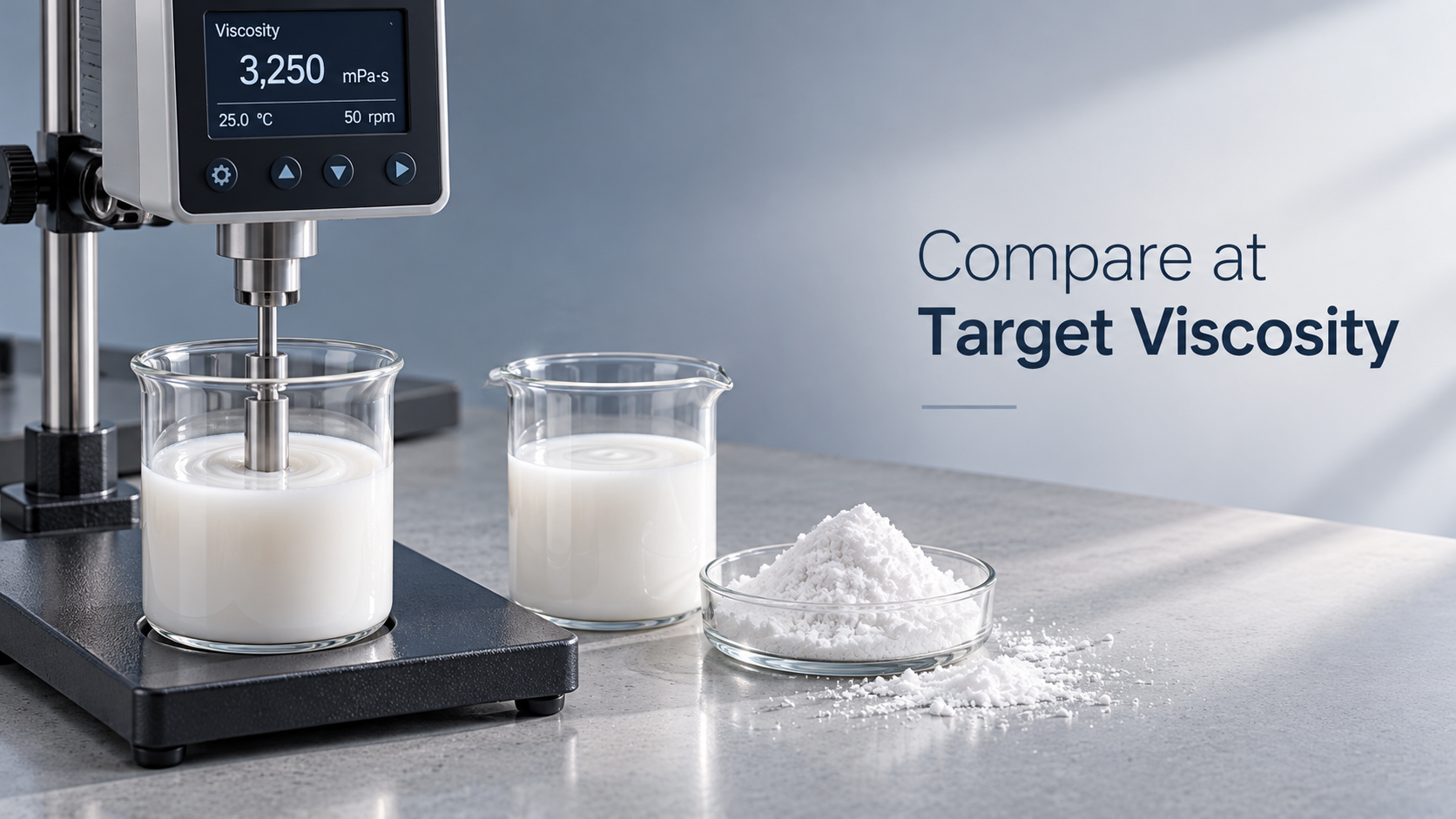
A lower price per kilo does not always make Fumed Silica the cheaper choice. For procurement teams, the more useful comparison is the cost of reaching—and maintaining—the required viscosity in a specific formulation. A material that needs a higher dosage, longer mixing, or repeated adjustment can consume the savings shown on the quotation.
The difficult part is that these costs rarely appear together. Purchasing sees the invoice, production sees the mixing time, and quality control sees the variation. A sound buying decision brings those figures into one comparison: the cost of producing an acceptable finished batch, not simply the cost of buying the powder.
Turn the viscosity target into a purchasing specification
“We need higher viscosity” is not a reliable basis for comparing suppliers. Neither is a viscosity number without a measurement method. Fumed silica creates a particle network within a formulation, and the measured response depends on the surrounding chemistry, dispersion history, temperature, and shear conditions.
Before requesting samples, agree on what acceptable performance means with the formulation and production teams. At minimum, record:
- The formulation: resin or binder type, solvent or water content, fillers, additives, and relevant moisture conditions.
- The measurement method: instrument, spindle or geometry, speed or shear rate, temperature, and sample preparation.
- The measurement timing: time after dispersion, pre-shear procedure, and rest period before testing.
- The acceptance window: minimum and maximum viscosity, rather than an unnecessarily precise single value.
- The practical requirements: sag resistance, settling control, pumpability, leveling, or dispensing behavior.
This last point matters. A coating can meet a viscosity target yet level poorly. An adhesive can look acceptable during a quick test but fail to recover enough structure after dispensing. Where these behaviors affect product quality, viscosity should be one acceptance criterion—not the entire specification.
The calculation that makes Fumed Silica quotes comparable
Start with the material cost at the approved dosage:
Fumed silica cost per tonne of finished product = delivered price per kilogram × kilograms required per tonne of finished product.
Use delivered cost on a consistent basis, including applicable freight, duties, and handling charges. Define dosage consistently, too: weight percent of the total finished formulation is not the same as parts per hundred resin.
The following example is hypothetical and illustrates the calculation only. It is not a market quotation or a claim about any supplier.
Grade B costs 20% more per kilogram but contributes $8 less per tonne of finished product. That conclusion holds only if both grades meet the same performance requirements under comparable production conditions.
There is also a useful break-even check: the higher-priced grade is cheaper on silica cost when its dosage ratio is lower than the inverse price ratio. In this example, Grade B must use less than 4.00 ÷ 4.80, or approximately 83.3%, of Grade A’s dosage.
Where the formulation must be rebalanced after changing silica content, include the cost of the displaced or replacement ingredients. Otherwise, the comparison remains incomplete.
Why apparently similar grades need different dosages
Two products labeled “fumed silica” are not automatically interchangeable. Their surface characteristics influence how they interact with the liquid phase and build structure.
Surface area is a screening parameter, not a purchasing verdict
Specific surface area, commonly reported using the BET method, helps distinguish grades. A higher surface area may provide stronger thickening in a suitable system, but it can also increase wetting difficulty or processing demands. There is no universal rule that the highest BET value delivers the lowest formulation cost.
Compare supplier recommendations within the actual binder system, then validate them. A technical data sheet can narrow the shortlist; it cannot establish your production dosage.
Hydrophilic and hydrophobic grades solve different problems
Hydrophilic fumed silica has surface silanol groups that participate in interactions affecting structure formation. Hydrophobic grades have surface treatments that change their compatibility and behavior. The appropriate choice depends on formulation polarity, moisture sensitivity, and the required rheological response.
Even two hydrophobic grades may use different treatments and perform differently. Ask for the grade designation, treatment description where available, and application guidance rather than accepting “hydrophobic silica” as a complete specification.
The surrounding ingredients can change the ranking
Resins, solvents, surfactants, dispersants, and other additives can influence the silica network. A grade that works efficiently in one formulation may require more material in another. This is why a successful supplier demonstration in a model system should lead to a trial—not directly to a purchase commitment.
Run a trial that purchasing can actually use
A useful comparison produces a dosage-performance curve, not one impressive sample. Test several dosage levels around the expected working range, using a consistent base formulation and recording any adjustments needed to keep the final composition balanced.
Begin with a controlled screening process. Keep equipment, batch size, addition sequence, mixing conditions, and temperature history consistent. Once suitable candidates emerge, optimize each within realistic plant constraints. This separates performance under a common process from performance under the best feasible process for each grade.
The trial record should capture more than the final viscosity:
- Powder addition time, wetting behavior, and visible dust or handling difficulties.
- Mixing equipment, blade geometry, speed, duration, and batch temperature.
- Evidence of incomplete dispersion, such as agglomerates or inconsistent texture.
- Viscosity after a defined rest period and at agreed later checkpoints.
- Application performance, including relevant sag, settling, flow, or recovery tests.
Do not assume that more mixing always improves the result. Insufficient dispersion can leave performance unrealized, while excessive processing can introduce heat, air, or changes elsewhere in the formulation. The objective is a reproducible processing window, not the longest possible dispersion cycle.
For scale-up, matching laboratory mixer speed alone is inadequate. Equipment geometry, power input, powder incorporation, and heat removal change with scale. Confirm the shortlisted grade in pilot or production equipment before calculating annual savings.
Count the costs hidden behind an acceptable viscosity reading
Once both candidates pass the technical requirements, expand the comparison beyond silica consumption. A practical cost model includes the following categories, using measured costs where available.
Fumed silica’s low bulk density can make storage and handling significant. Compare packaging format, pallet configuration, moisture protection, and suitability for your powder-feeding system. Follow the current safety data sheet and site exposure-control requirements; a lower quote does not justify inadequate dust control.
Keep the accounting disciplined. Shorter mixing time has a direct financial benefit when it reduces paid operating hours, energy consumption, or a genuine capacity bottleneck. Do not assign speculative savings to every minute saved, and avoid counting the same benefit twice.
Buy consistency, not just a successful sample
A single sample can establish feasibility. It cannot establish batch consistency. Before committing significant volume, request results from multiple production lots and, where practical, test more than one lot in your formulation.
Review the certificate of analysis alongside the technical data sheet. Relevant controls may include specific surface area, moisture-related measurements, pH under a stated method, and treatment-related parameters for hydrophobic grades. Distinguish guaranteed release limits from typical values.
These measurements support quality control, but they do not necessarily predict formulation viscosity by themselves. Your internal application test may remain necessary, particularly where the acceptable processing window is narrow.
Ask how the supplier handles changes to manufacturing location, process, surface treatment, or specifications. Agree on lot identification, traceability, complaint investigation, and change notification. A commercially attractive grade becomes expensive if production repeatedly has to rediscover its working dosage.
Keep a broad procurement program technically specific
A multi-category chemical supplier can simplify purchasing administration and consolidate communication. Luxi Chemical (Shandong) Co., Ltd. supplies chemical raw materials and products through its international trading business, serving customers in more than 60 countries and regions. For buyers, the value of that breadth depends on keeping documentation and qualification specific to each material.
For example, an unrelated catalog item such as Procaine hydrochloride CAS#51-05-8 requires its own application-specific assessment; its specifications provide no evidence of fumed silica performance. Consolidated purchasing should simplify administration without blurring technical requirements or implying compatibility between products.
When approaching a supplier about fumed silica, provide the application, current grade if available, dosage basis, target test method, annual demand, destination, and packaging preference. Ask the supplier to confirm grade availability, supporting documents, sample arrangements, and commercial terms rather than assuming that general chemical supply capability establishes application suitability.
Make the award conditional on usable performance
The final comparison should fit on one decision sheet: delivered price, approved dosage, silica cost per finished tonne, processing cost differences, performance results, lot-to-lot evidence, and supply conditions. Keep unresolved assumptions visible rather than burying them inside a savings estimate.
If a higher-priced grade wins, purchasing should be able to explain why in production terms. If the cheaper grade wins, it should be because its total cost is lower after qualification—not because other costs were ignored.
The best-value fumed silica is the grade that reliably delivers the required rheology at the lowest validated formulation-level cost. Price per kilo starts the conversation. Reproducible performance finishes it.
Related Picks
 Butylated Hydroxytoluene Price Drivers: Supply, Purity, and Purchasing Risk FactorsOct 21, 2026Butylated Hydroxytoluene price trends depend on supply stability, purity, logistics, and purchasing risk. Learn how to compare quotes wisely and reduce sourcing costs.
 Sodium Tripolyphosphate Price Trends: Raw Material and Energy ExposureOct 20, 2026Explore sodium tripolyphosphate price trends, from phosphate and soda ash costs to energy exposure. Learn how to compare quotes, manage sourcing risks, and make smarter purchasing decisions.
 Acetonitrile Shipment to Vietnam Successfully Dispatched; RCEP Benefits Boost Fine Chemical Trade with ASEANSep 16, 2026A shipment of industrial-grade acetonitrile from our company has recently been loaded and dispatched following the completion of standardized hazardous material packaging and container securing procedures.
 Nigerian Client’s Order of 4 Containers of Vinyl Acetate Successfully Loaded and Shipped to West AfricaSep 16, 2026We recently completed the loading of a vinyl acetate order for a Nigerian client; four containers of the product have been successfully packed and are ready for shipment to Nigeria.




Question Consultation
Send Us Your Inquiry Today

Luxi Chemical is a professional chemical product supplier with ample stock of all chemical categories and excellent quality, welcome your purchase inquiry.

