


Buying Plant Growth Regulators: Registration and Formulation Checks
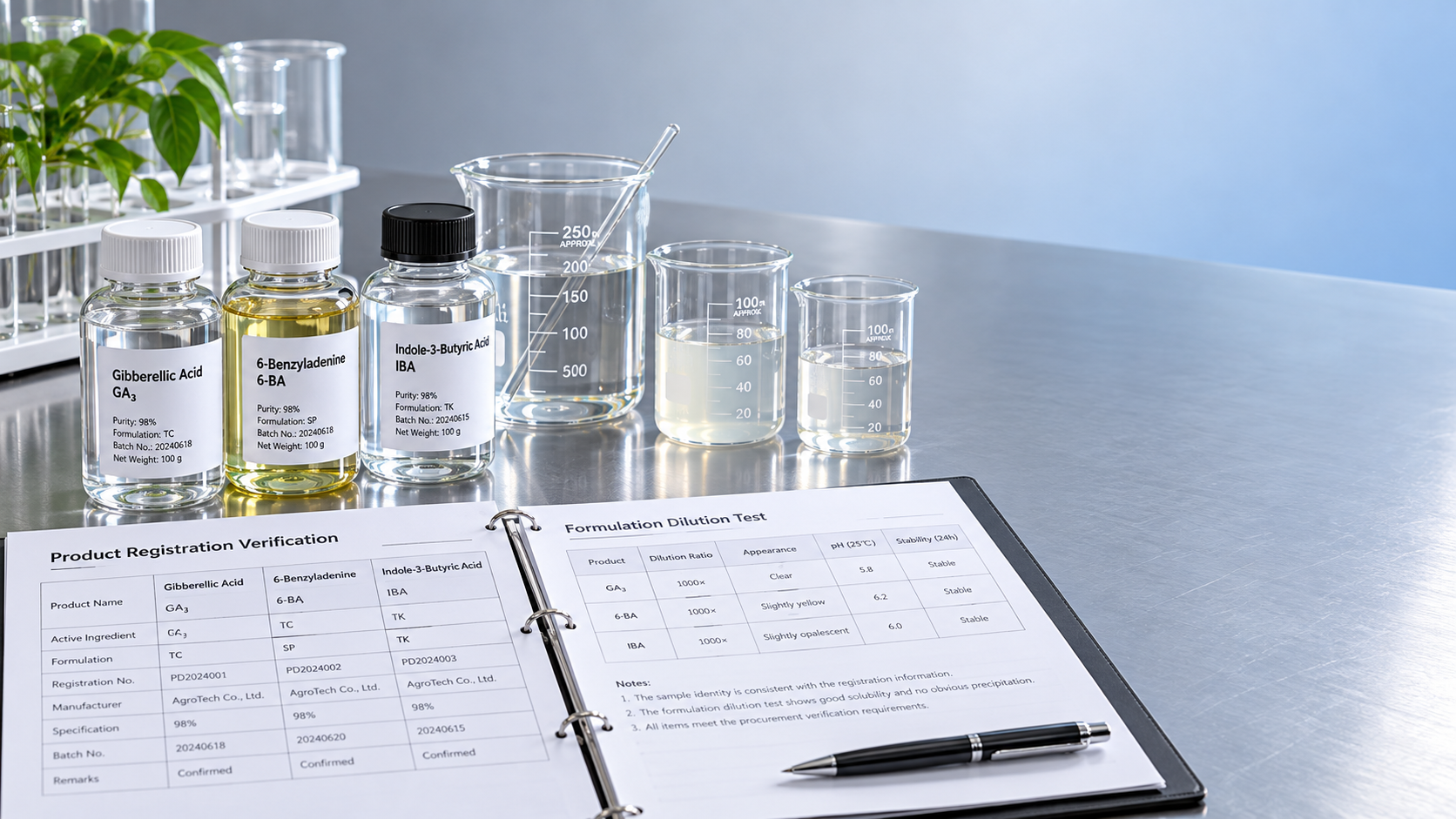
A low quotation for plant growth regulators becomes expensive if the product cannot be legally supplied for its intended use or fails to perform after storage and dilution. Procurement teams should establish two things before comparing offers: whether the exact product fits the destination market’s regulatory requirements, and whether its formulation suits the crop, application method, and operating conditions.
An active ingredient name and concentration cannot answer either question on their own. Products containing the same active substance may have different approved uses, formulation characteristics, and handling requirements. A useful purchasing decision therefore starts with a defined application and ends with an agreed specification, supporting documents, and clear batch acceptance conditions.
Establish the intended use before requesting prices
A request for quotation that asks only for “plant growth regulator, highest purity, best price” leaves too much room for incompatible offers. The buyer should specify the destination country, crop, intended growth response, application method, and whether the purchase concerns a finished formulation or technical material for further manufacturing.
Those details determine which offers deserve consideration. A product intended for use on an ornamental crop may not be acceptable for an edible crop. A treatment applied to planting material may have different authorization and formulation requirements from a foliar application. Material purchased for formulation requires a different assessment from a packaged product supplied directly to growers.
Also distinguish the desired biological response from the product category. Root initiation, fruit thinning, growth suppression, and other responses depend on the active substance, crop, timing, and dose. A supplier’s broad claim that a product “promotes growth” provides little basis for a purchase specification.
For repeat purchases, record the conditions under which the existing product works: water quality, application equipment, storage temperatures, packaging size, and time between opening and use. These details help assess whether a cheaper replacement is operationally equivalent.
Verify registration against the exact product and use
Regulatory treatment varies by jurisdiction and by the claims made for a product. Plant growth regulators may fall within pesticide or other agricultural input frameworks. A fertilizer listing, chemical inventory entry, or business license does not by itself establish authorization for a plant growth regulation claim. Begin with the destination authority’s applicable requirements and official records.
Where product registration is required, match the registration to the goods being offered. Approval of an active substance does not automatically authorize every finished formulation containing it. Registration in the exporting country also does not establish permission to import, distribute, or use the product elsewhere.
Request the registration evidence and approved label early enough to resolve discrepancies before paying a deposit. Compare the following details across the official record, label, quotation, and proposed shipment:
- Product name, registration holder, registration number, and current status.
- Active ingredient identity, declared concentration, and formulation type.
- Approved crops, purposes, application methods, rates, and timing.
- Restrictions affecting handling, application, harvest, or worker access, where applicable.
- Manufacturer or production source details where these form part of the authorization.
A similar trade name is insufficient. Different concentrations or formulation types may represent separate authorized products. A supplier offering an “equivalent” version should explain how that exact version fits the relevant authorization rather than relying on a registration document for another product.
Private labeling and bulk supply deserve particular attention. Permission to sell a registered product under one label does not necessarily extend to another brand, local repacking, or a different importer. Establish who holds the relevant rights and responsibilities, including any authorization needed for the proposed commercial arrangement.
For food crops, check how the intended use relates to applicable residue requirements and the grower’s sales market. Legal use in the production country does not automatically resolve requirements in every export destination. Purchasing teams serving export growers should involve their regulatory or agronomy colleagues before accepting a substitution.
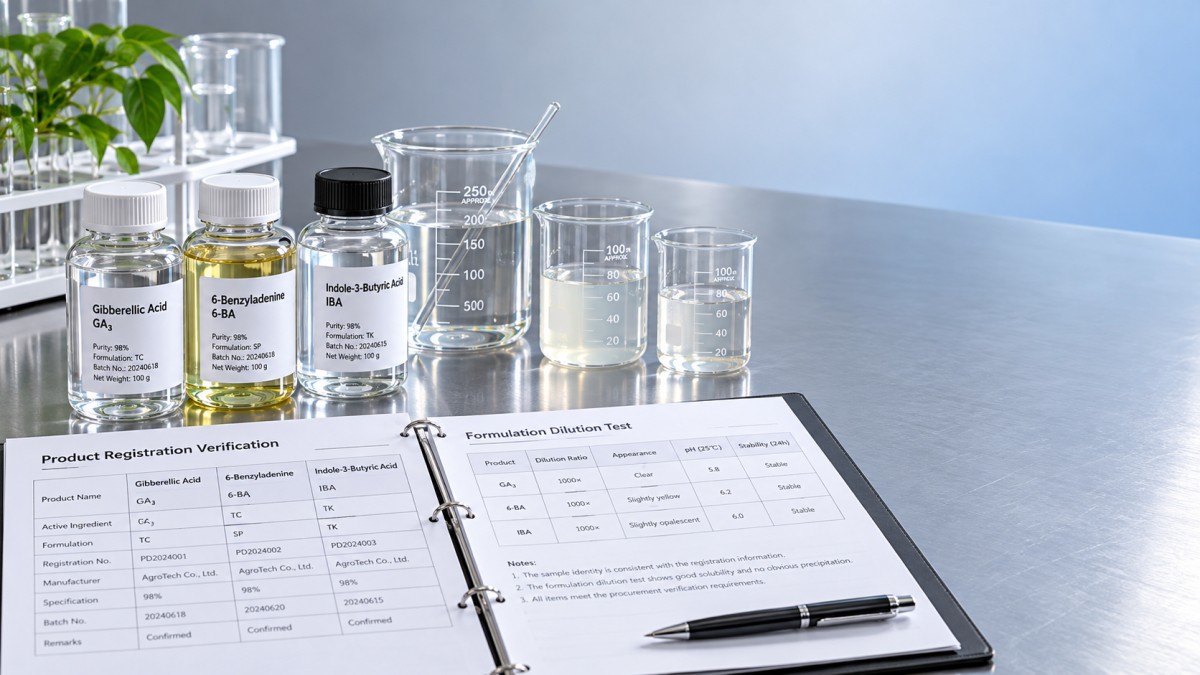
Keep registration evidence separate from supporting paperwork
A certificate of analysis describes tested quality characteristics. A safety data sheet communicates hazards and handling information. Neither document substitutes for product authorization. Likewise, a customs tariff code helps classify goods for trade purposes but does not establish permission to make agricultural claims or apply the product to a particular crop.
Build the document review around the actual transaction. Confirm the importer’s obligations, required label language, and any permits or local procedures that apply. For technical material, establish the lawful import and manufacturing route rather than assuming that a finished-product registration covers the shipment.
Compare formulations on a usable, measurable basis
Once the regulatory route is clear, normalize the technical comparison. Buyers should confirm the precise active substance, including its salt, ester, or other specified form where relevant. Check whether the concentration is expressed by mass, by volume, or as an equivalent amount of another chemical form. Similar percentage figures can describe different quantities.
A liquid declared by weight cannot be compared directly with one declared by volume without the appropriate conversion information. Density may be needed. Where an equivalent basis is used, obtain the supplier’s calculation and supporting specification. Avoid ranking quotations until they describe the same measurable basis.
Formulation type then determines what additional evidence matters. A soluble powder must dissolve adequately under the intended conditions. A suspension concentrate needs suitable dispersion and physical stability. An emulsifiable formulation requires attention to emulsion behavior and the practical implications of its solvent system. Higher active content alone does not establish better handling or performance.
Agree the relevant acceptance criteria before ordering. Depending on the formulation, these may include:
- Active ingredient content, test method, and permitted variation.
- Relevant impurities and degradation products.
- Water content, pH under specified test conditions, or density.
- Dissolution, dispersibility, suspensibility, or emulsion characteristics.
- Particle size, persistent foam, sediment, or redispersibility where relevant.
- Storage stability and compatibility with the proposed packaging.
Each specification needs a method and an acceptance limit appropriate to the product. A statement such as “excellent solubility” cannot serve as a batch release criterion. Ask what water, temperature, concentration, and observation period were used. These conditions can explain why a sample behaves differently from a supplier’s demonstration.
The supplier may reasonably protect its complete formulation recipe. Procurement still needs enough information to assess regulatory conformity, hazards, storage, and application compatibility. If a co-formulant or manufacturing change could affect those factors, address change notification in the supply agreement.
Test compatibility under the intended application conditions
Water hardness, pH, temperature, mixing order, and dilution can influence formulation behavior. Where mixing is permitted, a compatibility check using representative application water can reveal precipitation, separation, excessive foam, or other physical problems. Follow the label and supplier’s applicable instructions when designing the check.
A successful jar test establishes only limited physical compatibility under the conditions tested. It does not demonstrate crop safety, biological efficacy, or legal permission for the mixture. Those questions require separate evidence, particularly when introducing a new formulation into an established crop program.
Keep other agricultural chemicals outside the PGR assessment unless they have a defined role. For example, Sodium chlorite CAS#7758-19-2 is an oxidizing chemical associated with treatment and sanitation applications. It should not be treated as a substitute growth regulator or an assumed tank-mix partner. Where such chemicals share a procurement or storage system, assess their segregation and handling requirements separately.
Make the sample, production batch, and delivery specification agree
A satisfactory sample is useful only if the delivered material is controlled to the same agreed requirements. Ask whether the sample came from a commercial production batch and retain its identification. Record the specification revision against which it was evaluated, along with any relevant observations from dilution or application assessment.
For the shipment, request a batch-specific certificate of analysis identifying the product, batch number, manufacturing date, applicable expiry or retest date, test methods, and results. A generic specification sheet describes the target quality; it does not show that the dispatched batch met it.
Testing should address the uncertainty that matters. For a new source, independent verification of identity, active content, and selected quality characteristics may be justified. Broader testing can be appropriate where impurity control or formulation stability is unresolved. Agree the sampling procedure and laboratory method in advance so that disagreements are not caused by incompatible analytical approaches.
Packaging also belongs in the acceptance specification. Define pack size, closure, seal integrity, label details, and batch traceability. Consider whether containers can be emptied and measured reliably with the customer’s equipment. Residual product left in awkward packaging can affect both usable yield and operator handling.
Evaluate shelf life at the expected arrival and use dates. A long declared shelf life provides little purchasing value if most of it has elapsed before delivery. Storage claims should be supported for the supplied formulation and packaging; accelerated stability evidence alone should not be read as a guarantee under every transport or warehouse condition.
Compare the cost of an acceptable treatment
Price per kilogram is a useful starting point when offers are genuinely comparable. The purchasing decision should also account for concentration basis, approved application rate, freight, packaging, testing, documentation, and the amount likely to be used before expiry. Include any additional measuring, mixing, or equipment demands created by the formulation.
For eligible products serving the same application, compare product cost at the approved treatment rate. Do not assume that equal quantities of active ingredient will deliver equal results across different formulations or uses. Biological suitability must remain part of the comparison.
Keep foreseeable costs visible rather than assigning an unsupported value to every possible risk. A minimum order that exceeds seasonal demand, an unclear registration position, or a short remaining shelf life can outweigh a modest unit-price saving. Each creates a different purchasing response: negotiate quantity, resolve authorization, or change the delivery schedule.
Before issuing the purchase order, attach the agreed specification and document requirements. Define the minimum remaining shelf life, sampling and acceptance process, notification requirements for material changes, and the remedy for nonconforming goods. Release the order when the exact product, lawful intended use, batch quality requirements, and delivered cost are clear enough for both parties to work from the same terms.
Related Picks
 Butylated Hydroxytoluene Price Drivers: Supply, Purity, and Purchasing Risk FactorsOct 21, 2026Butylated Hydroxytoluene price trends depend on supply stability, purity, logistics, and purchasing risk. Learn how to compare quotes wisely and reduce sourcing costs.
 Sodium Tripolyphosphate Price Trends: Raw Material and Energy ExposureOct 20, 2026Explore sodium tripolyphosphate price trends, from phosphate and soda ash costs to energy exposure. Learn how to compare quotes, manage sourcing risks, and make smarter purchasing decisions.
 Acetonitrile Shipment to Vietnam Successfully Dispatched; RCEP Benefits Boost Fine Chemical Trade with ASEANSep 16, 2026A shipment of industrial-grade acetonitrile from our company has recently been loaded and dispatched following the completion of standardized hazardous material packaging and container securing procedures.
 Nigerian Client’s Order of 4 Containers of Vinyl Acetate Successfully Loaded and Shipped to West AfricaSep 16, 2026We recently completed the loading of a vinyl acetate order for a Nigerian client; four containers of the product have been successfully packed and are ready for shipment to Nigeria.




Question Consultation
Send Us Your Inquiry Today

Luxi Chemical is a professional chemical product supplier with ample stock of all chemical categories and excellent quality, welcome your purchase inquiry.

