


Sodium Tripolyphosphate in Seafood: Managing Uptake and Drip Loss
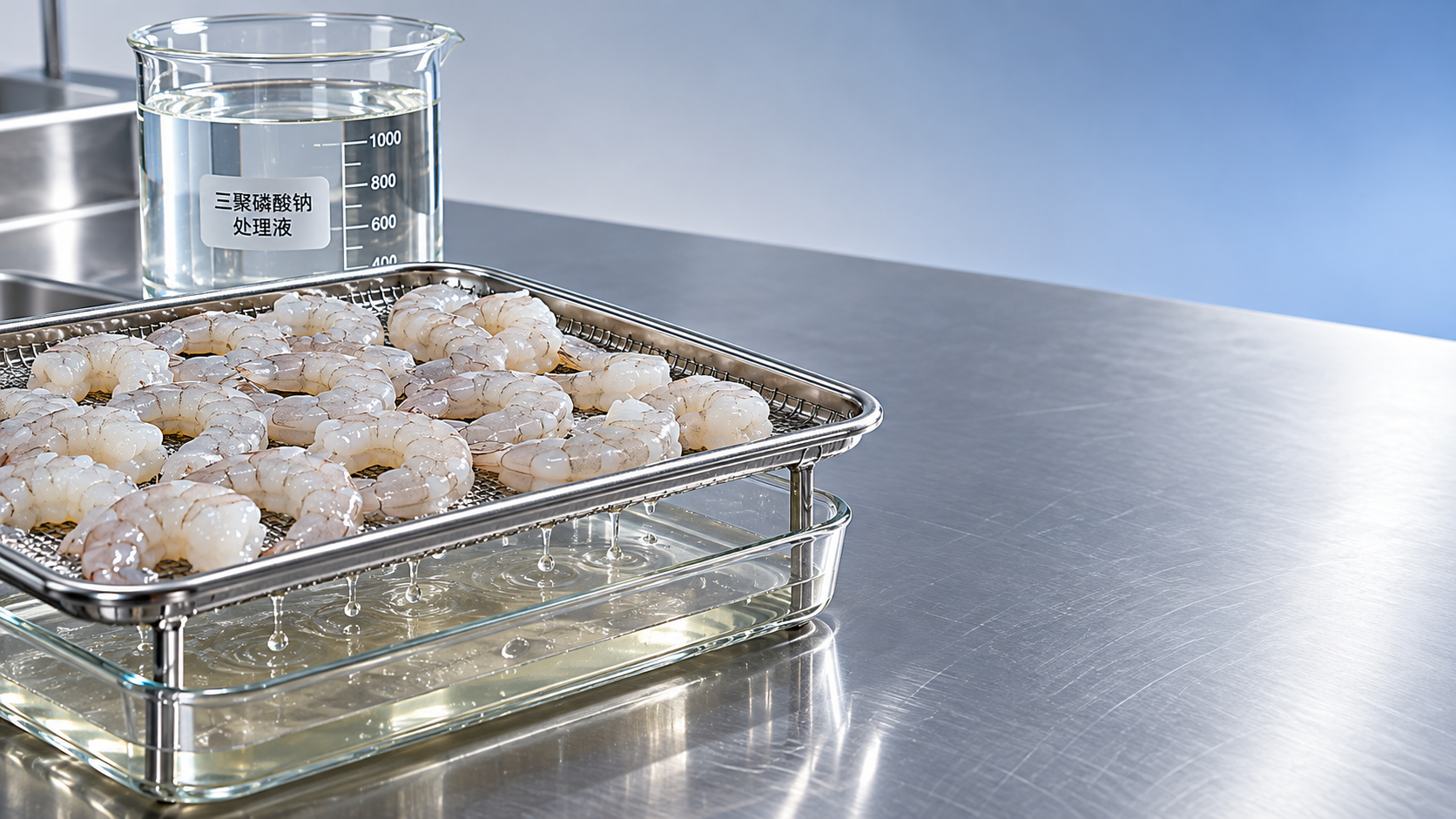
Sodium tripolyphosphate improves water retention in seafood when treatment conditions support useful protein functionality and the retained moisture survives subsequent processing. The practical target is a repeatable balance between treatment uptake, thaw drip, cooked yield, and acceptable texture. A large weight increase immediately after soaking provides little evidence of success if that gain disappears during thawing or produces a swollen, unnaturally soft product.
Establish the evaluation around the actual production sequence: treatment, draining, freezing, storage, thawing, and cooking where relevant. Compare treated and untreated portions from the same raw material lot, and measure weights at defined stages. This connects treatment settings to saleable product performance and separates retained moisture from surface liquid, glaze, and inconsistent drainage.
Uptake and retention measure different things
Phosphates influence muscle protein interactions, ionic conditions, and pH, increasing the capacity of suitable tissue to retain water. Their effect depends on the starting condition of the proteins. Fresh, structurally intact muscle responds differently from tissue damaged by prolonged storage, repeated freezing, or rough handling. Increasing phosphate exposure cannot restore all functionality lost through deterioration.
Immediate uptake includes liquid associated with the tissue and liquid remaining on its surface or trapped between pieces. Only part of this gain necessarily remains through freezing and thawing. Drain time, product orientation, basket loading, and surface geometry therefore influence the apparent treatment result. Peeled shrimp, intact fish fillets, and scallop meats require separate treatment windows even when the bath composition is identical.
Use clearly defined calculations throughout a trial:
- Treatment uptake: drained post-treatment weight minus initial weight, divided by initial weight, multiplied by 100.
- Thaw drip loss: pre-thaw seafood weight minus drained post-thaw weight, divided by pre-thaw seafood weight, multiplied by 100. Establish a consistent basis that excludes packaging and external glaze.
- Overall cooked yield: cooked, drained weight divided by initial untreated weight, multiplied by 100. This links the final edible output to the original material.
Cooking loss calculated from the thawed weight answers a different question from overall cooked yield. Reporting both makes it harder for an attractive intermediate result to conceal poor final retention. Weight measurements alone also cannot distinguish retained original moisture from absorbed treatment water; that distinction requires additional compositional evidence and interpretation.
Set the treatment window around the raw material
Species, cut size, skin condition, and previous freezing history change the rate and uniformity of treatment. Thin pieces expose more surface relative to their mass and generally equilibrate faster than thick portions. A mixed-size batch can therefore contain overtreated small pieces alongside insufficiently treated large ones. Size grading before a trial reduces this source of variation.
Record whether the material is fresh, chilled, partially thawed, or fully thawed. Residual ice creates uneven access to the tissue and changes bath dilution as it melts. Previously frozen seafood also brings existing structural damage into the experiment. Its untreated control must undergo the same thawing and handling sequence as the treated material.
Raw material pH provides useful context, but it should not become a standalone acceptance measure. Sampling location, measurement method, species, and storage condition affect the reading. Interpret pH alongside odor, appearance, tissue integrity, and storage records. Poor-quality material should not enter a treatment optimization study simply because it absorbs liquid readily.
Control concentration, contact time, and bath condition together
A concentration value is meaningful only when its basis is explicit. State whether it describes sodium tripolyphosphate as supplied, total phosphate blend, or another reporting basis, and whether the percentage is mass-based or volume-based. A commercial blend containing other phosphates or salt cannot be compared directly with pure sodium tripolyphosphate at the same nominal percentage.
Prepare the solution with a documented water source, addition sequence, and mixing procedure. Complete dissolution matters: undissolved material and concentrated pockets create uneven exposure. Water hardness and mineral content can affect solution behavior, including cloudiness or precipitation. If the bath changes appearance, investigate water chemistry and preparation conditions before increasing the dosage.
Longer contact does not guarantee proportionally better retention. Uptake can slow while undesirable texture or flavor becomes more apparent. Salt, where permitted and appropriate for the formulation, also changes protein behavior and uptake. Keep it constant while investigating phosphate concentration so that the contribution of each variable remains interpretable.
Maintain validated chilled handling conditions throughout the trial. Warming the bath to accelerate uptake introduces food safety concerns and changes the process being evaluated. Phosphate treatment does not replace hygienic handling or temperature control.
Bath pH and conductivity are useful process indicators, but neither directly establishes the remaining tripolyphosphate concentration. Dissolved salts, seafood exudate, dilution, and changes in phosphate composition affect these measurements. Use them to detect drift within a validated process, with suitable analytical testing where composition must be confirmed.
Build a trial that reveals where the gain disappears
Begin with a limited comparison of concentration and contact time while keeping temperature, salt, agitation, and product loading stable. Include an untreated control and, when useful, a water-only treatment exposed to equivalent handling. The water-only group helps separate the effect of immersion from the contribution of phosphate.
Randomly allocate comparable pieces from a single lot across treatments. Repeat the comparison across additional lots before setting a production window. Multiple pieces in one bath describe variation within that bath; independently prepared treatment runs provide stronger evidence of process repeatability.
- Record the initial product condition and weight using a consistent surface-draining procedure.
- Apply each treatment under documented conditions, then drain using the same equipment, loading depth, and duration.
- Freeze with comparable loading and airflow. Track external glaze separately so it cannot inflate the apparent treatment benefit.
- After a defined storage interval, thaw under controlled conditions, collect released liquid, and weigh the drained seafood. Evaluate cooking performance using a fixed endpoint and resting procedure where cooking is part of the intended use.
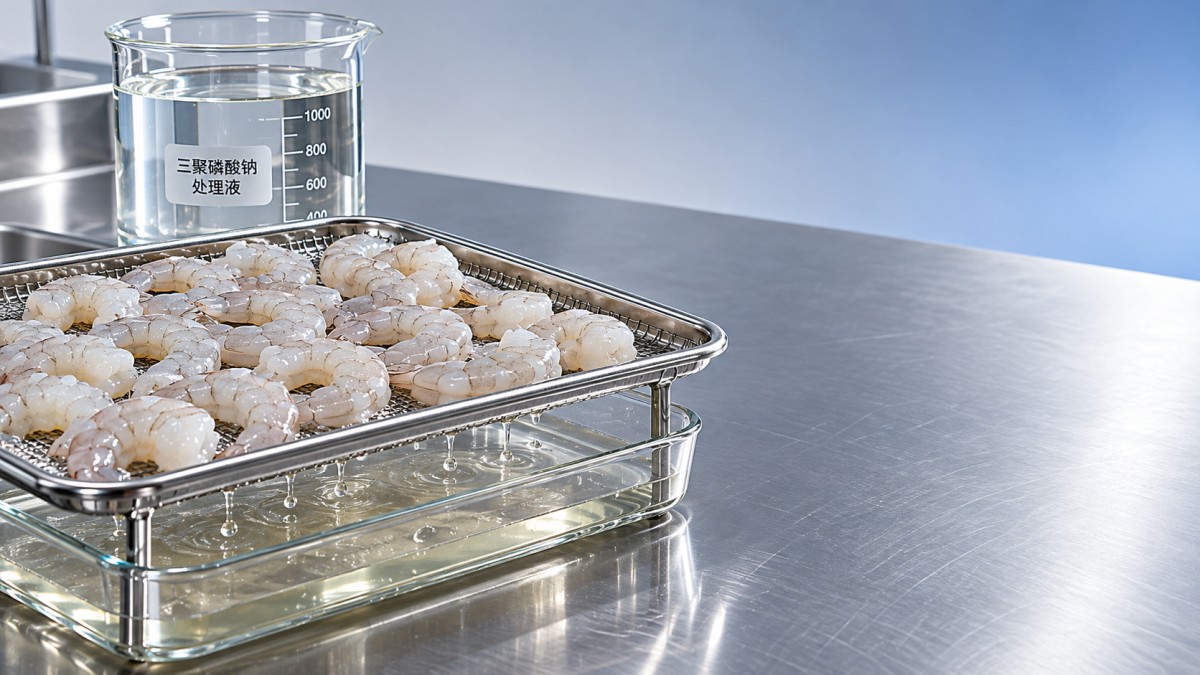
A single short storage test will not establish performance across the intended frozen shelf life. Include storage intervals relevant to the product and realistic distribution conditions. Freezing rate, temperature fluctuation, and dehydration alter tissue damage and moisture migration, potentially changing the ranking of treatments that looked similar immediately after processing.
For frozen products, define how pre-thaw seafood weight is established without counting glaze or losing meltwater inconsistently. Uncontrolled deglazing creates an uncertain denominator. Keep the preparation method identical across groups and document any unavoidable limitation in the mass balance.
Read texture and drip results together
The strongest treatment is not necessarily the one with the lowest measured drip. Texture, appearance, and flavor determine whether that retention is useful. Excessive treatment can produce swollen pieces, unusual translucency, soft or slippery surfaces, or an alkaline sensory impression. These observations deserve investigation even when weight results appear favorable.
Use consistent sensory preparation and evaluate coded samples where practical. Compare raw handling properties separately from cooked firmness and bite. Instrumental texture measurements become useful when sample geometry, measurement temperature, and cooking endpoint are standardized; otherwise, differences in thickness can dominate the apparent treatment effect.
Several result patterns help direct the next adjustment:
- High uptake followed by high thaw drip points toward weak retention, excessive surface carryover, or damage during freezing and storage. Examine the draining and freezing stages before extending treatment.
- Lower thaw drip with poor cooked yield indicates that retention during thawing has not translated into heat-stable performance.
- Acceptable average yield with wide variation suggests uneven size distribution, treatment exposure, or raw material condition. Raising the average dosage can worsen the most heavily treated portion.
If an untreated control also shows unexpectedly high drip, investigate the raw material and freezing process first. A phosphate adjustment made during a refrigeration or handling failure risks producing a recipe that compensates poorly once normal conditions return.
Ingredient identity and analytical results need a clear basis
Specify food-grade sodium tripolyphosphate for the intended seafood application and destination market. Relevant documentation includes identity, assay, impurity limits, and batch traceability. Physical characteristics such as particle size and dissolution behavior also affect preparation consistency. A chemical name alone does not establish suitability for food use.
Keep food ingredient records distinct from unrelated synthesis chemicals. Boron trifluoride diethyl etherate CAS#109-63-7 is a reactive Lewis acid reagent used in organic synthesis; it has no role in seafood phosphate treatment. Its specifications cannot serve as evidence for food-grade phosphate qualification.
Total phosphorus testing requires careful interpretation because seafood contains naturally occurring phosphorus. A result from treated tissue does not directly equal added sodium tripolyphosphate. Phosphate species can also change during processing and storage, so total phosphorus and residual tripolyphosphate answer different analytical questions. Establish the reporting basis with the laboratory before comparing results against product specifications or applicable requirements.
Confirm permitted use, relevant limits, and labeling obligations for the specific species, product presentation, and destination. A bath concentration is not a substitute for evaluating the finished product. Likewise, a published treatment recipe does not establish that the resulting composition or declaration is acceptable in every market.
Turn the preferred treatment into operating limits
Select a treatment window supported by final yield, sensory quality, and repeatability across representative lots. Define acceptable ranges for concentration, exposure time, temperature, loading, and drainage, together with a response to bath drift. Include conditions that trigger investigation, such as abnormal swelling, inconsistent dissolution, or a rising spread in uptake between samples.
When production moves to a different piece size, supplier lot profile, freezing system, or phosphate formulation, confirm performance under the changed conditions. Retain paired records of treatment uptake and downstream loss: their relationship reveals whether the process continues to deliver useful moisture retention as production conditions change.
Related Picks
 Butylated Hydroxytoluene Price Drivers: Supply, Purity, and Purchasing Risk FactorsOct 21, 2026Butylated Hydroxytoluene price trends depend on supply stability, purity, logistics, and purchasing risk. Learn how to compare quotes wisely and reduce sourcing costs.
 Sodium Tripolyphosphate Price Trends: Raw Material and Energy ExposureOct 20, 2026Explore sodium tripolyphosphate price trends, from phosphate and soda ash costs to energy exposure. Learn how to compare quotes, manage sourcing risks, and make smarter purchasing decisions.
 Acetonitrile Shipment to Vietnam Successfully Dispatched; RCEP Benefits Boost Fine Chemical Trade with ASEANSep 16, 2026A shipment of industrial-grade acetonitrile from our company has recently been loaded and dispatched following the completion of standardized hazardous material packaging and container securing procedures.
 Nigerian Client’s Order of 4 Containers of Vinyl Acetate Successfully Loaded and Shipped to West AfricaSep 16, 2026We recently completed the loading of a vinyl acetate order for a Nigerian client; four containers of the product have been successfully packed and are ready for shipment to Nigeria.




Question Consultation
Send Us Your Inquiry Today

Luxi Chemical is a professional chemical product supplier with ample stock of all chemical categories and excellent quality, welcome your purchase inquiry.

