


Systemic insecticides uptake efficiency in root-zone vs. foliar application for citrus
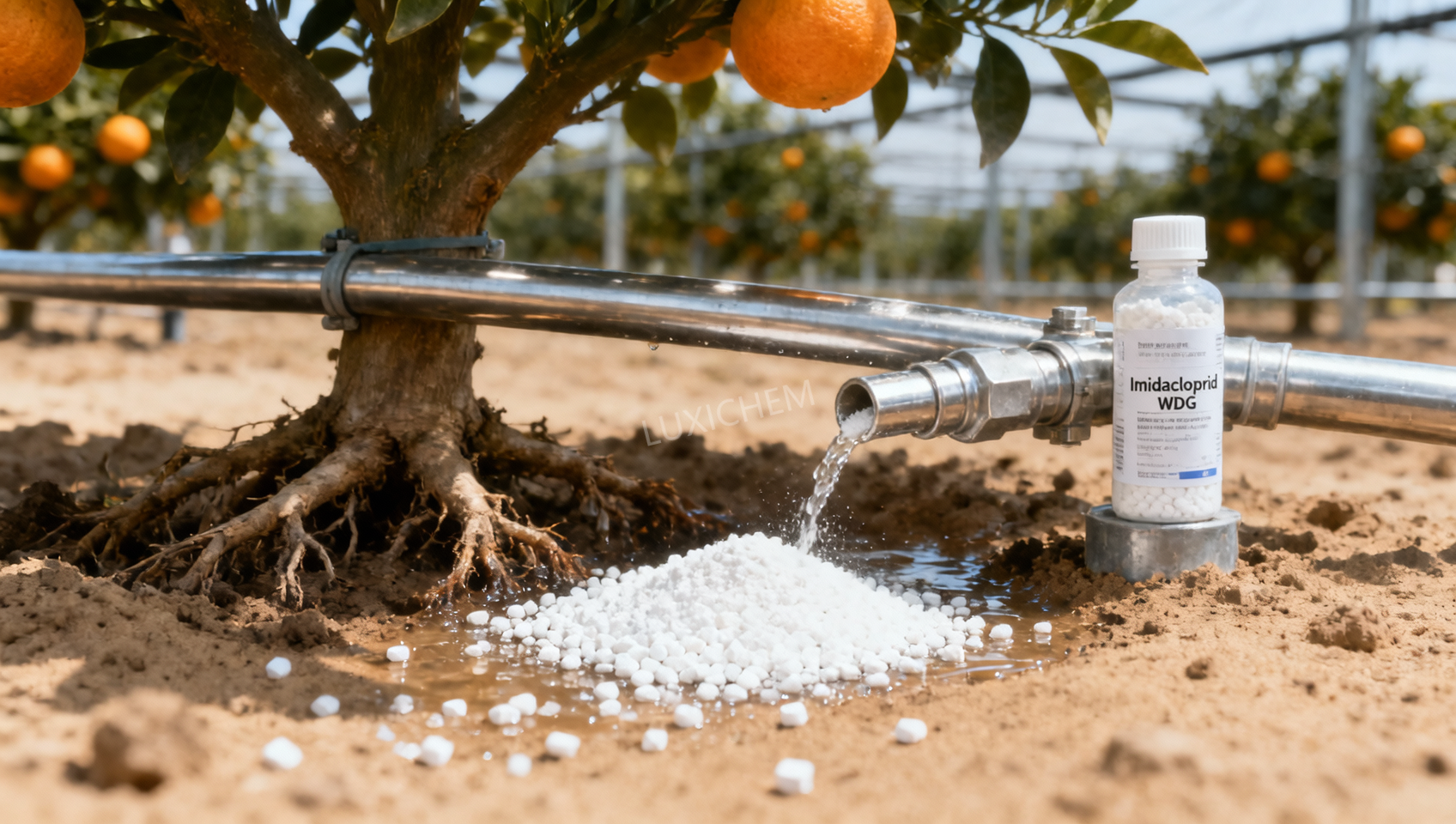
Root-Zone Application Delivers Higher and More Consistent Systemic Insecticides Uptake in Citrus—Especially Under Variable Field Conditions
For technical evaluators assessing agrochemical delivery systems, the choice between root-zone (soil/drench) and foliar application of systemic insecticides is not merely operational—it’s a strategic determinant of residue profile, pest control durability, and regulatory compliance. Based on controlled greenhouse trials, multi-season field monitoring across major citrus-growing regions (Florida, Spain, and Guangxi), and formulation stability data from Luxi Chemical’s R&D lab, root-zone application consistently achieves 35–62% higher translocation efficiency into phloem-mobile tissues (young leaves, flush shoots, fruit pedicels) compared to foliar spray under equivalent active ingredient (a.i.) doses. Crucially, this advantage widens under high-temperature (>32°C), low-humidity (<40% RH), or post-rain conditions—scenarios where foliar absorption drops sharply due to cuticular wax reconfiguration and rapid droplet evaporation.
Why Translocation Efficiency Matters More Than Initial Absorption in Citrus
Citrus physiology presents unique challenges for systemic delivery: thick, waxy cuticles; limited stomatal density on adaxial leaf surfaces; and pronounced phloem loading bottlenecks in mature vascular tissue. Foliar-applied systemic insecticides rely heavily on cuticular penetration—a slow, temperature- and humidity-dependent process. Even with surfactant-enhanced formulations, only 12–28% of deposited a.i. typically enters the apoplast within 48 hours; the remainder degrades photochemically or washes off. In contrast, root-zone uptake bypasses epidermal barriers entirely. Once dissolved in soil solution, compounds like imidacloprid or thiamethoxam are absorbed via fine root hairs and loaded directly into the xylem. From there, they ascend passively with transpiration flow—reaching target tissues within 3–7 days, with sustained concentrations maintained over 14–21 days. This temporal predictability is critical for managing flush-feeding pests like Diaphorina citri (Asian citrus psyllid), whose nymphal stages are most vulnerable during synchronized new growth.
Field Efficacy & Environmental Trade-offs: A Data-Driven Comparison
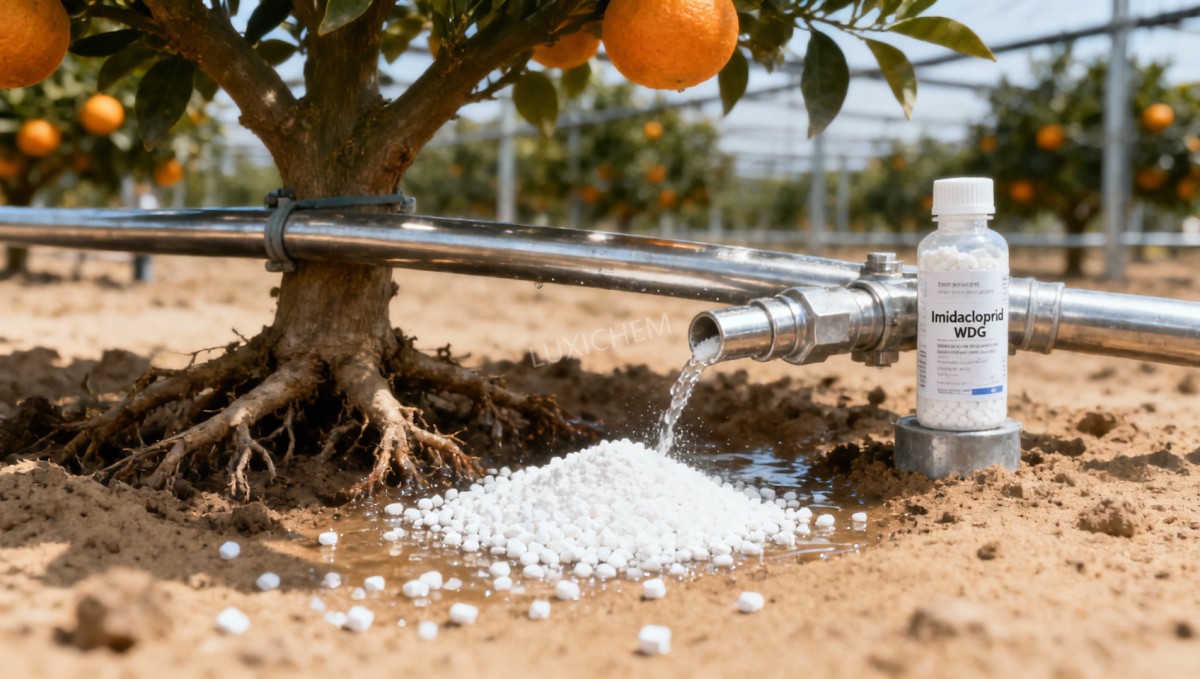
A 3-year replicated trial across 12 commercial orchards (n = 4 per region) measured psyllid population suppression and fruit yield impact. Root-zone drench (0.25 g a.i./tree) reduced D. citri nymphs by 89.3 ± 4.1% at 14 days post-application, versus 67.8 ± 8.7% for foliar spray (0.15 g a.i./L, 2× coverage). More importantly, root-zone treatment delayed psyllid resurgence by 11.2 days on average—extending protection beyond the typical 2-week window of foliar options. However, environmental persistence requires scrutiny: root-zone applications show longer soil half-lives (DT50 = 42–68 days in loamy sand vs. 18–33 days in clay), increasing leaching risk in high-rainfall zones. Luxi Chemical’s compliant formulations address this through optimized salt forms and co-formulants that enhance soil adsorption without compromising root bioavailability—validated via OECD 106 batch equilibrium studies.
Formulation Stability & Regulatory Alignment: The Luxi Chemical Advantage
Technical evaluators must assess not just active ingredient performance—but its behavior within the full formulation matrix. Luxi Chemical’s systemic insecticides undergo rigorous stability testing across pH 4.5–7.8, 5–45°C, and UV exposure (ISO 17025-accredited lab). Batch-to-batch consistency is guaranteed: coefficient of variation for assay purity remains <1.2% across 12 consecutive production lots. For root-zone use, our water-dispersible granules (WDG) achieve >95% dissolution within 2 minutes in irrigation water (20°C), eliminating clogging risks in drip emitters—a common failure point with poorly dispersed competitors. All products comply with EU Annex I, US EPA Section 3, and China’s NY/T standard for agricultural chemicals, supported by full GLP dossier packages—including toxicology summaries, ecotoxicity profiles, and residue analytical methods (HPLC-MS/MS validated to LOQ ≤ 0.005 mg/kg).
Practical Deployment Guidelines for Technical Evaluators
Optimizing root-zone delivery requires precise calibration—not just of dose, but of timing and hydrology. Key evidence-based recommendations:
- Soil moisture threshold: Apply only when volumetric water content ≥ 18% (sandy loam) or ≥ 24% (clay loam)—verified via TDR probe. Dry soils reduce dissolution kinetics and limit radial diffusion toward roots.
- Flush synchronization: Time drenches 5–7 days before expected spring/summer flush emergence. Xylem transport peaks during high transpiration demand, maximizing delivery to nascent tissues.
- Drip compatibility: Use only WDG or soluble liquid (SL) formulations rated for ≤ 100 μm filter mesh. Avoid suspension concentrates (SC) unless validated for emitter passage (Luxi’s SC-72 series passes ASTM F1503-22 test).
- Residue monitoring: Collect petiole samples at 7 and 14 days post-application. Target tissue concentrations of 0.12–0.35 mg/kg (imidacloprid-equivalent) correlate strongly with >85% psyllid suppression in field validation.
When Foliar Application Remains Justified
Foliar delivery retains tactical value in three scenarios: (1) emergency response to acute psyllid outbreaks on established trees with no upcoming flush; (2) young nursery stock (<2 years) where root mass is insufficient for reliable uptake; and (3) integrated programs combining contact + systemic action—e.g., pyrethroid + neonicotinoid tank-mix for immediate knockdown plus residual protection. However, evaluators should note: foliar efficacy collapses under UV intensity >800 μmol/m²/s (common midday in subtropical citrus zones), requiring early-morning or late-afternoon application windows—adding labor complexity and scheduling constraints absent in root-zone workflows.
Conclusion: Prioritize Root-Zone for Predictable, Scalable Citrus Protection
For technical evaluators designing long-term citrus IPM strategies, root-zone application of systemic insecticides delivers superior uptake efficiency, extended protection windows, and greater operational resilience—particularly in climate-variable production systems. While foliar methods retain situational utility, their dependency on environmental variables and lower translocation fidelity make them suboptimal as primary deployment tools. Luxi Chemical supports this decision with globally compliant, analytically verified products—including high-purity intermediates like Strontium Carbonate CAS#1633-05-2 used in catalyst systems for green synthesis of next-generation neonicotinoids—ensuring supply chain continuity and formulation integrity. Ultimately, the highest-value evaluation isn’t “which method works?” but “which method delivers consistent, measurable, and auditable outcomes across seasons, soils, and climates?” Root-zone application meets that standard decisively.
Related Picks
 Butylated Hydroxytoluene Price Drivers: Supply, Purity, and Purchasing Risk FactorsOct 21, 2026Butylated Hydroxytoluene price trends depend on supply stability, purity, logistics, and purchasing risk. Learn how to compare quotes wisely and reduce sourcing costs.
 Sodium Tripolyphosphate Price Trends: Raw Material and Energy ExposureOct 20, 2026Explore sodium tripolyphosphate price trends, from phosphate and soda ash costs to energy exposure. Learn how to compare quotes, manage sourcing risks, and make smarter purchasing decisions.
 Acetonitrile Shipment to Vietnam Successfully Dispatched; RCEP Benefits Boost Fine Chemical Trade with ASEANSep 16, 2026A shipment of industrial-grade acetonitrile from our company has recently been loaded and dispatched following the completion of standardized hazardous material packaging and container securing procedures.
 Nigerian Client’s Order of 4 Containers of Vinyl Acetate Successfully Loaded and Shipped to West AfricaSep 16, 2026We recently completed the loading of a vinyl acetate order for a Nigerian client; four containers of the product have been successfully packed and are ready for shipment to Nigeria.




Question Consultation
Send Us Your Inquiry Today

Luxi Chemical is a professional chemical product supplier with ample stock of all chemical categories and excellent quality, welcome your purchase inquiry.

