


What does 50% dodecyl dimethyl benzyl ammonium chloride concentration mean?
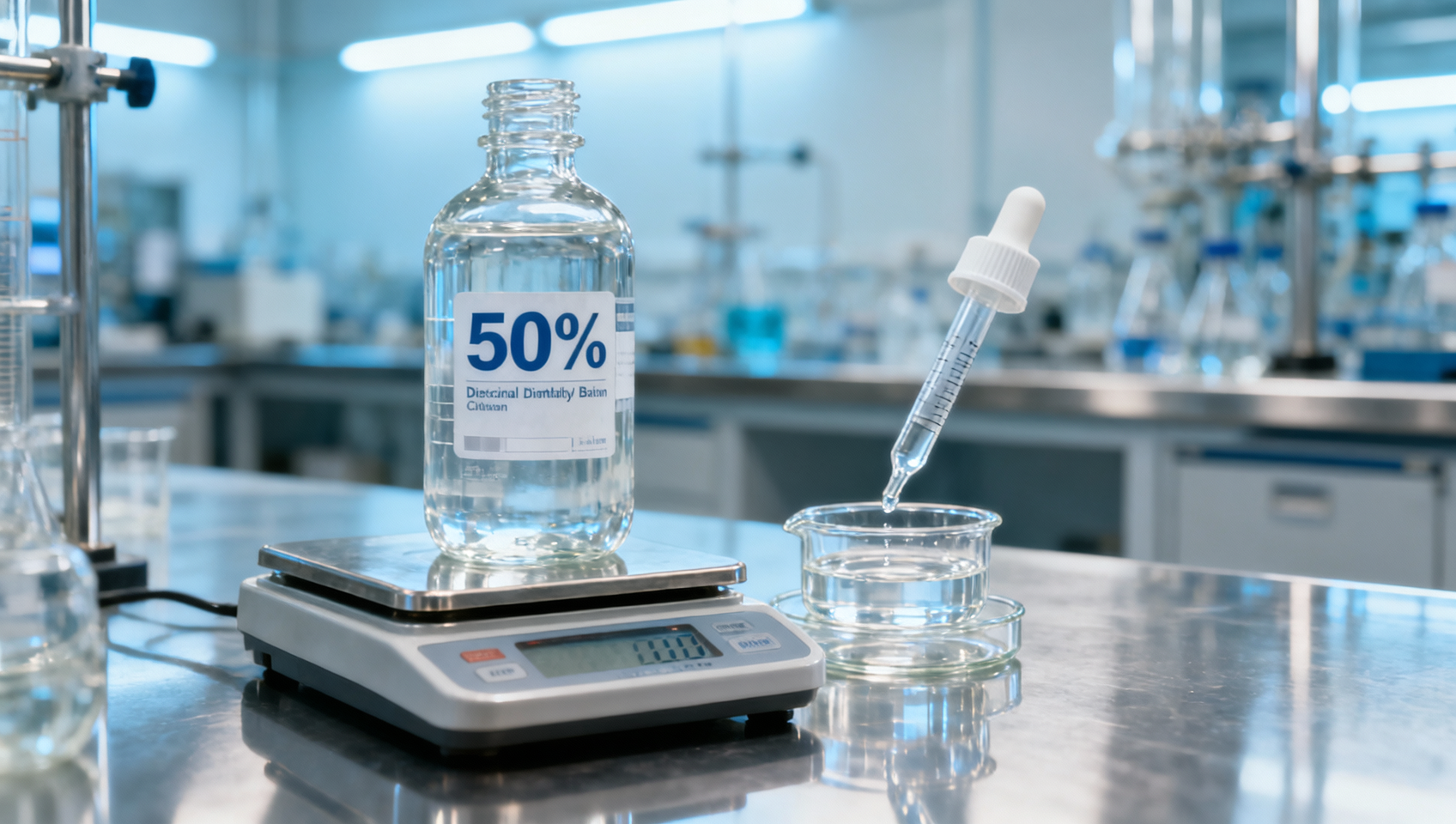
On most commercial labels, dodecyl dimethyl benzyl ammonium chloride 50% means that approximately half the product’s mass is active ingredient. A 100 g sample therefore contains about 50 g of the specified active material, with the balance mainly water or other declared solvents. The percentage normally describes a supplied solution, not a dry chemical that is only “50% pure.” Confirm that the specification explicitly states percentage by weight, often written as w/w or wt%.
This distinction matters when comparing quotations, checking a formulation, or calculating a dilution. Treating 50% concentrate as 100% active would introduce only half the intended active amount. Conversely, confusing a percentage by weight with a percentage by volume can produce an incorrect dose even when the arithmetic looks reasonable. The first step is to identify exactly what the supplier measures and how that measurement is expressed.
Reading the percentage on a product label
For a solution specified as 50% w/w, the relationship is straightforward:
Active content (%) = mass of active ingredient ÷ total mass of solution × 100
The denominator includes everything in the supplied product: active material, water, any declared co-solvent, and other constituents. It does not refer only to the solvent mass. Adding 50 g of active material to 100 g of water, for example, gives 150 g of solution containing approximately 33.3% active material—not 50%.
The following expressions are not interchangeable:
A product name alone may use “50%” as shorthand for a nominal grade. The technical specification should give the acceptance limits, while the certificate of analysis should identify the batch result or its reported compliance. A nominal grade is not a guarantee that every batch measures exactly 50.000%.
Active content is not the same as chemical purity
A deliberately diluted solution can have 50% active content while being manufactured from high-purity raw material. Water in that solution is an intended carrier, not automatically an impurity. Rejecting the product because the active content is “only 50%” would misunderstand its commercial form.
Purity asks a different question: how much of the material being assessed is the intended chemical rather than unwanted substances? Depending on the specification, purity might describe the isolated active substance, a chromatographic result, or another defined analytical measurement. It cannot be inferred simply by subtracting the solvent fraction from 100%.
Consider a formulation worksheet that requires 2 kg of active material. With a confirmed 50% w/w concentrate, the required product mass is 4 kg. The additional 2 kg entering the formulation is carrier and any other declared non-active material. That contribution belongs in the formulation balance, especially where water or solvent content affects compatibility, drying, or stability.
The same distinction helps when reviewing unrelated chemicals in a procurement list. For example, Glycidyl methacrylate CAS#106-91-2 is a reactive monomer containing methacrylate and epoxy functional groups, used in applications such as coatings, adhesives, and functional polymers. It is not a substitute for this quaternary ammonium compound. Its identity and specification must be assessed separately rather than compared through a percentage figure alone.
Check whether “active” means the C12 compound or a mixture
Dodecyl dimethyl benzyl ammonium chloride is a quaternary ammonium compound with a dodecyl, or C12, alkyl group. However, commercial terminology can be less precise than the chemical name suggests. Related benzalkonium chloride products may contain a distribution of alkyl-chain lengths rather than only the C12 component.
This creates a second possible misunderstanding: 50% total quaternary ammonium active content does not necessarily mean 50% of the single C12 compound. If a product contains several homologues, the reported assay may measure their combined active content. A name on a quotation is therefore insufficient to establish the exact composition.
When chemical identity matters, compare the full chemical description, CAS identification, and any stated alkyl-chain distribution. Ask whether the assay measures total quaternary ammonium compounds or specifically the named substance. A total-active test alone may not establish the proportion of each homologue; that requires suitable compositional information or additional analysis.
This is particularly relevant when reproducing a published formulation or comparing laboratory results. Two solutions with the same total active percentage can differ in composition, solvent system, and application behavior. Concentration establishes how much active material is present, but not every property of that material.
A dilution calculation that keeps the units consistent
Once both concentrations are confirmed as weight percentages, calculate the concentrate mass using:
Concentrate mass = final batch mass × target active fraction ÷ concentrate active fraction
As an arithmetic example, suppose a formulation requires 10 kg of solution containing 1% active material, prepared from a concentrate assayed at 50% w/w:
- Required active mass: 10 kg × 0.01 = 0.10 kg.
- Required concentrate mass: 0.10 kg ÷ 0.50 = 0.20 kg.
- Remaining mass allowance: 10.00 kg − 0.20 kg = 9.80 kg.
For a simple two-component dilution, the remaining 9.80 kg would be the specified diluent. In a formulated product, it must also accommodate every other ingredient. This example illustrates mass balance only; it is not a recommended use concentration or an antimicrobial performance claim.
“One part plus fifty parts” is not a fiftyfold dilution
Starting with a 50% concentrate, one part concentrate plus 49 parts diluent gives 50 total parts and a theoretical 1% active concentration, provided the parts are measured by mass. One part concentrate plus 50 parts diluent gives 51 total parts, producing approximately 0.98% active.
Instructions such as “dilute 1:50” can therefore be ambiguous. They may mean one part brought to 50 total parts or one part mixed with 50 parts diluent. Record the actual concentrate mass and final batch mass rather than relying on the ratio notation alone.
Account for the actual batch assay
If the certificate reports an assay different from the nominal 50%, use that value when the formulation requires accurate active dosing. Replace 0.50 in the equation with the measured mass fraction. Whether this correction is necessary depends on the formulation tolerance and the supplier’s acceptance range; it should not be decided from the product name alone.
Why litres and ppm need extra care
A weight percentage cannot be converted directly into grams per litre without the solution density. One litre of concentrate does not necessarily weigh one kilogram. The relevant relationship is:
Active mass per litre = solution density in kg/L × active mass fraction × 1,000 g/kg
Use density data for the supplied grade at the stated temperature. Do not borrow a density value from a different concentration or solvent system. Where accurate weighing is practical, a mass-based dilution avoids this conversion entirely.
Likewise, “ppm” needs a defined basis. On a mass basis, 1% equals 10,000 mg/kg, and 0.1% equals 1,000 mg/kg. For dilute aqueous solutions with density close to 1 kg/L, mg/L may be numerically close to mg/kg, but that approximation should not be carried over to concentrated solutions.
Another frequent error is reporting product concentration as active concentration. A solution containing 1% by weight of a 50% concentrate contains 0.5% active material, not 1%. A clear worksheet should distinguish “concentrate added,” “active content,” and “final batch mass” in separate fields.
What to verify in the supplier documents
A label is a starting point. The technical data sheet, batch certificate of analysis, and safety data sheet answer different questions and should agree on the product identity.
- Confirm the concentration basis. Look for w/w, wt%, or an equivalent definition rather than assuming the meaning of an unqualified percentage.
- Read the active-content specification. Check the permitted range, the batch result where supplied, and whether the assay covers total active material or a specific component.
- Identify the carrier. Establish whether the balance is water, a water/co-solvent mixture, or another declared system. Do not assume all non-active material is water.
- Match the documents to the batch. Product grade and batch identification should correspond to the container being used.
- Check properties needed for handling. Density matters for volumetric dosing; storage conditions and appearance criteria help assess whether the material remains within specification.
The safety data sheet describes hazards and handling requirements, but its composition ranges are not a substitute for a precise batch assay. Conversely, a certificate confirming active content does not establish every application claim, compatibility requirement, or authorization for a finished product.
A useful clarification request is: “Please confirm whether the nominal 50% is total active content by weight, identify the solvent system, and provide the batch assay and chemical composition.” This resolves the main interpretation problems without requesting unrelated information.
What the 50% figure cannot establish
The concentration does not, by itself, specify a safe working dilution or prove disinfectant effectiveness. Where antimicrobial use is intended, performance depends on the finished formulation, target organisms, contact time, application conditions, and applicable product authorization. A raw-material assay cannot replace validated instructions for the finished product.
Compatibility also remains a separate question. Quaternary ammonium compounds can interact with anionic ingredients, potentially affecting formulation stability or available activity. A calculation may correctly predict the amount added while failing to describe how that active material behaves after mixing.
Handle the concentrate according to its current safety data sheet, including specified protective equipment, dilution procedures, spill controls, and disposal requirements. The word “solution” does not imply harmlessness, and dilution should not be treated as permission for unrestricted discharge.
For a practical record, write the material as “50% w/w active solution,” followed by the confirmed identity, carrier, and batch assay. That description supports a defensible calculation. If any of those details remain unclear, resolve them before converting a label percentage into a formulation dose.
Related Picks
 Butylated Hydroxytoluene Price Drivers: Supply, Purity, and Purchasing Risk FactorsOct 21, 2026Butylated Hydroxytoluene price trends depend on supply stability, purity, logistics, and purchasing risk. Learn how to compare quotes wisely and reduce sourcing costs.
 Sodium Tripolyphosphate Price Trends: Raw Material and Energy ExposureOct 20, 2026Explore sodium tripolyphosphate price trends, from phosphate and soda ash costs to energy exposure. Learn how to compare quotes, manage sourcing risks, and make smarter purchasing decisions.
 Acetonitrile Shipment to Vietnam Successfully Dispatched; RCEP Benefits Boost Fine Chemical Trade with ASEANSep 16, 2026A shipment of industrial-grade acetonitrile from our company has recently been loaded and dispatched following the completion of standardized hazardous material packaging and container securing procedures.
 Nigerian Client’s Order of 4 Containers of Vinyl Acetate Successfully Loaded and Shipped to West AfricaSep 16, 2026We recently completed the loading of a vinyl acetate order for a Nigerian client; four containers of the product have been successfully packed and are ready for shipment to Nigeria.




Question Consultation
Send Us Your Inquiry Today

Luxi Chemical is a professional chemical product supplier with ample stock of all chemical categories and excellent quality, welcome your purchase inquiry.

