


When is citric acid E330 suitable for food formulation?
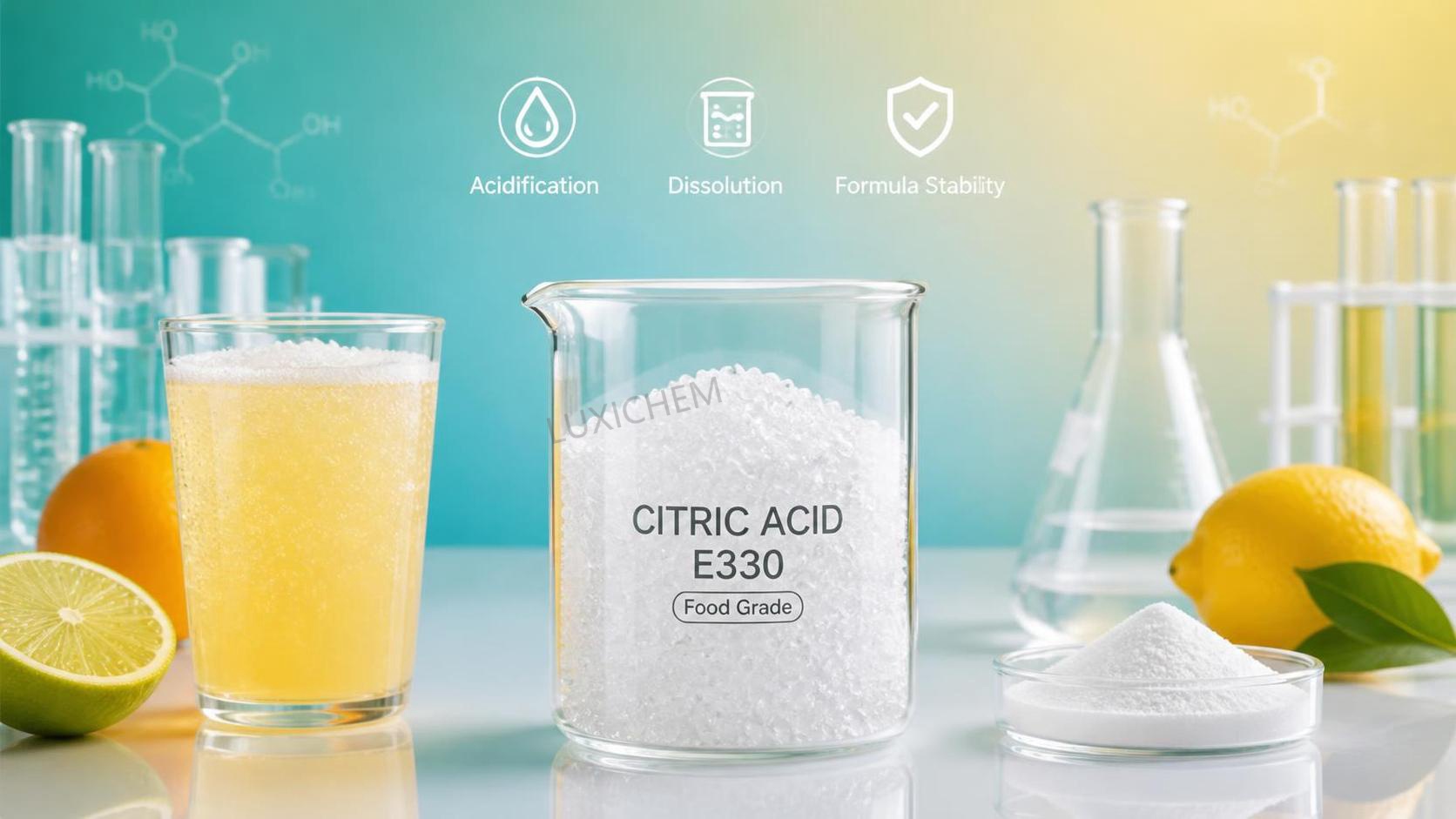
The practical question is not whether E330 works, but whether it works in this formula
Citric acid E330 is one of the most familiar acidulants in food processing, but familiarity can lead to weak formulation decisions. It is often selected because it is widely accepted, commercially available, relatively easy to handle, and capable of performing several functions at once. Yet a technical evaluator should not begin with the assumption that citric acid is automatically the best choice. The relevant question is whether it can achieve the required pH, sensory profile, process stability, shelf-life objective, and regulatory position in a specific product system.
In many applications, citric acid E330 is suitable because it provides a clean sour taste, reduces pH efficiently, supports preservative systems, and contributes to batch-to-batch consistency. In others, it may create excessive sharpness, destabilize a texture system, increase corrosion risk, or fail to deliver the intended microbial-control margin on its own. The difference lies in how the ingredient interacts with the full formulation rather than in its general reputation.
For food manufacturers, co-packers, and technical purchasing teams, an effective evaluation should connect laboratory performance with practical production realities: raw-material specification, solubility, dosing method, packaging format, storage humidity, traceability, export-market requirements, and supplier continuity. Acid selection is rarely just a flavor decision.
Where citric acid E330 is usually a strong fit
Citric acid is most suitable in formulations where moderate to strong acidification is required without introducing a distinctive mineral, vinegar-like, or fermented note. Its flavor is generally perceived as bright and direct, making it especially useful in fruit-based, citrus-flavored, and refreshment-oriented products. It is commonly considered during development of beverages, powdered drink mixes, confectionery, jams, fruit preparations, sauces, dairy-flavored products, bakery fillings, and certain processed foods.
Its suitability is particularly high when the product needs more than simple sourness. Citric acid can act as a pH regulator, flavor balancer, sequestrant in some systems, and a supporting component of a broader preservation strategy. In beverage production, for example, lowering pH can help maintain a profile that consumers associate with freshness while also improving the working environment for selected preservative systems. In fruit preparations, it can offset sweetness, reinforce fruit perception, and help manage browning-related issues when used with other appropriate controls.
It is also a practical candidate for dry formulations. Anhydrous and monohydrate grades can be selected according to processing needs, moisture sensitivity, flowability, and target use. Instant beverage powders, effervescent systems, seasoning blends, and confectionery applications may all benefit from its relatively predictable dissolution behavior. However, “soluble” does not mean that every dosing process will be trouble-free. Poor powder addition sequence, inadequate agitation, or local over-concentration can still create caking, uneven acidity, or temporary lump formation.
Start with the required pH, not the nominal dosage
A common development shortcut is to begin with a dosage used in a similar product. That can be useful as an initial benchmark, but it should not be treated as a formulation answer. The amount of citric acid required depends on the target pH, the buffering capacity of the food matrix, the presence of proteins or mineral salts, sweetener selection, fruit solids, water composition, and process losses.
A clear beverage containing water, sugar, flavor, and citric acid may show a relatively direct pH response. A dairy-based drink, protein beverage, sauce, or vegetable preparation can behave very differently because proteins, phosphates, salts, and natural solids resist pH change. In such systems, a dose that is acceptable in a bench sample may lead to protein destabilization, viscosity change, phase separation, or an unexpectedly harsh taste after pilot-scale processing.
The target pH should therefore be set as a product-control parameter rather than an afterthought. The formulation team should define an acceptable pH range, then verify sensory acceptance, microbial risk, and physical stability across that range. A product that reaches the desired pH but becomes unpleasantly sharp or unstable is not a successful application.
Acid taste is not the same as acid concentration
Citric acid E330 is often selected because its sensory profile aligns well with citrus, berry, tropical, and many fruit concepts. Still, the resulting taste depends on the whole flavor architecture. Sweetness level, salt content, fruit concentrate, aroma compounds, carbonation, temperature of consumption, and sweetness-modifier systems can all alter perceived acidity.
High-intensity sweeteners deserve particular attention. A product may require a different acid balance when sugar is replaced, because sucrose contributes body and rounds acidity in ways that some sweetener systems do not. In reduced-sugar beverages, a formula can reach a technically acceptable pH while tasting thinner, more metallic, or disproportionately sour. Blending citric acid with another permitted acidulant may be considered where the sensory target requires a longer, softer, or more layered acid profile, subject to regulatory and labeling review.
Technical teams should also account for flavor drift during shelf life. Freshly prepared samples can mask acid intensity through volatile flavor notes, while stored products may reveal more pronounced sourness as aroma balance changes. Accelerated storage tests are useful, but they should be interpreted carefully: elevated-temperature results are indicators, not automatic predictions of every real distribution condition.
Preservation support has limits
Citric acid can help reduce pH and thereby support microbial control, but it should not be described as a complete preservation solution. Its effect depends on the initial microbiological quality of ingredients, product water activity, thermal treatment, filling conditions, packaging integrity, distribution temperature, and the presence or absence of other preservation hurdles.
This distinction matters in procurement and product claims. Buying food-grade citric acid with a compliant certificate of analysis does not remove the need for process validation. The final product must be assessed as a system. For acidified beverages, sauces, and fruit preparations, the development team should define critical control points around acid addition, pH verification, mixing time, filling temperature where relevant, and retained-sample testing.
Citric acid also has chelating behavior that may be useful in some formulas, particularly where trace metals contribute to oxidation or discoloration. However, this effect should not be oversold. The actual outcome depends on the type and concentration of metals present, the food matrix, oxygen exposure, light conditions, packaging, and the antioxidant strategy.
In formulations where oxidation control is important, evaluators sometimes review flavonoid ingredients alongside acid and chelation measures. For example, Rutin CAS#153-18-4 may be relevant to an ingredient-screening discussion because rutin is associated with antioxidant applications. But it should not be treated as a direct substitute for citric acid or as a universal preservation aid. Its solubility, color contribution, sensory impact, permitted use status, and compatibility with the intended food category must be assessed independently.
Processing conditions can determine success or failure
Citric acid is generally straightforward to use, but the point of addition is important. In liquid systems, it is often best introduced as a pre-dissolved solution or through a controlled dosing process, especially at larger production volumes. Direct addition of powder into a partially mixed batch can create local pH zones that damage sensitive ingredients or make correction difficult.
Protein-containing products require especially careful sequencing. Adding acid before full hydration of stabilizers or before establishing the desired protein dispersion may increase the risk of aggregation. In some products, acidification must be coordinated with heat treatment, homogenization, and stabilizer selection. The correct approach depends on whether the product is intended to remain a stable emulsion, develop a gel structure, or deliver a deliberately acidified dairy profile.
For confectionery and sugar systems, late-stage addition may be preferred to limit unwanted changes during cooking. Acid exposure at high temperature can promote sucrose inversion, potentially affecting texture, stickiness, color, and storage behavior. The optimal sequence must be confirmed through pilot trials because the practical outcome is influenced by cooking temperature, residence time, solids content, and moisture level.
Equipment compatibility should also be reviewed. Acidified solutions can increase corrosion concerns in unsuitable metal-contact surfaces, particularly in older systems or where cleaning and drainage are not well controlled. The evaluation should include pumps, valves, transfer lines, holding tanks, and any points where concentrated acid solutions may contact equipment. This is a plant-engineering issue as much as an ingredient issue.
What to ask before approving a supplier
For a mature ingredient such as citric acid, price is visible and quality variation is often less visible until it affects production. Technical procurement should therefore establish an approval package that goes beyond a basic specification sheet. The required documentation varies by market and application, but a practical review normally includes identity, assay, moisture or water content as applicable, particle-size information where powder handling matters, microbiological limits where required, heavy-metal and impurity declarations, allergen information, origin details, shelf life, packaging specification, and lot traceability.
The grade must match the intended use. Food applications require an appropriate food-grade material and supporting compliance documentation relevant to the destination market. Regulatory frameworks differ by country and region, and product-category rules may impose conditions beyond the general authorization of citric acid as E330. Maximum-use expectations, labeling conventions, purity criteria, and permitted food categories should be confirmed against the applicable local rules. Specific legal requirements should be treated as subject to verification with the current authority guidance or qualified regulatory counsel.
Packaging and logistics are equally important because citric acid can pick up moisture in unfavorable storage conditions. Bags should be protected from humidity, palletization should prevent damage, and warehouse controls should limit exposure to wet floors, condensation, and strong odors. A technically compliant batch that arrives caked or with compromised packaging can still disrupt dosing accuracy and line efficiency.
- Confirm whether anhydrous or monohydrate material is required for the formula and dosing calculation.
- Align particle characteristics with the plant’s conveying, blending, and dissolution equipment.
- Require lot-level certificates and retain samples for complaints investigation.
- Review change-notification procedures for manufacturing site, process, specification, or packaging changes.
- Assess supply continuity across the expected production schedule, not only the first purchase order.
When another approach may be better
Citric acid is not automatically the preferred acidulant where a softer or more persistent acid profile is required, where a formula needs a highly specific buffering behavior, or where mineral fortification and protein stability create a narrow operating window. Some products benefit from acid blends, while others may require a different acidulant entirely. The correct comparison should be made on sensory performance, pH curve, stability, process behavior, cost-in-use, label implications, and local compliance status.
It may also be unsuitable as the sole response to a shelf-life problem. If spoilage arises from poor sanitation, inadequate thermal process, oxygen ingress, weak seal integrity, or temperature abuse in distribution, increasing acid dosage can create a sensory defect without addressing the primary cause. A product-development team should resist using acidification to compensate for an uncontrolled process.
For technical evaluators, the most useful decision framework is simple: define the product target, establish the necessary pH and sensory range, test citric acid under realistic process conditions, validate shelf-life performance, and approve supply against documented quality and compliance requirements. Citric acid E330 is highly suitable when those conditions align. Its value is not that it solves every formulation problem, but that it can provide a reliable, flexible control point in a well-designed food system.
Related Picks
 Butylated Hydroxytoluene Price Drivers: Supply, Purity, and Purchasing Risk FactorsOct 21, 2026Butylated Hydroxytoluene price trends depend on supply stability, purity, logistics, and purchasing risk. Learn how to compare quotes wisely and reduce sourcing costs.
 Sodium Tripolyphosphate Price Trends: Raw Material and Energy ExposureOct 20, 2026Explore sodium tripolyphosphate price trends, from phosphate and soda ash costs to energy exposure. Learn how to compare quotes, manage sourcing risks, and make smarter purchasing decisions.
 Acetonitrile Shipment to Vietnam Successfully Dispatched; RCEP Benefits Boost Fine Chemical Trade with ASEANSep 16, 2026A shipment of industrial-grade acetonitrile from our company has recently been loaded and dispatched following the completion of standardized hazardous material packaging and container securing procedures.
 Nigerian Client’s Order of 4 Containers of Vinyl Acetate Successfully Loaded and Shipped to West AfricaSep 16, 2026We recently completed the loading of a vinyl acetate order for a Nigerian client; four containers of the product have been successfully packed and are ready for shipment to Nigeria.




Question Consultation
Send Us Your Inquiry Today

Luxi Chemical is a professional chemical product supplier with ample stock of all chemical categories and excellent quality, welcome your purchase inquiry.

