


Insecticides Manufacturer Spotlight: How Vertical Integration Reduces Batch Variability in Technical Grade Products
2026.09.18
When technical evaluators assess a new insecticides manufacturer for potential long-term collaboration, they rarely start with pricing or delivery timelines. Instead, their first question—often unspoken but always present—is: *Can this supplier deliver the same molecular fingerprint, batch after batch?* Not “close enough.” Not “within specification.” But *identical*, down to trace impurity ratios, crystal habit, and residual solvent profiles. Because in agrochemical formulation, variability isn’t just an analytical footnote—it’s the difference between consistent field performance and unexpected phytotoxicity, between regulatory approval and a rejected dossier, between shelf-life stability and premature degradation.
Luxi Chemical (Shandong) Co., Ltd. understands that rigor. As a trusted insecticides manufacturer serving formulators across 60+ countries, we treat batch consistency not as a quality checkpoint—but as the central axis of our entire operational philosophy. And the mechanism enabling that precision? Vertical integration—not as a buzzword, but as a tightly orchestrated, chemistry-first value chain.
Unlike fragmented supply models where synthesis, crystallization, drying, and QC happen across disconnected sites—or worse, outsourced vendors—Luxi owns and controls every critical node: from early-stage R&D screening of synthetic routes, through proprietary crystallization protocols developed in-house, to final polishing steps like recrystallization under inert atmosphere and real-time HPLC monitoring at multiple process stages. This isn’t about cost consolidation. It’s about eliminating handoff points where variability hides: inconsistent seeding practices, uncalibrated drying kinetics, undocumented solvent swaps, or lab-to-plant scale-up drift.
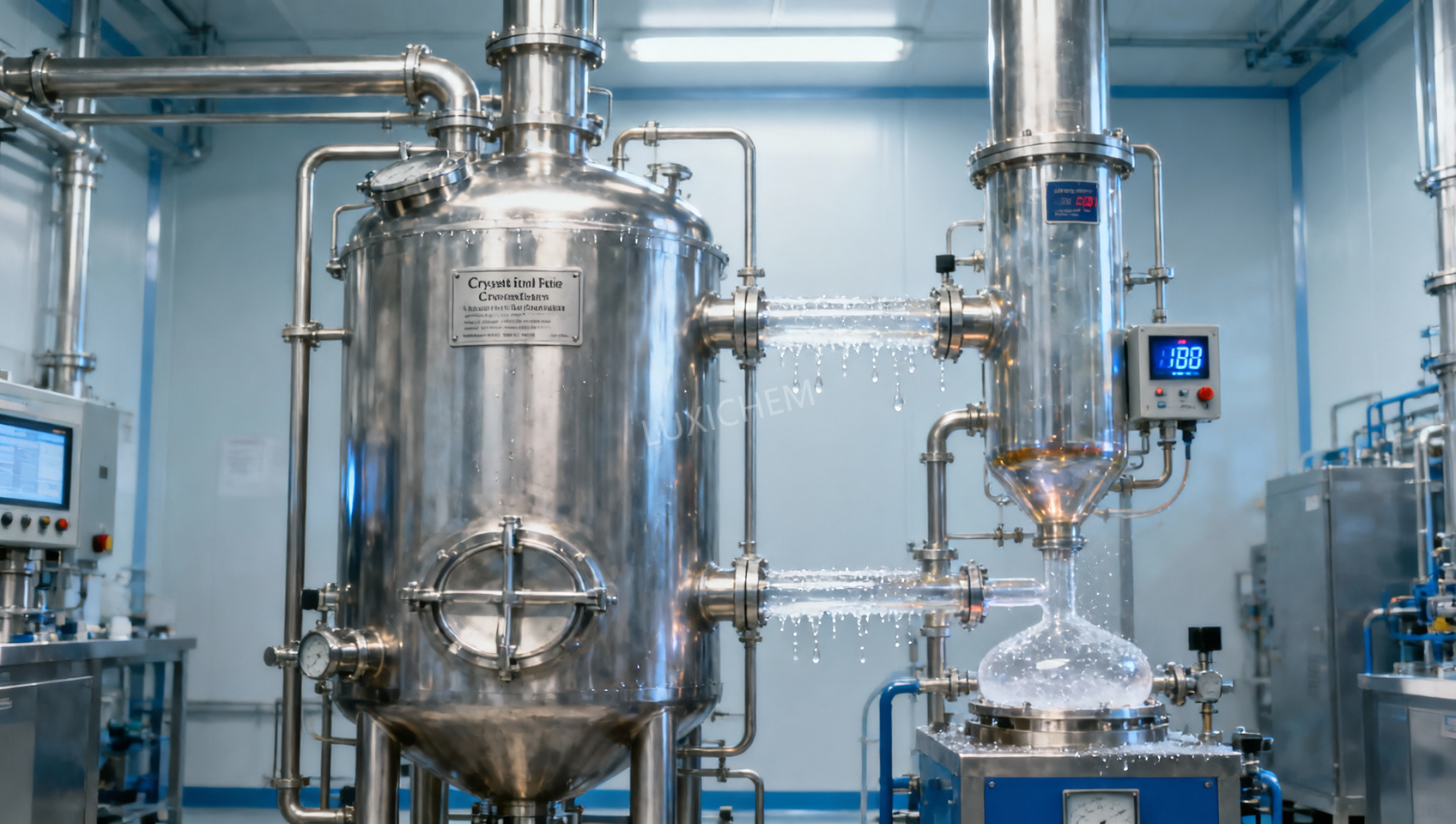
Consider purification—the most fragile link in technical-grade production. Many suppliers rely on generic distillation or basic washing, accepting broad impurity tolerances. At Luxi, purification is engineered. For compounds requiring high thermal stability, we deploy short-path molecular distillation under precise vacuum gradients. For thermolabile actives, we use gradient crystallization in jacketed vessels with AI-assisted cooling ramp control—ensuring reproducible nucleation density and crystal size distribution. Each step is mapped against ICH Q5 and Q7 guidelines, with in-process controls validated not just for identity and assay, but for *morphology* (via inline Raman), *polymorphic form* (via PAT-enabled XRD), and *residual metal content* (ICP-MS at <1 ppm detection).
That level of control extends beyond the active ingredient itself. Excipients, solvents, and co-formulants must meet equally stringent criteria—not just purity grades, but functional consistency. Take Glycerol CAS#56-81-5, for example. While not an insecticidal active, it plays critical roles in emulsifiable concentrate (EC) formulations as a viscosity modifier and stabilizer. Its water content, color (APHA ≤10), and UV absorbance at 260/280 nm directly impact emulsion stability and shelf life. We source glycerol only from ISO-certified synthetic streams—never biodiesel-derived—ensuring consistent hygroscopic behavior, refractive index (n₂₀/D 1.474), and absence of aldehyde byproducts that catalyze oxidation. That attention doesn’t stop at spec sheets; it’s embedded in how we store it (5–30°C, nitrogen-blanketed tanks), handle it (closed-loop transfer), and retest it upon receipt—not just for assay, but for dynamic viscosity shift over time.
 This integrated discipline translates into measurable outcomes for formulators. In one recent comparative study across five consecutive batches of a pyrethroid technical grade, Luxi’s material showed ≤0.15% RSD in HPLC assay, ≤0.08% RSD in major impurity (EP-1) area, and identical DSC melting onset (98.3 ± 0.1°C). Competing suppliers averaged 0.8–1.4% RSD in assay and exhibited polymorphic shifts detectable only via synchrotron XRD—shifts that later correlated with 12% faster hydrolysis in accelerated stability testing. Such data isn’t buried in internal reports. It’s shared proactively—alongside full chromatograms, residual solvent GC traces, and particle size distribution histograms—as part of our technical dossiers.
Of course, vertical integration alone isn’t sufficient. Without rigorous metrology, even the tightest process can drift. Our labs operate under ISO/IEC 17025 accreditation, with reference standards traceable to NIST and LGC. HPLC systems undergo daily system suitability checks using dual-wavelength UV detection; GC-MS runs include isotopically labeled internal standards for quantification accuracy. Crucially, we calibrate *against customer-relevant matrices*: not just neat active, but spiked formulations in mineral oil, xylene, or polyoxyethylated tallow amine—because impurity behavior changes when dissolved, not just when pure.
For technical evaluators weighing vendor risk, traceability matters as much as consistency. Every batch carries a digital twin: a secure, time-stamped record linking raw material COAs, reactor log files, crystallization temperature ramps, drying curves, and final QC results. No paper trails. No manual transcription errors. Just auditable, searchable lineage—available on demand via our secure portal. When a regulator asks *how* a batch passed, we don’t reconstruct—we retrieve.
None of this comes at the expense of scalability. Our multi-train manufacturing platform allows parallel production of structurally similar actives without cross-contamination—enabling rapid response to seasonal demand spikes while maintaining single-batch integrity. And because we manage import/export logistics in-house, we avoid third-party warehousing delays that expose sensitive materials to uncontrolled humidity or temperature excursions—conditions that can alter crystallinity or initiate hydrolysis before the material even reaches the formulator’s door.
Ultimately, reducing batch variability isn’t about chasing zero defects. It’s about building confidence—in your formulation’s predictability, in your registration dossier’s robustness, in your ability to replicate success across geographies and seasons. When you partner with an insecticides manufacturer whose chemistry runs deep—not just in reaction mechanisms, but in crystallization physics, purification thermodynamics, and analytical traceability—you’re not buying a commodity. You’re securing continuity. And in today’s tightly regulated, globally competitive agrochemical landscape, continuity isn’t convenience. It’s your most defensible technical asset.
Related Picks
 Butylated Hydroxytoluene Price Drivers: Supply, Purity, and Purchasing Risk FactorsOct 21, 2026Butylated Hydroxytoluene price trends depend on supply stability, purity, logistics, and purchasing risk. Learn how to compare quotes wisely and reduce sourcing costs.
 Sodium Tripolyphosphate Price Trends: Raw Material and Energy ExposureOct 20, 2026Explore sodium tripolyphosphate price trends, from phosphate and soda ash costs to energy exposure. Learn how to compare quotes, manage sourcing risks, and make smarter purchasing decisions.
 Acetonitrile Shipment to Vietnam Successfully Dispatched; RCEP Benefits Boost Fine Chemical Trade with ASEANSep 16, 2026A shipment of industrial-grade acetonitrile from our company has recently been loaded and dispatched following the completion of standardized hazardous material packaging and container securing procedures.
 Nigerian Client’s Order of 4 Containers of Vinyl Acetate Successfully Loaded and Shipped to West AfricaSep 16, 2026We recently completed the loading of a vinyl acetate order for a Nigerian client; four containers of the product have been successfully packed and are ready for shipment to Nigeria.




Question Consultation
Send Us Your Inquiry Today

Luxi Chemical is a professional chemical product supplier with ample stock of all chemical categories and excellent quality, welcome your purchase inquiry.

