


Assessing traceability at a dodecyl dimethyl benzyl ammonium chloride manufacturer
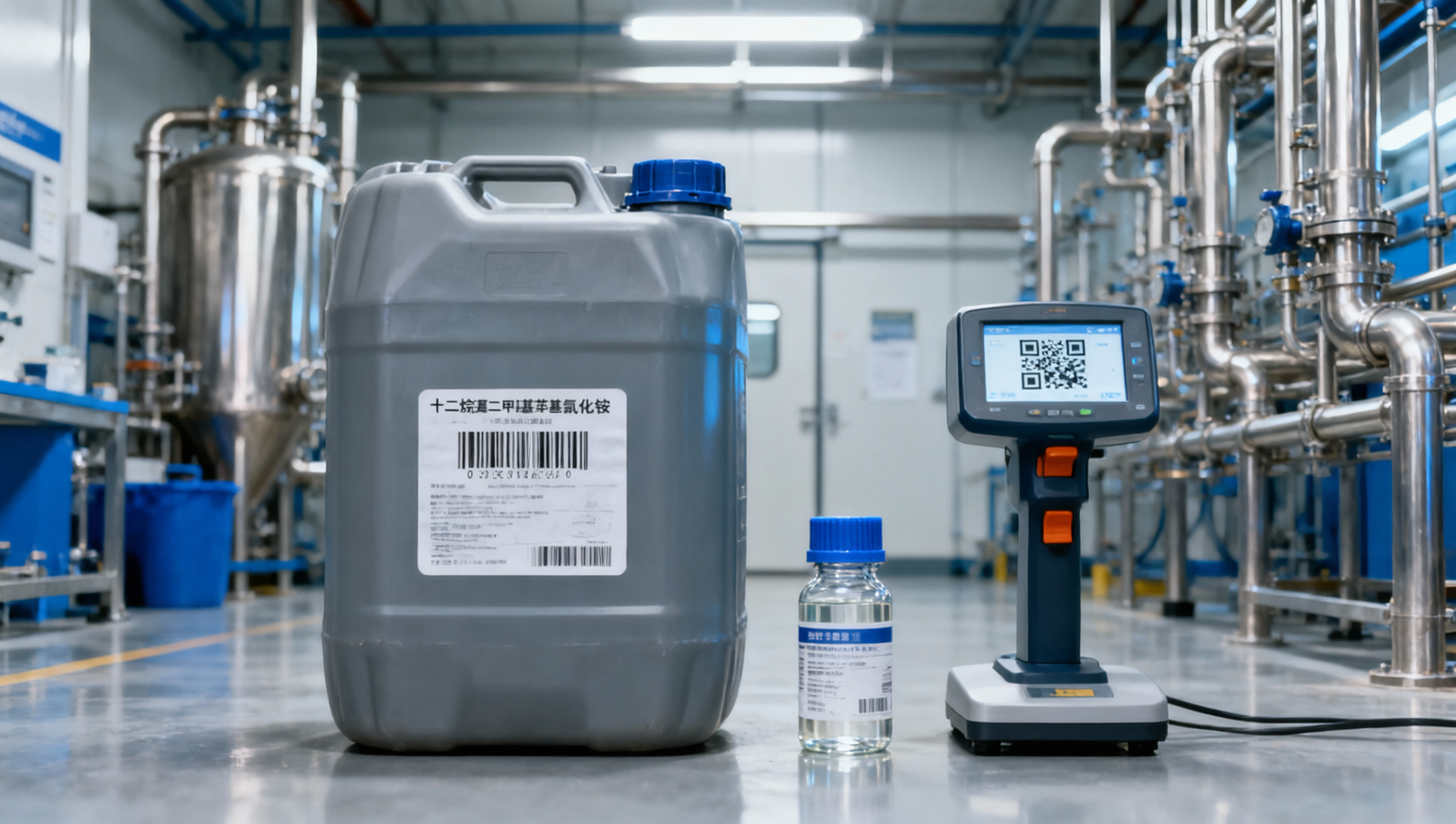
A drum arrives with the expected label, and its certificate of analysis shows results within specification. For receiving staff, that may look like a straightforward release. For quality control and safety teams, however, the real question is whether the batch can be traced back to its ingredients, processing history, analytical evidence, and delivery route.
When evaluating a dodecyl dimethyl benzyl ammonium chloride manufacturer, those connections matter more than a polished document package. Missing links can delay investigations, leave affected stock in circulation, or make it difficult to establish whether a discrepancy originated during manufacture, repacking, or transport. The most useful assessment therefore tests traceability in practice—not simply whether the supplier says it has a system.
Resolve chemical identity before assessing the batch trail
Traceability starts with knowing exactly what is being purchased. Similar names among quaternary ammonium compounds can create costly misunderstandings, especially when purchasing descriptions, product catalogs, and shipping documents use different naming conventions.
Dodecyl dimethyl benzyl ammonium chloride contains a benzyl group and one dodecyl chain. It should not be treated as interchangeable with a dialkyl dimethyl ammonium chloride. Commercial benzalkonium chloride materials may also contain an alkyl-chain distribution rather than a single C12 component. A supplier offering a broader mixture must demonstrate that it meets the specification actually requested.
Before reviewing manufacturing records, reconcile the following across the quotation, approved specification, safety data sheet, certificate of analysis, and container label:
- Chemical identity: the agreed name, applicable CAS number, and whether the material is a defined substance or a mixture.
- Composition: active content, solvent or carrier, and any relevant alkyl-chain distribution.
- Grade: the intended industrial application and agreed impurity limits.
- Physical form: solution, solid, or paste, including the basis on which concentration is reported.
- Origin: the actual manufacturing site and any separate repacking or distribution locations.
A discrepancy here is not an administrative detail. If the identity is unclear, even perfectly maintained batch records may be documenting the wrong material.
Ask the manufacturer to trace one real shipment
The strongest starting point is a recently supplied batch selected by the buyer, rather than a demonstration batch prepared for an audit. Request the records connecting that shipment to the manufacturing order, raw-material lots, quality release, packaging operation, and dispatch.
The supplier need not disclose every confidential process detail. It should nevertheless provide enough controlled evidence to establish an unbroken chain. Sensitive records can be reviewed under a confidentiality agreement or through a supervised audit; confidentiality should not become a blanket explanation for unverifiable origin.
A workable batch trail typically looks like this:
Incoming material lots → production batch → sampling and testing → authorized release → filling or repacking lots → shipment and customer receipt.
Walk through the chain in both directions. Starting with a delivered drum, can the supplier identify its parent batch and constituent raw-material lots? Starting with one raw-material lot, can it identify every finished batch and shipment that used it? Backward tracing supports root-cause analysis. Forward tracing establishes the scope of a withdrawal or recall.
Pay particular attention to split batches, blended batches, and partial shipments. These are common places for otherwise orderly systems to lose detail.
What a useful evidence package should contain
Read the certificate of analysis as a pointer, not proof of the entire system
A certificate of analysis is important, but it summarizes a release decision. It does not, by itself, prove how the sample was collected, which method was used, or whether the reported results came from the batch supplied.
For each critical characteristic, ask whether the certificate reports an actual measured result, a conformity statement, or a result obtained through an approved reduced-testing program. These approaches have different evidential value and should not be presented as equivalent.
Active-content testing deserves particular attention. A method used for total cationic active matter may not establish chemical identity or distinguish closely related quaternary ammonium compounds. Where identity, chain distribution, or specific impurities matter to the application, agree on appropriate additional analytical controls.
Check that specifications include units and reporting basis. “80% active,” for example, needs an agreed interpretation, including whether it is expressed by mass and how the solvent system affects the measurement. Method references, acceptance limits, and revisions should remain consistent across the purchase specification and release documentation.
Also examine how the supplier handles out-of-specification results. An investigation should explain the initial result, subsequent testing, conclusions, and disposition. Repeated testing until a passing result appears is not a defensible substitute for investigation.
Look closely at repacking, rework, and document changes
A material can leave the reactor with good traceability and lose it at the warehouse. Repacking into smaller containers, changing labels for an export market, or consolidating stock introduces additional handling and identification steps.
Ask how a newly assigned packing lot remains linked to its original manufacturing batch. If several original batches are combined, the records should identify all contributors and the resulting batch’s disposition. A new label must not erase manufacturing history.
Rework and returned material require similar scrutiny. The supplier should define when reuse is permitted, what quality assessment is required, and how the incorporated quantity is recorded. Buyers should agree in advance whether these practices are acceptable for their application.
Document control is equally important. Check who can amend a certificate, how superseded versions are identified, and whether customers receive corrected documents when necessary. Electronic systems should preserve attributable changes; paper systems should make corrections legible, dated, and authorized. The software brand matters less than the integrity of the record.
Keep related product information from becoming a substitution shortcut
A broad chemical portfolio can simplify procurement, but it also makes identity control more important. For example, Didodecyl dimethyl ammonium chloride CAS#3401-74-9 is a related quaternary ammonium compound, not the benzyl-containing material discussed here. Its documentation and suitability must be assessed separately.
Listed offerings include an 80% solution and a 99% grade, with applications spanning emulsification, dispersion, antistatic treatment, and certain disinfectant formulations. Those descriptions are useful starting points for a technical inquiry, not grounds for substituting one compound for another. Biocidal use also requires application-specific efficacy evidence and compliance with the destination market’s requirements.
Where a listing includes solid-state properties alongside solution or paste presentations, request a grade-specific technical data sheet. Storage instructions, appearance, solvent composition, and handling precautions should apply to the actual supplied formulation. Information about hygroscopicity or refrigerated storage should not be transferred automatically between related substances or grades.
Connect quality records with safety and logistics evidence
Safety teams need to know whether the material’s history includes conditions that could affect its composition, packaging integrity, or safe handling. A traceability review should therefore extend beyond laboratory results.
Check the current safety data sheet against the supplied concentration and solvent system. Confirm that container labels and transport classification reflect the actual formulation and applicable rules. Hazard classification cannot safely be inferred from the active ingredient’s name alone.
Where specified storage conditions are critical, ask how the supplier records and responds to excursions. Relevant evidence may include warehouse conditions, inspection records, seal checks, and transport incident reports. Temperature monitoring is not automatically necessary for every shipment; its use should follow the material’s documented requirements and a risk assessment.
For hygroscopic materials, moisture exposure during sampling and repacking may warrant particular attention. Packaging suitability, closure integrity, and handling procedures should support the agreed specification throughout distribution.
Retained samples can help investigate complaints, but only when they are representative, identifiable, and stored appropriately. Ask about sample quantity, retention period, storage conditions, and the link between the retained sample and the shipped batch.
Run a recall exercise before there is an incident
A mock recall reveals weaknesses that a document review may miss. Choose a plausible scenario: an incoming material lot is later found unsuitable, or a filling operation may have used an incorrect label. Then ask the supplier to identify the affected finished batches, quantities, customers, and remaining stock.
Agree on an exercise response time rather than assuming a universal target. The appropriate expectation depends on product risk, contractual obligations, and applicable requirements. Measure both speed and completeness; a rapid list is not useful if it omits repacked inventory.
The exercise should demonstrate:
- Quantity reconciliation: material produced, shipped, retained, scrapped, or still held can be accounted for, with differences explained.
- Containment: affected stock can be blocked from further release.
- Communication: current customer contacts and responsible decision-makers are available.
- Escalation: quality, safety, logistics, and commercial teams understand their roles.
- Closure: gaps lead to assigned corrective actions and follow-up verification.
An unsuccessful first exercise need not automatically disqualify a supplier. An unexplained gap, or unwillingness to correct it, is a more serious concern.
Turn the findings into a sourcing decision
Separate essential controls from desirable improvements. Confirmed identity, batch-level linkage, authorized release, and the ability to identify affected recipients are foundational. Faster retrieval, integrated portals, and automated reporting can improve performance, but they cannot compensate for missing records.
Where gaps are limited and containable, conditional approval may be appropriate: define the corrective action, completion date, interim controls, and evidence needed for closure. Unresolved identity discrepancies or broken batch genealogy should prevent routine approval until the underlying issue is addressed.
Luxi Chemical (Shandong) Co., Ltd. describes a chemical supply and import/export business serving customers across more than 60 countries and regions. For buyers considering a broad-range supplier, this makes it particularly important to distinguish manufacturing responsibility from trading and distribution responsibility. Ask which legal entity manufactures the selected material, which issues the certificate, and which retains the underlying records. A wide product range can reduce purchasing effort, but each product still needs its own qualification.
The final choice of a dodecyl dimethyl benzyl ammonium chloride manufacturer should rest on demonstrated connections, not document volume. When a supplier can trace a selected shipment backward, identify affected customers forward, and explain discrepancies openly, quality and safety teams gain something practical: a clearer basis for release decisions today and a more manageable investigation if something goes wrong tomorrow.
Related Picks
 Butylated Hydroxytoluene Price Drivers: Supply, Purity, and Purchasing Risk FactorsOct 21, 2026Butylated Hydroxytoluene price trends depend on supply stability, purity, logistics, and purchasing risk. Learn how to compare quotes wisely and reduce sourcing costs.
 Sodium Tripolyphosphate Price Trends: Raw Material and Energy ExposureOct 20, 2026Explore sodium tripolyphosphate price trends, from phosphate and soda ash costs to energy exposure. Learn how to compare quotes, manage sourcing risks, and make smarter purchasing decisions.
 Acetonitrile Shipment to Vietnam Successfully Dispatched; RCEP Benefits Boost Fine Chemical Trade with ASEANSep 16, 2026A shipment of industrial-grade acetonitrile from our company has recently been loaded and dispatched following the completion of standardized hazardous material packaging and container securing procedures.
 Nigerian Client’s Order of 4 Containers of Vinyl Acetate Successfully Loaded and Shipped to West AfricaSep 16, 2026We recently completed the loading of a vinyl acetate order for a Nigerian client; four containers of the product have been successfully packed and are ready for shipment to Nigeria.




Question Consultation
Send Us Your Inquiry Today

Luxi Chemical is a professional chemical product supplier with ample stock of all chemical categories and excellent quality, welcome your purchase inquiry.

