


Calculating dilutions from 50% dodecyl dimethyl benzyl ammonium chloride
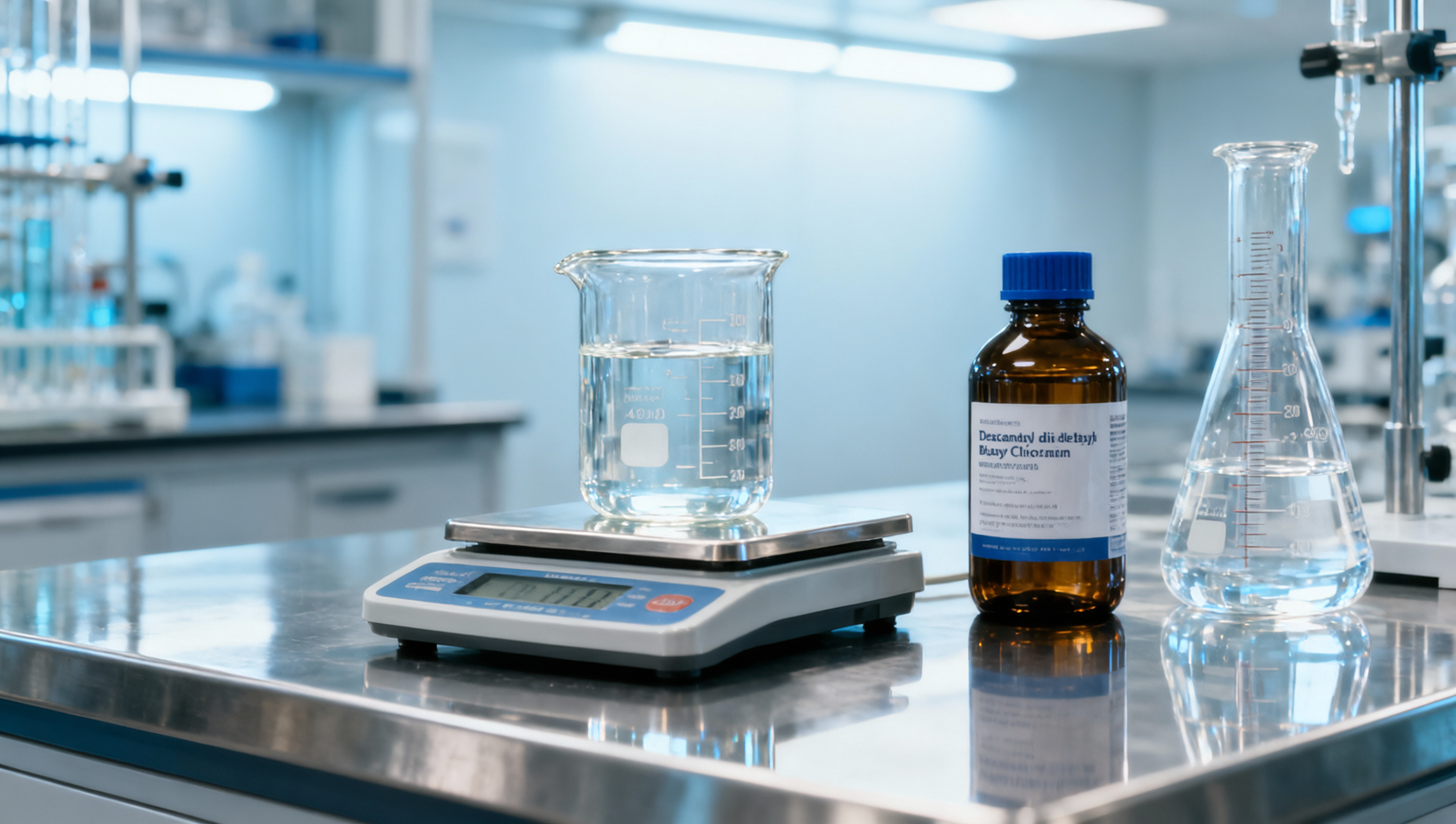
A batch sheet calls for a dilute working solution, but the drum label reads “50%” and the measuring container is marked in liters. This is where dilution errors begin: treating a weight-based concentrate as though it contains 50 g of active material per 100 mL can produce the wrong dose. For dodecyl dimethyl benzyl ammonium chloride 50%, first confirm the concentration basis, then calculate the amount of concentrate from the required active content and final batch size.
For a confirmed 50% w/w concentrate, concentrate mass = final solution mass × target active mass fraction ÷ 0.50. For example, a 10 kg batch at 0.10% w/w active requires 20 g of concentrate and 9.980 kg of water, assuming water is the only added ingredient. A batch specified in liters or mg/L needs a different calculation path; do not substitute volume for mass without checking density.
Read the specification before choosing a dilution ratio
The designation “50%” is incomplete unless the supplier identifies what is measured and how. Check the technical data sheet and certificate of analysis for active content, its reporting basis, and the chemical identity. Commercial benzalkonium chloride products can contain alkyl-chain mixtures rather than only the dodecyl component, so a similar product name does not establish an identical composition.
- 50% w/w: 50 g of active material in 100 g of concentrate.
- 50% w/v: 50 g of active material in 100 mL of concentrate.
- 50% v/v: a volume-based designation that must not be assumed equivalent to either expression above.
Also establish whether the target describes active material or commercial product. Adding concentrate at 0.10% w/w gives only 0.05% w/w active when its assay is 50% w/w. This distinction matters when one document gives a product addition rate and another gives a final active concentration.
The calculations below illustrate preparation methods, not recommended use concentrations. The required target, contact time, application method, and suitability must come from the authorized product instructions or an approved formulation. Correct arithmetic alone does not establish disinfectant performance or suitability for food-contact use.
Mass-based batches: the simplest calculation route
Use the same units for final batch mass and concentrate mass. Write both concentrations as fractions, or use both as percentages:
Concentrate mass = final batch mass × target active percentage ÷ concentrate active percentage
For a 25 kg solution containing 0.20% w/w active from a 50% w/w concentrate:
- Required active mass: 25 kg × 0.002 = 0.050 kg, or 50 g.
- Required concentrate: 0.050 kg ÷ 0.50 = 0.100 kg, or 100 g.
- Required water: 25.000 kg − 0.100 kg = 24.900 kg.
The water amount is the final batch mass minus the concentrate mass—not an additional 25 kg. Adding 100 g of concentrate to 25 kg of water creates 25.1 kg of solution and changes the intended concentration.
These examples assume exactly 50.0% w/w active content and no other ingredients. For formulated batches, subtract all ingredient masses when calculating the remaining water. Where the approved procedure requires lot-specific assay correction, use the certificate value instead of the nominal concentration.
When the instruction says ppm or mg/L
“ppm” needs a basis. For mass-based specifications, 1 ppm equals 1 mg/kg, and 1% w/w equals 10,000 ppm by mass. Therefore, 1,000 ppm by mass is 0.10% w/w. In dilute aqueous solutions, mg/L and mg/kg may be numerically close, but they are not universally interchangeable.
Example: 20 kg at 500 ppm by mass
The target active mass is 20 kg × 500 mg/kg = 10,000 mg, or 10 g. With a 50% w/w concentrate, weigh 20 g of concentrate and add water to a final mass of 20 kg. The water requirement is 19.980 kg.
Example: 20 L at 500 mg/L
Here, the active requirement is based on final volume: 20 L × 500 mg/L = 10,000 mg, or 10 g. The required concentrate is still 20 g when its assay is 50% w/w. However, the preparation endpoint is now 20 L of final solution, not 20 kg and not 20 L of added water.
Weigh the concentrate, mix it with part of the required water, and bring the mixture to the specified final volume using suitable calibrated equipment. For volume-defined batches, follow the temperature conditions in the preparation procedure, because liquid volume changes with temperature.
A target of 0.10% w/v similarly means 0.10 g per 100 mL, or 1 g/L. A 10 L batch therefore needs 10 g active and 20 g of 50% w/w concentrate. Writing the target units explicitly prevents an otherwise reasonable calculation from answering the wrong question.
Converting concentrate mass into a measurable volume
When an approved dosing setup measures concentrate by volume, obtain its density from the supplier at the relevant temperature. Do not use the density of water or a value from another chemical.
Concentrate volume = concentrate mass ÷ concentrate density
For illustration only, suppose a particular lot has a confirmed density of 1.02 g/mL at the dosing temperature. A calculated requirement of 20 g corresponds to 20 ÷ 1.02 = approximately 19.6 mL. This density is hypothetical, not a specification for the product.
The reverse calculation is equally useful: concentrate mass = measured volume × density. Under the same illustrative assumption, 20 mL weighs 20.4 g and contains 10.2 g active at 50% w/w. That difference may matter where dosing tolerances are narrow.
Final solution density is a separate property. It is needed when converting a final-volume requirement into final mass for a w/w target. Concentrate density alone cannot perform that conversion. For routine work, weighing the concentrate often removes one conversion and reduces uncertainty from cylinder readings, viscous drainage, and liquid retained on container walls.
Make dilution ratios unambiguous
A direction such as “1:100” can mean one part concentrate plus 100 parts water, or one part concentrate in 100 total parts. It may also omit whether “parts” are measured by mass or volume. Replace ambiguous ratios with an explicit ingredient quantity and final endpoint.
For a 50% w/w concentrate diluted by mass:
- 1 part concentrate plus 99 parts water gives 100 total parts and 0.50% w/w active.
- 1 part concentrate plus 100 parts water gives 101 total parts and approximately 0.495% w/w active.
To obtain 0.10% w/w active, the total dilution factor is 50 ÷ 0.10 = 500. The recipe is therefore one part concentrate plus 499 parts water by mass. A label stating “1 in 500, by mass, final solution” is clearer than an unexplained “1:500.”
The familiar equation C1V1 = C2V2 is appropriate when concentration is expressed as active mass per unit volume on a consistent basis. Applying it directly to w/w percentages and liquid volumes without density correction is not justified. For w/w calculations, use the corresponding mass balance instead.
Turn the calculation into a controlled preparation
- Confirm the batch instruction. Record the target, units, final mass or volume, product identity, assay, and any density used. Resolve unclear units before opening the container.
- Choose suitable measuring equipment. Check calibration, capacity, and readability. A scale suitable for weighing a drum may not reliably measure a small concentrate dose.
- Prepare the mixing vessel. Use clean, chemically compatible equipment and the water quality specified for the application. Exclude residues from previous batches.
- Charge part of the water. Follow the supplier’s addition order. Where permitted, add the measured concentrate gradually to water under controlled mixing, minimizing splashes and foam.
- Complete the batch. Add the remaining water to the specified final mass or final volume. Do not treat these endpoints as interchangeable.
- Mix and document. Ensure uniformity, then label the solution with identity, concentration basis, preparation date, and any storage or use period required by the approved procedure.
A transfer left incomplete can defeat an accurate calculation. For small batches, retained concentrate on a measuring vessel may represent a meaningful portion of the dose. Use a validated transfer or rinse procedure, counting rinse water within the final batch allowance.
Checks for batches that do not match expectations
Start with the records rather than judging concentration from foam, odor, or appearance. Recalculate the active amount actually added and divide it by the recorded final mass or volume on the correct basis. Check tare errors, unit conversions, incomplete transfers, and whether the operator added a full batch quantity of water before the concentrate.
If the certificate reports 49.0% w/w active rather than 50.0%, a target requiring 10 g active needs 10 ÷ 0.49 = approximately 20.41 g concentrate. Apply that correction only within the authorized formulation procedure; an out-of-specification raw material should not be accepted simply because the dosage can be adjusted.
A suitable, validated quat assay may support concentration verification. Confirm that its range and sample preparation suit the solution and that it measures the intended analyte. Conductivity, pH, or foam alone is not a selective active-content measurement.
Keep compatibility and handling separate from arithmetic
Follow the concentrate’s safety data sheet for gloves, eye protection, ventilation, spill response, and storage. Concentrated quaternary ammonium products can present significant skin and eye hazards; the diluted solution requires its own hazard assessment. Avoid spraying or generating mist unless the approved application specifically permits it.
Check compatibility before introducing detergents or other additives. Anionic surfactants can interfere with cationic quaternary ammonium compounds. Water quality, contamination, and formulation ingredients can also affect solution behavior. Do not correct cloudiness or unexpected pH by adding another chemical without an approved formulation instruction.
Raw-material identity is particularly important in shared chemical stores. Lithium hydroxide CAS#1310-65-2, available in anhydrous and monohydrate forms, is a separate alkaline material—not a substitute for this concentrate or a default dilution additive. Its specifications and storage requirements must remain separate from the dilution worksheet.
Before releasing a batch, retain the concentrate lot number, calculation, actual quantities, final endpoint, and verification result where required. A record reading “20 g concentrate; water to 10.000 kg; 0.10% w/w active based on 50.0% assay” is reproducible. A record reading only “diluted 1:500” leaves critical preparation details unresolved.
Related Picks
 Butylated Hydroxytoluene Price Drivers: Supply, Purity, and Purchasing Risk FactorsOct 21, 2026Butylated Hydroxytoluene price trends depend on supply stability, purity, logistics, and purchasing risk. Learn how to compare quotes wisely and reduce sourcing costs.
 Sodium Tripolyphosphate Price Trends: Raw Material and Energy ExposureOct 20, 2026Explore sodium tripolyphosphate price trends, from phosphate and soda ash costs to energy exposure. Learn how to compare quotes, manage sourcing risks, and make smarter purchasing decisions.
 Acetonitrile Shipment to Vietnam Successfully Dispatched; RCEP Benefits Boost Fine Chemical Trade with ASEANSep 16, 2026A shipment of industrial-grade acetonitrile from our company has recently been loaded and dispatched following the completion of standardized hazardous material packaging and container securing procedures.
 Nigerian Client’s Order of 4 Containers of Vinyl Acetate Successfully Loaded and Shipped to West AfricaSep 16, 2026We recently completed the loading of a vinyl acetate order for a Nigerian client; four containers of the product have been successfully packed and are ready for shipment to Nigeria.




Question Consultation
Send Us Your Inquiry Today

Luxi Chemical is a professional chemical product supplier with ample stock of all chemical categories and excellent quality, welcome your purchase inquiry.

