


Can anionic detergent residues weaken dodecyl dimethyl benzyl ammonium chloride disinfection?
Can anionic detergent residues weaken dodecyl dimethyl benzyl ammonium chloride disinfection?
Yes. Anionic detergent residues can interact with the positively charged active ingredient in a dodecyl dimethyl benzyl ammonium chloride disinfectant, potentially reducing antimicrobial performance. The practical concern is not simply whether a surface looks clean. It is whether the cleaning step has left behind enough incompatible material to interfere with the disinfectant applied afterward.
For food-processing equipment, daily chemical production lines, and other industrial surfaces, this is an avoidable source of uncertainty. A correctly prepared disinfectant may still perform poorly if it encounters detergent trapped in a gasket, a poorly drained rinse film, or a wiping cloth carrying cleaner from the previous task. Reliable results depend on separating cleaning from disinfection, controlling residues, and following the finished product’s dilution and contact-time instructions.
The incompatibility starts with charge, but does not end there
Dodecyl dimethyl benzyl ammonium chloride is a quaternary ammonium compound, commonly described as a quat. Its positively charged head group and hydrophobic chain contribute to its interaction with microbial membranes. Anionic surfactants carry a negative charge in solution. Examples found in cleaners include alkyl sulfates, alkylbenzene sulfonates, and soaps.
When these materials meet, they can form ion pairs or larger associations. Depending on the formulation and concentrations, the interaction may produce cloudiness, precipitation, or less obvious changes in the amount of active ingredient available to act against microorganisms. A clear solution is therefore not proof of compatibility.
There is no universal residue threshold that operators can safely apply across all products. The outcome depends on the surfactant chemistry, residue level, quat concentration, water quality, soil load, and test conditions. “Any trace makes it useless” is too absolute; “a little detergent cannot matter” is equally unreliable.
Also check what the disinfectant actually contains. The named compound is the C12 member of the benzalkonium chloride family, while commercial benzalkonium chloride products may contain a distribution of alkyl-chain lengths. Raw-material identity alone does not establish the efficacy, permitted applications, or required dilution of a finished disinfectant.
Where detergent carryover is easy to miss
A flat, accessible stainless-steel panel is usually easier to rinse than a valve seat, conveyor underside, or threaded connection. The vulnerable points are often places where cleaning solution enters readily but rinse water does not circulate or drain effectively. Spraying more disinfectant over those areas does not necessarily remove the trapped cleaner.
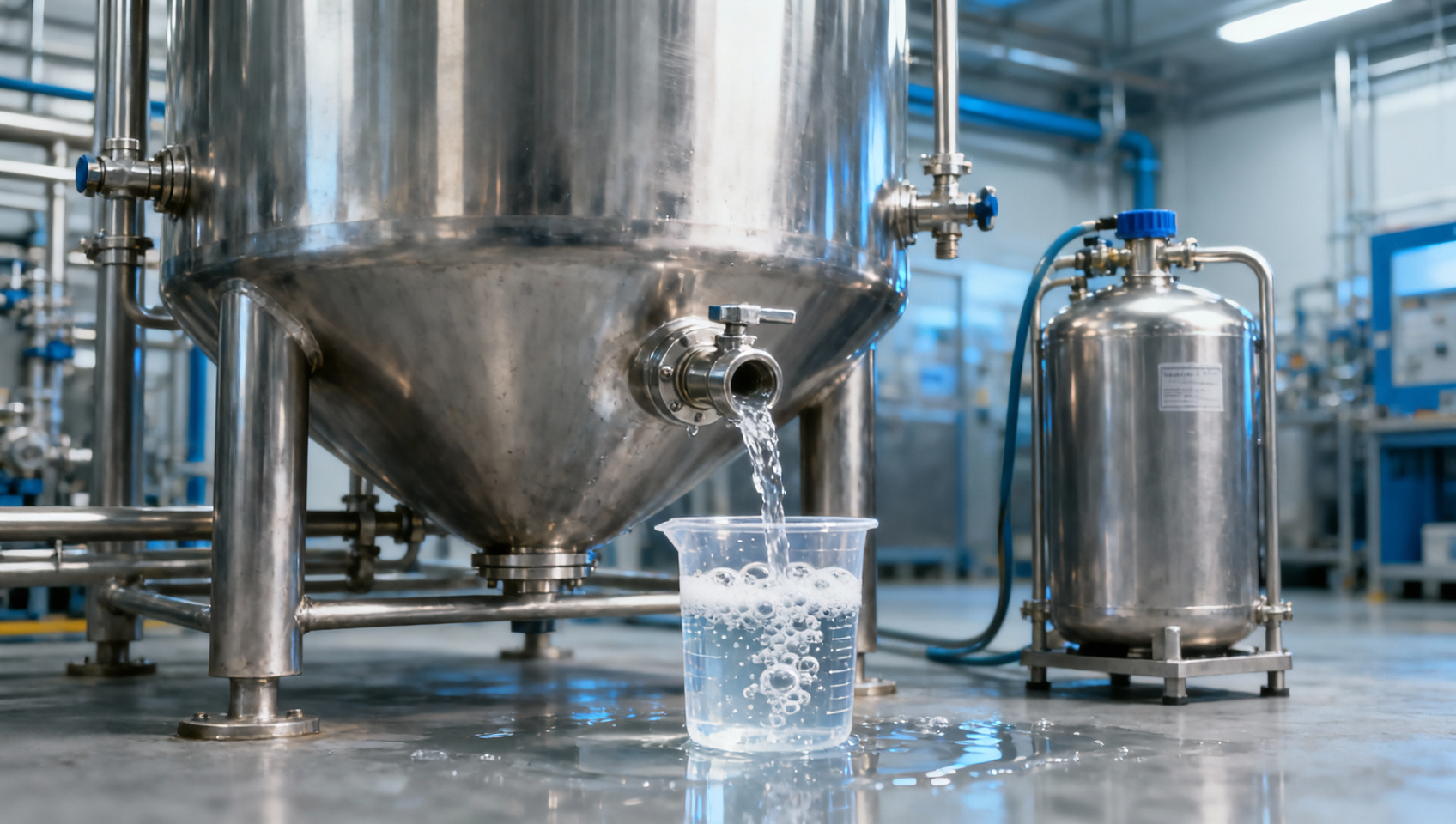
Consider a blending vessel cleaned with a foaming detergent. The visible wall may rinse clear while foam or liquid remains around the outlet assembly. If disinfectant is introduced without checking that location, the outlet receives a different chemical exposure from the upper wall. This is a plausible failure route to investigate, not evidence that every foaming cleaner is incompatible.
Manual tools create another route. A cloth dipped into detergent and then used to spread disinfectant can transfer incompatible surfactants directly into the application step. Some fabrics can also adsorb quats, reducing the concentration delivered to the surface. Dedicated tools help, but tool material and any laundering residues still need consideration.
In daily chemical manufacturing, the residue may come from the product itself. Anionic surfactants remaining after a shampoo or liquid-detergent batch can interfere with subsequent quat treatment. Operators should therefore review both the cleaning agent and the previous batch composition when investigating unreliable sanitation.
A dependable cleaning-to-disinfection sequence
The useful distinction is simple: cleaning removes soil; disinfection treats the adequately cleaned surface. Unless a finished product is specifically designed and validated for a combined process, separate chemicals should not be treated as an improvised cleaner-disinfectant formulation.
- Remove bulk material. Drain, scrape, or otherwise remove accessible product residues using the approved procedure before introducing cleaning chemistry.
- Clean under controlled conditions. Use the specified detergent concentration, temperature, mechanical action, and exposure time. Excess detergent adds to the rinsing burden without guaranteeing better cleaning.
- Rinse where required. Follow the cleaning procedure and disinfectant instructions. Give particular attention to low points, seals, valves, and surfaces outside the main rinse path.
- Drain adequately. Retained rinse water can dilute the disinfectant at the surface, even when it contains no incompatible detergent.
- Apply the prepared disinfectant. Confirm concentration with a suitable method and keep the surface wet for the full label-specified contact time.
- Complete any required final rinse. Food-contact requirements depend on the finished product, its permitted use, and applicable local rules.
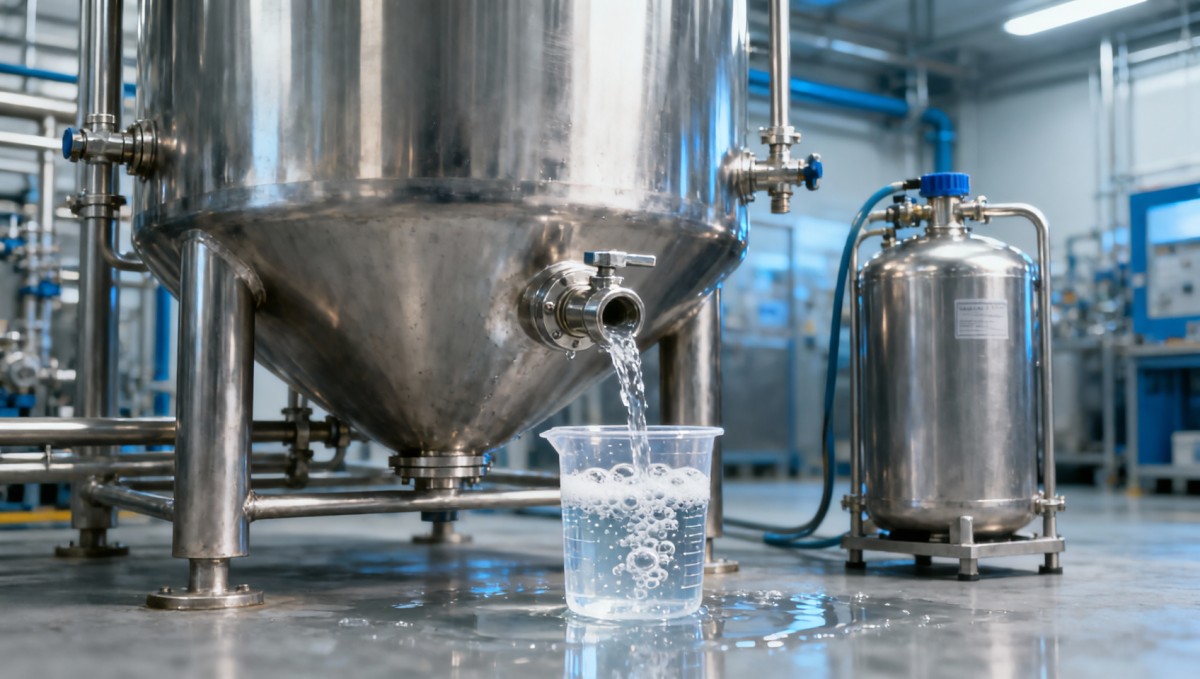
The difficult part is defining “rinsed adequately.” Absence of foam can be a useful observation, but it is not a validated chemical endpoint. Some residues produce little visible foam, and water conditions affect foaming. Conversely, bubbles caused by spraying do not necessarily indicate detergent carryover.
For repeatable equipment cleaning, conductivity or pH trends in the rinse return may support an established endpoint. Neither measurement identifies anionic surfactants specifically, and both require interpretation against incoming water and the cleaning formulation. Where carryover remains a concern, a targeted residue test or laboratory assessment is more informative than extending the rinse by guesswork.
Do not compensate by adding more disinfectant
Increasing quat concentration is a tempting response to suspected detergent residue. It is not a sound routine fix. The amount of interfering material is usually unknown, and a stronger mixture may exceed approved use conditions, increase residues, or create material-compatibility problems without resolving incomplete cleaning.
Longer contact time is not a dependable substitute either. Contact time matters only within the conditions for which the product’s performance is supported. A surface that dries early, contains heavy soil, or receives chemically compromised disinfectant is not made compliant merely by waiting longer.
Check dilution equipment before blaming chemistry. Worn dosing components, incorrect settings, or a changed concentrate strength can produce an under-strength solution. Use test strips or another method intended for the actual formulation and concentration range. Results from a clean preparation tank do not prove that the same concentration reaches a wet, residue-bearing surface.
Switching to a nonionic cleaner may reduce one incompatibility risk, but “nonionic” is not a complete compatibility assessment. Other ingredients, soil residues, and formulation effects still matter. Ask the suppliers about the proposed cleaning-disinfection sequence rather than relying on the surfactant category alone.
Separate chemical compatibility checks from hygiene verification
When sanitation results become inconsistent, investigate the preparation tank, delivery system, surface condition, and sampling procedure separately. A useful first comparison is disinfectant prepared in a clean dedicated container versus disinfectant delivered through the normal equipment. Differences can help locate carryover or dosing problems, although this comparison alone does not establish antimicrobial efficacy.
ATP testing can support cleaning verification, but it does not measure available quat or prove that the required microorganisms have been controlled. Detergents and disinfectants may also interfere with particular ATP systems. Follow the test manufacturer’s sampling guidance and use microbiological verification where required by the site’s hygiene program.
Microbiological sampling needs suitable neutralization. If disinfectant remains active after a swab enters the sample container, it can continue suppressing organisms during transport and testing, giving an artificially reassuring result. A qualified laboratory should select and verify a neutralization method appropriate to the disinfectant and sampling matrix.
For a recurring problem, record the detergent identity, dilution, rinse conditions, disinfectant batch, application method, and wet contact time. Note whether failures cluster around one equipment feature or follow a particular production changeover. That pattern is more useful than repeatedly changing several chemicals at once.
Keep unrelated process chemicals out of the sanitation circuit
Chemical-processing sites may handle materials whose hazards require a different response from ordinary detergent carryover. For example, Sodium Sulfide CAS#1313-82-2, used in applications such as sulfur-dye production and leather processing, is a strongly alkaline process chemical—not a substitute cleaning aid or an additive for quat disinfection.
Its residues require a specific, risk-assessed removal procedure. Contact between sulfide and acids can release toxic hydrogen sulfide, so an improvised acid rinse or “neutralization” step is dangerous. Keep process chemicals, cleaning concentrates, and disinfectants segregated, and consult current safety data sheets before changing a sequence. An unusual residue should trigger a compatibility review, not a stronger chemical mixture.
Luxi Chemical (Shandong) Co., Ltd. supplies chemical raw materials across food additives, organic intermediates, fertilizers, and other industrial categories. In a supply chain spanning different applications and markets, the relevant procurement question is not only whether a material meets its specification, but whether its identity and documentation suit the intended process. A raw-material specification should never be treated as evidence of finished disinfectant performance.
What to check before the next disinfection run
If an anionic cleaner precedes a dodecyl dimethyl benzyl ammonium chloride disinfectant, start with the rinse step and the places it is least likely to reach. Confirm the cleaner composition, inspect retained liquid, check application tools, and verify that the disinfectant reaches the surface at its specified concentration.
Do not discard an effective cleaning system solely because it contains anionic surfactants; an adequately controlled separation step may make the sequence workable. Equally, do not assume a visually clean surface is chemically ready. Where rinse effectiveness or compatibility remains uncertain, resolve that uncertainty through supplier guidance and appropriate testing before relying on the disinfection step.
Related Picks
 Butylated Hydroxytoluene Price Drivers: Supply, Purity, and Purchasing Risk FactorsOct 21, 2026Butylated Hydroxytoluene price trends depend on supply stability, purity, logistics, and purchasing risk. Learn how to compare quotes wisely and reduce sourcing costs.
 Sodium Tripolyphosphate Price Trends: Raw Material and Energy ExposureOct 20, 2026Explore sodium tripolyphosphate price trends, from phosphate and soda ash costs to energy exposure. Learn how to compare quotes, manage sourcing risks, and make smarter purchasing decisions.
 Acetonitrile Shipment to Vietnam Successfully Dispatched; RCEP Benefits Boost Fine Chemical Trade with ASEANSep 16, 2026A shipment of industrial-grade acetonitrile from our company has recently been loaded and dispatched following the completion of standardized hazardous material packaging and container securing procedures.
 Nigerian Client’s Order of 4 Containers of Vinyl Acetate Successfully Loaded and Shipped to West AfricaSep 16, 2026We recently completed the loading of a vinyl acetate order for a Nigerian client; four containers of the product have been successfully packed and are ready for shipment to Nigeria.




Question Consultation
Send Us Your Inquiry Today

Luxi Chemical is a professional chemical product supplier with ample stock of all chemical categories and excellent quality, welcome your purchase inquiry.

