


Bulk Insecticides Procurement Guide: MOQ, Packaging Options, Storage Requirements & Shelf-Life Validation Protocols
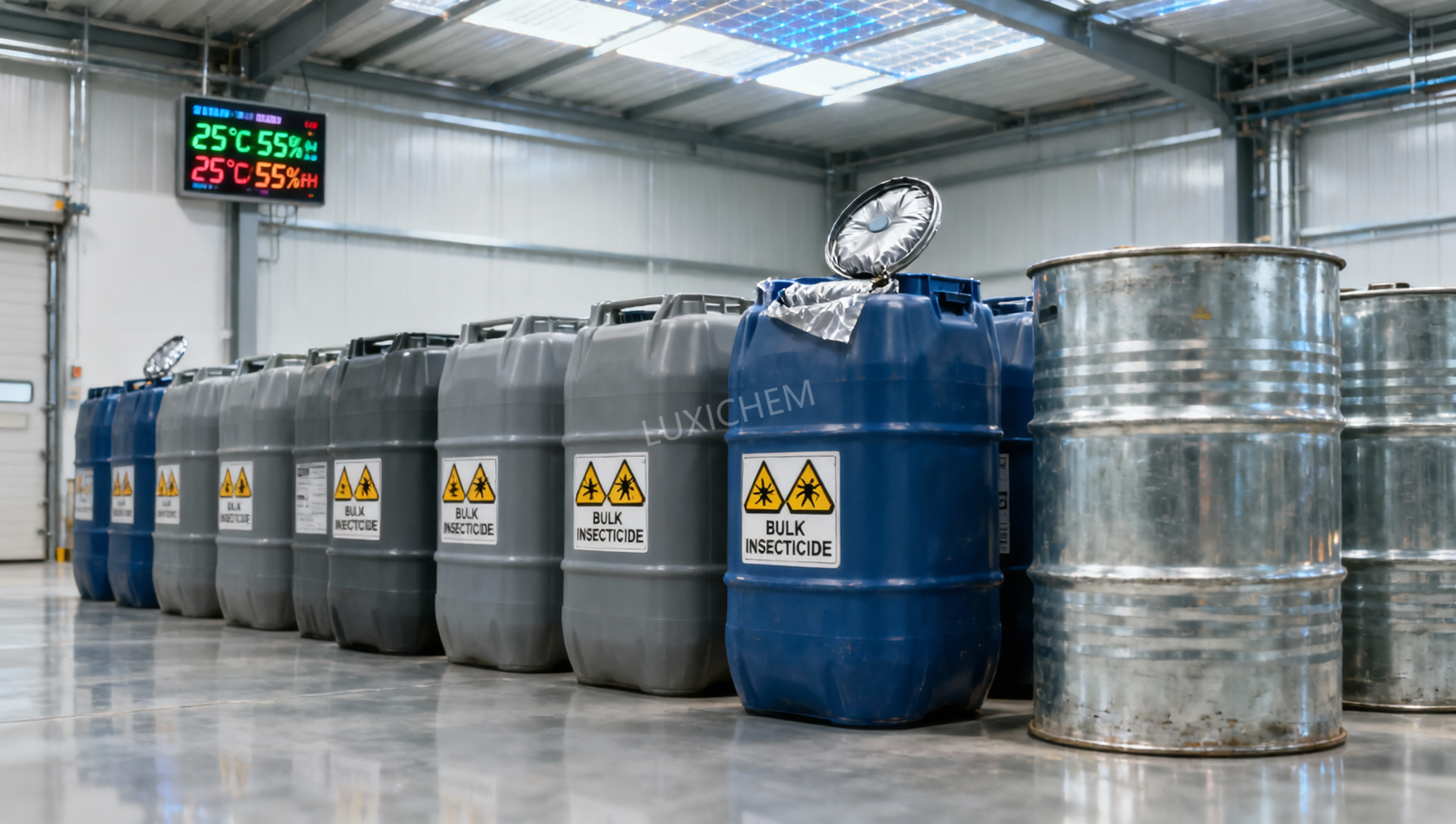
Sourcing bulk insecticides isn’t a simple transaction—it’s a supply chain checkpoint where cost efficiency meets regulatory rigor, chemical stability, and functional reliability. For procurement professionals, the real challenge isn’t finding the lowest unit price. It’s ensuring that every tonne delivered performs as expected *at the formulation stage*, remains stable during transit and storage, complies with destination-market labeling and hazard classification rules, and arrives without unexpected delays from documentation gaps or packaging nonconformance.
MOQ: Flexibility Isn’t Optional—It’s a Cost Lever
Minimum Order Quantity (MOQ) for bulk insecticides is often misread as a supplier-imposed barrier. In practice, it reflects real operational constraints: batch consistency validation, solvent recovery economics, drum/tote cleaning cycles, and quality release timelines. A rigid 10-metric-ton MOQ may suit large formulators running continuous blending lines—but it strains smaller R&D-driven agrochemical companies or regional distributors managing seasonal demand spikes.
What matters more than the number itself is *how the MOQ aligns with your production rhythm*. If your insecticide is used in a two-stage emulsifiable concentrate (EC) process requiring precise stoichiometric ratios, ordering below validated batch size risks inconsistent assay, residual solvent carryover, or unverified impurity profiles. Conversely, if your application is for technical-grade blending into dusts or granules—and you’ve already qualified multiple lots—then a lower MOQ (e.g., 500 kg in UN-certified HDPE drums) may be operationally sound *and* reduce working capital lockup.
At Luxi Chemical (Shandong) Co., Ltd., MOQs are evaluated per product family—not applied uniformly. For high-volume actives like synthetic pyrethroids or organophosphates, we support flexible tiered MOQs tied to packaging format and certification level (e.g., ISO 9001 vs. ISO 22000-compliant handling). This avoids forcing customers into oversized orders just to meet arbitrary thresholds.
Packaging: It’s Not Just About Containment—It’s About Compatibility & Compliance
Bulk insecticides aren’t commodities you pour into any container. Their chemical reactivity—especially toward metals, moisture, or UV exposure—dictates packaging integrity. Common failures include:
- Galvanized steel drums reacting with acidic insecticides, causing discoloration and metal ion contamination;
- Non-UV-stabilized IBC totes degrading under tropical port storage, leading to liner leaching or structural softening;
- Drum gaskets swelling or hardening due to solvent compatibility mismatches, resulting in vapor loss or leakage during air freight.
We specify packaging based on verified compatibility data—not generic assumptions. For instance, carbamate-based actives require oxygen-barrier liners and nitrogen purging; neonicotinoids demand low-permeability HDPE with UV inhibitors. All packaging carries UN markings, proper hazard labels (GHS-aligned), and full traceability (batch ID, fill date, QC release stamp).
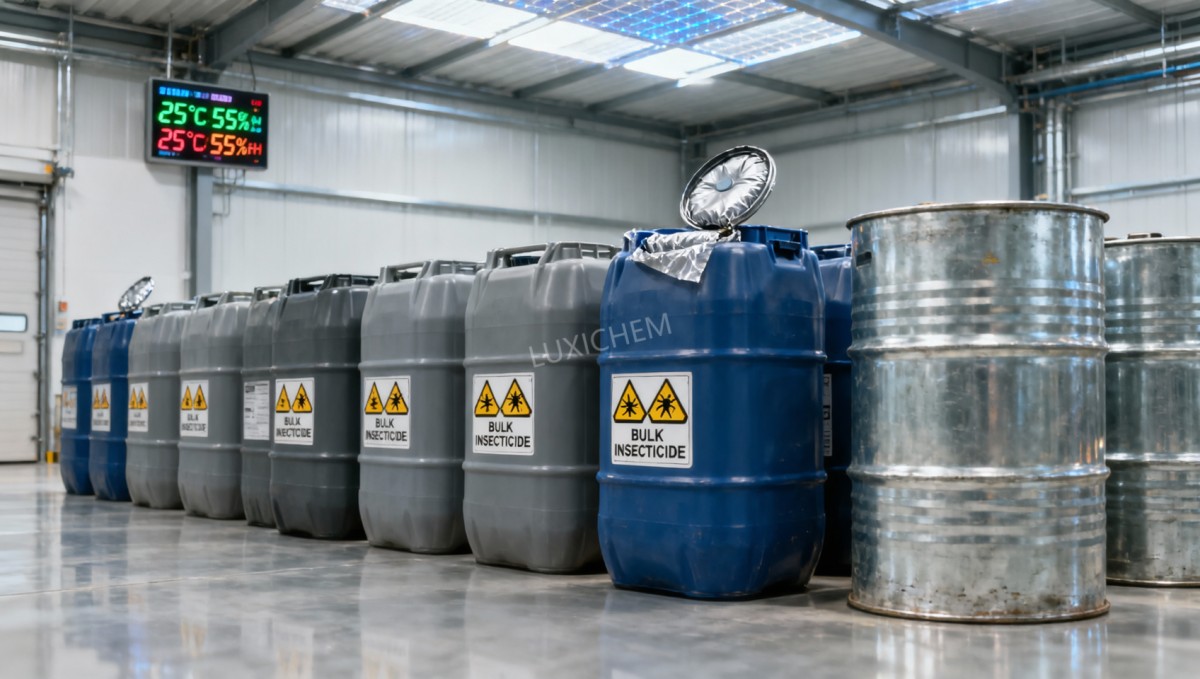
Storage: Temperature, Light, and Humidity Aren’t Suggestions—They’re Stability Controls
Stability isn’t guaranteed by shelf-life claims alone. It’s maintained through controlled conditions *from warehouse to loading dock*. Key non-negotiables:
- Temperature: Most technical-grade insecticides require ≤30°C storage. Exceeding this accelerates decomposition—especially for halogenated compounds or nitroaromatics. We validate stability at 40°C/75% RH for accelerated aging studies, but real-world compliance means climate-controlled warehousing—not ambient sheds.
- Light: UV exposure triggers photolysis in many pyrethroids and chlorinated hydrocarbons. Opaque, UV-resistant totes or drums stored indoors are mandatory—not optional “best practice.”
- Humidity: Hygroscopic materials (e.g., certain phosphoramidates or salt-form intermediates) degrade rapidly above 60% RH. Desiccant packs + sealed secondary packaging aren’t extras—they’re part of the specification.
Note: Storage conditions must match the product’s inherent chemistry—not industry averages. For example, 5-Bromo-2-chloropyrimidine CAS#32779-36-5, while not an insecticide, illustrates how sensitive halogenated heterocycles are: its hygroscopic nature and light sensitivity mean even short-term staging in non-climate-controlled areas risks assay drift and color change—directly impacting downstream coupling efficiency in pharmaceutical synthesis.
Shelf-Life Validation: Science, Not Stamping
A “24-month shelf life” means nothing without context. Validated shelf life requires three layers:
- Real-time stability data under specified storage conditions (not just accelerated testing);
- Assay and impurity profiling at defined intervals (e.g., 0, 6, 12, 18, 24 months) using ICH Q5C-compliant methods;
- Functional performance confirmation—e.g., does the active still achieve target LC90 in standardized bioassays after 18 months?
We don’t issue blanket shelf-life statements. Each bulk insecticide lot includes a Certificate of Analysis (CoA) with initial assay, residual solvents, heavy metals, and key impurities—and a separate Stability Summary referencing the specific study protocol used. If your formulation line requires tight tolerance on a particular degradant (e.g., dichlorvos formation in malathion), we can provide targeted stability data for that parameter upon request.
Procurement Reality Check: What You Should Confirm Before Placing the First Order
Before signing off on pricing or lead time, verify these five points—not as checkboxes, but as operational prerequisites:
- Is the MOQ aligned with your validated batch size? Ask for historical lot-to-lot assay variance data—not just a single CoA.
- Does the quoted packaging have documented compatibility with your insecticide’s solvent system and pH? Request test reports, not vendor assurances.
- Where exactly will the material be stored pre-shipment? Confirm temperature logs, humidity controls, and light shielding—not just “warehouse storage.”
- What stability data exists for your exact grade and packaging configuration? Avoid extrapolating from lab-scale or different container types.
- Are all regulatory documents (SDS, GHS labels, UN certs, origin certificates) available in your target market’s language and format before shipment? Delays happen at customs—not the factory gate.
For procurement teams balancing cost, speed, and compliance, the most expensive “bargain” is a low-MOQ offer that forces retesting, reformulation, or disposal due to unvalidated stability or incompatible packaging. True cost efficiency comes from upfront alignment—not post-delivery firefighting.
Luxi Chemical supports this with transparent technical documentation, flexible MOQ structures, and packaging validated per active—not per category. Our clients in over 60 countries rely on this approach to maintain formulation consistency, reduce qualification overhead, and avoid supply chain surprises—all without inflating unit cost.
Related Picks
 Butylated Hydroxytoluene Price Drivers: Supply, Purity, and Purchasing Risk FactorsOct 21, 2026Butylated Hydroxytoluene price trends depend on supply stability, purity, logistics, and purchasing risk. Learn how to compare quotes wisely and reduce sourcing costs.
 Sodium Tripolyphosphate Price Trends: Raw Material and Energy ExposureOct 20, 2026Explore sodium tripolyphosphate price trends, from phosphate and soda ash costs to energy exposure. Learn how to compare quotes, manage sourcing risks, and make smarter purchasing decisions.
 Acetonitrile Shipment to Vietnam Successfully Dispatched; RCEP Benefits Boost Fine Chemical Trade with ASEANSep 16, 2026A shipment of industrial-grade acetonitrile from our company has recently been loaded and dispatched following the completion of standardized hazardous material packaging and container securing procedures.
 Nigerian Client’s Order of 4 Containers of Vinyl Acetate Successfully Loaded and Shipped to West AfricaSep 16, 2026We recently completed the loading of a vinyl acetate order for a Nigerian client; four containers of the product have been successfully packed and are ready for shipment to Nigeria.




Question Consultation
Send Us Your Inquiry Today

Luxi Chemical is a professional chemical product supplier with ample stock of all chemical categories and excellent quality, welcome your purchase inquiry.

