


Carrageenan Selection for Dairy, Beverage, and Plant-Based Formulations
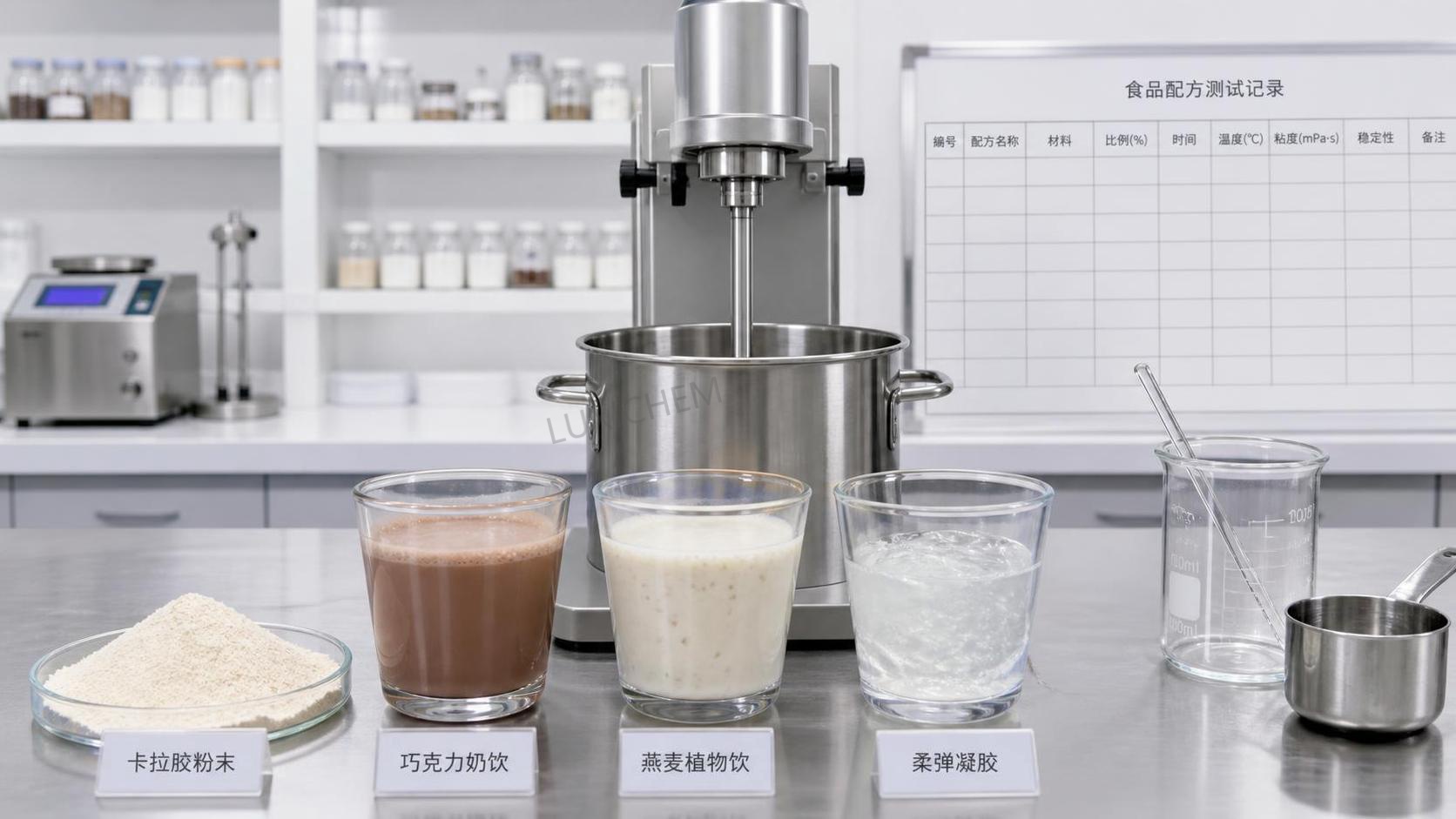
A chilled chocolate milk may look stable when it leaves the mixer but show a weak body, sediment, or serum separation after filling. A protein beverage may remain smooth at pilot scale yet develop viscosity drift after heat treatment. In plant-based drinks, the same stabilizer system can produce an appealing suspension in one oat base and an unpleasantly brittle gel in another. These are not usually solved by simply increasing the dosage.
The practical starting point is to select Carrageenan by matching its interaction mechanism to the formulation: kappa carrageenan is generally chosen where a firmer gel or strong dairy-protein interaction is needed; iota carrageenan suits elastic, freeze-thaw-tolerant textures; and lambda carrageenan provides viscosity without forming a true gel. The final choice depends on protein type, soluble solids, salt balance, pH, thermal process, and the texture expected after storage—not on Carrageenan type alone.
Start with the product failure you are trying to prevent
Selection becomes clearer when the expected role is defined before reviewing grades. Carrageenan can act as a protein stabilizer, suspension aid, water-management ingredient, texture builder, or gel former. A formulation may require more than one of these functions, but one should be treated as the primary decision criterion.
In dairy systems, the usual concern is often protein stabilization during heating and storage. In a flavored milk, milkshake, or cocoa dairy drink, casein particles can aggregate or settle if the colloidal balance is not controlled. Kappa Carrageenan is commonly effective in these systems because it interacts with casein micelles and can create a weak network that reduces phase separation. The desired result is usually not a rigid gel. It is a stable, pourable beverage with controlled body.
In dessert applications, the question changes. A spoonable pudding, dairy jelly, or processed cheese analogue may need a distinct cut, clean fracture, and resistance to whey-off. Here, kappa-rich grades are often considered because they develop stronger, more brittle gels in the presence of suitable cations, especially potassium. Where the product must remain flexible rather than brittle, iota Carrageenan or a kappa/iota balance may be more appropriate.
Plant-based formulations require a separate assessment. They do not contain the same casein system found in milk, so a Carrageenan grade selected for conventional dairy performance cannot be assumed to work in soy, pea, oat, coconut, or nut bases. Particle size, protein isolation method, mineral profile, oil content, and enzyme activity can all change the response. In these products, Carrageenan may be used mainly to provide body, limit settling, improve suspension, or support another hydrocolloid rather than relying on a direct dairy-style protein interaction.
Understand the three functional profiles before comparing grades
The labels kappa, iota, and lambda describe useful functional families, but commercial grades should still be tested as supplied. Molecular weight distribution, processing method, standardization, and blending with permitted co-components can affect hydration rate, gel response, and batch handling. A technical review should therefore compare application performance rather than rely only on the family name on a specification sheet.
Dairy beverages: stabilize protein without turning the drink into a gel
For milk-based beverages, the selection window is narrow. Too little Carrageenan may allow cocoa, protein, or fat-associated particles to settle. Too much, or an unsuitable grade, can produce a heavy mouthfeel, weak gel fragments, or viscosity that rises beyond the intended drinking profile. The best-performing system is often the one that produces the least visible structural change while maintaining stability through the full process.
Review the heat process first. High-temperature processing exposes the protein-stabilizer system to more severe conditions than simple pasteurization. Carrageenan must hydrate adequately before its functional role can develop, while protein interactions must remain controlled during heating and cooling. Dry addition directly into a high-solids powder blend can be workable when dispersion is well designed, but poor powder distribution may create hydrated lumps that do not fully dissolve later.
For chocolate milk and similar suspensions, distinguish between sediment caused by cocoa and separation caused by protein instability. A stronger network may reduce sedimentation, but it can also produce an undesirable gel-like body. The first evaluation should include sediment appearance, pour behavior, viscosity after cooling, and stability after anticipated storage—not merely the viscosity reading immediately after manufacture.
Minerals and pH can change the result more than expected
Kappa Carrageenan responds strongly to the ionic environment. Potassium can promote gel development, while calcium-rich systems may behave differently depending on the rest of the formulation. Milk naturally contains minerals, but fortification, water variation, flavor systems, and protein concentrates can shift the balance. A Carrageenan grade that performs well in one milk base may require re-evaluation after changing calcium level, replacing milk powder, or introducing a high-protein ingredient.
pH is equally important. Acidified dairy beverages are more demanding because protein approaches its isoelectric region as pH falls, increasing the risk of aggregation. Carrageenan alone should not be treated as a universal answer to acid protein stabilization. The acidification route, protein source, homogenization conditions, and use of other stabilizers must be evaluated together. Adding acid before adequate hydration or applying the wrong thermal sequence can create defects that appear to be a Carrageenan issue but are actually process-related.
Plant-based beverages require a matrix-by-matrix approach
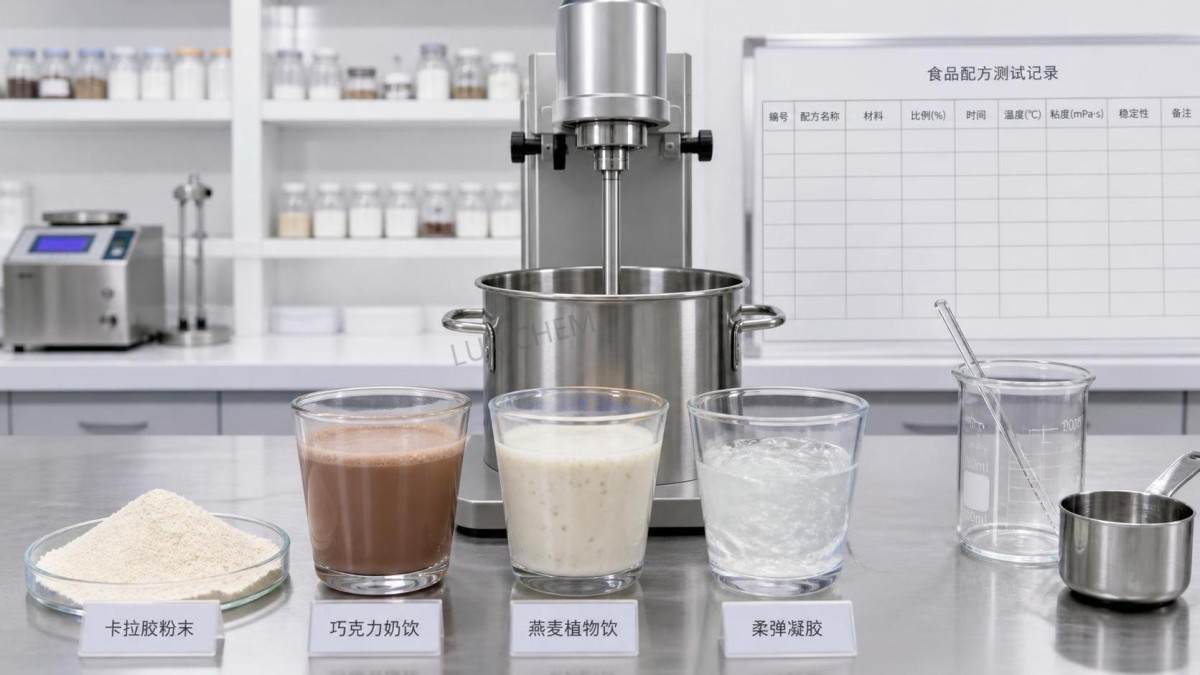
A plant-based drink may contain dispersed protein, insoluble fiber, starch, oil droplets, minerals, and added emulsifiers. The relative amount of each component varies widely. Soy beverages may present substantial protein interactions; oat drinks may be dominated by starch and beta-glucan behavior; pea systems can show persistent sedimentation and strong flavor masking requirements; coconut beverages may need emulsion support more than protein stabilization.
Because these matrices differ, begin by identifying the visible defect. A clear serum layer suggests insufficient water structuring or instability in the dispersed phase. A compact sediment at the base may indicate particles that are too large, inadequate homogenization, insufficient suspension support, or a protein-mineral interaction. A ropy texture can point to excessive hydrocolloid interaction or incomplete hydration. These symptoms should not all lead to a higher Carrageenan dosage.
Lambda Carrageenan can be useful where added body is required but a set structure would be unacceptable. Iota Carrageenan may be evaluated when a soft, resilient structure helps control movement of suspended particles. Kappa Carrageenan may contribute useful structure in selected plant bases, especially where the mineral system supports its function, but it should be screened carefully because brittle gel formation can be more noticeable in a low-fat or low-protein matrix.
Blended hydrocolloid systems are frequently more reliable than a single ingredient in plant-based products. Carrageenan may work alongside gums, starches, or proteins to divide functional tasks: one ingredient contributes suspension, another controls viscosity, and another improves heat or freeze-thaw behavior. Technical evaluation should identify whether Carrageenan is being asked to stabilize particles, replace fat perception, reduce syneresis, or create a gel. Assigning every task to one material often causes overuse and sensory penalties.
Use processing conditions as selection criteria, not post-trial explanations
Hydration is one of the first variables to control. Carrageenan generally needs sufficient temperature, dispersion, and time to hydrate properly. The exact conditions depend on grade and formulation, but poor hydration often appears as specks, fisheyes, uneven viscosity, or inconsistent gel strength. Preblending with sugar or another dry carrier can improve distribution. High-shear mixing may help disperse powder, yet excessive shear after a network begins to develop can alter the final texture.
Homogenization should be considered with the full stabilizer system. It affects particle size, emulsion stability, and the sensory perception of thickness. In a beverage with oil, protein, and suspended solids, improving homogenization may solve a settling problem more effectively than increasing Carrageenan. Conversely, a stable emulsion cannot compensate for an under-hydrated hydrocolloid that later forms irregular aggregates.
Where formulators are evaluating several food additives and process chemicals in parallel, material segregation is essential. Ingredients intended for food formulation should remain distinct from industrial raw materials used elsewhere in the facility or procurement portfolio. For example, Phosphorous acid CAS#13598-36-2 is an inorganic chemical raw material associated with applications such as water-treatment phosphonates, agricultural fungicides, metal-surface protection, and lubricant additives; it is not a Carrageenan substitute or a food-beverage texturizer. Clear specifications, labeling, storage controls, and approved-use review prevent application confusion during sourcing and development.
A practical trial sequence for technical evaluation
Laboratory trials should isolate variables wherever possible. Changing Carrageenan type, dosage, protein source, mineral salt, heating profile, and homogenization pressure in one round makes the result difficult to interpret. A staged approach produces more useful information.
- Define the target texture. Describe whether the product should pour freely, coat the mouth, hold suspended particles, set with a clean cut, or remain elastic after thawing.
- Map the base composition. Record protein type and level, fat source, sugar or sweetener system, mineral fortification, pH target, solids content, and other hydrocolloids.
- Select a functional starting family. Screen kappa for dairy-protein stabilization or firmer setting, iota for elastic gel behavior, and lambda for viscosity-led applications.
- Keep the process realistic. Use the intended hydration method, heating profile, shear conditions, homogenization stage, and filling temperature. A bench result produced under a simplified process may not predict factory behavior.
- Assess after storage, not only after cooling. Examine viscosity drift, sediment, serum separation, gel fracture, syneresis, and sensory changes at relevant storage conditions.
- Confirm the dosage window. Test below and above the preliminary target. The objective is to find a robust range, not simply the highest level that eliminates visible separation.
Read defects as formulation signals
A brittle, short texture points toward too much kappa-led structure, excessive potassium response, or an interaction with other gelling ingredients. Reducing dosage may help, but changing the kappa/iota balance can be more effective when elasticity is needed. Syneresis in a gel can indicate an overly tight network, poor solids balance, or thermal damage rather than insufficient stabilizer.
Persistent settling should prompt particle-size and processing checks before the stabilizer level is changed. In plant-based products, insoluble fractions may simply be too dense or too coarse for a viscosity adjustment to solve. In dairy drinks, a sediment may be primarily cocoa-related rather than protein-related. Looking at the sediment texture, redispersibility, and serum clarity helps distinguish these mechanisms.
Unexpected thickening during storage may result from continued hydration, starch interaction, protein restructuring, or an ionic shift. A lower initial viscosity does not automatically mean a weaker final product. Samples should be compared after a consistent holding period and under the intended temperature conditions.
Compliance and specification review should happen before scale-up
Carrageenan selection also requires confirmation that the grade is suitable for the intended food category and destination market. The review should cover identity, compositional specification, microbiological requirements where relevant, allergen and cross-contact statements, permitted-use conditions, documentation for the target market, and consistency of supply specification. Food-grade status should not be inferred from a generic material name.
Ask suppliers for application-relevant information rather than a broad promotional claim. Useful questions include recommended hydration conditions, typical gel behavior, compatibility with dairy proteins, mineral sensitivity, viscosity measurement conditions, particle size, and whether the grade is standardized or blended. Where a formula contains multiple hydrocolloids, request guidance on addition order because it can materially affect dispersion and final texture.
The most reliable Carrageenan choice is the one that remains stable under the actual formulation and process constraints while delivering the intended sensory profile. In dairy beverages, that often means controlled casein stabilization rather than maximum gel strength. In plant-based drinks, it means identifying whether the main challenge is suspension, viscosity, emulsion stability, or protein behavior before assigning Carrageenan a role. That discipline reduces unnecessary reformulation cycles and makes scale-up results easier to predict.
Related Picks
 Butylated Hydroxytoluene Price Drivers: Supply, Purity, and Purchasing Risk FactorsOct 21, 2026Butylated Hydroxytoluene price trends depend on supply stability, purity, logistics, and purchasing risk. Learn how to compare quotes wisely and reduce sourcing costs.
 Sodium Tripolyphosphate Price Trends: Raw Material and Energy ExposureOct 20, 2026Explore sodium tripolyphosphate price trends, from phosphate and soda ash costs to energy exposure. Learn how to compare quotes, manage sourcing risks, and make smarter purchasing decisions.
 Acetonitrile Shipment to Vietnam Successfully Dispatched; RCEP Benefits Boost Fine Chemical Trade with ASEANSep 16, 2026A shipment of industrial-grade acetonitrile from our company has recently been loaded and dispatched following the completion of standardized hazardous material packaging and container securing procedures.
 Nigerian Client’s Order of 4 Containers of Vinyl Acetate Successfully Loaded and Shipped to West AfricaSep 16, 2026We recently completed the loading of a vinyl acetate order for a Nigerian client; four containers of the product have been successfully packed and are ready for shipment to Nigeria.




Question Consultation
Send Us Your Inquiry Today

Luxi Chemical is a professional chemical product supplier with ample stock of all chemical categories and excellent quality, welcome your purchase inquiry.

