


Citric Acid Wholesale Buying Guide: MOQ, Packaging Options, and Price Drivers
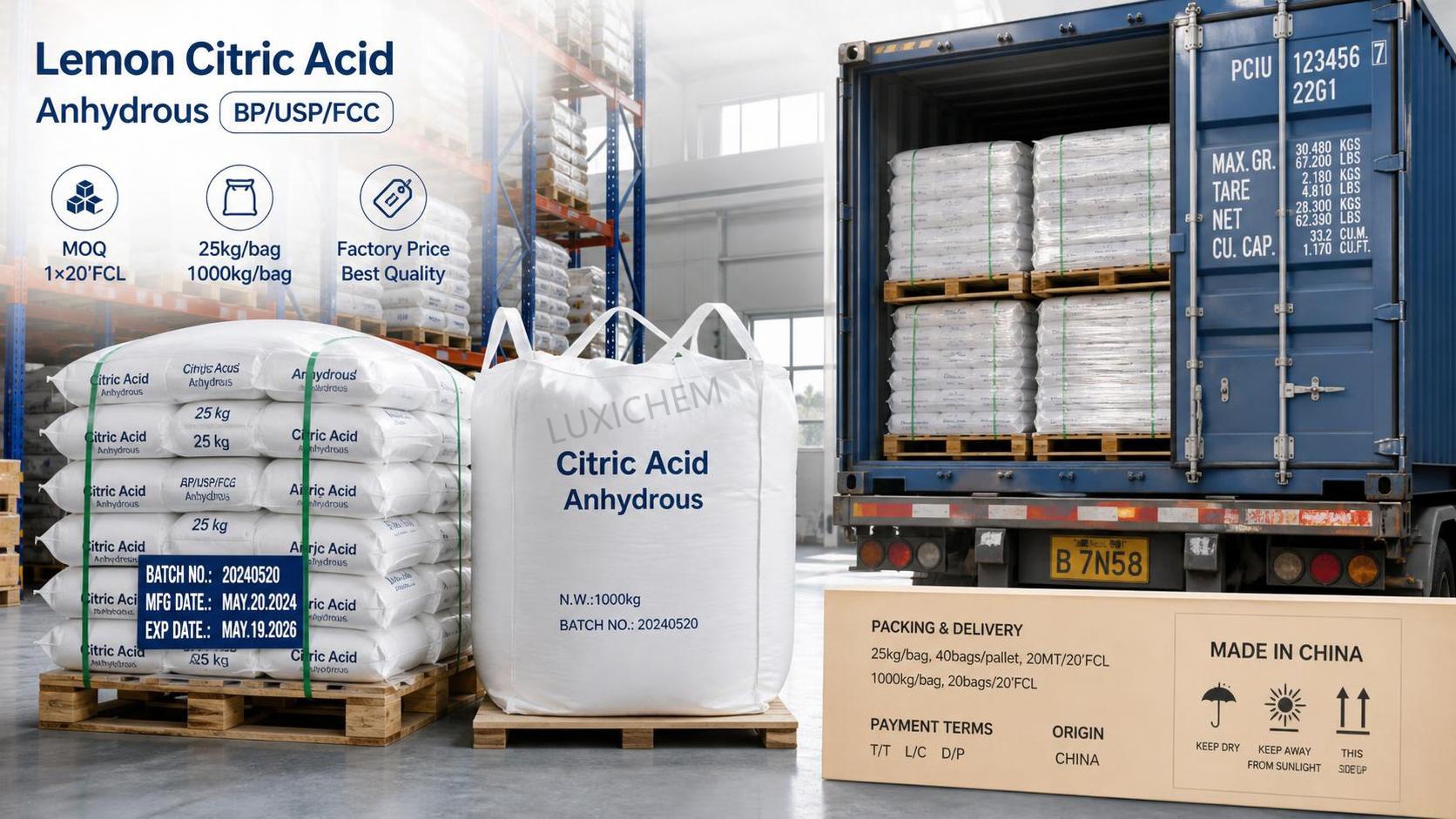
Citric Acid Wholesale Buying Guide: MOQ, Packaging Options, and Price Drivers
For most buyers, citric acid wholesale looks simple until the first shipment creates trouble. A low quote can lose its appeal very quickly if the supplier only accepts a large MOQ, if packaging is not suitable for your line, or if product consistency varies from lot to lot. In food processing, daily chemicals, and some industrial uses, citric acid is not an exotic material, but it is still one of those inputs where small purchasing decisions can affect freight cost, warehouse handling, formulation stability, and even claims exposure.
That is why experienced procurement teams usually compare more than unit price. They look at grade, mesh or crystal form where relevant, documentation, palletization, delivery rhythm, and whether the supplier can support mixed purchasing if citric acid is only one item in a broader raw material basket. Companies such as Luxi Chemical (Shandong) Co., Ltd., which handle chemical raw materials, food additives, organic intermediates, fertilizers, and import/export trade across multiple markets, are often evaluated not just on one SKU but on supply stability and coordination across categories.
MOQ is not just a sales condition
When buyers ask about MOQ, the real question is usually this: how much inventory risk am I taking on to get a workable landed cost? In citric acid wholesale, MOQ can vary depending on packaging type, production schedule, and whether the supplier is shipping from stock or arranging fresh production. A container-based MOQ may suit high-volume food processors. It is less comfortable for smaller blenders, contract manufacturers, or traders serving fragmented regional demand.
A higher MOQ often lowers unit price, but that does not automatically mean lower total procurement cost. If your monthly consumption is irregular, excess stock ties up cash and raises the risk of packaging damage, humidity exposure, or internal lot mixing. Citric acid is generally manageable in storage, but buyers still need to think about warehouse conditions, stock rotation, and how long the material will sit before use.
In practice, MOQ should be matched to three things: your average monthly consumption, your safety stock policy, and your inbound logistics model. If a supplier offers a strong price only at full-container volume, ask whether split shipments, mixed containers, or phased delivery are possible. That conversation often reveals how flexible the supplier really is.
Packaging decisions affect more than handling
Packaging is one of the most underestimated cost drivers. Buyers tend to compare 25 kg bags, jumbo bags, and palletized options mainly by packing charge. The better approach is to evaluate where cost appears downstream.
For example, 25 kg bags usually make sense when the material is used in controlled batch dosing, when warehouse labor is available, or when customers need easier stock segregation by lot. Jumbo bags may reduce packing and handling cost per ton, but they are only efficient if the receiving site has suitable unloading equipment and enough consumption speed to avoid partially used bags sitting open in storage.
Pallet configuration matters too. Buyers importing over long distances should check whether pallets are fumigated where necessary, whether stretch wrapping is robust enough for sea transit, and how many bags are stacked per pallet. A quote that looks lower on paper can become expensive if bags break during unloading or if the receiving warehouse cannot handle the pallet size.
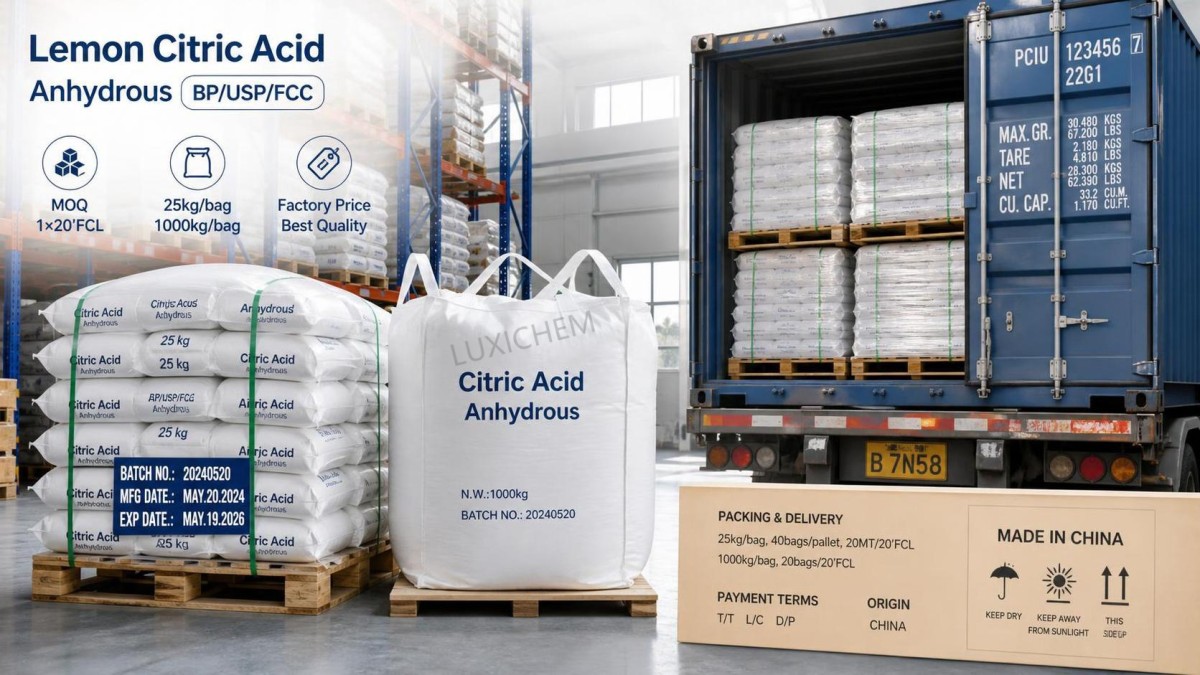
There is also the labeling issue. In food-related applications, outer and inner packaging details, lot numbers, production dates, and traceability marks can matter as much as the bag itself. If your internal quality system requires specific information for release, confirm it before the first order rather than after the container arrives.
The lowest price is often attached to the narrowest specification
Citric acid is sold into different application chains, so price comparisons only make sense when the grade and supporting documents are aligned. A buyer sourcing for food processing is not evaluating the same risk profile as a buyer sourcing for industrial cleaning or detergent blending. Even if the chemistry appears straightforward, procurement should still confirm intended use, applicable standard, and the document set needed for import and internal approval.
This is where many quotation tables become misleading. One supplier prices against standard export packing and a basic COA. Another includes more documentation support, tighter packaging control, or better batch consistency. The second quote may not be cheaper, but it may reduce time spent on quality queries, customs clarification, or production adjustment.
If you buy repeatedly, consistency becomes more valuable than a one-time discount. Procurement teams that have dealt with reformulation issues know this well. A small variation in appearance, particle behavior, or dissolution performance may be manageable, but each change adds work for production and QA. It is not always a non-conformance issue; sometimes it is simply a supply issue that was not discussed in enough detail.
What actually moves citric acid prices
Buyers usually ask why two offers differ when both claim to supply the same material. In citric acid wholesale, price is commonly shaped by a mix of factors rather than one single cause:
- Grade and intended application
- MOQ and whether the order fits a standard production or stock cycle
- Packaging type, palletization, and labeling requirements
- Freight timing, destination, and container availability
- Documentation expectations and compliance checks
- Payment terms and the supplier’s risk assessment
Freight deserves special attention. For bulk export purchases, ocean rates and port handling can alter landed cost enough to change supplier ranking. Buyers who only benchmark FOB may miss the real picture. In periods of shipping disruption, a supplier with slightly higher ex-works or FOB pricing but better booking capacity can end up being the more economical choice.
Currency movement can also influence quote validity. If your team is tendering across several weeks, confirm whether the price is fixed, what the validity period is, and whether packaging or freight surcharges may be adjusted. None of that is dramatic, but it affects budgeting.
Questions worth asking before you compare offers
A useful RFQ for citric acid should do more than request price per metric ton. It should clarify the operational details that tend to create hidden cost later. A few questions usually make comparison much cleaner:
The point is not to make the RFQ more complicated. It is to avoid wasting time on offers that are not genuinely comparable.
Why multi-product suppliers can change the cost equation
If citric acid is one line item in a larger raw materials plan, supplier structure matters. A company with broader chemical sourcing capability can sometimes reduce procurement friction even if the single-product price is not the absolute lowest. Consolidated purchasing, aligned export paperwork, and fewer vendor touchpoints can save more than a small price difference on one commodity.
That is particularly relevant for importers buying across food additives, intermediates, fertilizers, or daily chemical inputs. A supplier experienced in cross-category export coordination may help shorten order cycles and reduce administrative effort. Luxi Chemical’s positioning in one-stop procurement reflects this kind of buying logic: for many importers, transaction efficiency is part of the total cost discussion, not a separate issue.
You can see the same principle in broader chemical sourcing portfolios. A buyer may be discussing citric acid for one project and, in another context, evaluating a specialty material such as Europium Oxide CAS#1308-96-9. The products are unrelated in application, but the procurement question is similar: can the supplier handle specification clarity, export communication, and dependable shipment execution across different product types?
Common mistakes that make “cheap” purchases expensive
One common mistake is buying on trial-order logic and then assuming scale-up terms will be similar. Sometimes they are, sometimes they are not. MOQ, lead time, and packaging cost can change once you move from sample or small-lot supply to regular export volume.
Another is not defining the receiving condition clearly enough. If the warehouse needs pallets, if your line requires a certain bag type, or if your customer audit expects traceable labels, include that up front. Those details are easier to negotiate before quoting than after the goods are packed.
And then there is the freight blind spot. Buyers sometimes spend a lot of time negotiating a small material price reduction while ignoring demurrage risk, re-packing exposure, or poor loading efficiency. In container trade, operational details can erase a negotiated discount faster than people expect.
A practical way to evaluate citric acid wholesale offers
A workable comparison usually comes down to five filters: fit for intended application, realistic MOQ, packaging compatibility, landed cost, and supplier responsiveness on documentation and delivery questions. If one quote is lower but creates uncertainty on two or three of those points, it is not necessarily the better buy.
Good procurement in this category is rarely about chasing the cheapest ton. It is about buying a material that arrives in the right form, in the right quantity, with the right paperwork, at a cost structure your operation can actually use. If you review MOQ, packaging, and price drivers together rather than separately, supplier comparisons get much clearer—and so do the risks you are accepting.
Related Picks
 Butylated Hydroxytoluene Price Drivers: Supply, Purity, and Purchasing Risk FactorsOct 21, 2026Butylated Hydroxytoluene price trends depend on supply stability, purity, logistics, and purchasing risk. Learn how to compare quotes wisely and reduce sourcing costs.
 Sodium Tripolyphosphate Price Trends: Raw Material and Energy ExposureOct 20, 2026Explore sodium tripolyphosphate price trends, from phosphate and soda ash costs to energy exposure. Learn how to compare quotes, manage sourcing risks, and make smarter purchasing decisions.
 Acetonitrile Shipment to Vietnam Successfully Dispatched; RCEP Benefits Boost Fine Chemical Trade with ASEANSep 16, 2026A shipment of industrial-grade acetonitrile from our company has recently been loaded and dispatched following the completion of standardized hazardous material packaging and container securing procedures.
 Nigerian Client’s Order of 4 Containers of Vinyl Acetate Successfully Loaded and Shipped to West AfricaSep 16, 2026We recently completed the loading of a vinyl acetate order for a Nigerian client; four containers of the product have been successfully packed and are ready for shipment to Nigeria.




Question Consultation
Send Us Your Inquiry Today

Luxi Chemical is a professional chemical product supplier with ample stock of all chemical categories and excellent quality, welcome your purchase inquiry.

