


Citric Acid as a Preservative: Mechanism of Action, Effective Concentrations, and Synergies with Sorbate in Acidic Beverages
2026.09.17
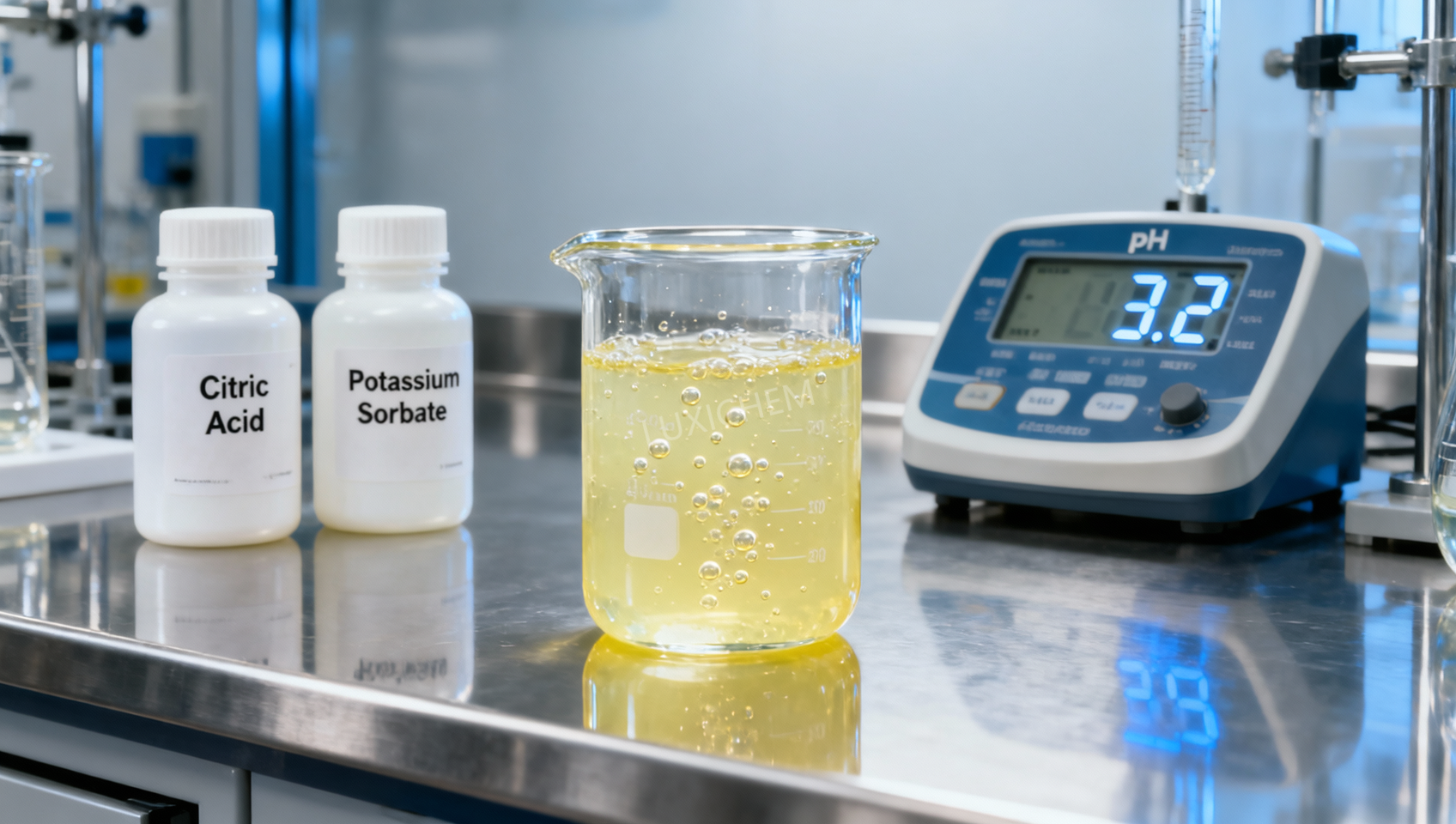
Citric acid’s role as a preservative in acidic beverages is not merely additive—it is functional, dynamic, and pH-dependent. Its efficacy does not stem from inherent antimicrobial potency alone, but from its capacity to shift the chemical environment in ways that amplify the activity of co-preservatives—particularly potassium sorbate. For production technicians and formulation specialists working with soft drinks, fruit juices, sports drinks, or ready-to-drink teas, citric acid is rarely used in isolation for microbial control. Instead, it serves as a critical enabler: lowering pH to stabilize the beverage matrix *and* converting sorbate into its biologically active, undissociated form (HSorb). This dual function makes citric acid indispensable—not as a standalone biocide, but as a precision tool in the stabilization toolkit.
The mechanism hinges on protonation. Citric acid (C₆H₈O₇), a weak triprotic organic acid, dissociates in water across three pKa values (pKa₁ ≈ 3.13, pKa₂ ≈ 4.76, pKa₃ ≈ 6.40). In most acidic beverages (pH 2.8–3.8), it exists predominantly in its mono- and di-dissociated forms, contributing both acidity and chelating capacity. Crucially, this low pH suppresses the dissociation of potassium sorbate (K-sorbate), whose pKa is 4.76. At pH 3.0, over 98% of sorbate remains in the undissociated HSorb form—the only species capable of penetrating microbial membranes and disrupting intracellular pH homeostasis. Below pH 3.5, citric acid’s buffering action helps maintain this narrow window where sorbate’s inhibitory power peaks against yeasts and molds—especially *Saccharomyces cerevisiae*, *Brettanomyces*, and *Aspergillus* spp.—without requiring excessive sorbate dosing.
Effective concentrations are tightly constrained by sensory and functional thresholds. Empirical data from industrial beverage trials indicate that citric acid at 0.05–0.15% w/v (500–1500 ppm) provides sufficient pH depression (typically ΔpH 0.2–0.5 units) and buffering capacity to sustain sorbate efficacy throughout shelf life—without introducing detectable sourness or metallic off-notes. Concentrations above 0.3% w/v often trigger consumer rejection in neutral or mildly flavored formats, particularly when combined with other acids (e.g., malic or phosphoric). Below 0.05%, pH drift during storage—driven by CO₂ loss in carbonated systems or enzymatic degradation in juice-based products—can push pH above 3.8, sharply reducing HSorb fraction and enabling spoilage. Stability testing under real-time and accelerated conditions confirms that citric acid’s buffering strength, not just its initial concentration, determines long-term protection. Beverages formulated with citric acid alone (no sorbate) show no meaningful inhibition of *Zygosaccharomyces bailii* at pH >3.0—even at 0.4% w/v—demonstrating its limited direct preservative utility outside synergistic contexts.
Synergy with potassium sorbate is not additive—it is exponential within defined pH and concentration windows. A study comparing shelf-life extension in orange juice blends found that 0.075% citric acid + 0.02% K-sorbate delivered 12-week mold/yeast stability at 30°C, whereas doubling the sorbate dose without citric acid yielded only 6 weeks. The citric acid here did not act as an antimicrobial agent per se; it prevented pH creep from 3.2 to 3.6 over time—a 0.4-unit shift that reduced the HSorb fraction from 96% to 72%, effectively halving sorbate’s bioavailability. Chelation further enhances this effect: citric acid binds metal ions (Ca²⁺, Mg²⁺, Fe²⁺) that catalyze oxidative browning and support microbial enzyme function. In high-calcium citrus concentrates, unchelated Ca²⁺ can shield *Lactobacillus* cells from sorbate penetration—citric acid mitigates this interference. However, excessive chelation risks destabilizing cloud emulsions or promoting copper-catalyzed ascorbic acid degradation. The optimal balance lies in using citric acid at the lowest effective level that maintains pH ≤3.5 *throughout* the product’s intended shelf life—not just at fill.
This precision demands attention to raw material consistency. Food-grade citric acid varies in residual moisture, ash content, and trace metal profiles—factors influencing both pH predictability and metal chelation efficiency. Batch-to-batch variation in citric acid purity (e.g., 99.5% vs. 99.8%) may seem trivial, but in low-buffering systems like flavored sparkling water, even 0.02% difference in assay can shift final pH by 0.05–0.08 units—enough to alter HSorb fraction by 5–8%. Suppliers with ISO 22000-certified manufacturing and rigorous lot-specific pH and titratable acidity testing provide formulation teams with reproducible input parameters. Luxi Chemical’s food-grade citric acid, compliant with FCC, EU E330, and China GB 1886.235 standards, undergoes full heavy metal profiling (Pb, As, Cd, Hg <1 ppm) and microbial limits (total plate count <100 CFU/g), ensuring consistent performance without introducing unintended catalytic impurities.
One overlooked risk lies in interaction with other formulation components. Citric acid accelerates the hydrolysis of certain preservative esters (e.g., sodium benzoate degrades faster above pH 3.0 in presence of citrate), and it can react with amino acids under heat to form off-flavor compounds via Maillard pathways. In protein-fortified beverages, citric acid below pH 4.0 increases solubility of whey proteins—but also raises susceptibility to thermal denaturation during pasteurization. These interactions do not invalidate citric acid use; they require formulation mapping. For example, in a mango-passionfruit RTD drink containing 0.015% K-sorbate, shifting from 0.08% to 0.10% citric acid improved yeast inhibition but triggered a slight astringent note after 8 weeks—traced to citrate-mediated extraction of polyphenols from pulp residue. Adjusting homogenization pressure resolved it, underscoring that citric acid’s impact extends beyond chemistry into physical processing variables.
 In specialized applications, citric acid’s chelating properties intersect with synthetic chemistry requirements. Its ability to sequester transition metals is leveraged not only in beverage stabilization but also in controlled reaction environments—for instance, in the synthesis of fluorinated pharmaceutical intermediates where metal-catalyzed side reactions must be suppressed. 4-Fluorobenzaldehyde CAS#459-57-4, used in the preparation of MAPK inhibitors, requires strict exclusion of iron and copper during condensation steps; citric acid is sometimes employed in pilot-scale purification protocols to passivate reactor surfaces before introduction of sensitive aldehyde reagents.
For practitioners, the takeaway is operational: citric acid concentration must be calibrated—not to a target number, but to a target *pH trajectory*. Measure pH immediately post-mix, again after carbonation or thermal treatment, and at 24h, 7d, and 30d under ambient storage. If pH rises >0.15 units in the first week, increase citric acid incrementally—or consider adding a secondary buffer (e.g., sodium citrate) to reinforce resistance to drift. Never rely solely on theoretical calculations: juice solids, dissolved CO₂, and container headspace all influence proton activity. And always verify that the citric acid source meets food-grade trace metal specifications—because inconsistent raw material quality undermines the very precision this system demands.
Related Picks
 Butylated Hydroxytoluene Price Drivers: Supply, Purity, and Purchasing Risk FactorsOct 21, 2026Butylated Hydroxytoluene price trends depend on supply stability, purity, logistics, and purchasing risk. Learn how to compare quotes wisely and reduce sourcing costs.
 Sodium Tripolyphosphate Price Trends: Raw Material and Energy ExposureOct 20, 2026Explore sodium tripolyphosphate price trends, from phosphate and soda ash costs to energy exposure. Learn how to compare quotes, manage sourcing risks, and make smarter purchasing decisions.
 Acetonitrile Shipment to Vietnam Successfully Dispatched; RCEP Benefits Boost Fine Chemical Trade with ASEANSep 16, 2026A shipment of industrial-grade acetonitrile from our company has recently been loaded and dispatched following the completion of standardized hazardous material packaging and container securing procedures.
 Nigerian Client’s Order of 4 Containers of Vinyl Acetate Successfully Loaded and Shipped to West AfricaSep 16, 2026We recently completed the loading of a vinyl acetate order for a Nigerian client; four containers of the product have been successfully packed and are ready for shipment to Nigeria.




Question Consultation
Send Us Your Inquiry Today

Luxi Chemical is a professional chemical product supplier with ample stock of all chemical categories and excellent quality, welcome your purchase inquiry.

