


Citric Acid Anhydrous: When You Need It — Thermal Stability Requirements in Dry Blends, Effervescent Tablets, and Catalyst Supports
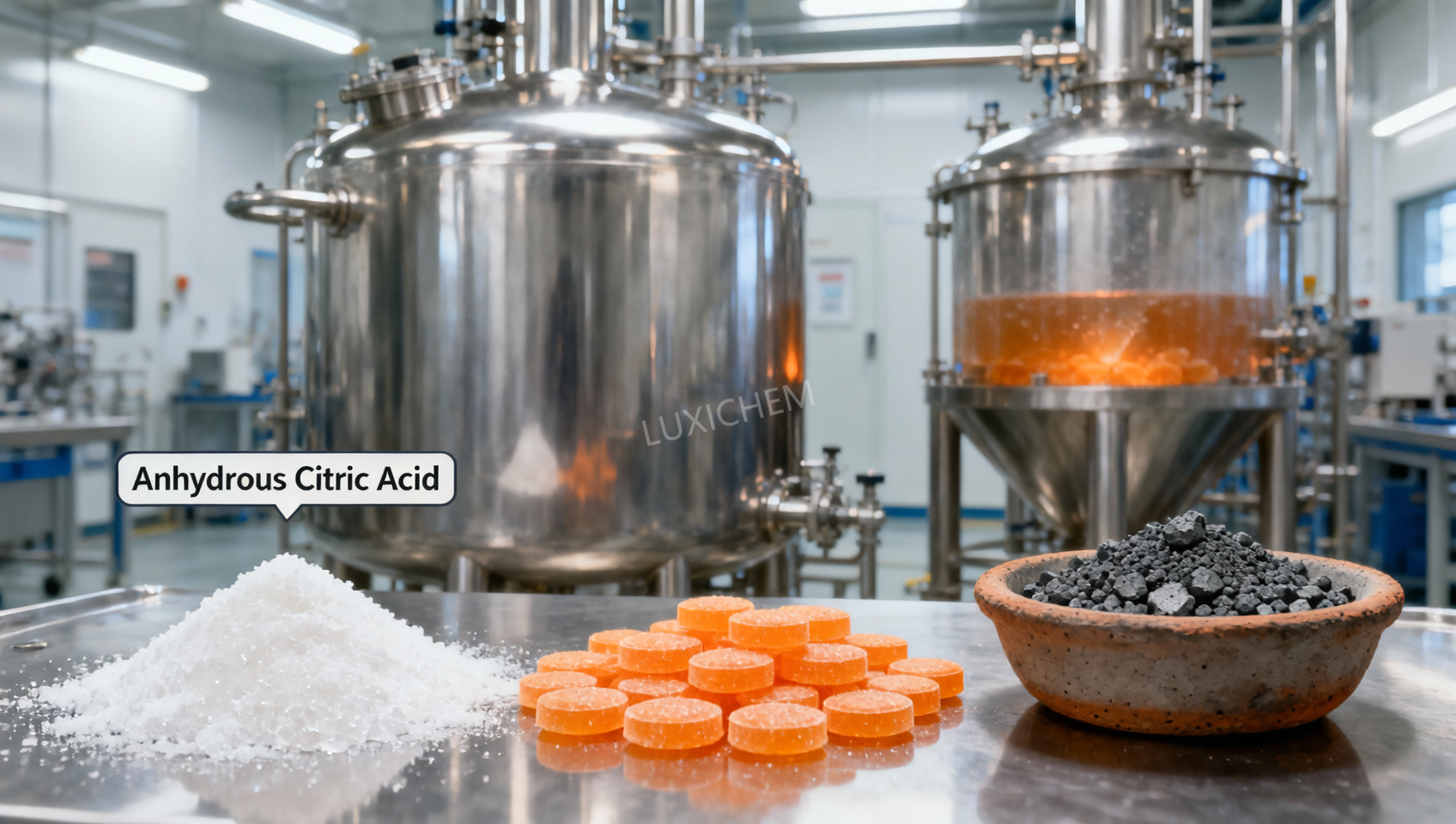
Citric Acid Anhydrous: When You Need It — Thermal Stability Requirements in Dry Blends, Effervescent Tablets, and Catalyst Supports
If you’ve ever seen citric acid monohydrate cake during high-speed dry blending—or watched effervescent tablet hardness drop mid-compression—you already know moisture isn’t just a contaminant. It’s an active participant in degradation pathways. That’s where citric acid anhydrous steps in—not as a “better version,” but as a functional necessity when thermal stability, low-humidity processing, and predictable reactivity are non-negotiable.
The difference between monohydrate and anhydrous isn’t academic. Citric acid monohydrate loses its water of crystallization around 40–50°C. In environments where ambient temperature creeps above 35°C—or where friction heat from mixing, granulation, or compaction spikes locally—the monohydrate begins dehydrating *in situ*. That releases water vapor into the blend, triggering premature acid-base reactions (e.g., with sodium bicarbonate), altering particle surface energy, and compromising flow and compressibility. Anhydrous citric acid, by contrast, remains structurally intact up to ~175°C—giving operators a wider thermal operating window without hidden hydration shifts.
Dry Blends: Where Consistency Starts with Crystalline Integrity
In dry-blended nutritional powders, instant beverages, or pharmaceutical premixes, citric acid often serves dual roles: pH adjuster and flavor enhancer. But in high-shear mixers running at 200+ rpm for 8–12 minutes, localized temperatures can easily exceed 60°C—especially near impeller tips or in dense powder beds. Monohydrate here doesn’t just “melt.” It undergoes partial dehydration, creating micro-damp zones that promote caking, static buildup, and uneven dispersion of co-actives like vitamins or minerals.
Anhydrous citric acid avoids this entirely. Its lower hygroscopicity means less moisture adsorption during storage and handling—even in humid climates or non-climate-controlled warehouses. For global supply chains serving Southeast Asia, the Gulf region, or coastal Latin America, that translates directly to fewer batch rejections due to clumping or assay drift before reaching the blender.
Effervescent Tablets: Compression Heat Changes Everything
Direct compression of effervescent formulations is fast—but unforgiving. Frictional heat generated during die filling and punch compression can briefly elevate local particle temperature by 20–40°C. If citric acid monohydrate is present, that heat accelerates water release, which then reacts with sodium bicarbonate *before* ejection. The result? Reduced tablet hardness, increased friability, and inconsistent disintegration times—sometimes flagged only during stability testing at 3 months, not QC release.
Anhydrous citric acid eliminates that variable. No water release = no premature gas evolution = consistent tablet density and dissolution profile across shifts and batches. Operators report fewer unplanned stoppages for recalibration of feed frames or pre-compression force—and more repeatable weight variation (±2.5% vs. ±5.0% with monohydrate under identical settings).
Catalyst Supports: When Surface Chemistry Dictates Performance
Citric acid isn’t just a food additive or effervescent acidulant. In catalysis—especially for metal oxide supports used in selective oxidation or hydrogenation—it acts as both chelating agent and carbon source during calcination. Here, the water content matters at the molecular level. Monohydrate introduces uncontrolled H₂O during thermal ramping, which can cause pore collapse, metal sintering, or incomplete carbon burnout. Anhydrous citric acid provides cleaner, more reproducible decomposition: first to aconitic acid (~150°C), then to itaconic acid (~200°C), and finally to CO₂ + H₂O + char residue—without the extra water molecule skewing kinetics.
That control is critical when scaling lab-prepared catalysts to pilot or production reactors. A 5% shift in surface area or metal dispersion isn’t theoretical—it changes selectivity, lifetime, and regeneration frequency. For teams optimizing Pd/Cu or Co/Mn oxide systems, choosing anhydrous over monohydrate isn’t about purity—it’s about eliminating a known source of process variability.
What “High-Purity” Actually Means in Practice
Not all anhydrous citric acid performs the same. Residual moisture (even 0.1–0.3%), trace metals (Fe, Cu), or residual solvents from crystallization can affect performance—especially in pharma-grade effervescents or catalyst precursors where metal contamination impacts final activity. At Luxi Chemical (Shandong) Co., Ltd., our citric acid anhydrous is produced via controlled vacuum dehydration of USP/EP-grade monohydrate, followed by nitrogen-purged milling and triple-sieving to ensure uniform particle size distribution (D90 ≤ 180 µm). Each lot undergoes Karl Fischer titration (≤0.15% H₂O), heavy metals testing (≤5 ppm), and assay verification (≥99.5%). This isn’t compliance theater—it’s built-in reliability for processes where a single deviation cascades into downtime or rework.
We serve customers across 60+ countries—from contract manufacturers in India adjusting blend parameters for monsoon-season production, to European nutraceutical firms validating new direct-compression lines, to catalyst developers in South Korea qualifying precursor materials for automotive exhaust systems. What they share isn’t just a spec sheet—it’s the need for material behavior they can count on, batch after batch.
A Note on Complementary Materials
While citric acid anhydrous handles thermal and moisture challenges, other formulation components demand equally precise handling—especially where reactivity with water is central to function. For example, in grain storage fumigation or industrial rodent control, rapid, controlled phosphine generation depends on strict moisture management. Aluminum Phosphide CAS#20859-73-8 relies on ambient humidity to initiate reaction—but only within defined safety thresholds. Its cubic crystal structure and controlled hydrolysis kinetics make it suitable for sealed silos or burrow applications where timing and gas concentration must be predictable. Like citric acid anhydrous, its value lies not in being “stronger,” but in delivering consistent, on-demand chemistry—when and where it’s needed.
None of this is about swapping one chemical for another on paper. It’s about matching material properties to your actual process envelope: temperature gradients, dwell times, equipment design, ambient conditions, and end-product specifications. If your current citric acid grade is causing variability in any of these three areas—dry blending, effervescent compression, or catalyst synthesis—then anhydrous isn’t an upgrade. It’s the right tool for the job.
For operators who’ve adjusted mixer speed, lowered compression force, or added desiccant packs just to compensate for citric acid behavior—we recommend reviewing your thermal profile alongside certified anhydrous data. Not every application needs it. But when you do, there’s no substitute for knowing exactly what’s in the drum.
Related Picks
 Butylated Hydroxytoluene Price Drivers: Supply, Purity, and Purchasing Risk FactorsOct 21, 2026Butylated Hydroxytoluene price trends depend on supply stability, purity, logistics, and purchasing risk. Learn how to compare quotes wisely and reduce sourcing costs.
 Sodium Tripolyphosphate Price Trends: Raw Material and Energy ExposureOct 20, 2026Explore sodium tripolyphosphate price trends, from phosphate and soda ash costs to energy exposure. Learn how to compare quotes, manage sourcing risks, and make smarter purchasing decisions.
 Acetonitrile Shipment to Vietnam Successfully Dispatched; RCEP Benefits Boost Fine Chemical Trade with ASEANSep 16, 2026A shipment of industrial-grade acetonitrile from our company has recently been loaded and dispatched following the completion of standardized hazardous material packaging and container securing procedures.
 Nigerian Client’s Order of 4 Containers of Vinyl Acetate Successfully Loaded and Shipped to West AfricaSep 16, 2026We recently completed the loading of a vinyl acetate order for a Nigerian client; four containers of the product have been successfully packed and are ready for shipment to Nigeria.




Question Consultation
Send Us Your Inquiry Today

Luxi Chemical is a professional chemical product supplier with ample stock of all chemical categories and excellent quality, welcome your purchase inquiry.

