


CAS Number 77-92-9 Verification Guide: How to Cross-Check Against SDS, COA, and Regulatory Databases for Authenticity
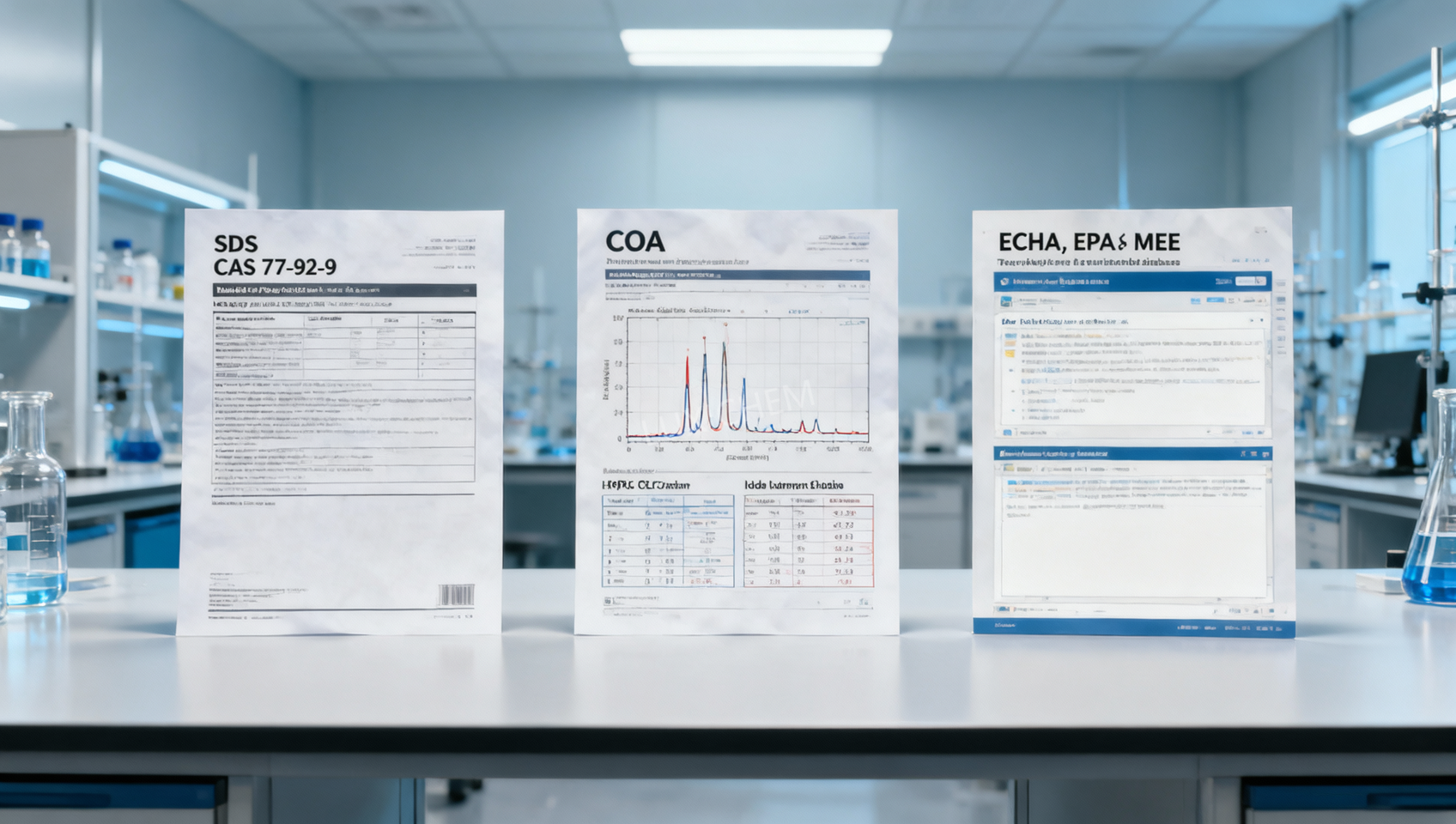
CAS Number 77-92-9 Verification: Why “Matching the Number” Isn’t Enough
If you’ve ever received a COA labeled “CAS 77-92-9” and assumed verification was complete, pause. Methyl ethyl ketone peroxide (MEKP) is not a commodity where CAS lookup alone satisfies technical due diligence. Its instability, formulation variability (monomer vs. dimer vs. oligomer ratios), and strict regulatory thresholds mean that identical CAS numbers can mask materially different hazard profiles, decomposition behaviors, and even functional suitability—especially in polymerization or curing applications. At Luxi Chemical, we see this mismatch repeatedly: a lab confirms the CAS number, but fails to cross-check whether the SDS reflects the *exact* concentration and solvent system shipped—or whether the COA’s assay method accounts for peroxide equivalence versus total organic peroxide content.
SDS Cross-Check: Look Beyond Section 1
Section 1 of an SDS gives the CAS number—but that’s just the starting point. For CAS 77-92-9, what matters is Section 9 (physical and chemical properties) and Section 10 (stability and reactivity). Does the SDS list the active oxygen content? Is the flash point reported for the supplied formulation (e.g., 40% MEKP in dimethyl phthalate) or for pure compound (which decomposes before boiling)? We’ve seen SDSs pulled from generic databases that cite “decomposes >100°C” without specifying whether that applies to neat material or diluted commercial grade—and that gap has triggered storage compliance failures in EU warehouses. Also check Section 15: regulatory information. If the SDS cites ECHA registration but omits the specific EC number assigned to *that batch’s composition*, treat it as incomplete—not merely outdated.
COA Validation: Assay Method Dictates Interpretation
A COA stating “98.5% purity” means little unless you know how it was measured. Iodometric titration measures total peroxide activity; HPLC quantifies individual species (MEKP monomer, dimer, residual MEK). For resin manufacturers, the dimer/monomer ratio affects cure speed and exotherm profile—yet many COAs omit this entirely. At Luxi, our COAs for CAS 77-92-9 include both iodometric assay *and* HPLC-species breakdown, with retention times anchored to NIST-traceable standards. If your supplier’s COA lacks method details—or worse, lists “peroxide value” without units (meq/g vs. wt%)—don’t assume equivalency. Ask for the raw chromatogram or titration protocol. A missing method footnote isn’t bureaucracy; it’s a signal that analytical rigor wasn’t built into the release process.
Regulatory Database Alignment: ECHA, EPA, and China’s MEE Don’t Speak the Same Language
ECHA’s database lists MEKP under EC 201-076-0—but that entry covers *all* MEKP formulations above 1%, regardless of concentration or stabilizer. EPA’s TSCA inventory treats it as a single substance (CAS 77-92-9), yet its significant new use rule (SNUR) applies only to certain processing conditions. China’s MEE inventory, updated via the “List of Hazardous Chemicals under Strict Supervision”, classifies MEKP by active oxygen content (>10% triggers stricter handling). The practical takeaway: matching CAS 77 92 9 across these systems confirms identity, but *not* compliance scope. You must map each database’s threshold criteria to your actual use case—not just the label. For example, shipping 30% MEKP into Guangdong requires MEE filing *even if* the same batch clears ECHA REACH without notification.
Where Things Go Wrong in Practice
We once supported a customer who accepted a shipment based on matching CAS 77-92-9 and a passing COA—only to discover during reactor commissioning that the peroxide decomposition onset temperature was 12°C lower than specified. Root cause? The supplier’s COA used accelerated DSC testing (10°C/min ramp), while the customer’s process relied on isothermal stability data at 40°C. No fraud occurred—the CAS was correct, the assay valid—but the *context* of measurement wasn’t transferred. That’s why Luxi’s technical documentation includes test conditions alongside results: ramp rate, atmosphere, sample mass, and instrument calibration date. It’s not extra detail; it’s the difference between reproducible performance and field failure.
One Practical Check You Can Do Today
Pull up the latest ECHA registered dossier for CAS 77-92-9. Scroll to “Toxicological Information”. Note the dermal sensitization classification (Skin Sens. 1B). Now compare that to your SDS. If your SDS says “Not classified”, don’t dismiss it as a typo—verify whether the SDS refers to the *diluted product* (where classification may not apply) or misapplies the CLP criteria. This kind of granular alignment—between regulatory classification logic and actual formulation—is where technical evaluators add real value. It’s not about finding contradictions; it’s about confirming that the hazard communication matches *your* exposure scenario.
And While You’re Verifying MEKP…
It’s worth remembering that rigorous cross-checking isn’t exclusive to reactive intermediates. For high-value biochemicals like L-Leucine CAS#61-90-5, optical purity ([α]²⁰/D +15.5°) and absence of D-isomer contamination are non-negotiable in infusion-grade applications—yet some COAs report only “≥98.5% HPLC purity” without chiral separation data. The discipline required to verify CAS 77-92-9 translates directly: method transparency, specification context, and regulatory mapping matter equally whether you’re qualifying a peroxide initiator or an essential amino acid.
Final Thought: Verification Is a Process, Not a Checkbox
There’s no universal “pass/fail” for CAS 77-92-9 verification. What passes for adhesive formulation may fail for pharmaceutical excipient use—not because the CAS is wrong, but because the supporting data doesn’t cover the required risk dimension. At Luxi Chemical, we structure our documentation to anticipate those dimensions upfront: SDSs with formulation-specific physical data, COAs with full method traceability, and regulatory summaries keyed to destination-market thresholds. But ultimately, the evaluator owns the final judgment call—based on their process, their customers’ requirements, and the weight they assign to each data stream. Don’t outsource that judgment to a database match.
Related Picks
 Butylated Hydroxytoluene Price Drivers: Supply, Purity, and Purchasing Risk FactorsOct 21, 2026Butylated Hydroxytoluene price trends depend on supply stability, purity, logistics, and purchasing risk. Learn how to compare quotes wisely and reduce sourcing costs.
 Sodium Tripolyphosphate Price Trends: Raw Material and Energy ExposureOct 20, 2026Explore sodium tripolyphosphate price trends, from phosphate and soda ash costs to energy exposure. Learn how to compare quotes, manage sourcing risks, and make smarter purchasing decisions.
 Acetonitrile Shipment to Vietnam Successfully Dispatched; RCEP Benefits Boost Fine Chemical Trade with ASEANSep 16, 2026A shipment of industrial-grade acetonitrile from our company has recently been loaded and dispatched following the completion of standardized hazardous material packaging and container securing procedures.
 Nigerian Client’s Order of 4 Containers of Vinyl Acetate Successfully Loaded and Shipped to West AfricaSep 16, 2026We recently completed the loading of a vinyl acetate order for a Nigerian client; four containers of the product have been successfully packed and are ready for shipment to Nigeria.




Question Consultation
Send Us Your Inquiry Today

Luxi Chemical is a professional chemical product supplier with ample stock of all chemical categories and excellent quality, welcome your purchase inquiry.

