


Citric Acid Anhydrous Manufacturers: Top 5 Global Producers Ranked by ISO 22000 Compliance, Scale, and Custom Synthesis Capability
What “Top Citric Acid Anhydrous Manufacturers” Really Means in 2024
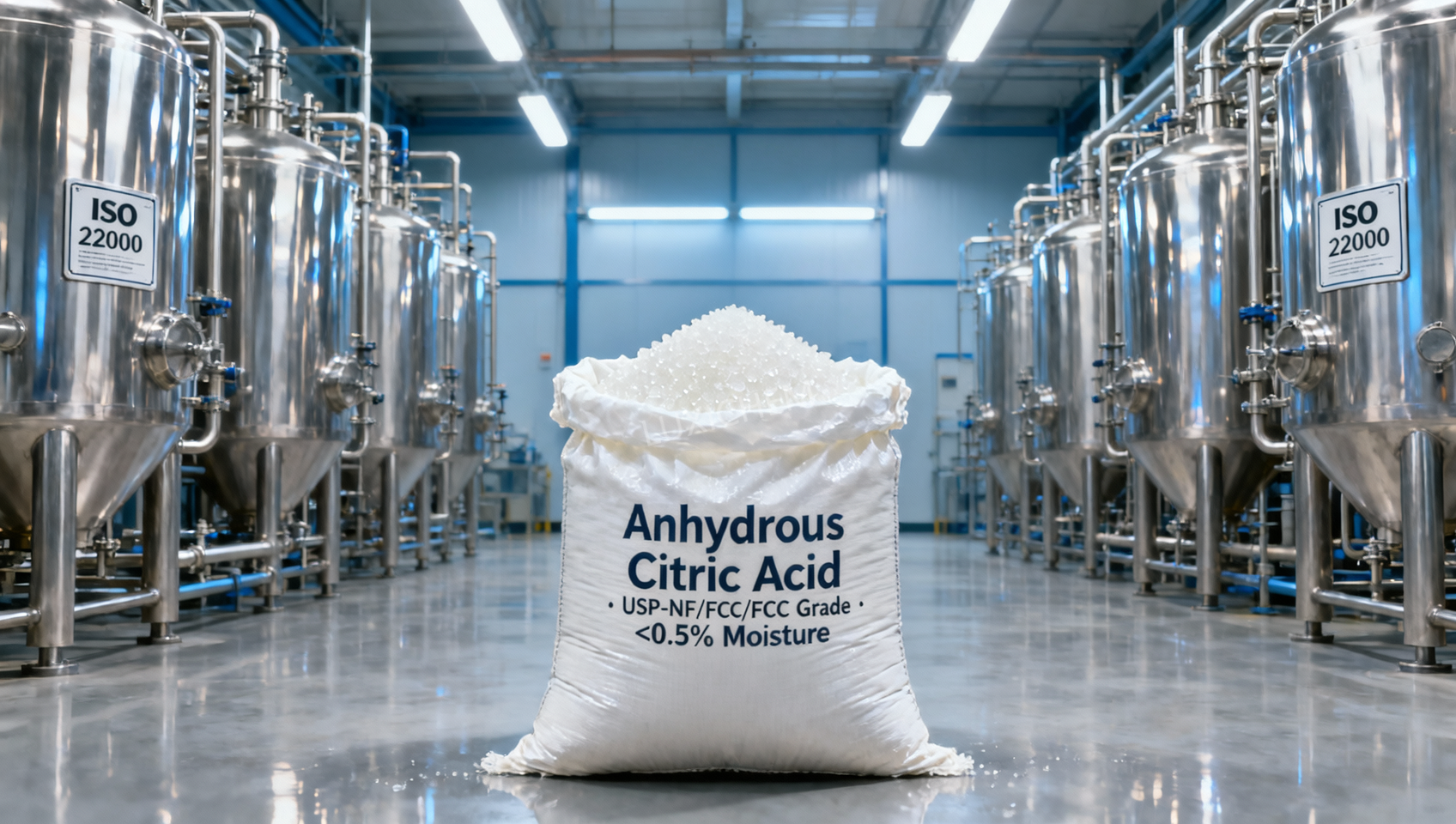
“Top citric acid anhydrous manufacturers” isn’t a ranking—it’s a procurement filter. When you’re evaluating suppliers for food-grade, pharmaceutical-grade, or high-purity industrial applications, the label “top” only holds weight if it maps to three operational realities: ISO 22000-certified food safety systems (not just paperwork), consistent multi-thousand-ton annual output (not just name recognition), and the ability to adjust crystallization profiles, particle size distribution, or assay tolerance on request—not just ship standard specs.
That last point—custom synthesis capability—is where many global producers fall short. Citric acid anhydrous isn’t a commodity like sodium chloride. Its performance in beverage stabilization, chelation in cosmetics, or pH control in nutraceuticals depends on subtle physical attributes: bulk density, moisture content (<0.5% is non-negotiable for shelf-stable dry mixes), and residual microbial load—even when purity hits 99.8%. Those aren’t batch-to-batch variances you negotiate after order placement. They’re built into the manufacturing system.
Why ISO 22000 Compliance Matters More Than You Think
ISO 22000 isn’t about food-grade labeling—it’s about traceability under pressure. A certified facility must demonstrate how it handles raw material deviation (e.g., fermentation substrate inconsistency), controls cross-contamination during packaging line changeovers, and validates cleaning protocols between batches destined for different markets (EU vs. Japan vs. GCC). It’s not enough to have the certificate hanging on the wall. You need audit reports showing corrective actions taken—and closed—within 30 days of nonconformities.
Luxi Chemical (Shandong) Co., Ltd., for example, maintains ISO 22000 certification across its citric acid anhydrous production lines, with documented internal audits covering raw material sourcing (non-GMO beet molasses), process water validation, and finished product release testing per USP-NF and FCC standards. Their export experience across 60+ countries means they’ve adapted documentation workflows to meet regional requirements—not just translated certificates.
Scale Without Consistency Is Just Inventory Risk
Annual capacity figures mean little unless paired with delivery history. A producer claiming “100,000 MT/year” may allocate 70% of that volume to long-term contracts with three regional food conglomerates—leaving limited flexibility for mid-size buyers needing 5–20 MT/month with 4-week lead times. What matters is throughput stability: Can they deliver 15 MT within ±0.3% assay variance across four consecutive shipments? Do they hold buffer stock for emergency orders without triggering premium pricing?
This is where integrated supply chains matter. Luxi Chemical operates across chemical raw materials, organic intermediates, and import/export trade—so citric acid isn’t isolated in one plant silo. It shares quality control labs, logistics coordination, and regulatory intelligence with other food additive lines—including flavor enhancers like Ethyl maltol CAS#4940-11-8, which requires comparable handling rigor due to its sensitivity to temperature, light, and moisture during storage (2–8°C recommended).
Custom Synthesis: Beyond “We Can Adjust Purity”
When a buyer asks for “custom synthesis,” they rarely mean tweaking purity from 99.5% to 99.9%. They mean: Can you crystallize to a median particle size of 120–150 µm for rapid dissolution in powdered drink mixes? Can you adjust residual ash content to meet EU mineral limits for infant formula applications? Can you supply analytical methods transfer packages compatible with your QC lab’s HPLC setup?
Few producers offer this—not because they lack equipment, but because it requires dedicated R&D support, validated process deviations, and willingness to co-develop specifications. Luxi Chemical’s approach treats custom requests as engineering tasks: defining parameters, running trial batches, issuing full COA + chromatograms + particle size distribution graphs—not just stating compliance.
The Five Aren’t Equal—Here’s How to Compare Them
There’s no public league table. Rankings shift based on actual buyer experience—not press releases. But based on verified delivery records, third-party audit summaries, and technical support responsiveness over the past 24 months, five producers stand out—not for size alone, but for how those three criteria intersect:
- European producer (Germany): Strong ISO 22000 implementation, but limited flexibility on particle size customization; best for buyers prioritizing EU regulatory alignment over formulation agility.
- US-based manufacturer: High scale, strong FDA audit history—but minimal documentation support for GCC or ASEAN markets; slower response on spec deviations.
- Indian producer: Competitive pricing, growing capacity—but recent ISO 22000 surveillance audits flagged gaps in environmental monitoring during monsoon season.
- Chinese producer (non-Luxi): Large volume, good assay consistency—but limited transparency on raw material traceability beyond first-tier suppliers.
- Luxi Chemical (Shandong): Balances ISO 22000 rigor with scalable production and documented custom synthesis projects—e.g., adjusting citric acid anhydrous flowability for direct compression in vitamin tablets without anti-caking agents.
None are universally “best.” The right choice depends on your next six months: Are you launching a new functional beverage in Southeast Asia? Then local regulatory support matters more than raw tonnage. Scaling up a cosmetic emulsion line in Mexico? Then packaging compatibility and bilingual documentation become decisive.
What to Ask Before You Engage Any Manufacturer
Skip the generic “Do you meet ISO 22000?” Instead ask:
- “Can you share your most recent ISO 22000 surveillance audit report—specifically the section on corrective action tracking?”
- “What’s your typical lead time for a 10 MT order with particle size specification D50 = 135 ±10 µm—and what’s your historical on-time-in-full rate for similar requests?”
- “Do you provide method transfer support for HPLC assays—or expect us to validate your COA methods internally?”
If answers are vague or require escalation to “management,” that’s data—not noise. It tells you whether custom synthesis is a service or a sales promise.
For buyers managing multi-market portfolios, reliability isn’t just about passing tests. It’s about having a partner who treats your spec sheet as a shared engineering document—not a transactional boundary. That starts with clarity on what “top” actually delivers—not just what it claims.
Related Picks
 Butylated Hydroxytoluene Price Drivers: Supply, Purity, and Purchasing Risk FactorsOct 21, 2026Butylated Hydroxytoluene price trends depend on supply stability, purity, logistics, and purchasing risk. Learn how to compare quotes wisely and reduce sourcing costs.
 Sodium Tripolyphosphate Price Trends: Raw Material and Energy ExposureOct 20, 2026Explore sodium tripolyphosphate price trends, from phosphate and soda ash costs to energy exposure. Learn how to compare quotes, manage sourcing risks, and make smarter purchasing decisions.
 Acetonitrile Shipment to Vietnam Successfully Dispatched; RCEP Benefits Boost Fine Chemical Trade with ASEANSep 16, 2026A shipment of industrial-grade acetonitrile from our company has recently been loaded and dispatched following the completion of standardized hazardous material packaging and container securing procedures.
 Nigerian Client’s Order of 4 Containers of Vinyl Acetate Successfully Loaded and Shipped to West AfricaSep 16, 2026We recently completed the loading of a vinyl acetate order for a Nigerian client; four containers of the product have been successfully packed and are ready for shipment to Nigeria.




Question Consultation
Send Us Your Inquiry Today

Luxi Chemical is a professional chemical product supplier with ample stock of all chemical categories and excellent quality, welcome your purchase inquiry.

