


Curcumin Extraction Methods Explained: Which Process Delivers Better Purity and Stability?
Curcumin Extraction Methods Explained: Which Process Delivers Better Purity and Stability?
If you are evaluating Curcumin for food, formulation, or specialty chemical use, the real question is not which extraction method sounds more advanced. It is which process gives you the impurity profile, batch consistency, and storage stability your application can actually tolerate. In practice, high yield alone is rarely enough. A Curcumin extract that looks acceptable on paper may still perform poorly if residual solvents, co-extracted resins, unstable color fractions, or poor crystallization control are left unresolved.
That is why technical evaluators usually compare extraction routes through three filters: purity, stability, and fit for downstream processing. Once you look at Curcumin this way, the differences between conventional solvent extraction, alkaline extraction, supercritical methods, and refined recrystallization become much easier to judge.
What technical teams usually want to know about Curcumin extraction
A short answer first: if your target is higher purity and more predictable stability, extraction alone is not the deciding step. The better result usually comes from the full process design, especially solvent selection, temperature control, light exposure, washing steps, and post-extraction purification. A basic solvent extraction process can still produce strong material if refinement is well managed, while an advanced extraction technology can underperform when the purification train is weak.
Many buyers assume the “best” Curcumin process is the one with the newest equipment. That is a common mistake. In real supply evaluation, the more useful question is this: what impurities remain after extraction, and how stable is the final product under transport, storage, and application conditions?
Why extraction method changes purity more than many buyers expect
Curcumin is typically obtained from turmeric-derived raw material, but the extract is not composed of Curcumin alone. Depending on the process, you may also bring along essential oils, waxes, sugars, proteins, resinous matter, and related curcuminoids such as demethoxycurcumin and bisdemethoxycurcumin. Whether those are acceptable depends on the grade you need.
For some industrial and food applications, a mixed curcuminoid profile is acceptable or even preferred. For other uses, especially where standardization, color reproducibility, or further formulation work matters, broader impurity bands become a problem. That is where process selection starts affecting procurement risk.
Purity is not only about assay value. It also includes:
- Residual solvent risk
- Inorganic contamination from poor handling or equipment contact
- Variability in curcuminoid ratio
- Moisture level and its effect on storage
- Oxidative degradation caused by heat, air, or light during processing
Two suppliers may both offer “high-purity Curcumin,” but one may deliver a much tighter and more stable technical profile because the extraction and finishing steps are better controlled.
Conventional solvent extraction: still common, still practical
In commercial production, solvent extraction remains one of the most widely used Curcumin extraction methods because it is scalable, relatively mature, and easier to implement at industrial volumes. Ethanol, acetone, ethyl acetate, and other organic solvents may be used depending on process design and regulatory context.
When done well, solvent extraction can achieve solid recovery and good purity after concentration and recrystallization. It is often the most practical route for producers balancing throughput, cost, and acceptable quality.
Its strengths are clear:
- Established industrial know-how
- Reasonable production economics
- Scalable equipment and process flow
- Good compatibility with downstream purification
But this route also has limits. If solvent recovery, washing, and drying are not tightly controlled, residual solvents and resinous impurities can remain. Thermal exposure during concentration may also reduce stability, especially if the process window is too aggressive.
For technical evaluators, solvent extraction is not a red flag by itself. It becomes a concern only when the supplier cannot clearly explain post-extraction purification and quality controls.
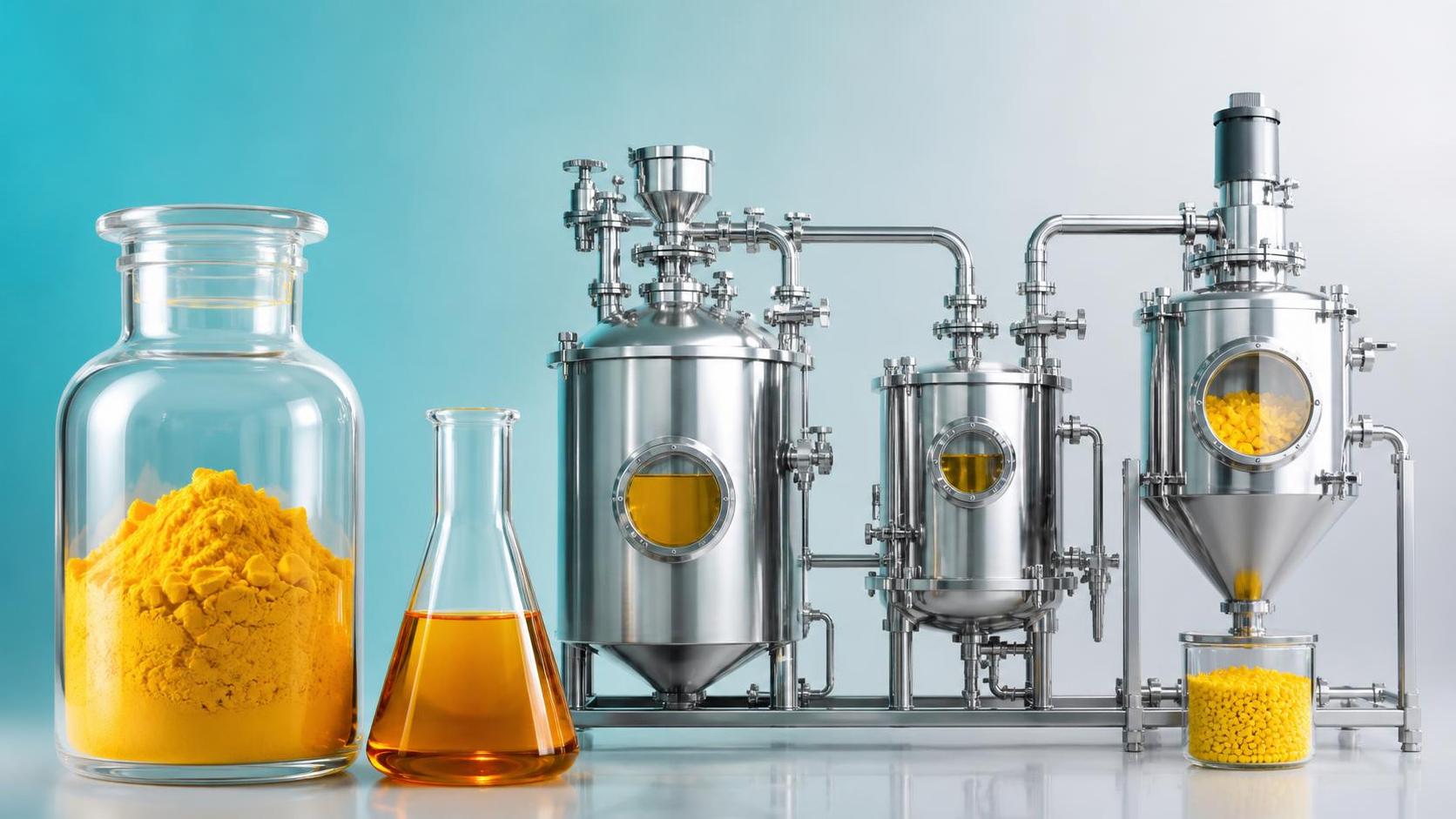
[图片占位符1:对比不同 Curcumin extraction methods 的工艺流程图,展示溶剂提取、纯化和结晶关键节点,alt="Curcumin extraction methods process comparison for purity and stability evaluation"]
Alkaline extraction and precipitation: useful, but not automatically cleaner
Some processes use alkaline conditions to improve extraction efficiency or separation behavior. On paper, this can look efficient. In practice, it needs careful control because Curcumin is sensitive to pH and may degrade under unsuitable alkaline exposure.
This is one of those areas where inexperienced buyers sometimes overfocus on yield. A process that pulls more target material from the raw feed is not necessarily producing a better final grade. If degradation products increase or the final color profile shifts, your apparent gain in extraction efficiency may be offset by poorer stability and more difficult standardization.
Alkaline-assisted methods may have a place in specific production systems, but they are not usually the first choice when the evaluation priority is long-term stability under commercial storage.
Supercritical CO2 extraction: attractive profile, but not a universal answer
Supercritical CO2 is often discussed because it avoids some of the drawbacks associated with conventional organic solvents. It can support cleaner extraction environments and may be useful where solvent residue concerns are especially sensitive.
That said, technical teams should be careful not to idealize it. Supercritical extraction is highly dependent on parameter control, co-solvent strategy, feed preparation, and what exactly the producer is trying to isolate. In turmeric-derived systems, this method can be effective for certain fractions, but it does not magically solve every purity problem. You still need purification logic after extraction.
There is also a commercial reality. A sophisticated extraction platform does not always translate into better lot-to-lot supply reliability, especially if the process is less established at the supplier’s actual operating scale. For many buyers, consistency beats novelty.
Where purity is really won: purification, crystallization, and drying
This is the part many searchers underestimate. The extraction step opens the door, but purification determines whether Curcumin reaches a usable specification.
Recrystallization is often the turning point for higher-purity material. A well-controlled crystallization step can reduce non-target fractions, improve appearance, and create a more predictable physical form. Drying conditions matter too. Excessive heat or poor protection from oxygen and light can compromise a product that was otherwise extracted correctly.
If you are reviewing suppliers, ask for detail on these points rather than stopping at the extraction label:
- What solvents are used in extraction and in purification?
- Is recrystallization part of the standard process?
- How is residual solvent verified?
- How is the material protected from light and oxidation during finishing?
- Are assay and moisture trends stable across multiple batches?
Those answers usually tell you more than a simple claim like “advanced Curcumin extraction technology.”
Purity and stability are related, but they are not the same thing
A Curcumin sample can have a strong purity number and still be weak in storage. Stability depends on more than assay. Light sensitivity, oxygen exposure, residual moisture, metal traces, packaging choice, and particle form all matter.
In real applications, instability often shows up as color drift, odor change, reduced dispersibility, or assay decline over time. This matters especially for buyers who need repeatable use in food processing, premix systems, or specialty formulations.
One practical way to judge stability is to ask whether the supplier can discuss packaging and handling with the same confidence as they discuss extraction. A producer that understands Curcumin well should be able to explain storage recommendations, likely stress points, and which applications need tighter protection.
That broader supply capability is often more valuable than a single impressive technical claim. Companies serving multiple compliant chemical categories tend to understand this better because they work across food additives, organic intermediates, and other application-driven supply chains. Luxi Chemical (Shandong) Co., Ltd., for example, operates as a comprehensive chemical enterprise with export experience across more than 60 countries and regions, which is relevant when buyers need not just a product, but stable documentation, coordination, and consistent supply handling.
How technical evaluators should compare Curcumin suppliers
If the goal is a dependable grade rather than a one-time sample pass, compare suppliers using a process-minded checklist:
- Ask for the extraction route, but also the purification route.
- Review COA patterns across batches instead of one isolated document.
- Confirm whether the grade is intended for food, industrial, or other specific use.
- Check residual solvent control and moisture control.
- Ask how the material is packed for light and oxidation protection.
- Verify whether storage and transport conditions were considered in the specification window.
For formulators working on broader ingredient systems, this matters beyond Curcumin itself. In some cases, a project may involve multiple supporting raw materials or excipients sourced through one supplier network. That is where one-stop procurement can save time, provided the supplier stays disciplined on documentation and grade matching. A related example is D-Mannitol CAS#69-65-8, which may appear in formulation or processing discussions depending on the application, even though it serves a very different role from Curcumin.
Which Curcumin process usually delivers better purity and stability?
If you need a direct judgment, here it is: Curcumin grades with better purity and stability usually come from a balanced process built around controlled solvent extraction or another suitable extraction route, followed by strong purification, careful crystallization, and disciplined drying and packaging. Extraction technology alone rarely decides the winner.
For routine industrial supply, conventional solvent-based processes with well-managed refinement often outperform “advanced” methods that are less mature in production control. For applications with stricter solvent sensitivity or branding around cleaner processing, supercritical approaches may be worth reviewing, but only if the supplier can prove batch consistency and finishing quality.
In other words, choose the process family based on the final specification you need, not on the prestige of the equipment.
Common evaluation mistakes
One is treating Curcumin purity as a single-number decision. Another is assuming that a higher extraction yield means a better commercial product. A third is ignoring how sensitive Curcumin can be to post-process handling.
There is also a documentation mistake that shows up often: buyers request assay and appearance, but skip questions about storage stability, impurity control logic, or packaging barrier performance. That can lead to trouble later, especially when scale-up batches behave differently from lab-approved samples.
If you are still early in evaluation, start with your end use. Decide first whether you need standardized color performance, high assay, low residual solvent exposure, or broader cost efficiency. Then work backward into the process. That is a much cleaner way to compare Curcumin options.
FAQ
Is solvent-extracted Curcumin automatically lower quality?
No. Solvent extraction can deliver strong commercial quality when purification, solvent removal, and crystallization are properly controlled.
Does higher Curcumin purity always mean better stability?
Not always. Stability also depends on moisture, oxidation control, light protection, and packaging conditions.
Should I prefer supercritical CO2 extraction for food-related applications?
Only if the full quality profile supports your requirement. The extraction method alone is not enough to judge suitability.
What is the first document to ask from a supplier?
Start with a recent COA and then ask how that result holds across multiple batches. One strong batch does not prove a stable process.
Closing thought on Curcumin selection
When technical teams compare Curcumin extraction methods, the most reliable decision usually comes from looking past the headline process and into the control points that shape the final material. Better Curcumin purity and stability are usually the result of disciplined extraction plus equally disciplined purification and handling. If a supplier can explain that full chain clearly, you are already looking at a stronger candidate.
Image Placeholder List
- Position suggestion: After the section on conventional solvent extraction and before the comparison of advanced methods; Content: a process flow comparison chart for major Curcumin extraction methods with purification and crystallization steps; Alt text: "Curcumin extraction methods process comparison for purity and stability evaluation"
Internal Link Anchor Text Suggestions
- Curcumin quality evaluation criteria: technical standard or product guide page
- Food additive raw material sourcing: category page or procurement guide
- Residual solvent control in plant extracts: technical blog or knowledge base page
- How to assess batch-to-batch chemical consistency: supplier evaluation article
- Organic intermediates and specialty chemical supply: product category page
External Authority Source Suggestions
- Pharmacopoeia or food additive standard references relevant to curcuminoids and residual solvent limits
- Peer-reviewed academic research on Curcumin extraction, degradation behavior, and stability
- Government or regulatory agency pages covering permitted solvents, food ingredient compliance, or import quality requirements
Related Picks
 Butylated Hydroxytoluene Price Drivers: Supply, Purity, and Purchasing Risk FactorsOct 21, 2026Butylated Hydroxytoluene price trends depend on supply stability, purity, logistics, and purchasing risk. Learn how to compare quotes wisely and reduce sourcing costs.
 Sodium Tripolyphosphate Price Trends: Raw Material and Energy ExposureOct 20, 2026Explore sodium tripolyphosphate price trends, from phosphate and soda ash costs to energy exposure. Learn how to compare quotes, manage sourcing risks, and make smarter purchasing decisions.
 Acetonitrile Shipment to Vietnam Successfully Dispatched; RCEP Benefits Boost Fine Chemical Trade with ASEANSep 16, 2026A shipment of industrial-grade acetonitrile from our company has recently been loaded and dispatched following the completion of standardized hazardous material packaging and container securing procedures.
 Nigerian Client’s Order of 4 Containers of Vinyl Acetate Successfully Loaded and Shipped to West AfricaSep 16, 2026We recently completed the loading of a vinyl acetate order for a Nigerian client; four containers of the product have been successfully packed and are ready for shipment to Nigeria.




Question Consultation
Send Us Your Inquiry Today

Luxi Chemical is a professional chemical product supplier with ample stock of all chemical categories and excellent quality, welcome your purchase inquiry.

