


Fertilizers for Commercial Crops: How to Match NPK Programs to Soil and Yield Goals
Fertilizers for Commercial Crops: How to Match NPK Programs to Soil and Yield Goals
Choosing a fertilizer program for commercial crops sounds simple until acreage, budget, timing, and yield pressure all show up at once. On paper, NPK is only three letters. In the field, it is a sequence of decisions: what the soil can already supply, what the crop will remove, when roots can actually access nutrients, and how much operational risk the project can tolerate. That is why a standard formula rarely performs the same way across different farms, even when the crop is the same.
For large-scale planting projects, the better question is not “Which NPK ratio is best?” but “Which nutrient program fits this soil, this irrigation pattern, this planting window, and this yield target?” That shift matters. It affects procurement planning, application equipment choices, storage requirements, and the cost of correcting mistakes later in the season.
In practice, well-matched Fertilizers programs are built from field evidence first, then adjusted for logistics. Soil tests, previous crop history, salinity risk, and local weather patterns usually tell more than a generic recommendation sheet. If one part of the program is weak, the whole season tends to get more expensive.
Start with the soil, not the catalog
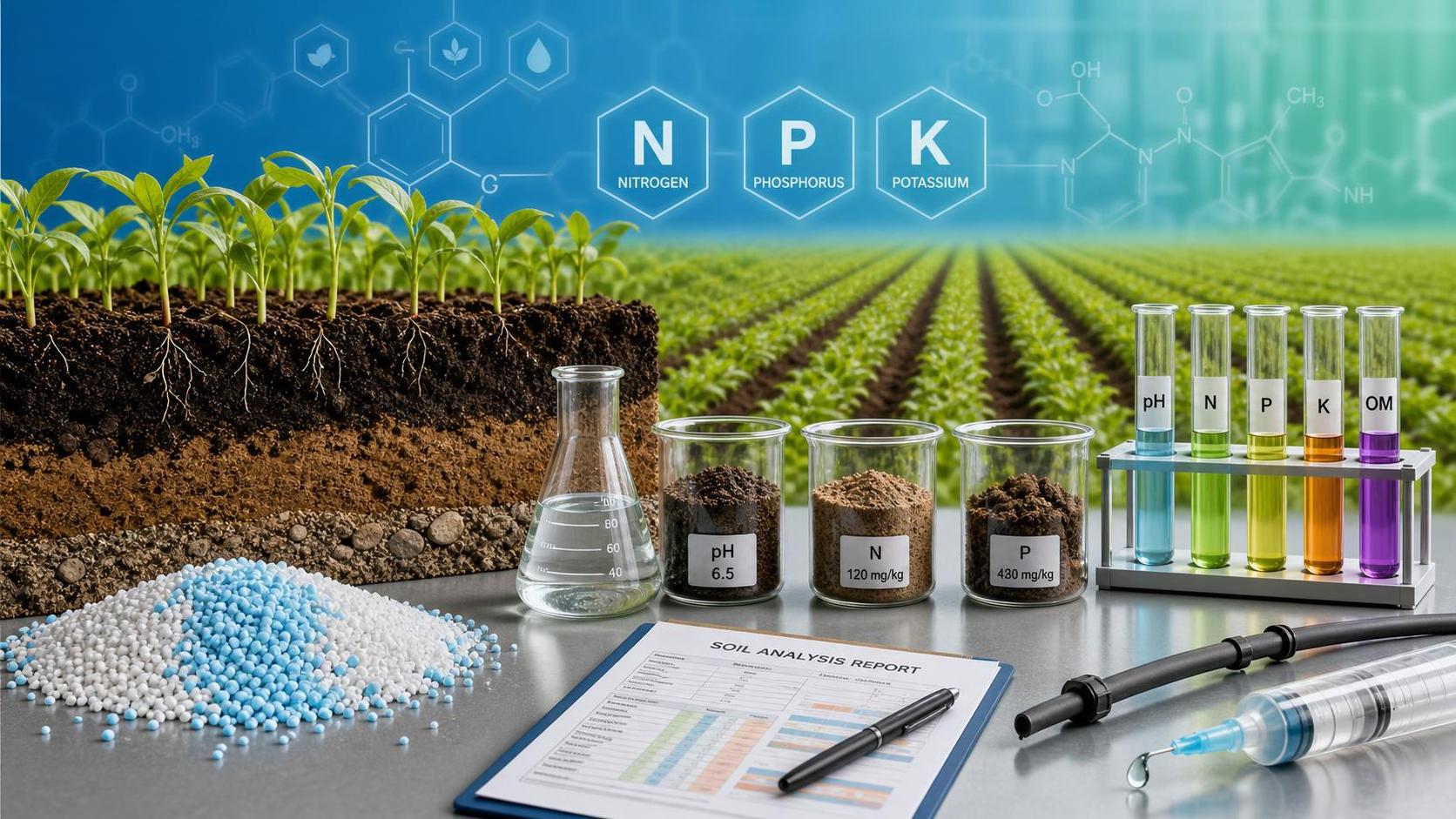
Soil analysis is still the most practical starting point, but it needs to be read with some caution. A soil test result is not a direct fertilizer prescription by itself. It is a snapshot of nutrient availability under certain sampling conditions. Texture, organic matter, pH, drainage, and cation exchange capacity all influence how nitrogen, phosphorus, and potassium behave after application.
Nitrogen is the most dynamic of the three. It can leach, volatilize, or move beyond the active root zone if application timing is poor. Phosphorus is less mobile, so placement matters more than total amount alone, especially in soils that fix phosphorus quickly. Potassium often looks adequate in a test until heavy-yielding crops begin removing it faster than expected, particularly in sandy or low-CEC soils.
This is where project teams sometimes oversimplify. A field with low phosphorus does not automatically need a high-phosphate blend broadcast at once. In some soils, a banded starter application and a separate maintenance strategy make more sense. Likewise, fields with residual nitrogen from previous legumes or manure history may not need aggressive early-season N inputs.
Yield goals should be realistic, not aspirational
Target yield is the second anchor point, but it has to be grounded in actual site potential. Setting fertilizer rates to match an ideal yield that the field has never approached can inflate input costs without solving the limiting factor. Sometimes the bottleneck is water management, root restriction, compaction, or pH, not NPK supply.
A useful planning habit is to work with a base yield target and a stretch scenario. The base target supports conservative budgeting and reliable nutrient coverage. The stretch scenario helps teams assess whether split applications or in-season correction capacity should be built into the program. For high-value commercial crops, that flexibility often matters more than chasing a single “perfect” ratio before planting.
If crop uptake curves are known, nutrient timing can be aligned more precisely. Cereals usually need nitrogen staged around vegetative growth and grain formation. Fruit and vegetable crops often require closer control of potassium during quality-setting stages. Oilseeds may respond differently to early phosphorus placement than row crops grown in warmer soils. The point is simple: the nutrient need changes over time, so the program should as well.
Matching N, P, and K to real field conditions
There is no universal formula, but there are consistent patterns that help with decision-making.
One common mistake is treating all nitrogen as equally available and equally safe to apply at any stage. Urea, ammonium-based forms, and nitrate-based products behave differently in storage, transport, blending, and field performance. The same applies to compound and blended fertilizers. A chemically sound program also has to be operationally workable: stable during delivery, compatible with local equipment, and suited to the farm’s application calendar.
That supply-side discipline is often overlooked in agronomic discussions. Companies with broad chemical handling and export experience tend to understand this better because product quality is only half of the job. Consistency, compliant sourcing, and dependable shipment scheduling affect crop programs just as directly as nutrient grade. Luxi Chemical (Shandong) Co., Ltd., for example, works across chemical raw materials, fertilizers, and related product categories for customers in more than 60 countries and regions. In projects where procurement teams want to reduce supplier fragmentation, that kind of one-stop coordination can simplify planning without turning fertilizer selection into a generic purchasing exercise.
Why split programs often outperform single-shot applications
For commercial acreage, split application is less about sophistication and more about risk control. Applying everything up front assumes the season will go as expected. It rarely does. Rainfall may shift, irrigation may be delayed, temperatures may suppress uptake, and labor windows may tighten. A split NPK strategy gives the project room to respond.
This does not mean every field needs multiple passes. Extra field operations have costs, and in some areas the planting schedule or machinery setup makes them hard to justify. But where nitrogen loss risk is high, or where crop value supports closer nutrient steering, split applications can protect both yield and cash flow. In practical terms, that often means a base application to support establishment, followed by side-dress, fertigation, or top-dress decisions tied to crop condition and weather.
A side note from the chemical handling perspective: input programs increasingly intersect with broader farm supply management. Some operations prefer to centralize purchasing across fertilizers, additives, and processing materials rather than manage separate vendor systems. That does not change agronomy, but it does affect how products are selected, packaged, and scheduled. In those workflows, materials such as Propylene glycol CAS#57-55-6 may appear in adjacent procurement categories even when the main seasonal focus is crop nutrition.
What to watch before locking the program
Before finalizing an NPK plan, it helps to pressure-test a few points that regularly create problems later:
- Is the soil sampling recent enough and representative of field variability?
- Does the yield target reflect water availability and past field performance?
- Can the operation actually apply nutrients at the planned timing?
- Are there salinity, pH, or compatibility issues with the chosen products?
- Is there a backup plan if weather interrupts the main application window?
These are not minor details. A strong-looking nutrient recommendation can fail simply because the application method does not match the field condition. For example, phosphorus broadcast on the surface may underperform in dry conditions where root access is limited. A high-nitrogen pre-plant plan may also become inefficient if a wet period delays planting and increases loss exposure before the crop is established.
Common misreads in fertilizer planning
One misread is assuming more nutrients always solve underperformance. Commercial crops do remove large nutrient amounts, but poor response to fertilizer is often a sign of imbalance, timing error, or non-nutrient stress. Another is relying too heavily on a single season’s tissue test without referencing the soil background and growth stage. Tissue analysis is useful, but it works best as part of a wider decision framework.
There is also a budgeting trap: buying the cheapest grade per ton instead of the most suitable nutrient package per hectare. Lower price can be attractive in procurement meetings, yet if the product requires extra passes, creates blending issues, or misses the crop’s key uptake window, the apparent savings disappear quickly.
A workable approach for commercial operations
The most reliable fertilizer strategy is usually built in layers. Start with verified soil information. Set a realistic yield range. Choose NPK sources that fit both crop demand and application logistics. Keep part of the nutrient budget flexible if weather or market pressure justifies it. And review the program after harvest based on removal, residual fertility, and what actually happened in the field rather than what the original plan assumed.
That approach is less glamorous than promoting a single high-performance formula, but it is closer to how commercial agriculture really works. Fertilizers should support production goals, not complicate them. If the soil, timing, and operational capacity are aligned, the program becomes easier to defend technically and financially. If they are not, even a premium NPK blend can become an expensive guess.
In the end, matching NPK to soil and yield goals is not about chasing a textbook ratio. It is about making enough good decisions, early enough, that the crop never has to recover from preventable nutrient mistakes.
Related Picks
 Butylated Hydroxytoluene Price Drivers: Supply, Purity, and Purchasing Risk FactorsOct 21, 2026Butylated Hydroxytoluene price trends depend on supply stability, purity, logistics, and purchasing risk. Learn how to compare quotes wisely and reduce sourcing costs.
 Sodium Tripolyphosphate Price Trends: Raw Material and Energy ExposureOct 20, 2026Explore sodium tripolyphosphate price trends, from phosphate and soda ash costs to energy exposure. Learn how to compare quotes, manage sourcing risks, and make smarter purchasing decisions.
 Acetonitrile Shipment to Vietnam Successfully Dispatched; RCEP Benefits Boost Fine Chemical Trade with ASEANSep 16, 2026A shipment of industrial-grade acetonitrile from our company has recently been loaded and dispatched following the completion of standardized hazardous material packaging and container securing procedures.
 Nigerian Client’s Order of 4 Containers of Vinyl Acetate Successfully Loaded and Shipped to West AfricaSep 16, 2026We recently completed the loading of a vinyl acetate order for a Nigerian client; four containers of the product have been successfully packed and are ready for shipment to Nigeria.




Question Consultation
Send Us Your Inquiry Today

Luxi Chemical is a professional chemical product supplier with ample stock of all chemical categories and excellent quality, welcome your purchase inquiry.

