


Fertilizer Blending Compatibility: Preventing Caking, Segregation, and Nutrient Loss
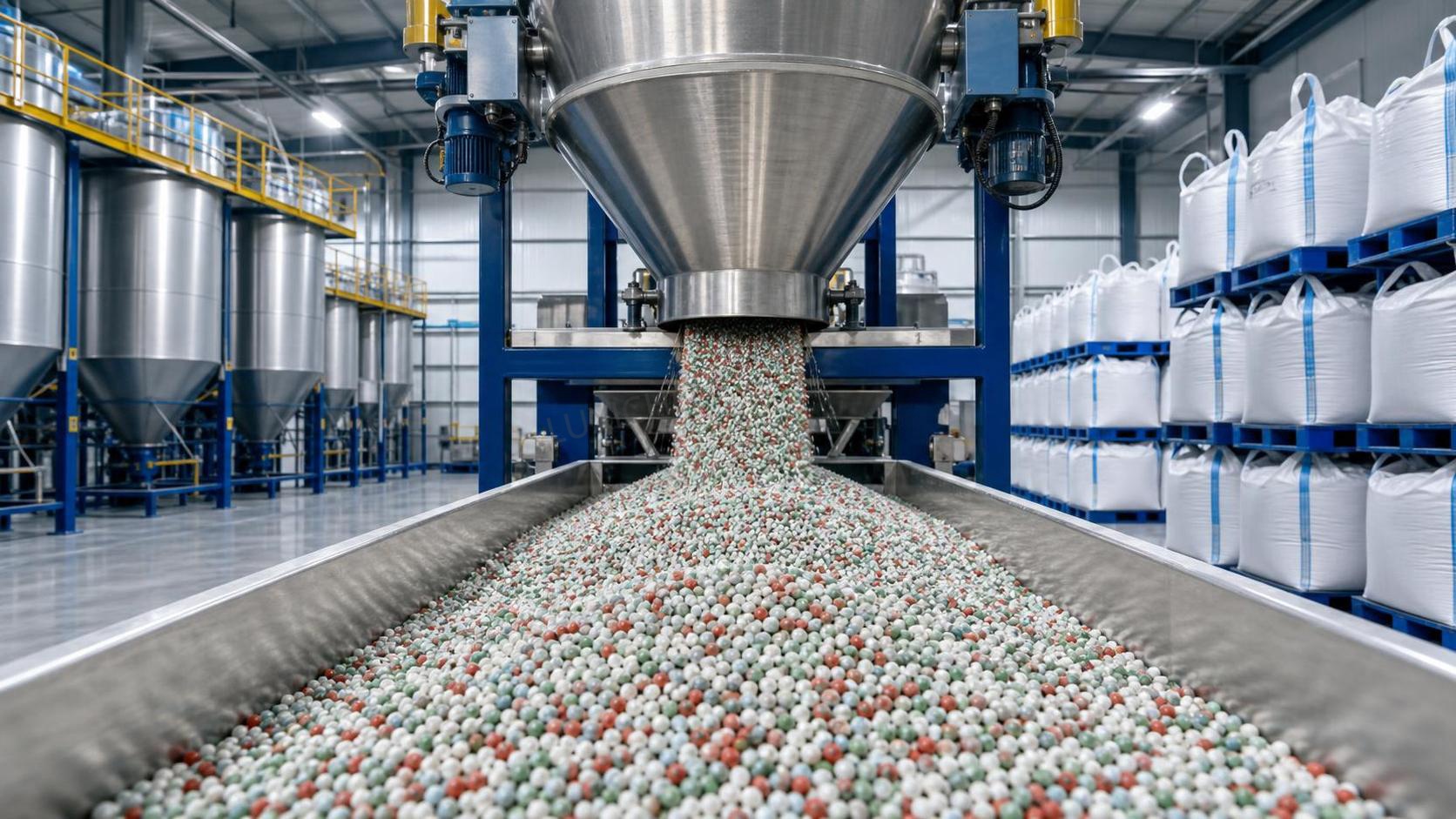
Fertilizer blends fail long before they reach the field when the physical and chemical behavior of the ingredients has not been considered. A blend may leave the mixer looking uniform, then harden in the warehouse, separate during transport, or deliver an uneven nutrient ratio through the spreader. For operators, these are not cosmetic defects. They affect application accuracy, rework, storage losses, customer complaints, and crop nutrient performance.
The practical starting point is simple: do not judge compatibility only by the nutrient analysis printed on each raw material. A workable blend must remain free-flowing, physically uniform, and chemically stable for the full period between production and application. Moisture, particle-size distribution, surface condition, storage temperature, and contact between reactive materials often matter as much as N-P-K content.
Why fertilizer blends cake, separate, or lose quality
Caking, segregation, and nutrient loss are different problems, but they often begin with the same operating decisions. A wet or hygroscopic component can create liquid bridges between granules. Fine particles can fill the gaps between larger particles and settle during handling. Reactive ingredients can change the local pH, generate heat, release ammonia, or draw in moisture. Once these mechanisms are active, a blend that was acceptable at dispatch can become difficult to spread or impossible to dose accurately.
Operators should treat blend compatibility as a combined question:
- Will the ingredients remain dry enough to flow?
- Will their particle sizes and densities remain sufficiently similar during conveying and spreading?
- Can the materials contact each other without a damaging chemical reaction?
- Can the blend tolerate the expected storage time, packaging, and climate?
A blend may pass one of these checks and still fail another. For example, two dry granular materials may have no major chemical incompatibility but segregate badly because one fraction contains much larger, denser particles. Conversely, materials with similar granule size may remain physically uniform but cake after absorbing moisture from humid air.
Moisture control is the first line of defense against caking
Many common fertilizer materials are hygroscopic to some degree. They absorb moisture from air, especially where product temperature falls below ambient conditions or where warehouse humidity fluctuates. That absorbed moisture can dissolve a small amount of salt at particle contact points. When the water later evaporates or redistributes, crystals form bridges between granules. The result is a hardened mass rather than a free-flowing blend.
The risk increases when hygroscopic ingredients are combined with materials that contribute free moisture, contain wet fines, or have damaged granule surfaces. It also rises when warm product is loaded into a cooler storage area, because condensation may form inside bulk bags, bins, or covered piles.
There is no universal moisture limit that makes every blend safe. The acceptable level depends on raw material chemistry, particle coating, packaging, storage duration, and local climate. What operators can control is the sequence of handling:
- Bring raw materials into the blend only after checking for wet lumps, excessive fines, damaged bags, or visible surface moisture.
- Keep storage areas dry, covered, and protected from direct contact with wet floors or walls.
- Avoid blending materials immediately after a temperature shift that may cause condensation.
- Limit the time that hygroscopic materials sit exposed in open hoppers, transfer points, or uncovered stockpiles.
- Use packaging and closures that match the anticipated storage and transport conditions.
Anti-caking agents can help, but they should not be used to compensate for uncontrolled moisture. A coating may improve flowability by reducing particle-to-particle contact and water uptake, yet it cannot reliably rescue product that has already absorbed substantial moisture or undergone a chemical reaction. The operator should first identify why caking occurs: raw material moisture, humidity exposure, hot spots in storage, excessive fines, or a problematic ingredient pair.
Particle size determines whether the field receives the intended analysis
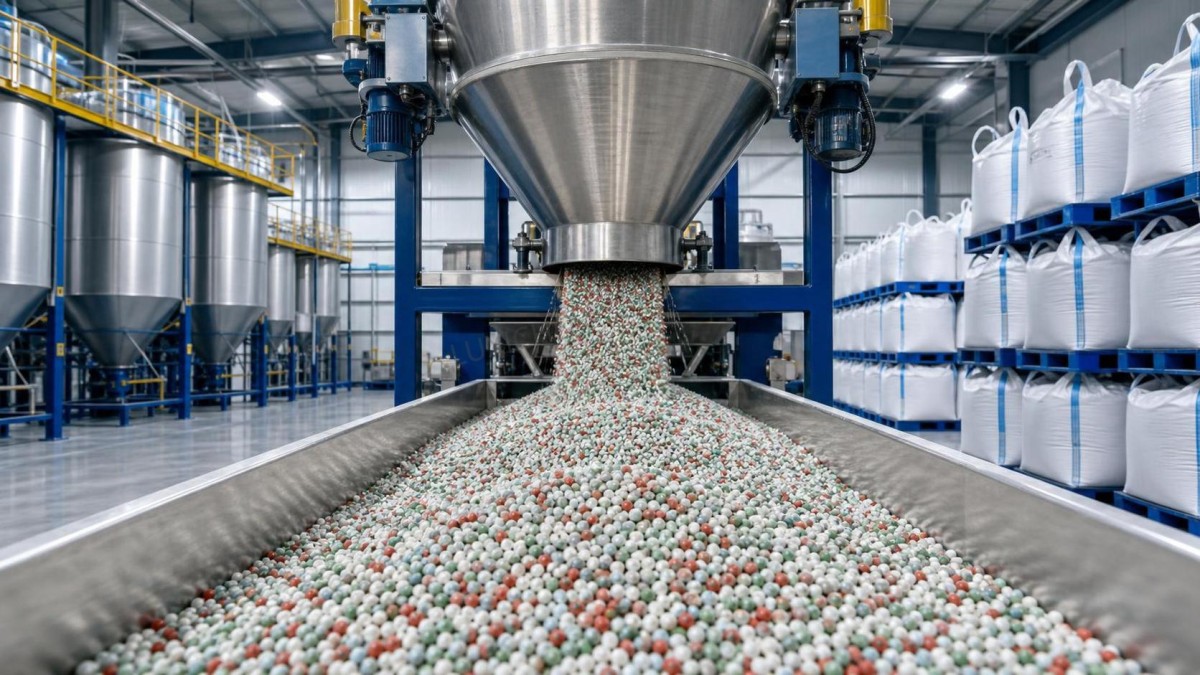
Segregation is often underestimated because a blend can look homogeneous in a sample scoop. During conveying, bag filling, unloading, truck movement, and spreader vibration, particles sort themselves by size, shape, and density. Smaller particles tend to move into voids between larger particles; rounded granules may roll farther than irregular particles; denser components can migrate differently under vibration.
The problem becomes visible at application. If one nutrient source accumulates at the bottom of a bag or hopper while another remains near the top, the first portion of the field may receive a different nutrient ratio from the last portion. A correct formula on paper then becomes an inconsistent field treatment.
Particle-size matching should therefore be part of raw material selection, not only a final quality inspection. The most stable dry blends generally use components with overlapping size ranges and similar physical form. A coarse granular material mixed with powder or a large proportion of fines is inherently difficult to keep uniform. Repeated transfers make the condition worse.
Before approving a formulation, compare more than average granule diameter. Ask for the full particle-size distribution, percentage of fines, bulk density, particle shape, and hardness. A material with the same nominal size can still behave differently if it fractures easily or contains a broad range of particle sizes.
Conveying design also matters. Long drops, abrupt directional changes, high-speed belts, and repeated transfers create more opportunities for particle separation and breakage. Where the formula is sensitive, minimize handling steps after blending and use sampling points that reflect the actual filled package or loaded vehicle, not only the mixer discharge.
Chemical compatibility must be checked before materials enter the mixer
Some fertilizer components can coexist in a dry blend for a limited time but become unsuitable once moisture is present. Others react more directly, causing nutrient loss, odor, hardening, or unstable material properties. The chemical risk is especially important when nitrogen sources, alkaline materials, acidic phosphates, micronutrients, chlorides, sulfates, or organic additives are combined.
A common example is the potential for ammonia loss when ammonium-containing materials come into contact with strongly alkaline substances under moist conditions. The blend may develop an ammonia odor, lose nitrogen value, and create a more difficult working environment. The severity depends on the materials involved, their moisture, temperature, and storage time. This is why an operator should not assume that “dry blending” automatically prevents nutrient loss.
Acid-base interactions can also alter surface conditions and promote caking. Some combinations may remain manageable for prompt application but are poor choices for warehousing or export transit. In those cases, the correct decision may be to keep ingredients separate until close to application, change one nutrient source, or supply the product through a different formulation route.
Micronutrients deserve the same attention. Their low inclusion rate can make them easy to overlook, but their chemical form and particle size strongly affect distribution. A fine micronutrient powder added directly to a granular blend may not distribute evenly unless it is properly conditioned, coated onto a carrier, or incorporated through a suitable granulation process. A blend can meet its calculated analysis while still delivering uneven micronutrient placement across the field.
Use a compatibility review that reflects the real storage window
Compatibility should be assessed for the actual operating scenario, not an idealized short-contact test. A material pair may appear stable after mixing and still fail after several days in humid storage or after transport through changing temperatures. The review should consider how long the blend will remain in inventory, whether it will travel in bulk or bags, the expected climate, and whether the customer will apply it promptly.
For new formulations, retain representative samples in packaging comparable to the planned commercial pack. Inspect them after a realistic storage interval for hardening, moisture pickup, odor, discoloration, free-flow behavior, and visible separation. This type of retained-sample check does not replace formal analytical testing where required, but it reveals handling failures that a nutrient assay alone may miss.
Storage conditions can undo good blending practice
Even a well-designed blend can deteriorate in poor storage. Bags placed directly on a damp floor, exposed to rain intrusion, stacked against condensation-prone walls, or left in direct heat can develop localized caking. Bulk storage carries similar risks when pile turnover is poor and temperature differences create wet zones.
Operators should keep inventory rotation disciplined. Long storage periods increase the chance that moisture migration, compaction, and chemical interaction will become visible. First-in, first-out handling reduces that exposure, but it is only effective when lots are clearly identified and older product is physically accessible for dispatch.
Stacking height should also reflect product strength and packaging performance. Excessive compression can turn minor caking tendency into a serious unloading problem, particularly for lower-strength granules or blends containing moisture-sensitive salts. If product must be stored for longer periods, a conservative approach is to verify flowability before dispatch rather than assuming the original production result still represents the condition in the package.
What to check when a blend begins to fail
When caking or segregation appears, avoid treating every issue as a mixing-time problem. The failure may have started before production or after packaging. A structured check usually finds the cause faster than adding more anti-caking agent or increasing mixer time.
- Check incoming materials: Compare moisture condition, particle-size range, fines content, temperature, and lot-to-lot appearance against the approved specification.
- Inspect the sequence: Determine whether one material was added while warm, wet, or after excessive residence time in a hopper.
- Review transfer points: Look for long drops, abrasive handling, blocked chutes, and locations where fines accumulate.
- Examine packaging and storage: Check for condensation, damaged liners, poor sealing, floor moisture, roof leaks, and prolonged storage.
- Sample by location: Take samples from the top, middle, and bottom of bags, bins, or bulk loads to identify segregation rather than relying on a single composite sample.
For nutrient loss concerns, focus first on odor, unusual heat, moisture increase, visible surface change, and the specific materials that were in direct contact. These observations can narrow the problem to a chemical incompatibility, environmental exposure, or physical breakdown. Changing multiple variables at once makes the root cause harder to identify.
Build the formulation around handling reality
The most reliable fertilizer blend is usually the one designed for the conditions it will actually face: local humidity, available storage, transport distance, package type, spreading equipment, and expected time to field application. A formula that is technically possible in a mixer may still be unsuitable for a distribution chain that includes repeated loading, warehouse storage, and uneven application equipment.
For operators, the practical discipline is to qualify raw materials by both nutrient value and handling behavior, keep particle-size ranges aligned, control moisture before and after blending, and treat reactive combinations cautiously when storage is unavoidable. Those measures reduce caking, limit segregation, and help ensure that the nutrient analysis sold is the nutrient distribution delivered in the field.
Related Picks
 Butylated Hydroxytoluene Price Drivers: Supply, Purity, and Purchasing Risk FactorsOct 21, 2026Butylated Hydroxytoluene price trends depend on supply stability, purity, logistics, and purchasing risk. Learn how to compare quotes wisely and reduce sourcing costs.
 Sodium Tripolyphosphate Price Trends: Raw Material and Energy ExposureOct 20, 2026Explore sodium tripolyphosphate price trends, from phosphate and soda ash costs to energy exposure. Learn how to compare quotes, manage sourcing risks, and make smarter purchasing decisions.
 Acetonitrile Shipment to Vietnam Successfully Dispatched; RCEP Benefits Boost Fine Chemical Trade with ASEANSep 16, 2026A shipment of industrial-grade acetonitrile from our company has recently been loaded and dispatched following the completion of standardized hazardous material packaging and container securing procedures.
 Nigerian Client’s Order of 4 Containers of Vinyl Acetate Successfully Loaded and Shipped to West AfricaSep 16, 2026We recently completed the loading of a vinyl acetate order for a Nigerian client; four containers of the product have been successfully packed and are ready for shipment to Nigeria.




Question Consultation
Send Us Your Inquiry Today

Luxi Chemical is a professional chemical product supplier with ample stock of all chemical categories and excellent quality, welcome your purchase inquiry.

