


Food Additives Supplier Evaluation: How to Balance Compliance, Cost, and Supply Stability
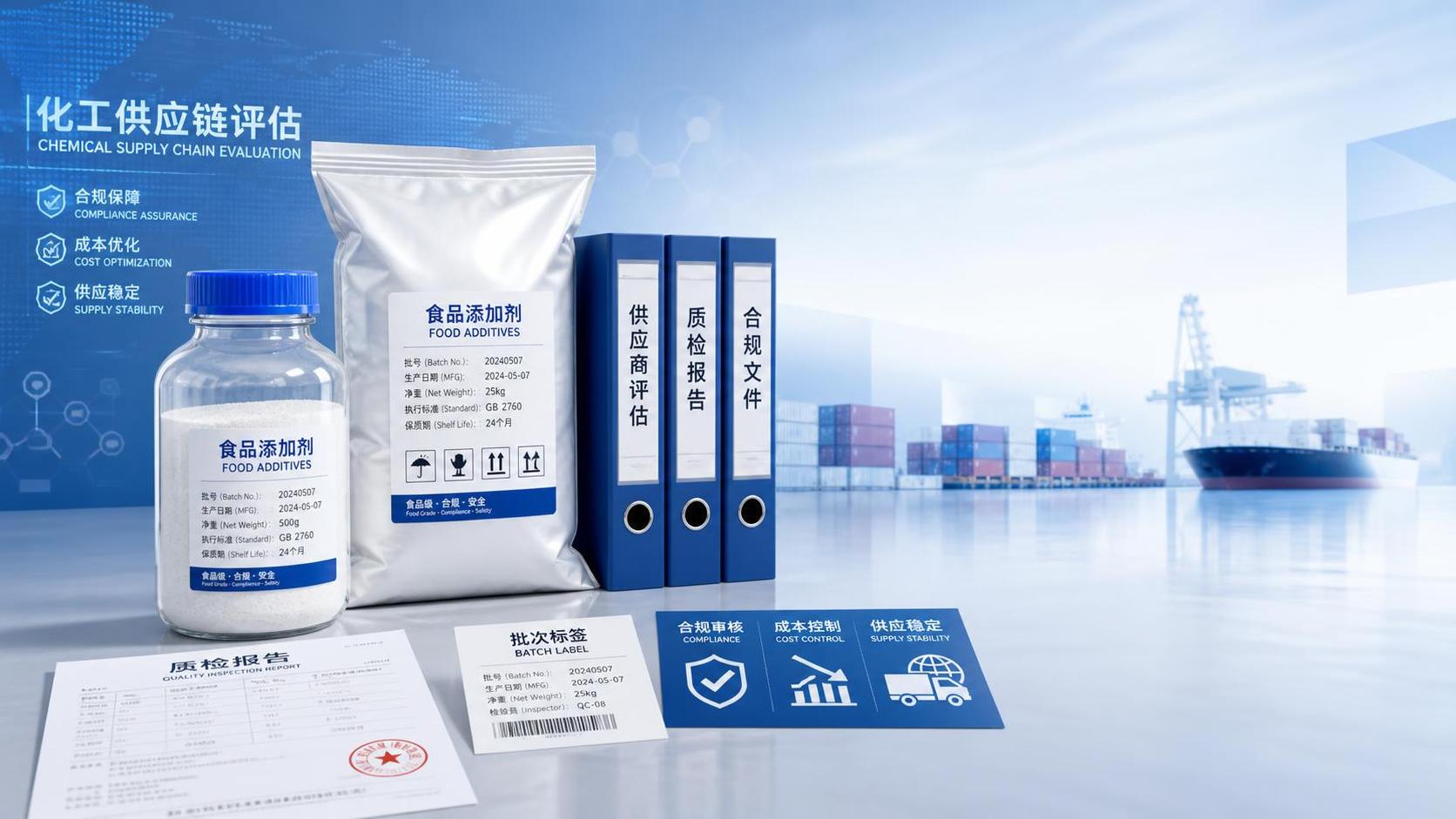
Choosing the right Food Additives supplier is no longer just about price. For procurement professionals, the real challenge is balancing regulatory compliance, total sourcing cost, and long-term supply stability in a fast-changing global market. A qualified supplier should deliver consistent quality, reliable documentation, and flexible service that supports efficient purchasing while reducing operational risk and procurement pressure.
That shift matters because procurement teams are now being judged on more than annual savings. A low quote can quickly become expensive if it leads to customs delays, failed audits, inconsistent batches, reformulation work, or urgent spot buying when supply is interrupted. In Food Additives sourcing, the supplier decision increasingly sits at the intersection of quality assurance, regulatory review, logistics planning, and cost control.
Why Food Additives supplier evaluation has become more complex
In the past, many buyers could separate sourcing into simple layers: approved specification, target price, shipping lead time. That approach is harder to sustain today. Food manufacturing customers are under tighter scrutiny from regulators, retailers, and end consumers. Ingredient traceability expectations are rising. Documentation requirements differ across destinations. Ocean freight volatility, port disruption, and regional policy shifts can affect even standard products.
For procurement, this means supplier evaluation is no longer a one-time qualification exercise. It is an ongoing risk assessment. A supplier may look competitive on unit price but still create hidden costs through incomplete dossiers, unstable raw material sourcing, poor lot consistency, or weak export execution.
The practical question is not “Who offers the cheapest Food Additives?” but “Which supplier can meet my compliance obligations, protect my production schedule, and keep my landed cost under control over the next 12 to 24 months?”
Compliance is the first filter, not a later checkpoint
Many purchasing problems begin when compliance review happens too late. Buyers shortlist suppliers based on quotation, then discover missing documents, non-aligned specifications, or market-specific restrictions after samples have been approved. At that point, time is lost and negotiating leverage is weaker.
A more effective process is to treat compliance as the first commercial filter. For Food Additives, procurement should verify at least four areas early:
- Whether the product is permitted in the target market and intended application
- Whether product specifications align with the required standard or customer-defined criteria
- Whether the supplier can provide complete and current documentation
- Whether manufacturing and quality systems can support traceability and batch consistency
Documentation is often where weaker suppliers are exposed. Depending on destination and use case, buyers may need specification sheets, certificate of analysis, allergen statements, GMO statements, heavy metal data, residual solvent information, origin declarations, packaging details, and in some cases third-party certifications. The exact list varies by country and product, so procurement teams should avoid assuming that “standard export documents” are sufficient.
There is also a common mistake in relying too heavily on a certificate name without checking scope and relevance. A supplier may hold a quality management certificate, but that does not automatically prove that every product line, production site, or outsourced stage meets the buyer’s actual requirement. For high-volume or sensitive ingredients, document review should be paired with a structured supplier questionnaire and, where justified, an audit or third-party verification.
Low price is rarely the same as low procurement cost
Experienced buyers usually know this in theory, but it is still easy for internal decision-making to revert to headline price comparisons. In Food Additives sourcing, the more useful metric is total sourcing cost. That includes:
- Unit price
- Freight and inland transport
- Import duties and customs handling
- Sampling and testing cost
- Cost of quality deviations and claims
- Inventory carrying cost due to long lead times
- Administrative cost of documentation correction and follow-up
- Emergency sourcing cost if supply fails
A supplier with a slightly higher ex-works or FOB price may still be cheaper over a full procurement cycle if they provide stable lead times, faster document turnaround, lower rejection rates, and more efficient consolidation options. This is especially true for buyers managing multiple additive categories and trying to reduce supplier fragmentation.
For example, companies that can source several compliant chemical categories through one established export partner may reduce internal coordination cost. A broader supplier portfolio does not guarantee stronger execution, but in practice it can simplify purchasing when the supplier has mature product management, documentation discipline, and international trade experience. That is often more valuable than a narrow quotation advantage on a single line item.
How to assess supply stability beyond capacity claims
Supply stability is one of the most misunderstood parts of supplier qualification. Nearly every supplier claims “stable supply,” but procurement teams need to test what that phrase actually means.
Useful questions include:
- Is the supplier a manufacturer, trader, or hybrid model?
- For traders, how diversified is the upstream supplier network?
- For manufacturers, what are the critical raw materials and how exposed are they to price swings or policy control?
- What is the supplier’s normal production cycle and order scheduling method?
- Can they support both forecast-based contracts and urgent replenishment?
- What percentage of output is committed to long-term customers?
- How do they handle force majeure, energy restrictions, or transport disruption?
Capacity alone is not enough. A plant may have sufficient nameplate output but poor reliability due to upstream constraints, environmental controls, seasonal shutdowns, or dependence on a limited raw material base. In chemical and additive-related supply chains, local policy changes can also affect operating rates with little notice. Buyers who source from one country or region only because it is currently cost-advantaged may be underestimating concentration risk.
One practical way to evaluate stability is to ask for recent shipment performance over a defined period, such as on-time delivery trends, typical lead-time range, and examples of how disruptions were handled. Reliable suppliers usually answer concretely. Weak suppliers often respond with general assurances.
Supplier type matters: manufacturer, distributor, or integrated exporter
Procurement teams sometimes default to “buy direct from manufacturer” as the best option. In reality, the right model depends on order structure, compliance burden, and internal purchasing capacity.
A direct manufacturer may offer stronger pricing and process visibility for high-volume, single-product sourcing. But if the buyer needs multiple additives or adjacent chemical categories, the operational burden can increase sharply: more vendor onboarding, more shipment coordination, more document follow-up, and more exposure to uneven service levels.
An integrated exporter or specialized distributor can make sense when procurement is trying to balance portfolio breadth, shipment consolidation, and cross-border execution. This is particularly relevant for buyers handling mixed orders across food processing, agriculture, or daily chemical inputs. A company with broader chemical trade experience may be better equipped to manage export documentation, packaging adaptation, and multi-category purchasing support. That kind of capability is not limited to food ingredients alone; many chemical suppliers build process discipline across product families, whether the item is a food-grade additive or an industrial intermediate such as Aniline CAS#62-53-3. The point for procurement is not the product overlap itself, but the supplier’s operating maturity in regulated, specification-driven trade.
The trade-off is that distributor and exporter models require closer verification of source control, batch traceability, and change management. Buyers should ask who actually manufactures the product, whether source changes are disclosed in advance, and how lot integrity is maintained from production to delivery.
Quality consistency is where hidden risk becomes visible
In Food Additives procurement, batch consistency often matters more than whether a sample initially passes. A supplier that produces acceptable first samples but struggles with long-run consistency creates downstream cost in blending, processing performance, shelf-life variation, and complaint handling.
Procurement should therefore work with QA and production teams to define which quality parameters are commercially critical, not just technically listed. These may include purity, moisture, particle size, color, odor, flowability, microbiological criteria, or packaging integrity, depending on the additive and application.
The deeper question is whether the supplier can control variation at production level, not simply issue a compliant COA. Areas worth reviewing include:
- Raw material qualification procedures
- In-process control methods
- Retention sample policy
- Deviation and corrective action process
- Change notification mechanism
- Complaint response timing and root cause analysis
For strategic suppliers, buyers should also clarify what happens when specifications are revised by the customer or affected by regulatory updates. A supplier that cannot manage controlled changes may become a long-term compliance risk.
Lead time, Incoterms, and packaging choices all affect cost
Procurement discussions often focus on product price while underestimating the commercial effect of logistics terms. Yet lead time and Incoterms can materially change working capital, stock coverage, and landed cost.
Longer production or shipping cycles may require higher safety stock. That ties up cash and warehouse space. If the supplier can offer flexible batch release, partial shipments, or predictable sailing schedules, the effective procurement cost can fall even when nominal freight rates do not.
Packaging also deserves more attention than it usually gets. For Food Additives, packaging quality affects not only product protection but also storage efficiency, contamination risk, discharge handling, and claim rates. Drums, bags, liners, pallets, labeling, and moisture protection should be aligned with route conditions and warehouse reality, not just supplier standard practice.
When comparing quotes, buyers should normalize commercial terms as much as possible. Price comparisons across EXW, FOB, CFR, and DDP structures can be misleading if service scope differs. A slightly higher quote that includes reliable export handling and lower documentation risk may be commercially stronger than a bare price that shifts complexity back to the buyer.
What strong procurement teams ask before approving a supplier
Good supplier evaluation is less about collecting the largest number of documents and more about asking the questions that reveal operating discipline.
- What are the top three causes of delayed shipments in the last year, and how were they resolved?
- How often do you update product documentation and regulatory declarations?
- What triggers customer notification for raw material, process, packaging, or source changes?
- Can you provide lot traceability from production to shipment?
- How do you manage urgent orders when production is fully booked?
- What is your claim handling timeline and escalation path?
- Can you support multi-product sourcing without compromising document accuracy?
These questions are useful because they move the discussion away from generic sales claims and toward repeatable business processes. Procurement decisions improve when buyers assess not just whether a supplier can deliver, but how they deliver under pressure.
Building a decision model that balances compliance, cost, and continuity
In practice, the best supplier is rarely the one with the highest score in only one category. Procurement teams need a weighted decision model that reflects actual business exposure. For Food Additives, that often means giving priority to compliance and supply continuity first, then evaluating total cost within the pool of qualified suppliers.
A workable approach is to segment purchases into three groups:
- Critical, high-volume additives that require deep qualification and dual-source planning
- Standard recurring items where total cost and service efficiency drive supplier choice
- Low-volume or specialty items where flexibility and documentation support may matter more than price
This segmented method is more practical than applying one approval standard to every item. It also helps procurement explain decisions internally when a lower-priced offer is not selected.
Where possible, buyers should avoid over-reliance on a single supplier or single origin for strategic materials. Even when current performance is strong, market conditions can change quickly. Diversification does not always mean splitting orders immediately; it can also mean keeping a qualified backup source warm, with updated documents and trialed logistics routes.
Suppliers that combine compliant product management, broad chemical trade capability, and stable export execution can be useful partners in that strategy. The benefit is not simply access to product range, but reduced procurement friction across sourcing, compliance coordination, and shipment management. That is often what procurement teams need most when they are expected to control cost without increasing risk.
In the end, supplier evaluation for Food Additives is a business continuity decision disguised as a purchasing task. Price still matters, but only after the supplier proves they can support regulatory compliance, quality consistency, and dependable delivery. Procurement teams that evaluate on those terms usually spend less time fighting exceptions, and more time building a sourcing base that remains workable when the market becomes less predictable.
Related Picks
 Butylated Hydroxytoluene Price Drivers: Supply, Purity, and Purchasing Risk FactorsOct 21, 2026Butylated Hydroxytoluene price trends depend on supply stability, purity, logistics, and purchasing risk. Learn how to compare quotes wisely and reduce sourcing costs.
 Sodium Tripolyphosphate Price Trends: Raw Material and Energy ExposureOct 20, 2026Explore sodium tripolyphosphate price trends, from phosphate and soda ash costs to energy exposure. Learn how to compare quotes, manage sourcing risks, and make smarter purchasing decisions.
 Acetonitrile Shipment to Vietnam Successfully Dispatched; RCEP Benefits Boost Fine Chemical Trade with ASEANSep 16, 2026A shipment of industrial-grade acetonitrile from our company has recently been loaded and dispatched following the completion of standardized hazardous material packaging and container securing procedures.
 Nigerian Client’s Order of 4 Containers of Vinyl Acetate Successfully Loaded and Shipped to West AfricaSep 16, 2026We recently completed the loading of a vinyl acetate order for a Nigerian client; four containers of the product have been successfully packed and are ready for shipment to Nigeria.




Question Consultation
Send Us Your Inquiry Today

Luxi Chemical is a professional chemical product supplier with ample stock of all chemical categories and excellent quality, welcome your purchase inquiry.

