


How Polypropylene Pellets Perform in Injection Molding and Extrusion
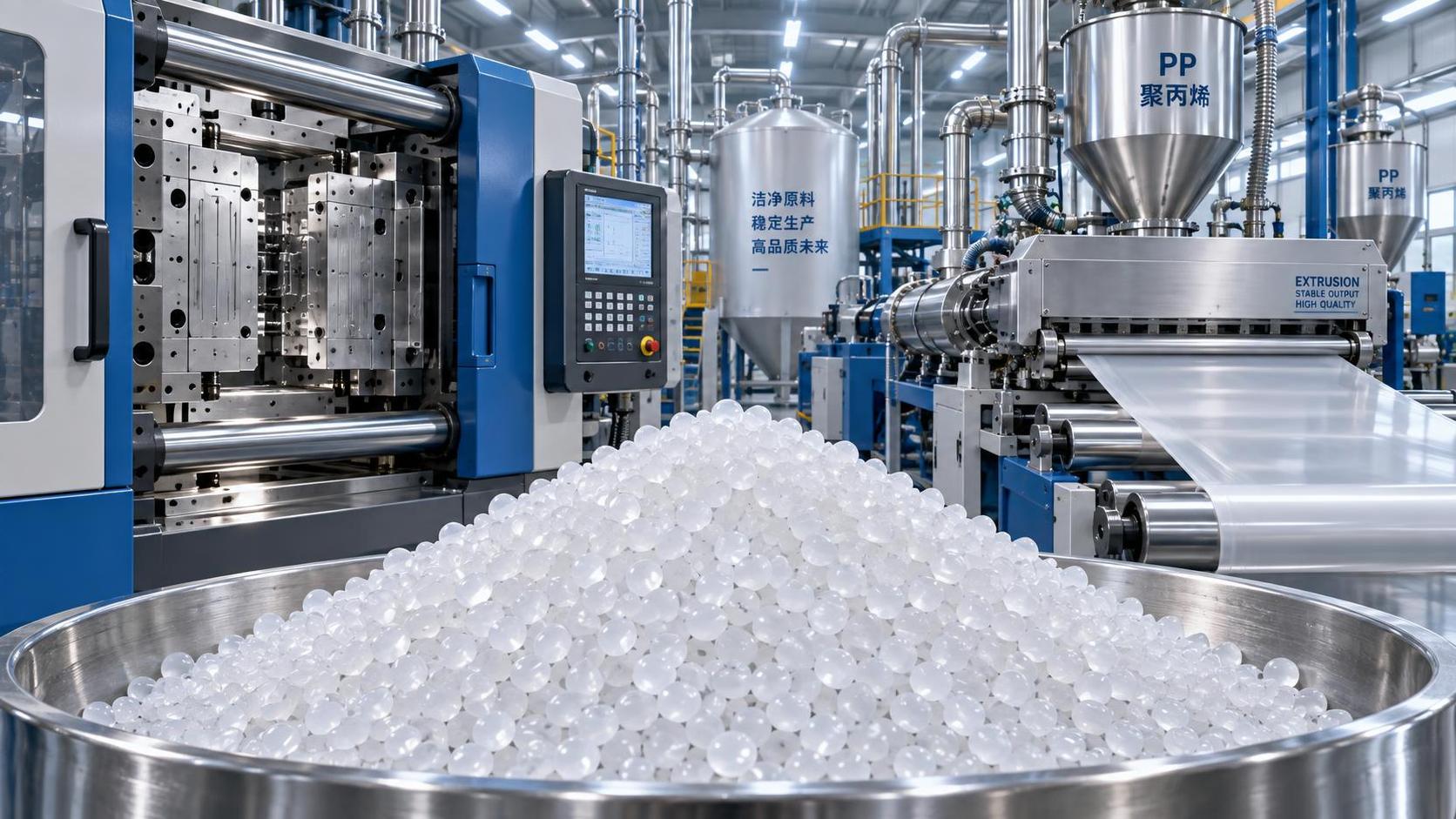
Polypropylene pellets can perform very differently in injection molding and extrusion even when the resin is sold under the same broad “PP” description. The decisive variables are not limited to polypropylene type or nominal melt flow rate. Molecular-weight distribution, copolymer structure, additive package, moisture and contamination level, pellet uniformity, and the thermal history imposed by the machine all affect whether a grade fills a thin-wall mold cleanly, holds dimensional stability in a rigid part, forms a stable extrudate, or develops defects after conversion.
For material approval, the useful question is therefore not whether polypropylene pellets are generally suitable for a process. It is whether a specific grade provides an acceptable processing window while retaining the mechanical, visual, regulatory, and durability properties required by the finished article. Injection molding places priority on fast cavity filling and repeatable packing; extrusion places greater demands on melt strength, output stability, die behavior, and resistance to long residence times. A resin that is efficient in one process may be a poor technical fit for the other.
Polypropylene grade architecture determines the starting point
Commercial polypropylene is commonly supplied as homopolymer, random copolymer, or impact copolymer. This classification is more useful than a generic PP label, but it is still only the starting point for evaluating performance.
PP homopolymer has relatively high stiffness, good heat resistance for many applications, and often favorable flow characteristics. It is widely considered for rigid packaging, housewares, caps and closures, fibers, and industrial molded parts. Its lower inherent impact resistance, especially at reduced temperature, can limit use where drop performance or durable impact behavior is important.
Random copolymer PP contains a lower level of comonomer incorporated into the polymer chain. Compared with homopolymer, it generally offers improved clarity, lower sealing temperature in relevant packaging structures, and better impact behavior, while sacrificing some stiffness and heat resistance. It is frequently assessed for transparent or translucent injection-molded packaging and some extruded sheet and film applications.
Impact copolymer PP, often referred to as heterophasic copolymer, contains a rubbery phase that improves impact resistance. It is relevant for automotive components, appliances, crates, pails, and other products requiring a more balanced stiffness-impact profile. The rubber phase can reduce gloss, increase haze, and alter shrinkage behavior, so visual requirements and dimensional tolerances must be reviewed alongside impact data.
Within each category, polymerization design and compounding can create substantial differences. Two grades with similar melt flow rate may have different molecular-weight distributions, which changes shear response, die swell, melt strength, and sensitivity to processing conditions. A technical evaluation should not assume interchangeability from MFR alone.
Melt flow rate is a screening tool, not a complete processability verdict
Melt flow rate (MFR), typically measured according to ISO 1133 or ASTM D1238 under grade-specific test conditions, is the most commonly referenced property for polypropylene pellets. It indicates the mass of polymer flowing through a standard capillary over a defined time, temperature, and load. In practical terms, a higher MFR generally indicates lower average molecular weight and easier flow under the test condition.
For injection molding, higher-flow grades can reduce injection pressure, support thin-wall filling, and shorten the time required to fill complex cavities. Their lower viscosity can be useful for closures, thin-walled containers, detailed consumer goods, and high-cavity molds. The trade-off is that very high flow may correspond with lower melt strength and, depending on the formulation, reduced impact performance or greater sensitivity to property loss from excessive thermal exposure.
Extrusion does not simply favor the lowest-flow resin. Sheet, profile, pipe, thermoforming sheet, and certain film processes require a melt that remains coherent after leaving the die. If melt strength is insufficient, the line may show unstable drawdown, uneven gauge, sag in thermoforming sheet, weak web stability, or irregular die swell. A lower-MFR material often offers higher melt strength, but may require higher pressure, more torque, or modified screw and die conditions.
MFR is measured at one shear regime, whereas injection molding and extrusion expose polymer to a broad range of shear rates. Rheological data over a relevant shear-rate range are more informative for critical projects. Capillary rheology, rotational rheology, or supplier viscosity curves can reveal whether a material has a narrow or broad molecular-weight distribution and how sharply viscosity falls under shear. This distinction matters when a material appears suitable in a data-sheet comparison but behaves differently during rapid injection or steady extrusion.
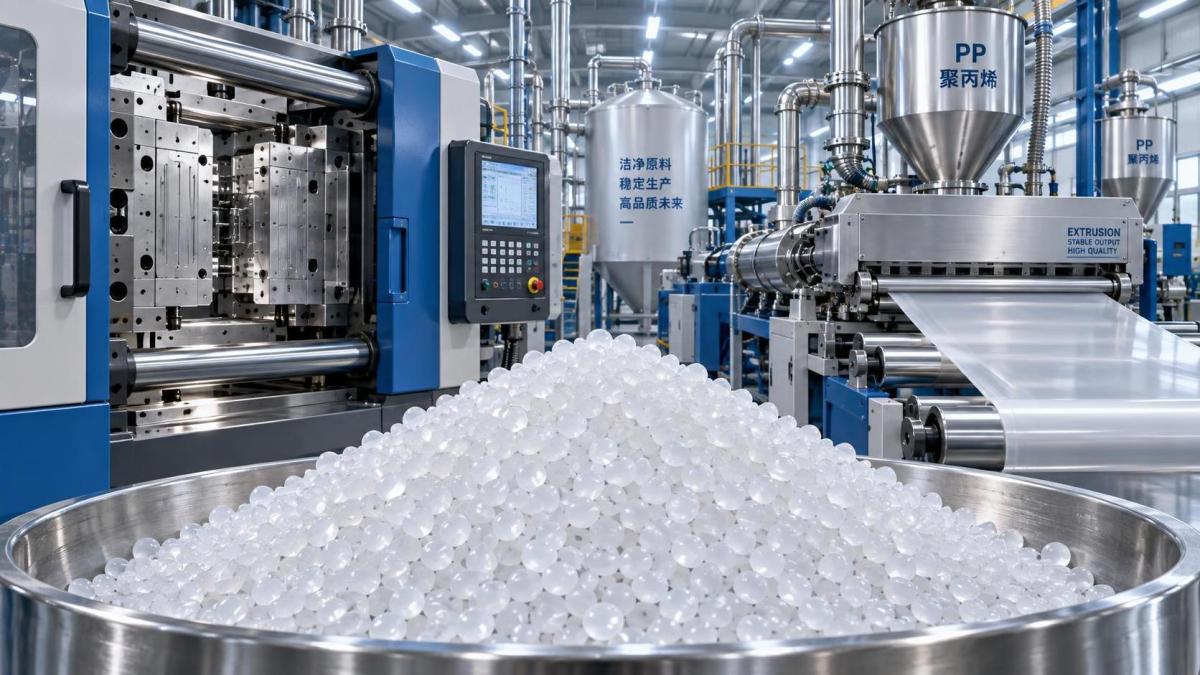
Injection molding: filling is only one part of the material assessment
In injection molding, polypropylene must flow from the barrel through the runner system, gate, and cavity before the advancing melt front freezes. A grade can fill successfully yet still generate sink marks, warpage, poor weld-line performance, brittle gate areas, or unstable cycle-to-cycle dimensions. Material assessment must therefore extend beyond short-shot capability.
High-flow PP can help fill thin sections and long flow paths, but the mold design still controls much of the outcome. Gate location, gate size, runner balance, venting, cavity surface temperature, and cooling symmetry determine how the polymer packs and crystallizes. Polypropylene is semicrystalline. Its shrinkage is therefore materially higher than that of many amorphous plastics and varies with flow orientation, mold temperature, packing pressure, filler content, and part geometry.
Warpage is especially relevant in flat panels, large lids, thin-wall containers, and parts with ribs or uneven wall thickness. Excessive packing can reduce local sink marks but may increase orientation stress or amplify differential shrinkage. Under-packing can create shrinkage voids, poor rib appearance, and dimensional variation. The appropriate material choice is one that allows a stable process window, rather than one that only produces an acceptable part under a narrow set of machine conditions.
For filled grades, talc, calcium carbonate, glass fiber, or mineral reinforcement may improve stiffness, reduce shrinkage, and improve dimensional control. These benefits come with separate considerations: higher abrasion in processing equipment, altered gate wear, increased anisotropy, lower surface gloss, and potentially reduced impact strength. Glass-filled PP requires particular attention to fiber orientation and weld-line performance because local fiber alignment can materially affect both mechanical properties and part distortion.
Mechanical values supplied on a technical data sheet should be read with the test standard and specimen condition in view. Tensile properties are often measured under ISO 527 or ASTM D638; flexural properties under ISO 178 or ASTM D790; impact performance under ISO 179, ISO 180, ASTM D256, or other specified methods. Notched versus unnotched impact results cannot be treated as interchangeable. Nor can room-temperature results establish suitability for low-temperature handling, repeated impact, or long-term loading.
Extrusion requires stable output and melt strength
Extrusion subjects polypropylene to a more continuous thermal and mechanical history than injection molding. The resin must melt uniformly, convey consistently through the screw, pass through screens and the die without unacceptable pressure fluctuation, and retain enough melt integrity during downstream cooling, drawing, forming, or winding.
For sheet extrusion, gauge consistency depends on a combination of resin rheology, melt temperature uniformity, screen-pack condition, die adjustment, roll temperature, and line speed. A resin with variable pellet-to-pellet composition or excessive fines can contribute to pressure variation and visual defects. For profile extrusion, die swell and post-die relaxation need to be anticipated in tool design. For thermoforming sheet, the relevant criterion is not sheet appearance alone: the sheet must heat and stretch with sufficient uniformity to avoid thinning, webbing, or loss of corner definition during forming.
In fiber and raffia applications, the balance shifts toward drawability, orientation response, and thermal stability under high line speeds. In blow molding or melt-strength-sensitive applications, conventional linear PP may need a grade specifically designed for that process rather than a general-purpose injection grade. Attempting to compensate for inadequate melt strength only by lowering temperature can increase pressure and reduce melt homogeneity; raising temperature may improve flow temporarily but can worsen degradation. A process-specific grade is normally the more defensible route.
Extrusion also exposes material quality problems that may remain less visible in a short injection cycle. Gels, black specks, unmelted particles, contamination, and poorly dispersed additives can appear as surface defects, die lines, weak spots, or filter-pressure increases. For high-appearance film, fine sheet, and light-colored products, quality specifications should include contamination limits and visual assessment methods rather than relying solely on bulk mechanical properties.
Thermal stability is tied to residence time, not just barrel temperature
Polypropylene is sensitive to thermo-oxidative degradation. Excessive heat, oxygen exposure, high shear, and long residence time can cause chain scission, leading to molecular-weight reduction and an increase in flow. In processing, this may show up as reduced melt strength, odor, discoloration, unstable dimensions, loss of impact resistance, or deposits around vents and dies.
The stated melting behavior of PP does not define a safe universal processing temperature. Actual settings depend on the grade, machine design, screw profile, back pressure, cycle time, melt temperature, and use of masterbatch or regrind. Measuring real melt temperature is more meaningful than relying on barrel setpoints alone. A barrel may display a nominally acceptable profile while shear heating drives actual melt temperature beyond the preferred range.
Stabilizer packages matter. Primary antioxidants help limit radical formation, while secondary antioxidants can decompose hydroperoxides formed during processing. Long-term heat stabilizers, UV stabilizers, and pigment systems must be compatible with the intended service exposure. A natural-color indoor component and a dark outdoor component may require very different formulations even if both are based on the same base PP resin.
Colorant selection deserves specific scrutiny where processing temperatures and light exposure overlap. Some organic pigments and carotenoid-derived materials are temperature- or light-sensitive. For example, Xanthophyll CAS#127-40-2 is described as light sensitive and temperature sensitive; its use in a polypropylene formulation would require compatibility, migration, color stability, and processing-survival evaluation rather than an assumption that a colorant suitable for another application will remain stable through melt processing. Such evaluation is particularly important when the final product has food-contact, cosmetic, medical, or tightly controlled appearance requirements.
Pellet condition and formulation consistency affect conversion reliability
Polypropylene is not as hygroscopic as engineering polymers such as nylon or PET, so routine predrying is not always necessary for virgin PP. That does not mean pellet condition is irrelevant. Surface moisture, storage condensation, dust, packaging damage, and contamination can still create processing and quality problems. Hygroscopic additives, fillers, or masterbatches can introduce separate moisture requirements, and reclaimed material may carry a different contamination and volatility profile from virgin resin.
Pellet geometry and bulk density influence hopper flow and feed consistency. Excessive fines can bridge, segregate, or increase dust loading. In a compounded grade, inadequate dispersion of fillers, pigments, or impact modifiers may cause visible streaks, property variation, or weak areas. For critical components, incoming checks should connect supplier certificates with actual conversion risks: MFR verification, ash content where filled materials are used, color measurement, contamination screening, and—when relevant—volatile content or odor assessment.
Regrind requires a separate control strategy. Reprocessing can increase MFR through degradation and may reduce impact performance, especially after repeated heat histories. The allowable regrind level depends on the application, the quality of segregation, the part’s load case, color sensitivity, regulatory status, and traceability requirements. Closed-loop use of clean, single-grade sprues is technically different from incorporating mixed post-industrial scrap. These material streams should not be evaluated as equivalent.
Assess end-use performance under the conditions that matter
Injection molding and extrusion convert polypropylene into shapes, but the final specification should reflect service conditions rather than process convenience. A storage tote may need creep resistance under sustained load. A hinged closure needs fatigue performance. An appliance component may need elevated-temperature stiffness. An outdoor profile needs retention of impact and color after UV exposure. A food package may require compliance evidence for the intended jurisdiction and conditions of use, including the status of resin, additives, colorants, and recycled content where applicable.
Creep is often underestimated because short-term tensile or flexural values can look adequate. PP can deform over time under sustained stress, and its response is influenced by temperature, load level, crystallinity, reinforcement, and part design. Where dimensional retention is important, long-term creep data or application-representative testing is more useful than a single room-temperature tensile strength value.
Chemical resistance also needs to be defined precisely. Polypropylene generally resists many aqueous solutions, but performance can change with oxidizing agents, surfactants, hydrocarbons, temperature, stress level, and exposure duration. Environmental stress cracking is a system-level issue involving resin grade, molded-in stress, chemical exposure, and geometry. A material designation alone cannot establish suitability.
A defensible approval approach
A sound evaluation begins by defining the conversion process and end-use failure modes before narrowing the candidate grade list. For injection molding, this includes wall thickness, flow length, gate concept, expected cycle time, dimensional tolerance, impact requirement, appearance criteria, and service temperature. For extrusion, it includes output rate, die geometry, allowable pressure range, draw ratio, cooling method, gauge tolerance, downstream forming requirements, and line residence time.
Supplier data sheets should then be treated as comparative references, not complete qualification evidence. Confirm the MFR test condition, copolymer type, additive status, filler level, applicable test methods, color, and regulatory declarations. Trial results should record actual melt temperature, pressure behavior, cycle or line stability, scrap rate, dimensional data, appearance, and post-conditioning mechanical performance. If a grade change is being considered, compare parts made under equivalent conditions; otherwise, a machine-setting difference may be mistaken for a material effect.
The strongest polypropylene selection is not necessarily the grade with the highest stiffness, fastest flow, or lowest nominal cost. It is the one whose rheology, stabilization, formulation, pellet quality, and compliance documentation fit the actual processing window and the finished product’s load, environment, and appearance requirements. That distinction is what separates a resin that merely runs from one that remains reliable in production and in service.
Related Picks
 Butylated Hydroxytoluene Price Drivers: Supply, Purity, and Purchasing Risk FactorsOct 21, 2026Butylated Hydroxytoluene price trends depend on supply stability, purity, logistics, and purchasing risk. Learn how to compare quotes wisely and reduce sourcing costs.
 Sodium Tripolyphosphate Price Trends: Raw Material and Energy ExposureOct 20, 2026Explore sodium tripolyphosphate price trends, from phosphate and soda ash costs to energy exposure. Learn how to compare quotes, manage sourcing risks, and make smarter purchasing decisions.
 Acetonitrile Shipment to Vietnam Successfully Dispatched; RCEP Benefits Boost Fine Chemical Trade with ASEANSep 16, 2026A shipment of industrial-grade acetonitrile from our company has recently been loaded and dispatched following the completion of standardized hazardous material packaging and container securing procedures.
 Nigerian Client’s Order of 4 Containers of Vinyl Acetate Successfully Loaded and Shipped to West AfricaSep 16, 2026We recently completed the loading of a vinyl acetate order for a Nigerian client; four containers of the product have been successfully packed and are ready for shipment to Nigeria.




Question Consultation
Send Us Your Inquiry Today

Luxi Chemical is a professional chemical product supplier with ample stock of all chemical categories and excellent quality, welcome your purchase inquiry.

