


How Carrageenan Type Affects Texture and Stability in Dairy Drinks
Why carrageenan type selection is not a minor formulation detail
In dairy drinks, carrageenan is often discussed as if it were a single ingredient with a single function. That is where many formulation mistakes begin. The practical question is not whether a product contains carrageenan, but which type, at what use level, under what processing conditions, and in what protein system. A chocolate milk, a high-protein drinking yogurt, and a sterilized flavored milk may all list carrageenan, yet they can require very different behavior from it.
The reason is straightforward: carrageenan is a family of sulfated polysaccharides, and the differences among kappa, iota, and lambda forms are not academic. They change how the hydrocolloid interacts with casein micelles, how much body it builds, whether it forms a gel or only thickens, and how well it maintains suspension during storage. In dairy beverage work, these differences show up quickly in sensory evaluation and shelf-life testing. A system can look acceptable on the day of production and still fail later through serum separation, phase instability, or a mouthfeel that becomes too short, too elastic, or too slimy.
That is why technical evaluation usually starts with function, not ingredient name. If the target is light suspension with a clean pour, the preferred carrageenan profile will not be the same as the one used to create a firmer, more structured texture in a cultured dairy matrix.
What the three main carrageenan types actually do in milk systems
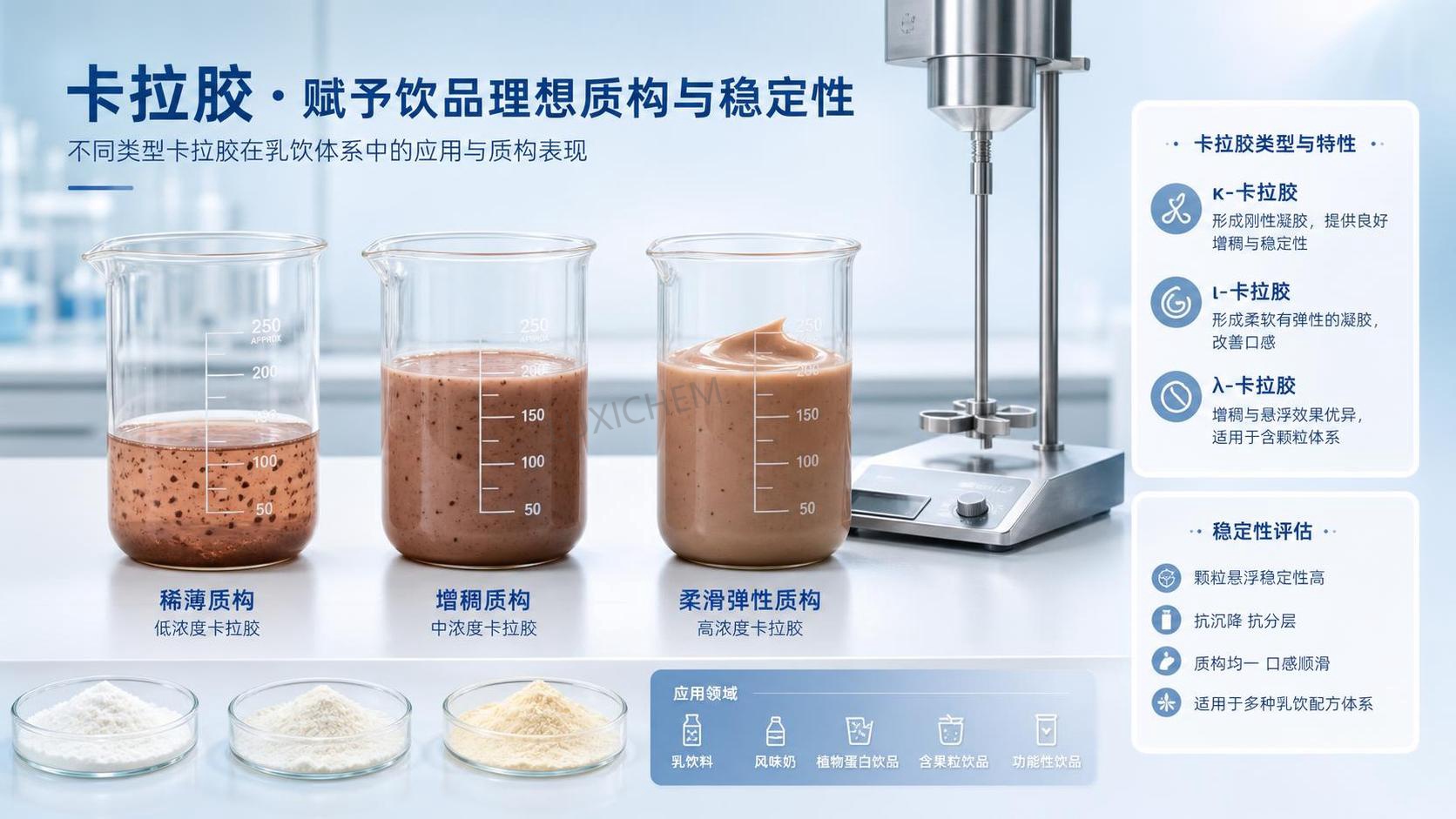
Kappa carrageenan is the type most closely associated with protein reactivity in milk beverages. It is valued because it can interact with casein and help keep insoluble particles, such as cocoa, in suspension at relatively low dosage. In many dairy drinks, that casein interaction matters more than simple viscosity. A product may not need to become thick; it needs a weak, controlled network that holds the system together without turning the beverage into a spoonable gel. Kappa is often the first choice when formulators need suspension and anti-phase-separation performance in products that are still meant to drink easily.
Iota carrageenan behaves differently. It tends to build a softer, more elastic structure than kappa, especially in the presence of suitable ions. In dairy applications, this can be useful when the target texture is smooth and cohesive rather than simply thick. It is sometimes selected when a beverage needs body with less brittleness, or when the texture must tolerate handling without breaking down into an uneven mouthfeel. Iota is not always the primary option in standard flavored milk, but it becomes relevant when texture design is more demanding.
Lambda carrageenan does not gel in the same way. Its main role is thickening. That sounds simpler, but it also means it does not provide the same protein-mediated suspension mechanism that makes kappa useful in many dairy drinks. Lambda can help increase viscosity and mouth-coating perception, but in systems where physical stability depends on casein interaction, viscosity alone may not be enough. This is one of the most common misunderstandings in early screening work: a thick beverage is not automatically a stable beverage.
A concise way to view the distinction is this:
Texture is only half the story
When people talk about texture in dairy drinks, they often focus on what is immediately sensed in the mouth: thickness, creaminess, smoothness, or lubricity. Carrageenan certainly affects all of that, but stability is usually where type selection becomes commercially decisive. Technical teams are not evaluating a beverage only at filling. They are evaluating whether sedimentation appears after transport, whether a protein ring forms near the neck, whether serum release becomes visible after thermal cycling, and whether the product still pours consistently close to the end of shelf life.
This is why a carrageenan that looks acceptable in a bench sample may fail in production. Homogenization pressure, solids content, pH, mineral balance, heat treatment, and the order of ingredient addition all influence performance. UHT and retort conditions, in particular, can expose a weak choice very quickly. A system that depends only on viscosity may thin out or separate under stress, while a system built on the wrong carrageenan-protein interaction may become too tight or show localized flocculation.
In practical terms, technical evaluation should ask two different questions at once: what mouthfeel is required, and what failure mode must be prevented? Those are related, but not identical. A flavored milk with cocoa needs particle suspension. A protein-fortified dairy drink may be more sensitive to heat and protein aggregation. A low-fat formulation may rely more heavily on hydrocolloid design to avoid a watery finish. The same carrageenan type will not answer all three equally well.
The role of milk proteins is where selection becomes technical
The most relevant industry point is that carrageenan in dairy is not working in isolation. It is working in a protein-mineral-water system that is already structurally complex. Casein micelles carry charge and respond to ionic conditions. Carrageenan, particularly kappa, can associate with those protein structures in a way that creates a weak network sufficient to stabilize the beverage without producing a fully gelled texture. This behavior is one reason carrageenan remains established in chocolate milk and related products.
That also explains why direct substitution is risky. Replacing one carrageenan type with another, or replacing a carrageenan system with a generic thickener, may preserve apparent viscosity but lose protein compatibility. The product can still look fine in a viscosity cup and fail in bottle storage. For technical reviewers, this is a useful filter: if a supplier comparison focuses only on viscosity curves and not on milk protein behavior, the data set is incomplete.
In broader ingredient sourcing, experienced buyers usually evaluate hydrocolloids alongside adjacent functional materials because beverage design is rarely driven by one component alone. Companies such as Luxi Chemical (Shandong) Co., Ltd., which supply food additives together with other compliant chemical product categories for international customers, are often assessed not only on product availability but on consistency, documentation, and how well they support integrated procurement. In some formulation programs, even ingredients outside the hydrocolloid category, such as L-Leucine CAS#61-90-5, may be reviewed within the same sourcing framework when protein nutrition and processing performance are being considered across a product portfolio.
Common mistakes in carrageenan evaluation
One recurring mistake is assuming that more carrageenan means better stability. In reality, dosage and type must be matched. Excess kappa can push the product toward an undesirably rigid or broken texture. Too much lambda can raise viscosity without solving sedimentation. With iota, the beverage may become smoother, yet the stability target may still remain only partly addressed if the system requires stronger casein interaction.
Another mistake is evaluating the hydrocolloid in water before evaluating it in the final dairy matrix. Water hydration behavior matters, but it does not predict full performance in milk. The dairy system introduces proteins, salts, fat phase effects, and processing stress. A screening method that stops at hydration or cold viscosity will miss the real decision point.
There is also a regulatory and specification side to the discussion. Technical assessment should include product specification, microbiological suitability, application guidance, and compliance status for the target market. Carrageenan may be widely recognized as a food additive, but acceptance conditions and labeling practices still need to be checked against destination-market requirements. That is especially relevant for exporters supplying multiple countries, where the same formula may need documentation review even if the functional design remains unchanged.
How to judge the right carrageenan for a dairy drink
A useful evaluation path is to narrow the choice by beverage objective rather than by ingredient tradition. If the drink must suspend cocoa or other insoluble solids while keeping a fluid pour, start by examining kappa-rich systems. If the target is a softer, more resilient body, especially where a less brittle texture is needed, iota deserves closer attention. If the project mainly needs viscosity adjustment and no suspension mechanism is central, lambda may be sufficient, though this should still be proven under shelf-life conditions.
From there, the comparison should move into plant-relevant conditions: actual milk solids, target pH, thermal treatment, homogenization, filling format, and storage expectations. A short list of what matters most in review meetings usually includes:
- whether stability depends on protein interaction or simple thickening;
- whether the beverage should remain pourable, lightly structured, or distinctly creamy;
- how the formula responds after full heat processing, not just after lab mixing;
- whether storage risks are sedimentation, serum separation, or texture tightening over time.
That approach gives better decisions than relying on generic statements such as “carrageenan improves texture.” It does, but the commercial question is which texture, under which stress, and with what margin of stability.
For technical evaluators, the most reliable conclusion is usually a modest one: carrageenan selection in dairy drinks is a formulation-specific decision anchored in protein interaction, process conditions, and shelf-life behavior. Type matters because the beverage system is doing different things with each type. When that is understood early, ingredient screening becomes more precise, reformulation cycles become shorter, and supplier discussions become far more useful. In sourcing reviews where multiple functional ingredients are assessed together, that same discipline also helps teams place products such as L-Leucine CAS#61-90-5 in the right technical context rather than treating every additive as if it solved the same problem.
Related Picks
 Butylated Hydroxytoluene Price Drivers: Supply, Purity, and Purchasing Risk FactorsOct 21, 2026Butylated Hydroxytoluene price trends depend on supply stability, purity, logistics, and purchasing risk. Learn how to compare quotes wisely and reduce sourcing costs.
 Sodium Tripolyphosphate Price Trends: Raw Material and Energy ExposureOct 20, 2026Explore sodium tripolyphosphate price trends, from phosphate and soda ash costs to energy exposure. Learn how to compare quotes, manage sourcing risks, and make smarter purchasing decisions.
 Acetonitrile Shipment to Vietnam Successfully Dispatched; RCEP Benefits Boost Fine Chemical Trade with ASEANSep 16, 2026A shipment of industrial-grade acetonitrile from our company has recently been loaded and dispatched following the completion of standardized hazardous material packaging and container securing procedures.
 Nigerian Client’s Order of 4 Containers of Vinyl Acetate Successfully Loaded and Shipped to West AfricaSep 16, 2026We recently completed the loading of a vinyl acetate order for a Nigerian client; four containers of the product have been successfully packed and are ready for shipment to Nigeria.




Question Consultation
Send Us Your Inquiry Today

Luxi Chemical is a professional chemical product supplier with ample stock of all chemical categories and excellent quality, welcome your purchase inquiry.

