


How Does Sodium Tripolyphosphate Control Hardness in Cleaning Water?
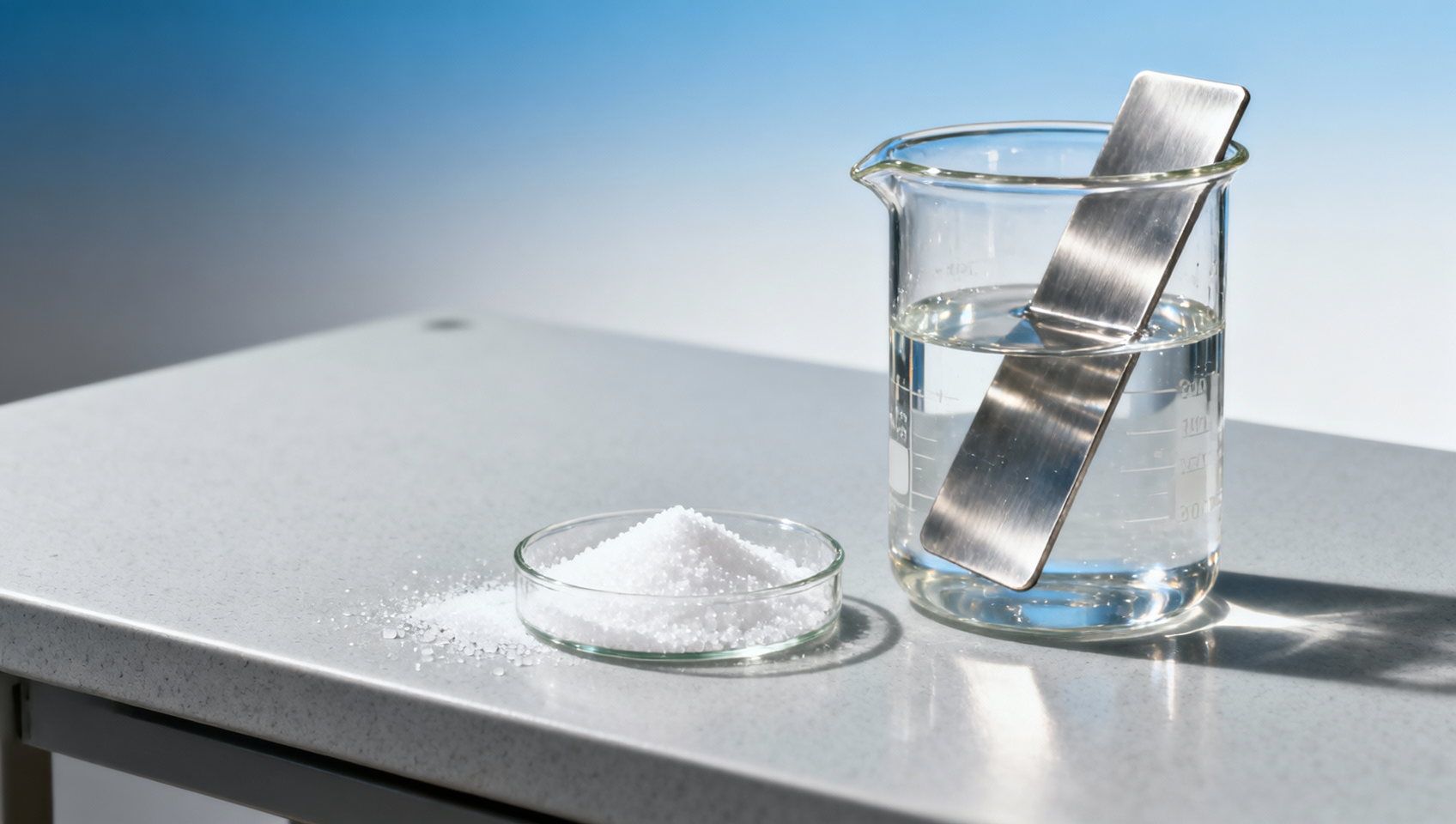
Sodium tripolyphosphate (STPP) controls hardness in cleaning water by binding calcium and magnesium ions into soluble complexes. This reduces the amount of free hardness available to interfere with surfactants or form deposits during washing. The calcium and magnesium remain in the wash liquor, but their chemical behavior changes while they are adequately complexed.
For a technical evaluator, the useful question is whether enough effective STPP remains available throughout the cleaning cycle. Performance depends on the hardness entering with the water, additional mineral loads from soil, formulation pH, dissolution, temperature, and contact time. A sodium tripolyphosphate water softener can support reliable cleaning under these conditions, but it does not provide the same result as removing hardness upstream.
How STPP keeps hardness from disrupting cleaning
Hard water introduces calcium and magnesium ions into a detergent system. These ions can react with soap to form insoluble material, alter the behavior of some other anionic surfactants, and contribute to deposits when the wash contains carbonate or other precipitation partners. The visible effects may include films on equipment, residue on cleaned surfaces, or reduced soil removal at an otherwise adequate detergent concentration.
STPP dissolves to supply sodium ions and tripolyphosphate species. The phosphate groups provide sites that coordinate calcium and magnesium, forming complexes that can remain dissolved under suitable wash conditions. This process, called sequestration, lowers the activity of free metal ions and reduces their participation in competing reactions.
The distinction between free and total hardness matters. A treated wash solution may still contain essentially the same total quantity of calcium and magnesium as before treatment. Successful sequestration therefore does not require a reduction in total dissolved calcium or magnesium. It requires those ions to remain sufficiently controlled for the detergent and cleaning process to work.
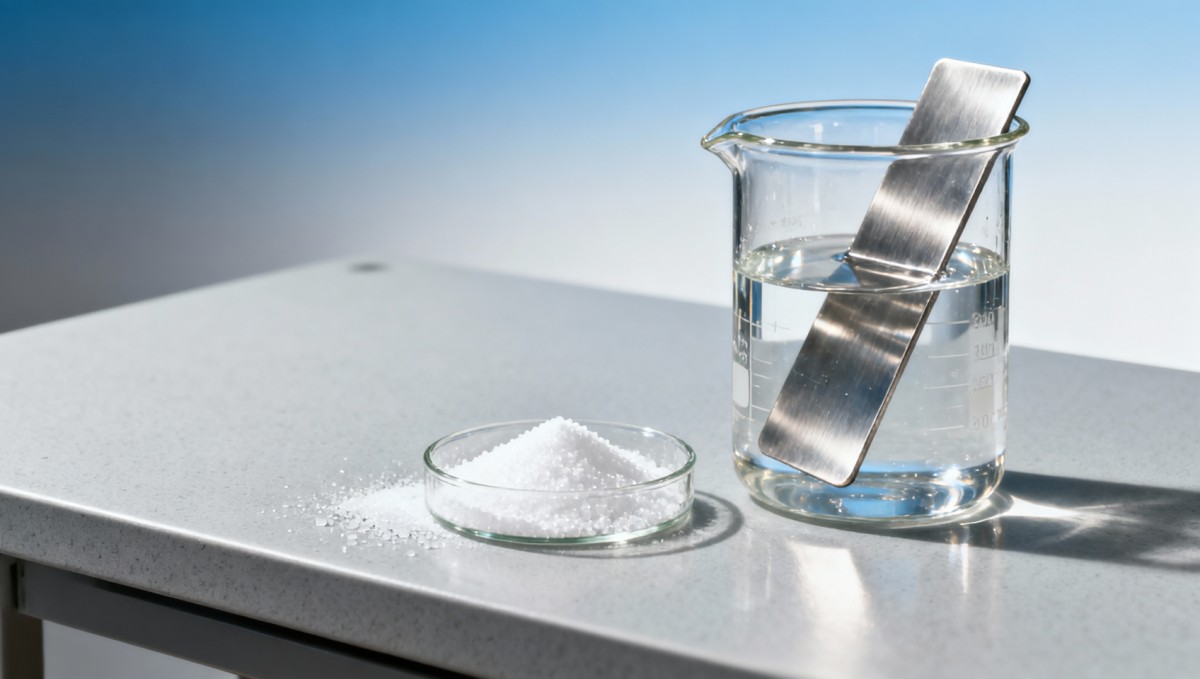
Complex formation is an equilibrium process. Its effectiveness depends on the concentration and chemical form of the tripolyphosphate, the metals present, and the surrounding solution. The familiar description that STPP “ties up hardness” is useful, provided it is not interpreted as permanent removal or unlimited binding capacity.
STPP also acts as a detergent builder. Depending on the formulation, it can contribute alkalinity and buffering, support soil dispersion, and help reduce redeposition. These functions overlap in a cleaning test. Better soil removal after adding STPP may reflect several effects at once, so cleaning performance alone does not establish how much hardness has been sequestered.
Sequestration and precipitation produce different operating outcomes
Precipitation-based softening converts dissolved hardness into solids that must be managed. Sequestration aims to keep hardness in a soluble, less reactive form during use. This makes STPP useful where mineral precipitation in the wash would create an additional cleaning problem.
However, a formulation containing STPP can still produce precipitates. If the available sequestration capacity is insufficient, residual free calcium may react with carbonate or phosphate species. Local concentration gradients during mixing can also expose hardness to precipitating ingredients before STPP has dissolved and distributed. The presence of STPP on an ingredient list does not, by itself, establish deposit control.
The conditions that determine whether hardness stays controlled
Hardness load must be assessed in the working solution
Water hardness is the starting point for evaluation, but the incoming water is only one source of demand. Mineral-containing soils, residual process fluids, and carryover between cleaning stages can introduce additional calcium and magnesium. Other multivalent metals can also interact with phosphate species and complicate the available capacity.
For that reason, a dose selected from the water supply analysis may perform differently in a heavily loaded wash bath. Recirculating systems deserve particular attention: repeated soil input and water replacement can change the balance between available builder and accumulated contaminants over time.
Hardness values also need a consistent reporting basis. A value expressed as calcium carbonate equivalent cannot be compared directly with a value expressed as elemental calcium or magnesium. Before calculating a starting formulation, establish what the laboratory result represents and whether both principal hardness ions are included.
A theoretical binding calculation can help define an initial screening range, but it should not become a universal dosing rule. Actual requirements depend on solution chemistry, competing reactions, raw-material assay, and the level of residual free hardness the cleaning process can tolerate.
pH affects both complexation and deposit formation
The charge and binding behavior of tripolyphosphate species change with pH. Alkaline conditions used in many cleaning formulations can support effective hardness control, while also improving removal of certain soils. Yet alkalinity changes the surrounding precipitation chemistry as well.
For example, carbonate-containing formulations may become vulnerable to calcium carbonate deposition when sequestration is inadequate. Magnesium can also form poorly soluble material under sufficiently alkaline conditions. Raising pH may improve one aspect of cleaning while increasing the consequences of an uncovered hardness load.
Evaluate the pH of the diluted working bath, including its change after soil addition. A concentrate specification gives limited insight into the conditions at the surface being cleaned. Two formulations with similar initial pH may also respond differently as soils consume alkalinity because their buffering capacities differ.
Temperature, time, and dissolution affect the available builder
STPP must dissolve and disperse before it can control hardness throughout the wash. In powder products, particle characteristics, mixing intensity, water temperature, and the order of ingredient addition influence how quickly this happens. Undissolved material can create an early period in which hardness remains available to interfere with the detergent.
Tripolyphosphate can also hydrolyze into shorter-chain phosphate species, including pyrophosphate and eventually orthophosphate. The rate depends on conditions such as pH, temperature, and time. These products do not reproduce the same sequestration behavior, and their interactions with calcium and magnesium can change deposit risk.
A short cleaning cycle and a liquid concentrate stored for months therefore present different stability questions. Fresh dilution performance cannot establish long-term concentrate stability. Likewise, an acceptable stored product still needs to dissolve or distribute fast enough at the intended use temperature.
Testing should cover the actual sequence: storage, dilution, heating where applicable, soil exposure, and the period before draining. A formulation that performs well immediately after preparation may behave differently after prolonged hot holding or repeated circulation.
Why more STPP does not always solve a cleaning problem
If hardness exceeds the effective capacity of the formulation, increasing STPP may improve performance. Once hardness is adequately controlled, however, additional STPP may deliver little benefit. Remaining failures may come from unsuitable surfactants, inadequate wetting, insufficient mechanical action, soil-specific chemistry, or poor rinsing.
The surfactant system influences the value of sequestration. Soap is particularly vulnerable to calcium and magnesium. Other surfactants differ in hardness tolerance, and a formulation built around more tolerant ingredients may show a smaller cleaning response to added STPP. Even then, deposit control can remain relevant because hardness also interacts with inorganic formulation components.
Appearance is an incomplete guide. Clear wash liquor can contain soluble calcium and magnesium complexes and still perform well. Cloudiness can come from mineral precipitation, dispersed soil, or formulation instability. Neither observation identifies the cause without further examination.
STPP also cannot be assumed to remove established scale simply because it helps prevent fresh deposits. Dissolving an existing mineral layer depends on its composition and on the chemistry and contact conditions of the cleaner. A hardness-control trial and a descaling trial answer different questions.
Rinsing creates another boundary. After the wash drains, fresh hard rinse water may contact the surface with little remaining sequestrant. Spots formed during drying can therefore persist even when wash-stage hardness control is successful. Increasing builder in the wash may have limited influence on a problem introduced later.
Finally, STPP adds phosphorus to the wastewater stream. Product-category restrictions, discharge conditions, and treatment capability can constrain its use. These requirements depend on the application and destination market; they belong in the feasibility assessment before a formulation is finalized.
How to evaluate STPP without mistaking one effect for another
A useful evaluation connects water chemistry to the cleaning result. Testing only total hardness misses sequestration, while testing only visible cleanliness can hide the reason a formulation succeeds or fails. The strongest assessment uses both chemical and application measurements.
Start with representative water and a defined cleaning task. Record calcium and magnesium where available, alkalinity, initial pH, dilution, temperature, contact time, and soil loading. Include the operating variation that matters, such as a harder water source or accumulated soil in a recirculating bath.
A compact comparison can then examine:
- A formulation without STPP: establishes how strongly the existing system responds to hardness.
- Several STPP concentrations: shows whether performance improves and where further additions stop producing useful gains.
- A softened-water reference: helps reveal how much of the remaining cleaning limitation is associated with incoming hardness.
- The intended storage and use conditions: checks whether initial performance survives aging, dilution, and the full operating cycle.
Keep the rest of the formulation controlled as far as practical. Adding STPP can change alkalinity, ionic strength, and soil dispersion as well as metal binding. If the purpose is to understand the mechanism, a comparison that accounts for pH helps avoid attributing every improvement to sequestration.
Choose measurements that answer the right question
A total-metal measurement determines how much calcium and magnesium is present, including complexed forms when the analytical preparation captures them. It does not directly show how much remains available to interfere with cleaning. Conversely, a free-ion measurement requires a method suited to the detergent matrix and the concentration range involved.
Routine hardness tests can be difficult to interpret in a solution containing builders and complexing agents. Endpoint behavior and competition between the test reagent and existing complexes may affect the result. Select the method with the laboratory, define whether it measures free, titratable, or total hardness, and verify that the formulation does not invalidate the interpretation.
Application measurements should include soil removal and residue on the relevant substrate. Where deposits matter, examine surfaces after rinsing and drying, since a wash solution can look acceptable while leaving a film. For recirculating applications, assess performance after realistic bath loading as well as in fresh solution.
The decision point is whether an STPP concentration provides consistent cleaning and acceptable deposits across the expected operating range. If increasing the dose no longer improves results, investigate the remaining process limitations. If performance collapses only at high hardness or late in the bath cycle, the options may include adjusting builder capacity, controlling bath replacement, or softening incoming water.
STPP is most useful when its soluble complexes remain effective for the duration of the wash and the process can accommodate the resulting phosphorus load. Establishing those boundaries turns a general claim of “water softening” into a practical formulation decision: how much hardness the cleaner can handle, for how long, and with what result on the cleaned surface.
Related Picks
 Butylated Hydroxytoluene Price Drivers: Supply, Purity, and Purchasing Risk FactorsOct 21, 2026Butylated Hydroxytoluene price trends depend on supply stability, purity, logistics, and purchasing risk. Learn how to compare quotes wisely and reduce sourcing costs.
 Sodium Tripolyphosphate Price Trends: Raw Material and Energy ExposureOct 20, 2026Explore sodium tripolyphosphate price trends, from phosphate and soda ash costs to energy exposure. Learn how to compare quotes, manage sourcing risks, and make smarter purchasing decisions.
 Acetonitrile Shipment to Vietnam Successfully Dispatched; RCEP Benefits Boost Fine Chemical Trade with ASEANSep 16, 2026A shipment of industrial-grade acetonitrile from our company has recently been loaded and dispatched following the completion of standardized hazardous material packaging and container securing procedures.
 Nigerian Client’s Order of 4 Containers of Vinyl Acetate Successfully Loaded and Shipped to West AfricaSep 16, 2026We recently completed the loading of a vinyl acetate order for a Nigerian client; four containers of the product have been successfully packed and are ready for shipment to Nigeria.




Question Consultation
Send Us Your Inquiry Today

Luxi Chemical is a professional chemical product supplier with ample stock of all chemical categories and excellent quality, welcome your purchase inquiry.

