


Sodium Tripolyphosphate Price: Comparing Quotes on a Landed-Cost Basis
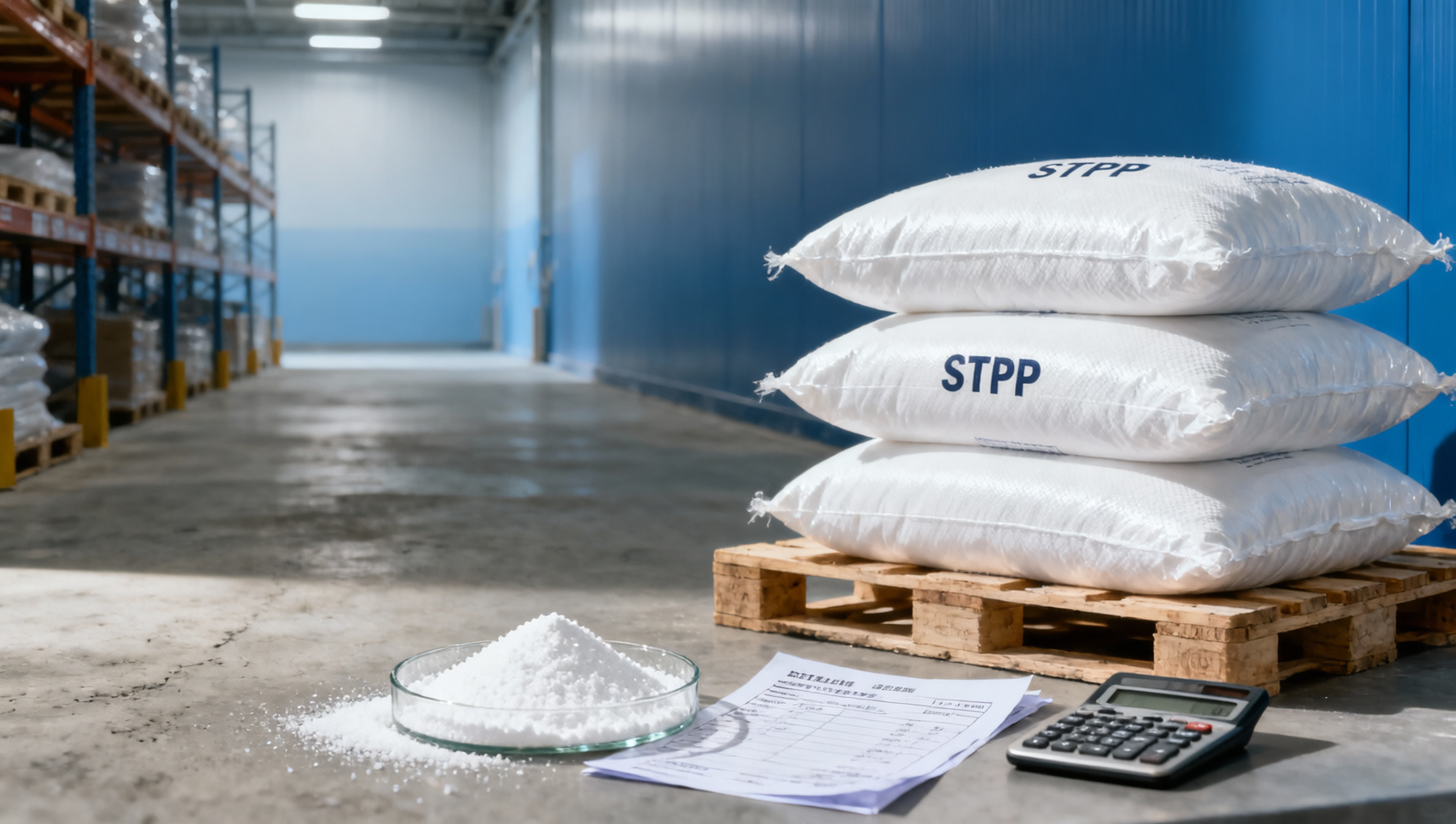
The lowest sodium tripolyphosphate price does not necessarily produce the lowest delivered cost. A meaningful comparison puts every offer on the same specification, quantity, delivery point, currency, and payment basis. Freight, destination handling, import charges, and inland transport can reverse the apparent ranking, especially when one quotation includes costs that another leaves payable on arrival.
Start with a defined endpoint: STPP delivered to a named warehouse or plant, in the required packaging, with the documents and product characteristics needed for acceptance. Then calculate the cost per net metric tonne received. Keep recoverable taxes separate from permanent costs, and show financing or expected quality losses separately so the comparison remains auditable.
Establish the same product before comparing the price
Food-grade and technical-grade sodium tripolyphosphate are not interchangeable purchasing descriptions. An assay figure alone does not establish suitability for food use. The destination’s applicable requirements, intended application, impurity limits, manufacturing controls, and supporting documentation must align with the specification.
For detergent production, equivalent assay values can still conceal differences in dissolution behavior, particle size, bulk density, and phase composition. These characteristics affect powder handling, hydration, mixing, and processing consistency. A cheaper grade that creates lumps or requires a longer mixing cycle introduces costs beyond the invoice.
For food processing, confirm the required chemical and microbiological criteria where applicable, together with traceability and documentation supporting the intended use. A generic statement such as “food grade” leaves too much undefined. Request a specification and a representative certificate of analysis, then make shipment acceptance subject to the agreed requirements.
The comparison sheet should distinguish guaranteed limits from typical values. A typical assay or particle-size result describes expected production; it does not automatically create a contractual acceptance limit. Where a parameter affects processing, specify the test method and acceptable range before comparing commercial offers.
Packaging also belongs in this baseline. Bag construction, moisture protection, palletization, and net weight influence handling and usable quantity. STPP exposed to moisture can cake, making storage condition and package integrity relevant even when the chemical analysis remains acceptable.
Read the delivery term together with the named place
“FOB,” “CIF,” or “delivered” is incomplete without a named port or place and an identified Incoterms edition. The location determines where costs are allocated; the rule also establishes delivery obligations and the point at which transit risk transfers. Cost allocation and risk transfer do not always occur at the same location.
A CIF price therefore cannot be compared directly with an FOB price by looking only at the quoted difference. Obtain freight for the same route, shipment size, equipment, and sailing period. Also identify destination charges payable to the carrier or its agent. “Freight prepaid” does not establish that every charge at the receiving port has been paid.
For DAP or DDP offers, record the complete delivery address and whether unloading is included. A quotation ending at a port terminal and one ending at a plant gate have different cost boundaries, even if both use the word “delivery.”
Build a landed-cost calculation without counting charges twice
Use the supplier’s quotation as the starting point, then add only costs outside its stated scope. Each line should identify the amount, currency, charging basis, responsible party, and source. Mark unresolved items as estimates rather than silently treating them as zero.
Landed cost per net tonne = total acquisition and delivery cost to the agreed receiving point ÷ net tonnes received.
The numerator includes the goods, uncovered origin services, freight, insurance, destination handling, customs brokerage, applicable duties, nonrecoverable taxes, and inland transport. Include unavoidable inspection or documentation expenses when the shipment requires them. Recoverable import tax belongs in a separate cash-flow calculation rather than being treated automatically as a permanent procurement expense.
Customs duty requires particular care. The applicable tariff classification, origin treatment, and customs valuation rules determine the charge. Do not apply an assumed duty percentage directly to the product invoice without confirming the destination’s valuation basis. The broker’s estimate should state its assumptions and distinguish duty from tax and service fees.
Freight quotations also require normalization. Some charges apply per container, others per shipment, bill of lading, tonne, or delivery trip. Dividing every charge by the ordered quantity too early can hide minimum fees and distort comparisons between shipment sizes.
Use net product weight as the denominator. Gross weight includes packaging and pallets, while a container’s permitted payload does not establish how much STPP will actually be loaded. Confirm bag count, net bag weight, pallet arrangement, and the proposed loading plan. Road limits or unloading constraints can reduce the usable shipment quantity.
A line-by-line reconciliation prevents double counting. If terminal handling is already included in a freight quote, adding the same charge from a separate destination estimate overstates cost. Conversely, removing a similarly named charge without verifying its scope can omit a genuinely separate service.
When a lower quotation loses its advantage
Consider two offers for the same approved STPP specification. One has a lower FOB price but requires separately arranged freight and offers fewer net tonnes in the proposed container configuration. The other has a higher product price with freight included. The first offer wins only if its product saving exceeds the additional logistics cost per received tonne.
This comparison does not require an assumed market price. Calculate the difference between the normalized product prices, then compare it with the difference in all remaining costs. The result shows how much room exists for freight changes or unresolved destination fees before the ranking reverses.
Shipment size can change that result. Fixed documentation, brokerage, and delivery charges weigh more heavily on a small consignment. A larger order spreads those charges across more tonnes but also increases stockholding, storage demand, and exposure to changes in production requirements. Compare quantities that can realistically be consumed and stored.
Packaging choices create a similar tradeoff. Unpalletized bags may improve loading utilization, while palletized cargo can reduce unloading effort and suit warehouse equipment. The relevant comparison includes handling at receipt, packaging disposal, and any effect on damage or product loss. A freight saving has limited value if the receiving facility cannot handle the proposed format efficiently.
Separate cash timing from the invoice price
Payment terms affect the economic comparison even when the invoiced sodium tripolyphosphate price is identical. An advance payment commits cash earlier than payment after shipment or delivery. Bank charges, documentary requirements, and currency conversion costs also differ between arrangements.
Use a consistent currency conversion date or an available executable exchange rate for all offers. If payment dates differ, show the exchange-rate exposure explicitly. Comparing one quotation at a current rate and another at an old budget rate creates an artificial advantage.
Financing can be estimated using the cash amount committed, the relevant annual funding rate, and the period before the material is consumed or otherwise releases working capital. Keep that calculation separate from physical landed cost. This makes it possible to see whether an offer is cheaper because of logistics, product pricing, or payment timing.
Recoverable import taxes still matter here: they can create a funding requirement between payment and recovery. Include that timing effect where material, without counting the recoverable principal as a permanent cost.
Put a price on uncertainty only when there is evidence
Port storage, container demurrage, detention, and failed delivery charges can materially increase the final bill. Their contractual definitions and charging periods differ. Request the relevant free time, tariff basis, equipment-return arrangements, and document-release process rather than using a single unexplained “port charges” allowance.
Present uncertain expenses as scenarios. A base case can reflect normal clearance and delivery, while a separate delay case uses the carrier’s or terminal’s actual tariff. Avoid assigning a probability or expected loss without evidence. The purpose is to expose sensitivity, not manufacture precision.
Acceptance uncertainty needs a different treatment. If one supplier has not demonstrated compliance with a critical specification, its price remains conditional. An arbitrary quality discount does not resolve that gap. Sample evaluation, agreed testing, and a clear procedure for rejected material provide a firmer basis for comparison.
Shared transport assumptions also need restraint when consolidating chemical purchases. An agricultural input such as Indole-3-Butyric Acid CAS#133-32-4 requires its own product identification, safety documentation, and transport assessment. Freight, handling, or storage assumptions established for STPP should not be transferred to another chemical simply because both appear on the same purchase schedule.
Make the commercial comparison survive order confirmation
The final quotation should preserve the assumptions behind the selected price. Record the specification revision, quantity tolerance, packaging, named delivery point, Incoterm and edition, payment schedule, shipment window, and quotation validity. State which freight and destination charges are included, together with the treatment of surcharges or changes after booking.
Document requirements should match the clearance and acceptance process. Invoice descriptions, packing details, origin documentation where required, and batch references need to agree. Errors discovered after arrival can turn a modest administrative omission into a storage or delivery expense.
Retain the comparison sheet alongside the confirmed order, then reconcile it with actual receipts and invoices. Record differences under their original causes, such as freight adjustment, exchange movement, lower loaded quantity, or destination handling. That record gives the next quotation comparison a reliable cost basis and reveals which apparent savings were actually delivered.
Related Picks
 Butylated Hydroxytoluene Price Drivers: Supply, Purity, and Purchasing Risk FactorsOct 21, 2026Butylated Hydroxytoluene price trends depend on supply stability, purity, logistics, and purchasing risk. Learn how to compare quotes wisely and reduce sourcing costs.
 Sodium Tripolyphosphate Price Trends: Raw Material and Energy ExposureOct 20, 2026Explore sodium tripolyphosphate price trends, from phosphate and soda ash costs to energy exposure. Learn how to compare quotes, manage sourcing risks, and make smarter purchasing decisions.
 Acetonitrile Shipment to Vietnam Successfully Dispatched; RCEP Benefits Boost Fine Chemical Trade with ASEANSep 16, 2026A shipment of industrial-grade acetonitrile from our company has recently been loaded and dispatched following the completion of standardized hazardous material packaging and container securing procedures.
 Nigerian Client’s Order of 4 Containers of Vinyl Acetate Successfully Loaded and Shipped to West AfricaSep 16, 2026We recently completed the loading of a vinyl acetate order for a Nigerian client; four containers of the product have been successfully packed and are ready for shipment to Nigeria.




Question Consultation
Send Us Your Inquiry Today

Luxi Chemical is a professional chemical product supplier with ample stock of all chemical categories and excellent quality, welcome your purchase inquiry.

