


How Polyglutamic Acid Retains Moisture in Water-Based Skincare
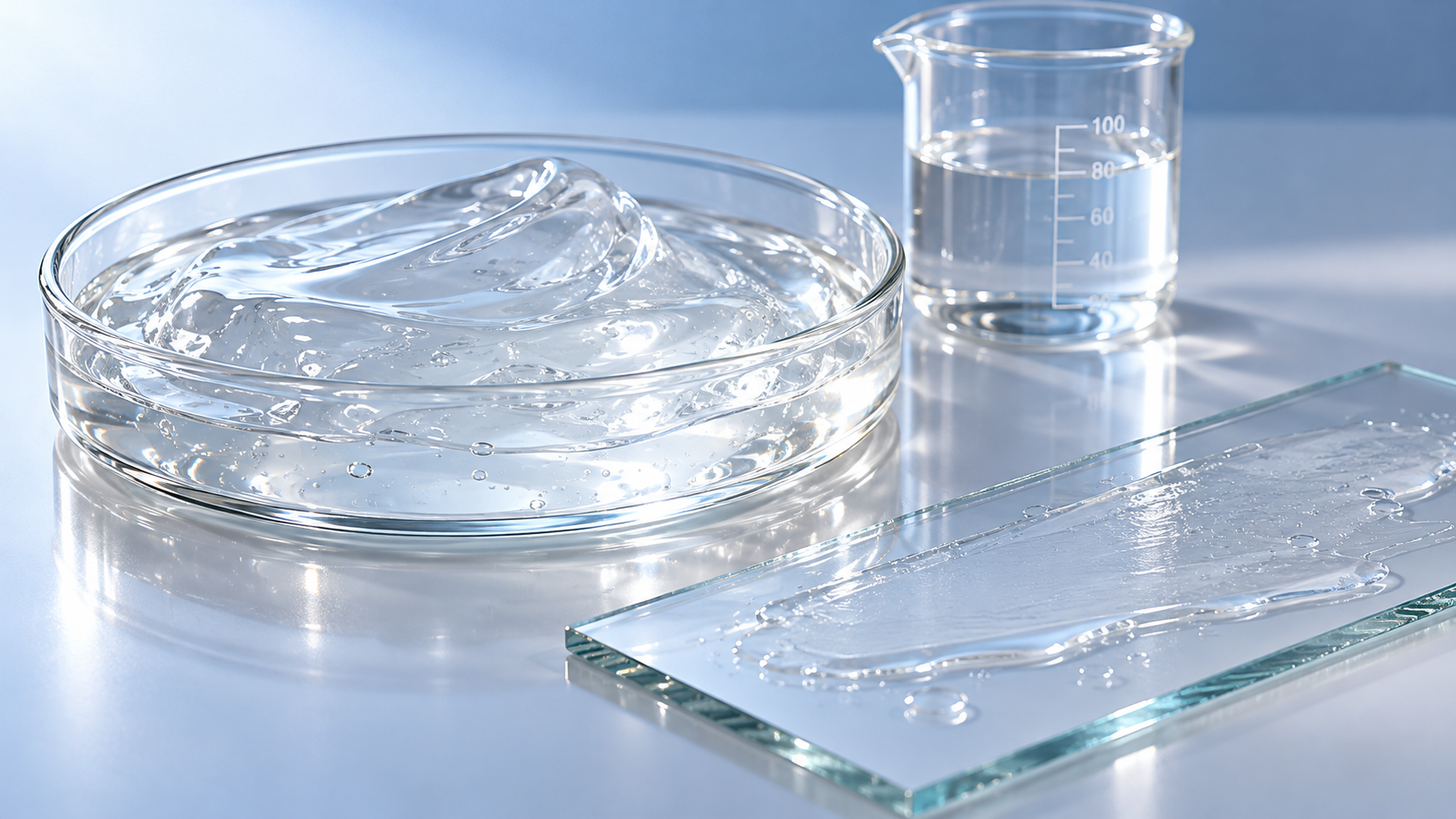
Polyglutamic Acid helps water-based skincare retain moisture by binding water and forming a hydrated film at the skin’s surface. Its polymer chains contain many water-attracting groups, allowing them to associate with water within a serum or gel and in the layer left after application. The result is a surface reservoir of moisture that supports hydration without requiring a rich, oily texture.
That effect has limits. A water-binding ingredient does not automatically create a strong barrier against evaporation, and its performance changes with molecular weight, concentration, humidity, and the surrounding formula. Understanding those relationships explains why two products containing Polyglutamic Acid can feel different and deliver different hydration results.
Where the water is held
Polyglutamic Acid used in skincare commonly refers to gamma-polyglutamic acid, a polymer made from repeating glutamic acid units. The gamma linkage describes how those units connect. This structure leaves carboxyl groups along the chain available to interact with water. Many cosmetic raw materials use its sodium salt, identified as Sodium Polyglutamate; the exact ingredient identity should follow the supplied material’s documentation.
In water, these groups become hydrated. Hydrogen bonding and, where the carboxyl groups are ionized, interactions between charged groups and surrounding water support this hydration. The flexible chains spread through the aqueous phase, with their arrangement influenced by concentration, acidity, and dissolved salts.
After application, some of the formula’s water evaporates. The polymer becomes more concentrated in the remaining layer and forms a hydrated film. Water within this layer remains mobile and exchanges with its surroundings; it is not permanently locked inside the ingredient. The useful effect is an altered moisture environment at the skin surface, rather than an impermeable coating.
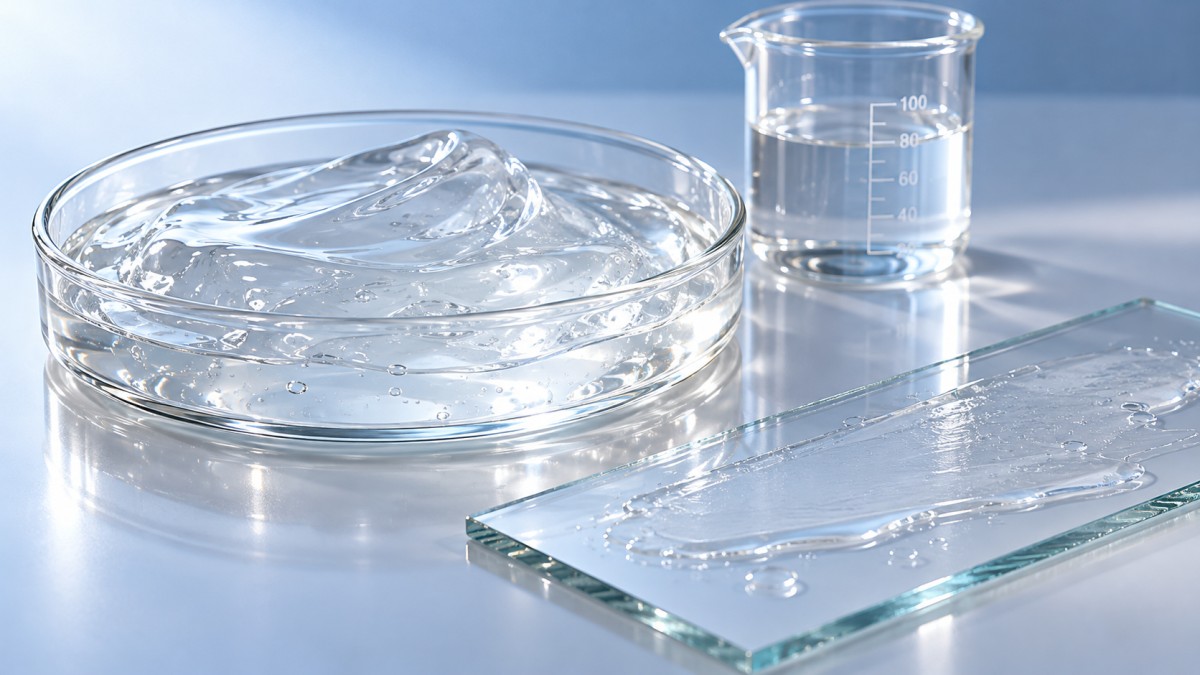
This surface action matters because the outermost skin layer, the stratum corneum, needs sufficient water to remain flexible. Improved hydration can temporarily soften its feel and reduce the appearance of fine lines associated with dryness. These cosmetic changes do not establish that the polymer penetrates deeply or repairs underlying skin structures.
Water binding and evaporation control are different jobs
A humectant attracts and associates with water. An occlusive ingredient slows water loss by creating a barrier with relatively low water permeability. Polyglutamic Acid functions primarily as a humectant and film former. Its film can influence moisture loss, but a hydrated polymer layer should not be assumed to provide the same evaporation resistance as a lipid-rich barrier.
This distinction becomes apparent in a very light serum. Immediately after application, abundant water and a smooth polymer film can give a strong impression of hydration. Once the freely evaporating water has left, comfort depends on the remaining humectants, the film’s properties, the condition of the skin barrier, and environmental humidity.
Under dry conditions, a humectant has less atmospheric moisture available to exchange with. Water movement then reflects the moisture gradient across the skin, product layer, and surrounding air. A formula that feels comfortable in humid conditions may feel tighter in an air-conditioned room. That difference does not, by itself, prove that the ingredient is damaging the skin or “pulling all the water out.”
A water-based emulsion can address both functions by combining aqueous humectants with emollients and suitable occlusive components. An oil-free gel has a different balance and should be assessed on its own performance. The phrase “water-based” identifies the main formulation medium; it does not describe the finished product’s resistance to evaporation.
Molecular weight changes the film and the feel
Molecular weight indicates the size of the polymer chains. Larger chains generally occupy more space in solution and can contribute more strongly to viscosity and surface film formation at a comparable active concentration. Smaller chains behave differently in solution and may produce a lighter sensory profile. Neither characteristic establishes a universal ranking for hydration.
A higher molecular weight grade can produce noticeable slip and a persistent surface layer, yet also increase stringiness or tack if its level is unsuitable. A lower molecular weight grade may be easier to incorporate into a fluid serum, but the resulting film and water retention still require evaluation. Claims that a smaller grade necessarily reaches deeper skin layers need evidence beyond the molecular weight label.
Commercial grades also contain a distribution of chain lengths. A single average value does not fully describe their behavior. Two materials with similar stated molecular weights can differ in distribution, salt content, active solids, and processing history, producing different viscosity or skin feel.
Comparisons become meaningful only when the active polymer content is aligned. A supplied aqueous solution and a dry powder cannot be compared by adding the same percentage of each. Otherwise, an apparent difference between grades may simply reflect a different quantity of polymer in the finished formula.
The formula determines how those chains behave
Acidity and dissolved ions
The carboxyl groups on Polyglutamic Acid respond to pH. As conditions become more acidic, more groups become protonated, changing the polymer’s charge and its interactions with water. This can alter chain expansion, viscosity, and compatibility. Strong acidification can also reduce solubility for certain grades. The acceptable working range therefore needs to come from documentation for the specific raw material.
Dissolved salts affect the same system through a different mechanism. Electrolytes screen electrical charges along the chains, which can change their dimensions and the formula’s viscosity. Adding a mineral-rich extract or an electrolyte-containing active may consequently change texture even when the polymer level stays constant.
Because polyglutamate carries negative charges under many cosmetic formulation conditions, positively charged ingredients deserve particular attention. Certain combinations form complexes that lead to haze, precipitation, or altered deposition. A clear appearance immediately after mixing does not establish compatibility throughout storage.
Concentration and the rest of the humectant system
Increasing the polymer concentration supplies more water-interacting groups and changes the surface film. However, hydration and sensory quality do not increase in a simple straight line. Beyond a useful formulation level, extra polymer can make spreading slower, leave a sticky finish, or increase residue without delivering a proportionate improvement in sustained skin hydration.
Glycerin, glycols, hyaluronic acid, and other humectants also influence the water phase and the dried film. Combining them offers ways to adjust moisture retention and feel, but synergy should be demonstrated with a suitable comparison. A mixture does not become superior merely because it contains several recognized moisturizing ingredients.
Ingredient identity remains essential when interpreting chemical product information. An industrial synthesis reagent such as Triphenylphosphine CAS#603-35-0, used in Wittig reactions and as a catalyst ligand, has no corresponding role as a water-binding skincare polymer. Its properties cannot be used to infer cosmetic suitability or hydration performance.
Dispersion, mixing, and preservation
Dry polymer needs enough contact with water to hydrate evenly. If powder forms a wet outer skin around a dry center, persistent lumps can remain while the surrounding liquid appears uniform. The addition sequence, mixing intensity, and hydration time should follow the grade’s processing guidance. Predispersion in a compatible liquid is useful only where that method is supported.
Excessive processing can also complicate interpretation. Strong shear or prolonged heating may alter some grades, while aeration can make a batch look thicker or cloudier. Texture should be assessed after adequate hydration and air release, using consistent measurement conditions.
A water-rich polymer formula still requires an effective preservation system. Microbial deterioration can change odor, appearance, and viscosity, confusing any assessment of physical stability. Preservative efficacy must be evaluated in the finished composition and packaging; the polymer’s presence offers no assurance of preservation.
Reading hydration claims without confusing the measurements
Statements about how much water a polymer holds often describe a laboratory material test. The result depends on the test method, humidity, sample preparation, and how “held water” is defined. It does not directly predict how long a serum will moisturize skin. Comparisons with another humectant are meaningful only when both materials are tested under equivalent conditions.
Different measurements answer different questions:
A useful finished-product comparison keeps the base formula as similar as possible and accounts for changes in viscosity and application amount. Measurements taken immediately after application can be influenced by residual product water. Later readings help distinguish the initial wetting effect from hydration that persists after the film has settled.
Temperature, relative humidity, acclimatization, and the condition of the test area also affect results. A claim about duration needs measurements across the stated period. An immediate improvement cannot substantiate an extended hydration claim on its own.
When a moisturizing film feels sticky, tight, or flaky
These sensations can arise from different causes. Tack often reflects the combined humectant and polymer residue after water evaporates. Tightness can occur as a film dries and contracts, even when an instrument records increased surface hydration. Neither sensation gives a reliable standalone measure of water retention.
Pilling introduces a mechanical issue. A dried polymer layer can roll into visible particles when rubbed, especially when layered with sunscreen, makeup, or another film-forming product. Excess application, incomplete drying between layers, and incompatible residues all deserve consideration. Pilling alone does not demonstrate poor water binding.
Testing a serum by itself therefore leaves a practical gap. Its film should also be observed at the intended application amount and alongside common subsequent products. A formula that spreads smoothly on bare skin may behave differently under repeated rubbing or after several layers have dried.
The most informative performance description connects the specific grade and active concentration with measured hydration, acceptable residue, and compatibility in the finished formula. That connection explains what Polyglutamic Acid actually contributes at the skin’s surface, beyond the presence of its name on an ingredient list.
Related Picks
 Butylated Hydroxytoluene Price Drivers: Supply, Purity, and Purchasing Risk FactorsOct 21, 2026Butylated Hydroxytoluene price trends depend on supply stability, purity, logistics, and purchasing risk. Learn how to compare quotes wisely and reduce sourcing costs.
 Sodium Tripolyphosphate Price Trends: Raw Material and Energy ExposureOct 20, 2026Explore sodium tripolyphosphate price trends, from phosphate and soda ash costs to energy exposure. Learn how to compare quotes, manage sourcing risks, and make smarter purchasing decisions.
 Acetonitrile Shipment to Vietnam Successfully Dispatched; RCEP Benefits Boost Fine Chemical Trade with ASEANSep 16, 2026A shipment of industrial-grade acetonitrile from our company has recently been loaded and dispatched following the completion of standardized hazardous material packaging and container securing procedures.
 Nigerian Client’s Order of 4 Containers of Vinyl Acetate Successfully Loaded and Shipped to West AfricaSep 16, 2026We recently completed the loading of a vinyl acetate order for a Nigerian client; four containers of the product have been successfully packed and are ready for shipment to Nigeria.




Question Consultation
Send Us Your Inquiry Today

Luxi Chemical is a professional chemical product supplier with ample stock of all chemical categories and excellent quality, welcome your purchase inquiry.

