


Scaling Up Chemical Catalysts: Heat and Mass Transfer Limits to Check
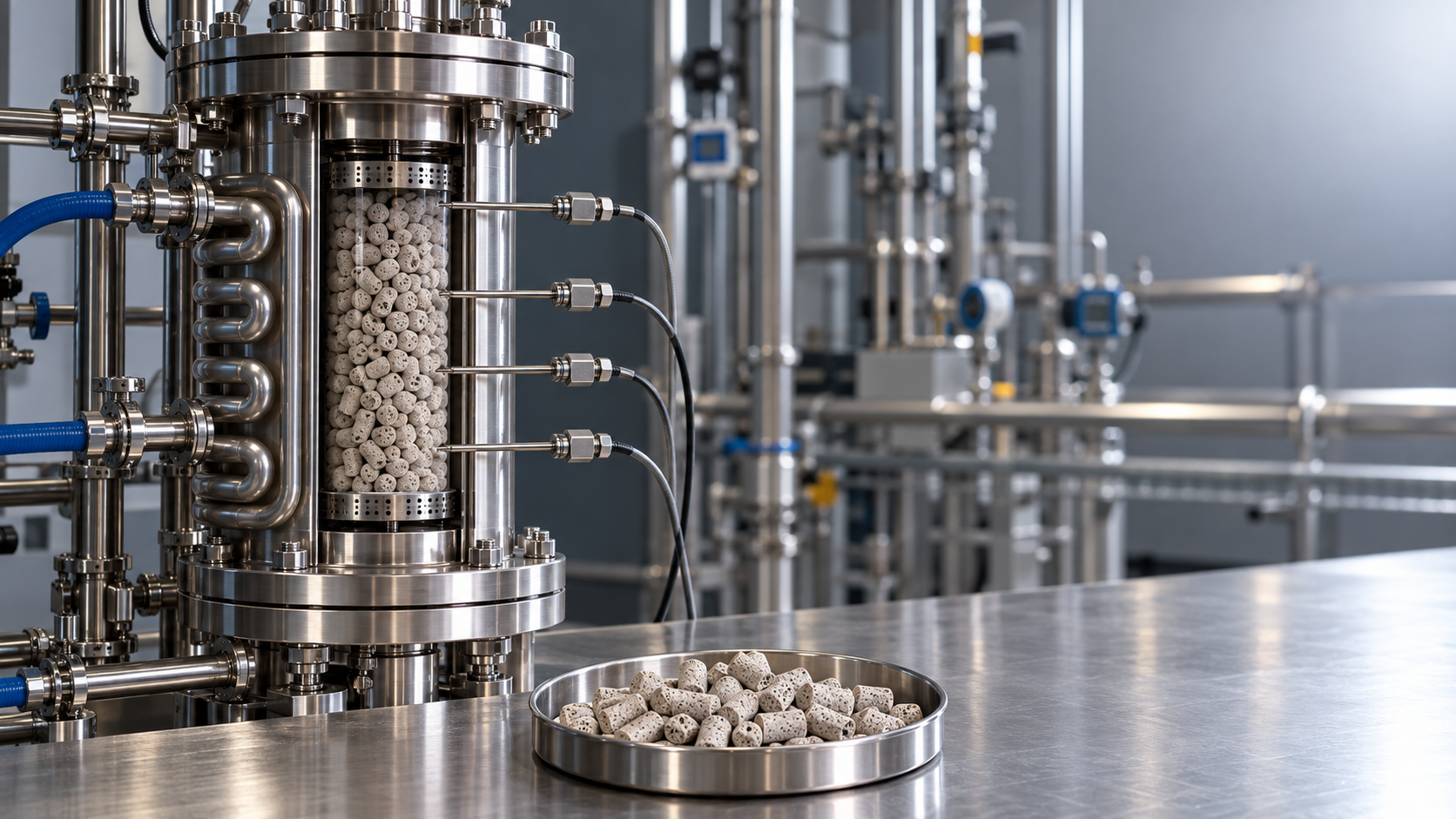
Scaling up chemical catalysts requires evidence that reaction rates, selectivity, and temperature profiles remain acceptable at commercial particle sizes and reactor dimensions. Laboratory conversion alone cannot establish this. A small reactor often removes heat efficiently, uses finely divided catalyst, and provides mixing conditions that production equipment cannot reproduce. Before equipment specifications are fixed, the design needs a defensible separation of intrinsic kinetics, particle transport, fluid mixing, and reactor heat removal.
The most useful starting point is a rate model supported by transport checks under representative conditions. That model must then be tested against the proposed reactor geometry, including credible operating disturbances. An acceptable average outlet temperature does not rule out a damaging hot spot inside a catalyst pellet or near the inlet of a packed bed.
Establish what the laboratory rate actually measures
An observed reaction rate combines chemical kinetics with the delivery of reactants and removal of products and heat. If a catalyst consumes reactant faster than diffusion supplies it, increasing intrinsic activity produces little additional throughput. Conversely, an exothermic particle that runs hotter than the measured fluid temperature can appear unusually active, leading to an overstated kinetic rate constant.
Laboratory comparisons should vary transport conditions while holding the relevant chemical conditions constant. In a stirred slurry, increase agitation until the measured rate becomes insensitive to further increases, while verifying that temperature and gas availability remain controlled. In a packed bed, varying superficial velocity requires attention to residence time and conversion; otherwise, a conversion change can be mistaken for evidence of film resistance.
Particle-size comparisons are particularly informative. A higher rate per unit catalyst mass after reducing particle size suggests internal diffusion resistance, provided crushing has not altered active-site accessibility, composition, or catalyst structure. Attrition and changes in wetting can also affect the result. Use measured particle-size distributions rather than a nominal sieve designation alone.
Obtain kinetic data over the expected concentration and temperature range, including relevant product inhibition. Low-conversion measurements simplify interpretation because concentration and temperature vary less through the test reactor. However, kinetics fitted only to fresh feed may describe the downstream region poorly when products, water, or inhibitors accumulate.
Distinguish the transport limits before changing the design
These mechanisms frequently overlap. Increasing fluid velocity can improve both mass and heat transfer, while reducing particle size affects pore diffusion, pressure drop, and particle temperature. A single successful adjustment does not identify the controlling mechanism. Interpretation needs measured temperatures, material balances, and a consistent reactor model.
Translate particle performance into commercial catalyst loading
The Thiele modulus compares the characteristic reaction rate with internal diffusion. For a first-order reaction in an isothermal spherical particle, a common definition is φ = Rp√(kv/Deff), where Rp is particle radius, kv is a rate constant expressed on a compatible catalyst-volume basis, and Deff is effective diffusivity. Larger particles, faster reactions, and lower diffusivity increase the likelihood of internal concentration gradients.
Real catalysts require more detail than this expression supplies. Extrudates have different geometries, multicomponent diffusion can matter, and liquid-filled pores behave differently from gas-filled pores. Effective diffusivity must represent the actual pore network and operating composition. A value inferred from an unrelated catalyst or a dry material measurement can produce a misleading scale-up prediction.
The Weisz–Prater criterion offers a screening calculation using the observed rate, particle dimensions, effective diffusivity, and reactant concentration at the particle surface. External transfer screening, often using a Mears-type criterion, evaluates the concentration difference across the surrounding fluid film. Apply published criteria with their stated geometry, reaction-order assumptions, and unit conventions; rates expressed per mass of catalyst must be converted consistently before combining them with volume-based quantities.
When internal diffusion is significant, represent it through an effectiveness factor or a resolved particle model. For a simple isothermal reaction, the effectiveness factor compares the actual particle rate with the rate at uniform surface conditions. Complex reaction networks need species-specific treatment: pore gradients can change intermediate residence times and selectivity even when overall conversion remains acceptable.
Choosing smaller pellets solely to recover activity can create an impractical bed pressure drop. The particle decision therefore needs a joint calculation of reaction rate, pressure drop, mechanical strength, fines generation, and expected fouling. Commercial pellet dimensions should be included in pilot work before the final catalyst inventory is established.
Calculate heat generation where the reaction occurs
For an exothermic reaction, local heat generation follows the local reaction rate and reaction enthalpy. A basic screening relationship is qgen = (−ΔHr)r, using compatible molar and volume bases. Overall heat removal is often expressed as Q = UAΔT, but the selected temperature difference must reflect the exchanger arrangement and changing process and coolant temperatures.
These relationships answer different questions. Total cooling duty establishes the heat that must leave the system. Local calculations establish whether that heat reaches the cooling surface quickly enough to avoid excessive temperature. Adequate installed duty does not guarantee an acceptable bed-center temperature.
Geometric scale-up is especially problematic for jacketed vessels because volume grows faster than external surface area. In a fixed bed, increasing tube diameter increases the distance heat must travel toward the wall. A larger vessel with the same nominal residence time can therefore develop a substantially different thermal profile.
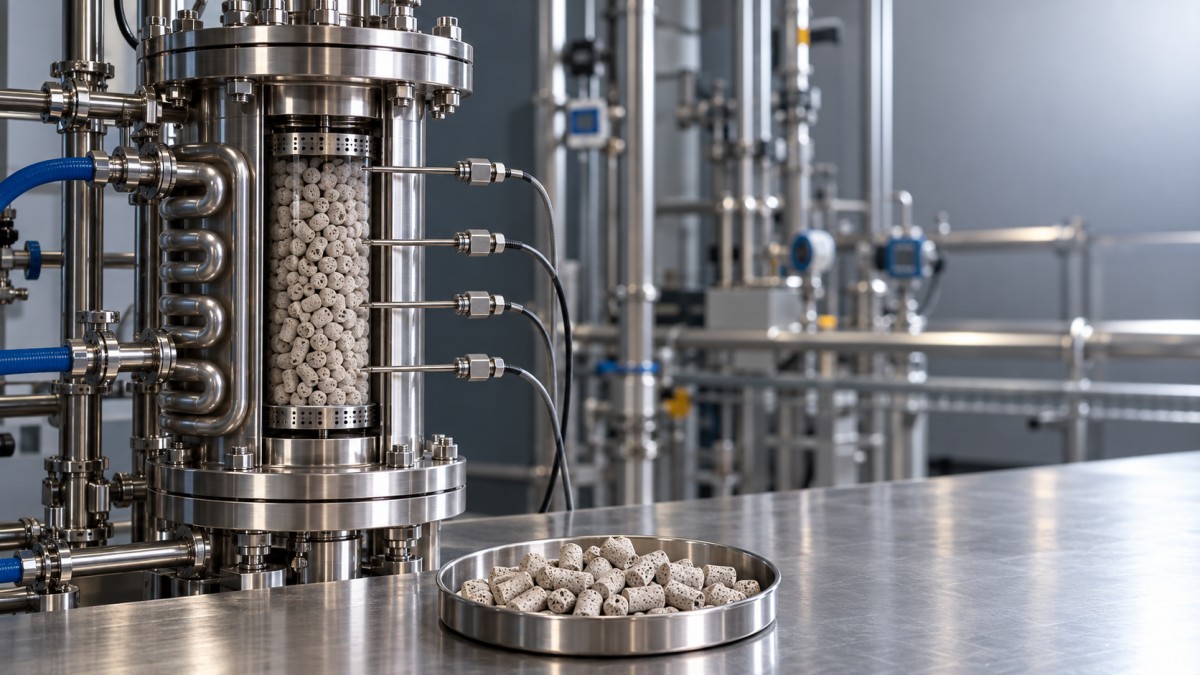
Evaluate radial and axial temperature gradients using heat-transfer parameters appropriate to the selected packing, flow regime, and fluid properties. Include wall effects and coolant warming where relevant. Heat-transfer coefficients established with clean equipment should not silently become end-of-run design values when fouling is expected.
Calculate the adiabatic temperature rise as a screening measure of the temperature increase available from reaction without heat removal. Its interpretation must account for conversion, heat capacity, phase changes, and competing reactions. Then examine whether temperature sensitivity creates accelerating heat generation near the proposed operating point. A steady heat balance alone does not establish thermal stability.
Where the thermal assessment identifies a limitation, relevant design changes include smaller-diameter reaction tubes, staged catalyst loading, inert dilution, interstage cooling, or feed staging. Each changes the reaction and flow distribution, so the revised configuration requires recalculation rather than an assumed improvement.
Preserve phase contact and distribution during scale-up
Matching rotational speed does not preserve mixing between laboratory and production vessels. Impeller geometry, power per volume, tip speed, gas dispersion, and solids suspension respond differently to size. Select the governing mixing requirement from the process mechanism. Maintaining suspended catalyst does not prove that gas absorption can supply the required dissolved reactant.
For gas–liquid catalytic reactions, compare gas-to-liquid transfer capacity with reactant consumption. The volumetric transfer term kLa and the dissolved-gas driving force must reflect actual pressure, composition, temperature, and liquid properties. If gas transfer controls the observed rate, adding catalyst increases inventory without a proportional production increase.
Trickle beds introduce wetting efficiency and liquid distribution as additional constraints. Partial wetting leaves some catalyst poorly supplied, while channeling produces uneven residence times and temperature profiles. A distributor that performs well at design flow may distribute poorly during turndown. Feed nozzles, distributor layout, bed supports, and loading practices therefore belong in the scale-up assessment.
Composition changes deserve the same attention as equipment changes. In aqueous formulations containing Sodium metaphosphate CAS#10361-03-2, for example, establish actual pH, ionic composition, solubility, and compatibility with the catalyst. Its presence alone does not establish catalytic or buffering performance under the proposed conditions. Formulation changes can affect catalyst surfaces and fluid properties, so transport measurements should use representative process liquid.
Use pilot results to challenge the scale-up model
A pilot reactor is valuable when it resolves uncertainties that laboratory equipment cannot reproduce. Its dimensions and operating range should be selected around the disputed mechanism. A very narrow pilot bed may support kinetic measurements while understating the radial heat-removal problem expected in a wider commercial tube.
Temperature measurements need enough spatial coverage to detect the predicted hot region. An outlet thermocouple cannot locate an upstream peak. Probe placement, response time, and disturbance of local flow also matter, particularly in narrow beds. Compare measured profiles with model predictions rather than fitting only outlet conversion.
Useful pilot acceptance evidence includes:
- Material and energy balances that close within defined measurement uncertainty, with sampling that captures relevant by-products.
- Temperature profiles across the proposed operating range, including the conditions expected to produce the greatest heat release.
- Pressure-drop and distribution data at minimum and maximum intended flow. A stable design point alone leaves turndown behavior unresolved.
- Performance after a representative operating period, sufficient to assess whether fouling, deactivation, or attrition changes the controlling limitation.
Fresh catalyst and aged catalyst do not necessarily create the same limiting case. Fresh material can generate the highest local heat release. Aging can reduce activity while increasing pressure drop or redistributing flow. Separate these effects in the model instead of applying one uniform activity correction to the whole bed.
Set equipment limits from an operating envelope
Commercial specifications should identify the conditions under which throughput and selectivity remain achievable: feed composition, catalyst condition, particle distribution, coolant conditions, pressure drop, and allowable local temperatures. Specify the measurement locations and uncertainty behind those limits. An average temperature specification leaves considerable room for incompatible interpretations.
Disturbance analysis should cover credible changes such as loss of agitation, reduced coolant flow, feed enrichment, and interrupted circulation. Reaction calorimetry and process hazard analysis provide the basis for evaluating protective measures and emergency response requirements. Transport correlations alone cannot establish safe shutdown behavior.
Before design release, unresolved assumptions should have explicit bounds and a defined consequence for equipment sizing or operation. If the required production rate is achievable only with an unverified diffusivity or an optimistic heat-transfer coefficient, the scale-up remains technically open. The next experiment should target that uncertainty directly.
Related Picks
 Butylated Hydroxytoluene Price Drivers: Supply, Purity, and Purchasing Risk FactorsOct 21, 2026Butylated Hydroxytoluene price trends depend on supply stability, purity, logistics, and purchasing risk. Learn how to compare quotes wisely and reduce sourcing costs.
 Sodium Tripolyphosphate Price Trends: Raw Material and Energy ExposureOct 20, 2026Explore sodium tripolyphosphate price trends, from phosphate and soda ash costs to energy exposure. Learn how to compare quotes, manage sourcing risks, and make smarter purchasing decisions.
 Acetonitrile Shipment to Vietnam Successfully Dispatched; RCEP Benefits Boost Fine Chemical Trade with ASEANSep 16, 2026A shipment of industrial-grade acetonitrile from our company has recently been loaded and dispatched following the completion of standardized hazardous material packaging and container securing procedures.
 Nigerian Client’s Order of 4 Containers of Vinyl Acetate Successfully Loaded and Shipped to West AfricaSep 16, 2026We recently completed the loading of a vinyl acetate order for a Nigerian client; four containers of the product have been successfully packed and are ready for shipment to Nigeria.




Question Consultation
Send Us Your Inquiry Today

Luxi Chemical is a professional chemical product supplier with ample stock of all chemical categories and excellent quality, welcome your purchase inquiry.

