


How dodecyl dimethyl benzyl ammonium chloride works as a biocide
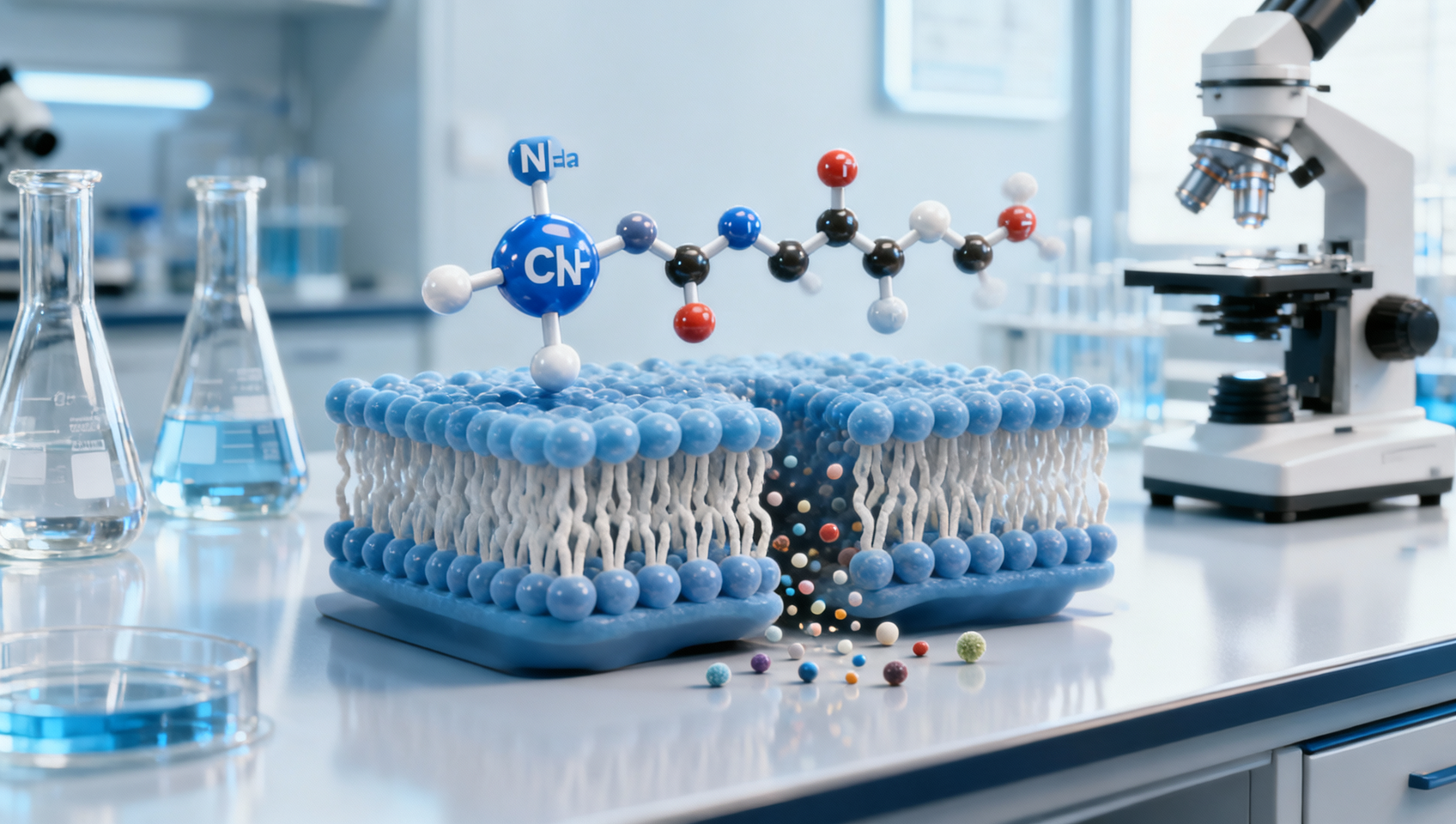
Dodecyl dimethyl benzyl ammonium chloride works as a biocide mainly by damaging microbial membranes. Its positively charged molecular head interacts with the microbial cell surface, while its hydrocarbon chain associates with membrane lipids. This disrupts the barrier that controls movement into and out of the cell, allowing essential components to leak and undermining the functions needed for survival.
That mechanism explains both its usefulness and its limits. The compound can act against susceptible bacteria, fungi, and enveloped viruses, but it is not a universal sterilant. Performance depends on whether enough active material reaches the organism and remains in contact long enough. Dirt, incompatible formulation ingredients, biofilms, and differences in microbial structure can all change the result.
The molecular structure behind its antimicrobial action
Dodecyl dimethyl benzyl ammonium chloride belongs to the quaternary ammonium compound family, often abbreviated as QACs or “quats.” Its nitrogen atom carries a permanent positive charge and is attached to a dodecyl group, two methyl groups, and a benzyl group. Chloride is the counterion; it is not the source of the compound’s principal antimicrobial action.
The molecule is amphiphilic: it contains both a water-compatible charged region and a hydrophobic region that associates with fats and other nonpolar materials. The dodecyl group is a twelve-carbon chain. Together with the benzyl group, it gives the molecule the ability to interact with lipid-rich structures, including microbial membranes.
This combination makes it a cationic surfactant as well as an antimicrobial agent. Its surfactant properties can support wetting and interaction with surfaces, but wetting alone does not demonstrate disinfection. Antimicrobial performance requires sufficient exposure to produce damage that the target organism cannot repair.
Chemical identity matters when interpreting product information. Dodecyl dimethyl benzyl ammonium chloride is the C12 member of the alkyl dimethyl benzyl ammonium chloride family. Commercial benzalkonium chloride products can contain mixtures of alkyl-chain lengths rather than only this single compound. Results obtained with a mixed-chain product should not automatically be treated as results for the isolated C12 material.
It should also not be confused with didecyl dimethyl ammonium chloride, another QAC with a different structure. Similar names and overlapping abbreviations can obscure meaningful formulation differences. The full chemical name, composition, and active-content specification provide a more reliable basis for comparison.
How membrane damage becomes microbial inactivation
The process begins with adsorption to the microbial surface. Many bacterial cell-envelope components carry negative charges, which favor interaction with the positively charged ammonium group. These interactions help bring the molecule close to the cell, although surface charge is not the only factor governing susceptibility.
Once at the cell envelope, the hydrophobic portion associates with membrane lipids. The resulting disturbance changes membrane organization and permeability. A healthy membrane is not simply a container: it maintains ion gradients, supports transport, and provides an organized environment for proteins involved in essential cellular processes.
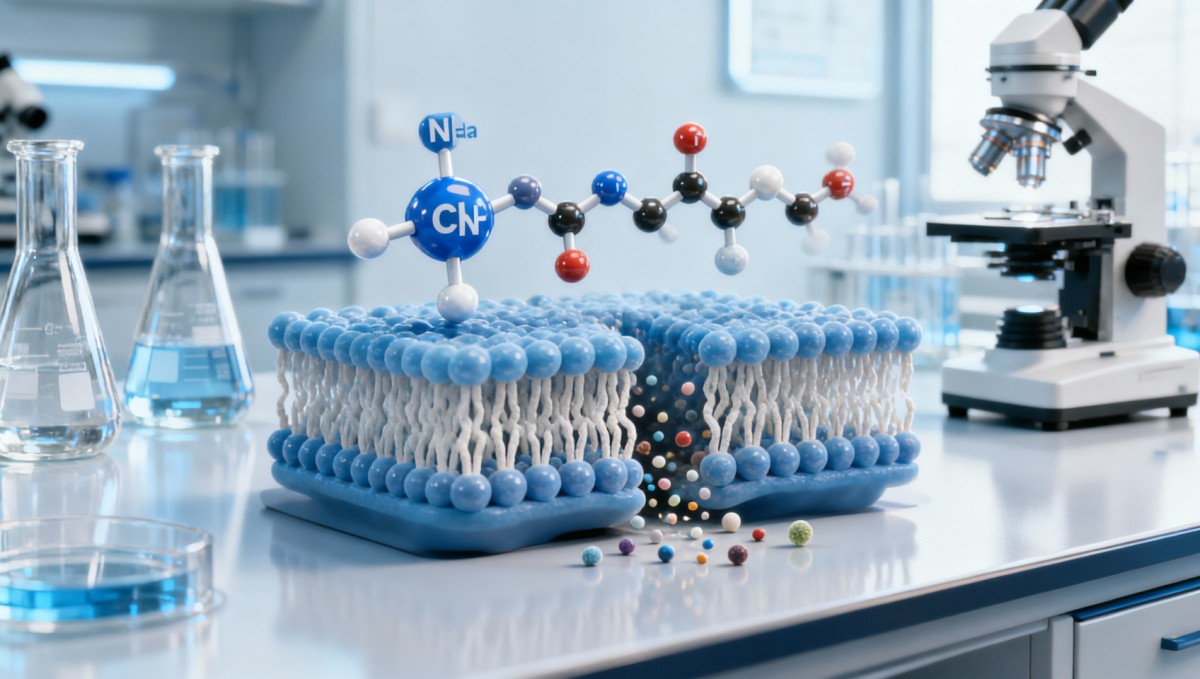
As membrane integrity deteriorates, ions and small intracellular molecules can escape. The cell becomes less able to maintain its internal conditions, import nutrients selectively, or sustain energy-related processes. Disruption of membrane-associated proteins can contribute to this loss of function. With sufficient exposure, the combined damage becomes lethal.
The effect is therefore more complex than “bursting the cell.” Visible rupture is not required for antimicrobial action. A cell may lose viability because its membrane can no longer maintain the electrochemical gradients and regulated transport on which metabolism depends.
At insufficient exposure, growth inhibition or sublethal injury may occur instead of reliable killing. This distinction matters when interpreting laboratory evidence: a compound that prevents visible growth under one test condition has not necessarily demonstrated rapid disinfection under practical use conditions.
Why different microorganisms respond differently
The membrane-targeting mechanism provides a useful starting point for understanding antimicrobial spectrum, but microbial envelopes differ substantially. The organism, strain, physiological state, and test conditions all influence the outcome.
For Gram-negative bacteria, the outer membrane can restrict access to the underlying cytoplasmic membrane. Differences in envelope composition, transport systems, and efflux mechanisms help explain why activity against one bacterial species does not establish equivalent activity against another.
Enveloped viruses present a different case. They are not cells, but their lipid envelope is essential to infection. Damage to that envelope can inactivate them. Non-enveloped viruses have a protein capsid without the same lipid target, so the mechanism does not support a blanket claim of effectiveness against all viruses.
Bacterial spores are also fundamentally different from vegetative cells. Their protective layers and dormant state make them difficult to inactivate with conventional QAC disinfectants. A need for sporicidal treatment or sterilization therefore requires a different evidence base and, frequently, a different chemistry.
Concentration and contact time must be considered together
A dodecyl dimethyl benzyl ammonium chloride biocide does not have one universally effective use concentration. The required exposure depends on the target organism, formulation, temperature, soil load, and intended application. A concentration shown to work in a clean laboratory suspension cannot automatically be transferred to a contaminated surface or industrial process.
The relevant quantity is active ingredient in the final use solution, not simply the amount of commercial concentrate added. Two concentrates with different active contents will produce different working concentrations at the same dilution ratio. Mixed-active formulations introduce further differences because the accompanying ingredients can alter antimicrobial performance.
Contact time is equally important. Microbial inactivation requires sustained exposure; application followed by immediate wiping may not reproduce a validated disinfectant procedure. On surfaces, premature drying can interrupt contact even when the dilution is correct.
Adding more chemical is not a dependable substitute for adequate contact time or prior cleaning. Excess concentration can increase residue, exposure hazards, and material-compatibility problems without establishing the required microbiological result. The defensible operating conditions are those supported by testing for the finished formulation and intended use.
What prevents the active ingredient from reaching its target?
The nominal concentration in a container is not necessarily the concentration available at the microbial membrane. QACs can associate with other materials in the formulation or application environment, reducing the amount available to act against microorganisms.
Organic contamination and surface deposits
Proteins, oils, microbial debris, and other soil can interfere with treatment in two ways: they may bind the active ingredient, and they can physically shield microorganisms. This is why cleaning and disinfection are related but separate operations. Removing contamination improves access; applying a biocide does not automatically remove the contamination itself.
A formulation validated under a specified dirty condition offers more relevant evidence for contaminated applications than a clean-condition test. However, even dirty-condition testing represents a defined challenge, not every possible deposit or soil load.
Incompatible detergents and formulation components
Because this compound is cationic, anionic surfactants can interact with it and reduce its antimicrobial availability. Mixing a QAC disinfectant with another cleaner can therefore impair performance, even if the mixture remains visually clear.
Other ingredients may improve wetting, stability, or antimicrobial performance when deliberately formulated and tested together. Compatibility cannot be inferred merely from solubility or appearance. A finished formulation must be evaluated as a system, rather than as a collection of ingredients with individually favorable properties.
Water quality, pH, and temperature
Hardness salts and dissolved materials can influence formulation behavior and antimicrobial activity. The size and direction of the effect depend on the complete formulation, making universal claims of hard-water tolerance inappropriate.
The quaternary ammonium group remains positively charged across ordinary use pH ranges. Nevertheless, pH can affect microorganisms, other formulation ingredients, and the surrounding soil. Temperature also influences the rate of antimicrobial action and, on open surfaces, evaporation. Evidence generated under one set of conditions does not establish identical performance under another.
Biofilms make access a separate problem from susceptibility
A biofilm is a surface-associated microbial community embedded in a self-produced matrix. That matrix can slow access, bind antimicrobial agents, and create protected regions. Cells within it may also have different metabolic states from freely suspended cells.
Consequently, a QAC formulation that kills suspended bacteria may perform less effectively against an established biofilm. This is not necessarily evidence that the membrane-disruption mechanism has stopped working. The active material may fail to reach all cells at an effective exposure.
In industrial systems, lowering microbial counts in circulating water and removing attached growth are different objectives. Mechanical cleaning, deposit management, and a validated microbial-control program may be needed alongside chemical treatment. Simply raising the dose does not prove that a mature biofilm has been removed.
Reduced susceptibility can also arise through biological mechanisms, including changes in the cell envelope and increased efflux. Repeated sublethal exposure can select for organisms better able to survive treatment. This supports careful control of dilution, contact time, and cleaning—not the assumption that all QAC use inevitably creates resistance.
What an efficacy claim actually establishes
The strongest evidence concerns the finished formulation under defined application conditions. Useful test information identifies the microorganisms challenged, active concentration, contact time, temperature, soil conditions, and method used to measure surviving organisms.
Suspension tests establish activity when microorganisms and the treatment are mixed under controlled conditions. Surface or carrier tests address additional challenges, such as drying, surface attachment, and application coverage. Neither result should be generalized beyond its demonstrated scope without supporting evidence.
Minimum inhibitory concentration data answer whether growth is inhibited under particular laboratory conditions. They do not, by themselves, establish how quickly a disinfectant kills microorganisms. Likewise, laboratory testing needs an effective neutralization step at the end of exposure; otherwise, residual biocide can continue acting during recovery and exaggerate the apparent result.
Disinfectant, preservative, and industrial microbial-control uses may also carry different regulatory requirements. The presence of a recognized antimicrobial ingredient does not itself authorize every application or establish every organism-specific claim.
Effective membrane disruption also creates safety limits
The interaction with biological membranes is not exclusive to microorganisms. Concentrated QAC products can present significant skin and eye hazards, while exposure through mists requires assessment according to the formulation and handling method. Working solutions and concentrates should not be treated as having identical hazards.
Environmental release also requires control because QACs can be toxic to aquatic organisms. Their tendency to bind to solids or sludge does not eliminate environmental concern. Handling, disposal, rinsing, and discharge decisions should follow the relevant safety data, product directions, and local requirements.
The practical value of dodecyl dimethyl benzyl ammonium chloride lies in a specific mechanism: interaction with and disruption of susceptible microbial membranes. Whether that mechanism delivers useful control depends on chemical availability, access to the target, and sufficient exposure. The decisive evidence is therefore not the ingredient name alone, but demonstrated performance of the formulation under conditions that match its intended application.
Related Picks
 Butylated Hydroxytoluene Price Drivers: Supply, Purity, and Purchasing Risk FactorsOct 21, 2026Butylated Hydroxytoluene price trends depend on supply stability, purity, logistics, and purchasing risk. Learn how to compare quotes wisely and reduce sourcing costs.
 Sodium Tripolyphosphate Price Trends: Raw Material and Energy ExposureOct 20, 2026Explore sodium tripolyphosphate price trends, from phosphate and soda ash costs to energy exposure. Learn how to compare quotes, manage sourcing risks, and make smarter purchasing decisions.
 Acetonitrile Shipment to Vietnam Successfully Dispatched; RCEP Benefits Boost Fine Chemical Trade with ASEANSep 16, 2026A shipment of industrial-grade acetonitrile from our company has recently been loaded and dispatched following the completion of standardized hazardous material packaging and container securing procedures.
 Nigerian Client’s Order of 4 Containers of Vinyl Acetate Successfully Loaded and Shipped to West AfricaSep 16, 2026We recently completed the loading of a vinyl acetate order for a Nigerian client; four containers of the product have been successfully packed and are ready for shipment to Nigeria.




Question Consultation
Send Us Your Inquiry Today

Luxi Chemical is a professional chemical product supplier with ample stock of all chemical categories and excellent quality, welcome your purchase inquiry.

