


How to Choose Natural Pigments for pH-Sensitive Beverage Applications
Start with the beverage, not the color chart
When a drink is pH-sensitive, the wrong pigment usually fails in a predictable way: it shifts hue after hot fill, fades under shelf light, drops out in a cloudy system, or looks fine in the lab and unstable in commercial batching. That is why technical evaluation should begin with the beverage environment itself. Before comparing Natural Pigments, lock down the actual pH window, target shelf life, thermal process, packaging type, sweetener system, and whether the product is clear, pulpy, protein-based, or emulsified.
A pigment that performs well at pH 3.0 in a clear fruit drink may behave very differently at pH 4.2 in a tea-based formulation with metal ions, added vitamins, and oxygen pickup during filling. Many selection mistakes happen because teams evaluate colorants in water or a simplified bench formula, then assume the same result will hold in the finished beverage. It rarely does.
Check the pH response curve before discussing shade
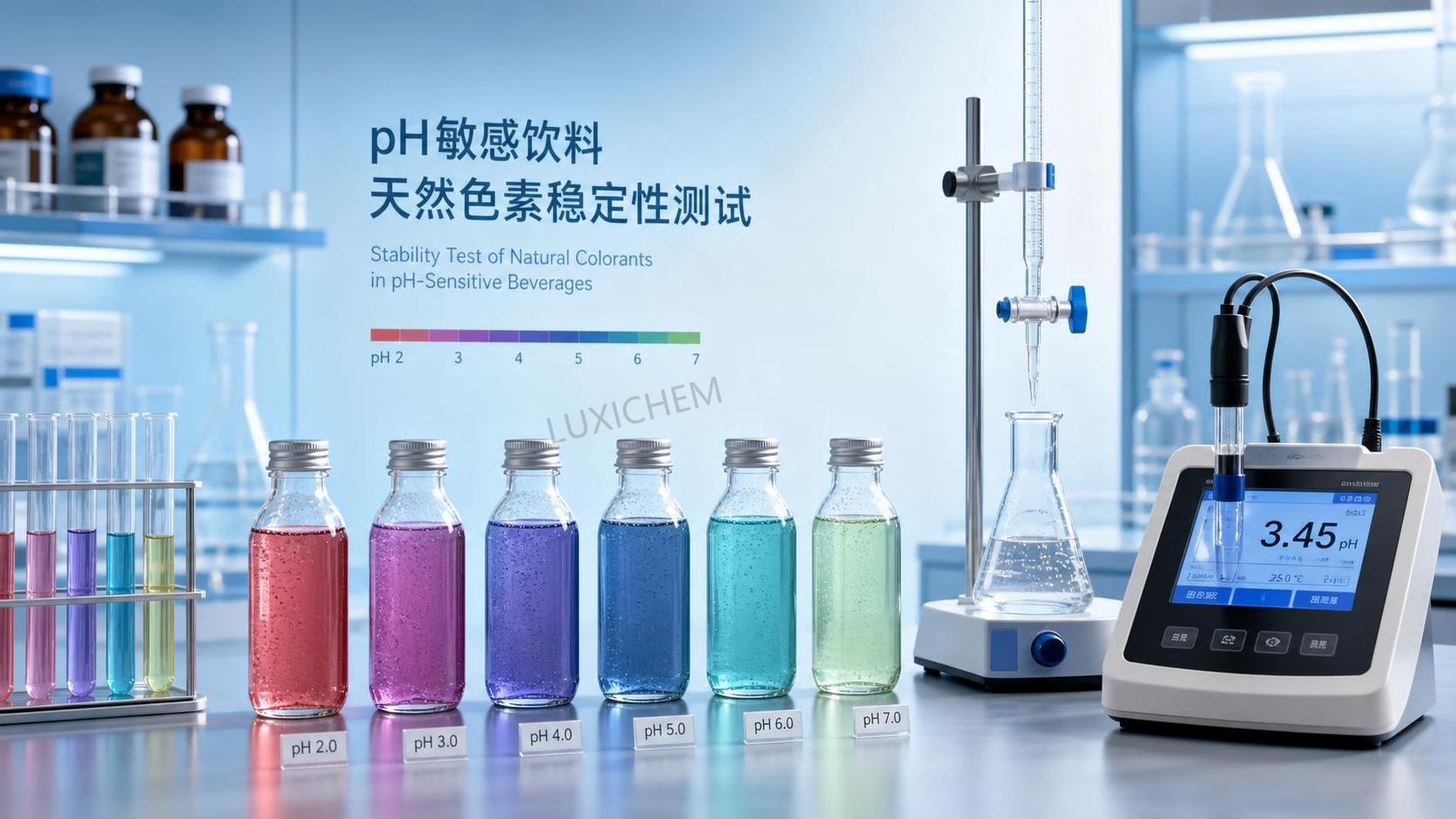
For pH-sensitive beverage work, shade selection comes after pH behavior. Natural Pigments can be highly responsive to acidity, and that response is not always linear. Some pigments stay attractive across a narrow acidic range, then shift abruptly as the formula moves closer to neutral. Others lose brightness first, then show sediment or ring formation later.
- Map the intended pH range, including normal production variation and end-of-shelf-life drift.
- Review the color response in the finished matrix, not only in stock solution.
- Look for reversible and irreversible changes. A temporary shift during mixing is one thing; permanent degradation is another.
- Record both instrumental data and visual appearance under retail lighting.
If your formulation team expects future line extensions at different acidities, avoid choosing a pigment system that works only at one exact pH point. That usually creates unnecessary reformulation work later.
Separate “acid stable” from “process stable”
This distinction matters more than many buyers expect. A pigment can survive low pH and still fail during UHT treatment, tunnel pasteurization, or hot-fill holding. Heat, oxygen exposure, and shear often act together. In practice, the issue is not whether a supplier says a pigment is stable, but stable under which process conditions and in which beverage base.
Run the screening in the same sequence your plant will use: premix, hydration if needed, acid addition point, homogenization, deaeration if applicable, thermal treatment, and filling. A lab sample added at the end of preparation can hide problems that show up once the pigment sees the full process.
A quick filter for technical evaluators is this: if the color change appears immediately after heating, it is usually a process compatibility issue; if it develops slowly during storage, look harder at oxygen, light, residual enzyme activity, trace metals, and package barrier performance.
Watch the full formulation, not just the pigment itself
Natural Pigments do not fail in isolation. Their performance depends on what else is in the bottle. Acidulants, preservatives, sweeteners, clouding agents, proteins, minerals, botanical extracts, and fortification systems can all shift stability.
A few formulation interactions are worth flagging early:
- Metal ions: trace iron or copper can accelerate discoloration in some systems.
- Ascorbic acid and other reactive ingredients: useful in the formula, but sometimes unfriendly to long-term color retention.
- Protein or plant solids: these can change how color is perceived and may also affect dispersion.
- High turbidity: can make a pigment look weaker or dirtier than it is.
- Emulsions: distribution between phases may alter visual uniformity.
If a candidate pigment looks unstable, do not reject it before checking whether the issue is really coming from another ingredient or from the order of addition. In many beverage projects, the fix is procedural rather than a complete pigment change.
Confirm regulatory fit by market and product identity
This is where technical screening and commercial reality meet. A pigment can be technically excellent and still be the wrong choice if it does not match the destination market, beverage category, or labeling strategy. “Natural” is not a universal regulatory conclusion; it depends on how the ingredient is defined and permitted in the target jurisdiction.
The practical check is straightforward. Review the supplier specification, ingredient description, and supporting compliance documents against the exact market where the beverage will be sold. Then match that to the product identity on pack: juice drink, flavored water, sports drink, tea beverage, dairy alternative, and so on. The same color solution may be acceptable in one category and problematic in another because of use conditions, naming conventions, or additive permissions.
For teams sourcing through broad chemical and ingredient portfolios, this is often where procurement and regulatory should talk earlier. Companies with mixed product lines, such as food additives and other chemical materials, can streamline supply access, but technical evaluators still need product-specific paperwork rather than portfolio-level assumptions.
Judge the dispersion system as hard as the color
A pigment that cannot be dispersed consistently is expensive even when the unit price looks attractive. In pH-sensitive beverages, poor dispersion shows up as specking, settling, neck ring, inconsistent shade between batches, or visible color stratification after transport.
Ask practical questions:
- Does the pigment require pre-dissolution, hydration time, or a carrier system?
- At what point should acid be introduced?
- Can the plant’s existing mixing energy handle the material without overprocessing it?
- Will filtration or polishing remove part of the color?
If the answer to any of these is unclear, the trial design is incomplete. This part is often treated as routine, but it directly affects scale-up success.
Use packaging exposure as part of the pigment decision
Shelf appearance is a packaging question as much as a pigment question. Light-sensitive Natural Pigments may perform acceptably in opaque or fully sleeved containers and underperform in clear PET on bright retail shelves. Oxygen ingress and headspace control also change the outcome.
Do not approve a pigment on bench stability alone if the packaging decision is still open. Those two choices belong in the same review.
Compare total use cost, not purchase price per kilogram
The cheaper pigment is often the more expensive one after rework, batch rejects, or overuse to chase a target shade. Technical evaluators should compare candidates on delivered color effect under actual process conditions. Include dosage, yield loss, handling complexity, extra stabilizers, waste, and shelf-life risk.
This matters even more for teams buying through one-stop sourcing channels. A supplier with broad availability across food additives and related chemical categories may reduce transaction time, but the final decision still has to sit on formulation performance and cost-in-use, not convenience alone.
Keep supplier documentation tied to the actual lot and application
A polished technical sheet is useful, but it is not the whole qualification package. For beverage applications, ask for the documents that let you judge consistency and application relevance: specification, certificate of analysis for the supplied lot, recommended use conditions, storage guidance, and any application notes specific to acidic beverages.
This is also the point where teams sometimes overread unrelated product information from the same supplier catalog. For example, a company may also list materials such as 5-Bromo-2-chloropyrimidine CAS#32779-36-5, which is part of a broader chemical offering, but that should not be treated as evidence about beverage pigment performance. Keep the file set tightly connected to the ingredient you are evaluating.
Build the trial around failure modes you actually see in production
The most useful screening plan is not the one with the most test points. It is the one that reproduces the real ways products fail. If your line is prone to oxygen pickup, make that part of the trial. If your beverage sits in transparent bottles in warm distribution, include light and temperature stress. If operators sometimes change the acid addition sequence during scale-up, test that too.
A practical screening sequence usually looks like this:
- Bench screening in the final formula at the real pH target.
- Small process simulation with thermal exposure and realistic mixing order.
- Short accelerated storage to expose the likely weak points.
- Pilot confirmation in the intended package.
That sequence catches most expensive mistakes before commercialization.
Make the final call with a narrow decision sheet
When several candidates are still in play, reduce the discussion to a short decision sheet: pH tolerance in the finished beverage, thermal survival, light and oxygen sensitivity in the chosen package, regulatory fit by market, dispersion reliability, and cost-in-use. If a pigment is weak in one of those areas, the team should know whether the weakness is manageable through process control or whether it is a disqualifier.
For technical evaluators, that is the cleanest way to choose Natural Pigments for pH-sensitive beverages without drifting into trial-and-error development. Start with the beverage environment, challenge the pigment under real process conditions, and only then compare commercial terms. That order saves time, reduces reformulation loops, and produces a color choice the plant can actually hold batch after batch.
Related Picks
 Butylated Hydroxytoluene Price Drivers: Supply, Purity, and Purchasing Risk FactorsOct 21, 2026Butylated Hydroxytoluene price trends depend on supply stability, purity, logistics, and purchasing risk. Learn how to compare quotes wisely and reduce sourcing costs.
 Sodium Tripolyphosphate Price Trends: Raw Material and Energy ExposureOct 20, 2026Explore sodium tripolyphosphate price trends, from phosphate and soda ash costs to energy exposure. Learn how to compare quotes, manage sourcing risks, and make smarter purchasing decisions.
 Acetonitrile Shipment to Vietnam Successfully Dispatched; RCEP Benefits Boost Fine Chemical Trade with ASEANSep 16, 2026A shipment of industrial-grade acetonitrile from our company has recently been loaded and dispatched following the completion of standardized hazardous material packaging and container securing procedures.
 Nigerian Client’s Order of 4 Containers of Vinyl Acetate Successfully Loaded and Shipped to West AfricaSep 16, 2026We recently completed the loading of a vinyl acetate order for a Nigerian client; four containers of the product have been successfully packed and are ready for shipment to Nigeria.




Question Consultation
Send Us Your Inquiry Today

Luxi Chemical is a professional chemical product supplier with ample stock of all chemical categories and excellent quality, welcome your purchase inquiry.

