


How to Evaluate Grape Seed Extract for Polyphenol-Rich Products
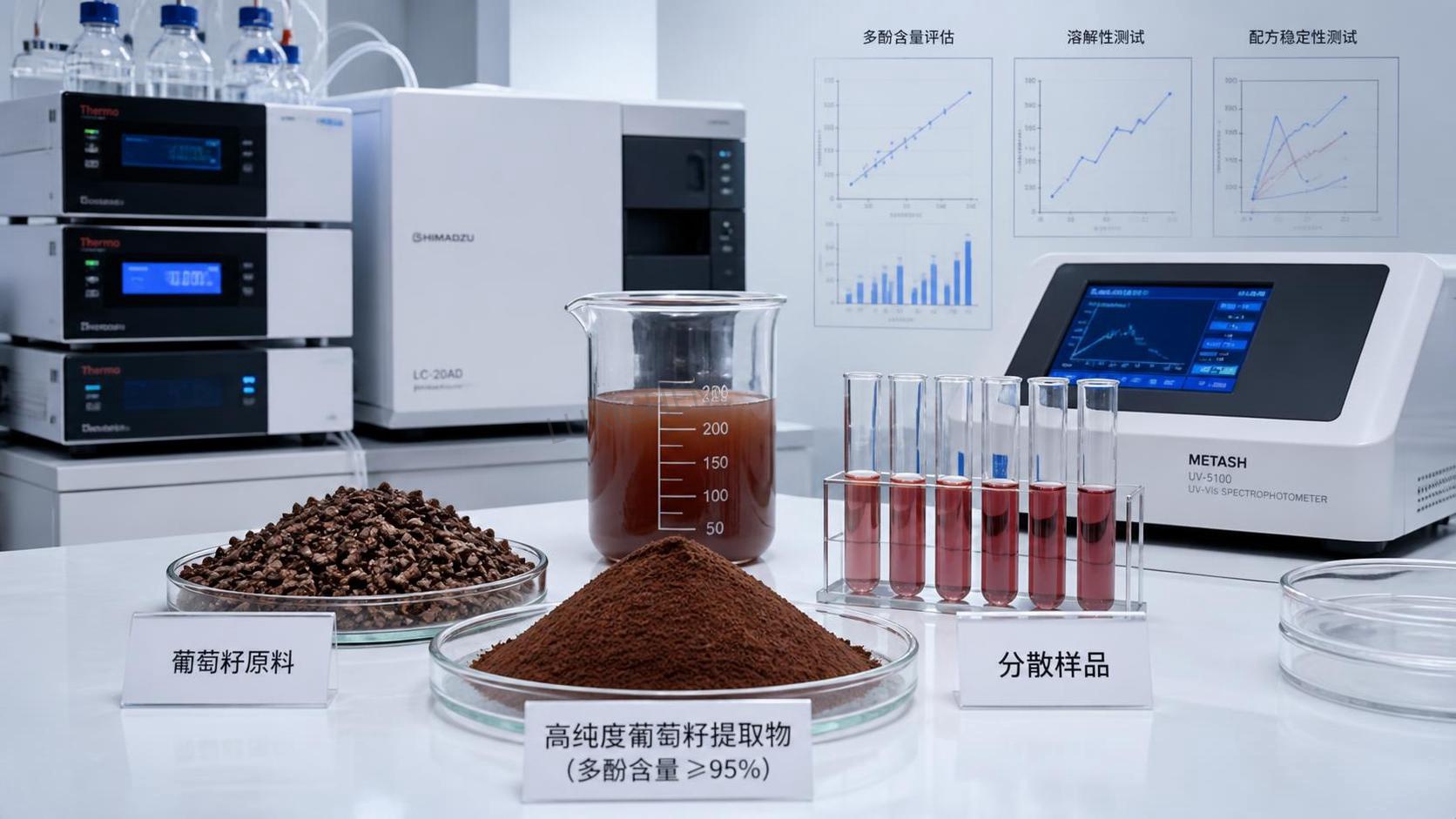
A strong Grape Seed Extract is not defined by a high polyphenol claim alone. For technical evaluation, the useful question is whether the extract delivers a controlled phenolic profile, behaves predictably in the intended formulation, and remains within an acceptable contaminant and sensory risk profile through its shelf life.
Two samples may both be sold as “high-polyphenol” grape seed extract while performing very differently. One may disperse cleanly in a powdered beverage but become hazy in a ready-to-drink product. Another may show an attractive total polyphenol result but carry a high level of tannins that create unacceptable bitterness or interact with proteins. A purchase decision should therefore connect the supplier’s analytical data to the actual dosage form, process conditions, and finished-product claim.
Start with the polyphenol profile, not the headline number
Grape seed extract contains a complex mixture of flavan-3-ols and oligomeric proanthocyanidins, commonly described as OPCs, together with other phenolic components. “Total polyphenols” is useful as an initial screening figure, but it is not enough to establish functional equivalence between suppliers.
The first requirement is to define what the finished product needs from the material. If the formulation is positioned around grape-derived polyphenols, the assay should be tied to the component group relevant to that claim. If antioxidant contribution is the practical goal, assessors should still avoid treating a single colorimetric result as a complete quality judgment. Broad assays can be influenced by different phenolic compounds and may not distinguish a desirable oligomer profile from a more astringent or less soluble fraction.
Request a specification and certificate of analysis that clearly state:
- the reported marker or marker group, such as proanthocyanidins or total polyphenols;
- the analytical method used and the reporting basis;
- moisture or loss-on-drying information, since water content changes the apparent concentration of active solids;
- the permitted assay range rather than only one typical result;
- identity testing that connects the powder to grape seed-derived material.
A supplier should be able to explain whether the value represents the extract as received, a dry basis result, or a standardized result after blending. This distinction matters when comparing quotations. A lower-priced powder with more carrier or higher moisture may not be less expensive once the dose is normalized to the desired polyphenol level.
Extraction route determines more than yield
The extraction and purification approach influences composition, residual solvents, color, odor, solubility, and batch consistency. Technical teams do not need a proprietary process description, but they do need enough process transparency to understand the material’s likely behavior.
Ask whether the extract is produced from food-appropriate processing inputs, whether a carrier is used, and whether the material has been deodorized, refined, or standardized. A carrier is not automatically a defect. It can improve powder flow, reduce hygroscopicity, or help achieve a stable assay range. The issue is whether its identity and proportion are declared, and whether it is compatible with the proposed application.
Extraction intensity also has a practical tradeoff. Recovering more phenolic material may increase yield, but it can also concentrate compounds that deepen color, increase bitterness, or create stronger interactions with proteins and minerals. For a capsule or tablet, those effects may be manageable. For a lightly flavored beverage, a clear oral liquid, or a facial serum, they may determine whether the extract is usable at all.
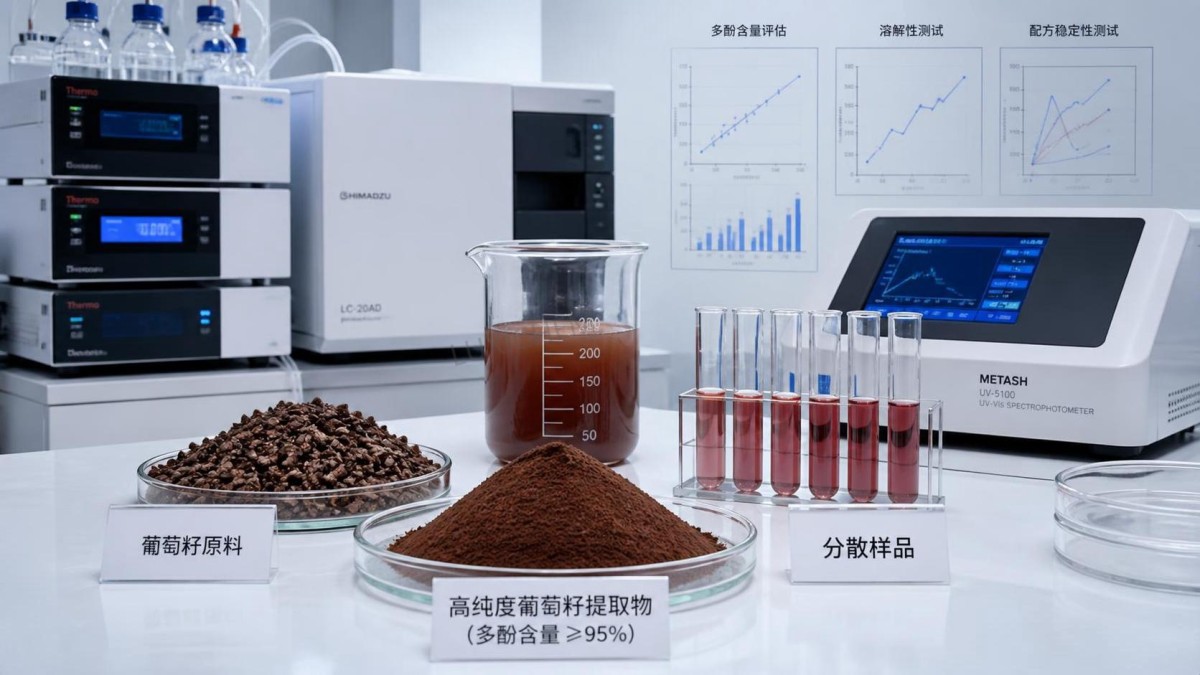
Match the extract grade to the formulation environment
A technical evaluation should use a representative formulation screen, not water alone. Grape seed extract can behave differently when exposed to acids, salts, proteins, sweeteners, surfactants, oxygen, heat, and light. A sample that appears fully soluble in a laboratory beaker may form sediment or haze after pasteurization, storage, or pH adjustment.
For beverages, test the intended dose at the final pH and with the actual sweetener, flavor, mineral, and protein system. Evaluate the freshly prepared sample, then repeat after the same thermal treatment and storage stress expected for the product. For topical systems, inspect both the aqueous phase and the finished emulsion; polyphenolic materials can alter color and interact with formulation components in ways that are not visible in a simple solubility test.
Color deserves deliberate attention. Darker extract is not automatically lower quality, but color can limit use in clear drinks, pale gummies, white tablets, transparent gels, and light-colored creams. Set an internal color acceptance range that reflects the finished product rather than asking for an arbitrary “light color” grade.
Do not overlook stability and oxidation management
Polyphenol-rich materials are sensitive to their chemical surroundings. Exposure to oxygen, elevated temperature, light, and certain metal ions can contribute to color changes and loss of formulation consistency. The risk is usually more relevant after the extract has been dispersed than while it remains in a sealed bulk package.
Selection should therefore include packaging and handling questions. Determine the recommended storage condition, barrier properties of the packaging, resealing practice, and expected behavior after opening. A supplier’s retained sample may be stable because it is kept in a tightly controlled environment; this does not prove that the material will tolerate repeated production-floor exposure.
In some food or oral formulations, an antioxidant co-ingredient may be evaluated as part of the broader stability strategy. For example, a water-soluble, buffered vitamin C source such as Calcium ascorbate dihydrate CAS#5743-28-2 may be relevant where a non-acidic ascorbate is compatible with the product design. It should not be assumed to solve extract stability by itself. The combined system still needs testing because pH, dissolved oxygen, packaging headspace, trace metals, and process heat can change the outcome.
Impurity limits are part of product quality, not a procurement formality
Because grape seeds are agricultural raw materials, traceability and contaminant control should be evaluated alongside active content. The assessment package should address heavy metals, microbiological quality where relevant, residual solvents where applicable, pesticide-related risk, and foreign matter control. The exact acceptance criteria should be set by the destination market and finished-product category, but the technical principle remains the same: a high assay result does not offset an unsuitable impurity profile.
Traceability should connect the extract to defined raw material sourcing and manufacturing lots. Useful supplier records include lot identification, country or region of raw material origin when relevant to the procurement program, production date, retest or expiry information, and a change-control approach for raw materials, process aids, and specifications.
For import and export procurement, documentation quality often becomes a deciding factor. Technical assessors should confirm that the certificate of analysis, safety documentation, packaging description, and product specification use consistent product identification. Mismatched names, assay bases, or lot references can create avoidable delays and complicate incoming quality control.
Batch consistency should be tested across more than one lot
One approved sample is a starting point, not evidence of a reliable supply. Natural-source extracts have more compositional variability than a single-molecule chemical raw material. A robust approval process compares multiple production lots where possible and focuses on the attributes that affect finished-product performance: marker assay, moisture, color, odor, particle size, dispersibility, and sensory profile.
Set limits according to application risk. A capsule blend may tolerate some color movement if assay and safety parameters remain controlled. A clear beverage with a mild flavor profile may require much tighter control of color, haze, and bitterness. Using the same acceptance standard for both applications can either reject a practical ingredient unnecessarily or approve one that is unsuitable in use.
Incoming testing should verify identity and the critical quality attributes identified during formulation work. Routine checks do not need to replicate every supplier test, but they should be capable of detecting the variations that would affect production or finished-product release.
A practical approval sequence
- Define the use case: dosage form, target dose, desired claim support, acceptable color and taste, process temperature, and shelf-life expectations.
- Screen documentation: compare marker definition, assay method, carrier declaration, contaminant profile, packaging, storage, and traceability records.
- Qualify the sample in the real formulation: test at intended concentration under normal processing conditions rather than in a simplified solvent system.
- Run focused stability checks: look for precipitation, color drift, odor change, and loss of sensory acceptability after thermal and storage exposure relevant to the product.
- Confirm supply repeatability: review additional lots and establish incoming controls before committing to commercial production.
For organizations sourcing multiple food additives, organic intermediates, or formulation ingredients, consolidated procurement can reduce administrative work, but technical approval should remain material-specific. A supplier that can provide clear specifications, stable lot documentation, and coordinated export support is more useful than one offering only a broad catalog. Luxi Chemical (Shandong) Co., Ltd. supports global chemical-product procurement across food processing, agriculture, and daily chemical applications, where product documentation and consistency are central to cross-border supply decisions.
When a high-polyphenol extract is the wrong choice
Do not select a concentrated grape seed extract simply because it has the strongest assay figure. It may be a poor fit when the product requires near-colorless appearance, very low astringency, complete clarity, or high compatibility with protein-rich systems. In those cases, a lower-dose botanical approach, a differently processed extract, a reformulated flavor system, or another antioxidant ingredient may produce a more reliable finished product.
The right decision is usually the extract that meets the intended polyphenol target while remaining controllable in manufacturing and acceptable to the end user. Evaluate composition, processing history, contaminants, formulation behavior, and lot consistency as one set of linked conditions. That approach turns Grape Seed Extract selection from a specification comparison into a defensible technical decision.
Related Picks
 Butylated Hydroxytoluene Price Drivers: Supply, Purity, and Purchasing Risk FactorsOct 21, 2026Butylated Hydroxytoluene price trends depend on supply stability, purity, logistics, and purchasing risk. Learn how to compare quotes wisely and reduce sourcing costs.
 Sodium Tripolyphosphate Price Trends: Raw Material and Energy ExposureOct 20, 2026Explore sodium tripolyphosphate price trends, from phosphate and soda ash costs to energy exposure. Learn how to compare quotes, manage sourcing risks, and make smarter purchasing decisions.
 Acetonitrile Shipment to Vietnam Successfully Dispatched; RCEP Benefits Boost Fine Chemical Trade with ASEANSep 16, 2026A shipment of industrial-grade acetonitrile from our company has recently been loaded and dispatched following the completion of standardized hazardous material packaging and container securing procedures.
 Nigerian Client’s Order of 4 Containers of Vinyl Acetate Successfully Loaded and Shipped to West AfricaSep 16, 2026We recently completed the loading of a vinyl acetate order for a Nigerian client; four containers of the product have been successfully packed and are ready for shipment to Nigeria.




Question Consultation
Send Us Your Inquiry Today

Luxi Chemical is a professional chemical product supplier with ample stock of all chemical categories and excellent quality, welcome your purchase inquiry.

