


How to verify the identity of CAS 77 92 9 before use
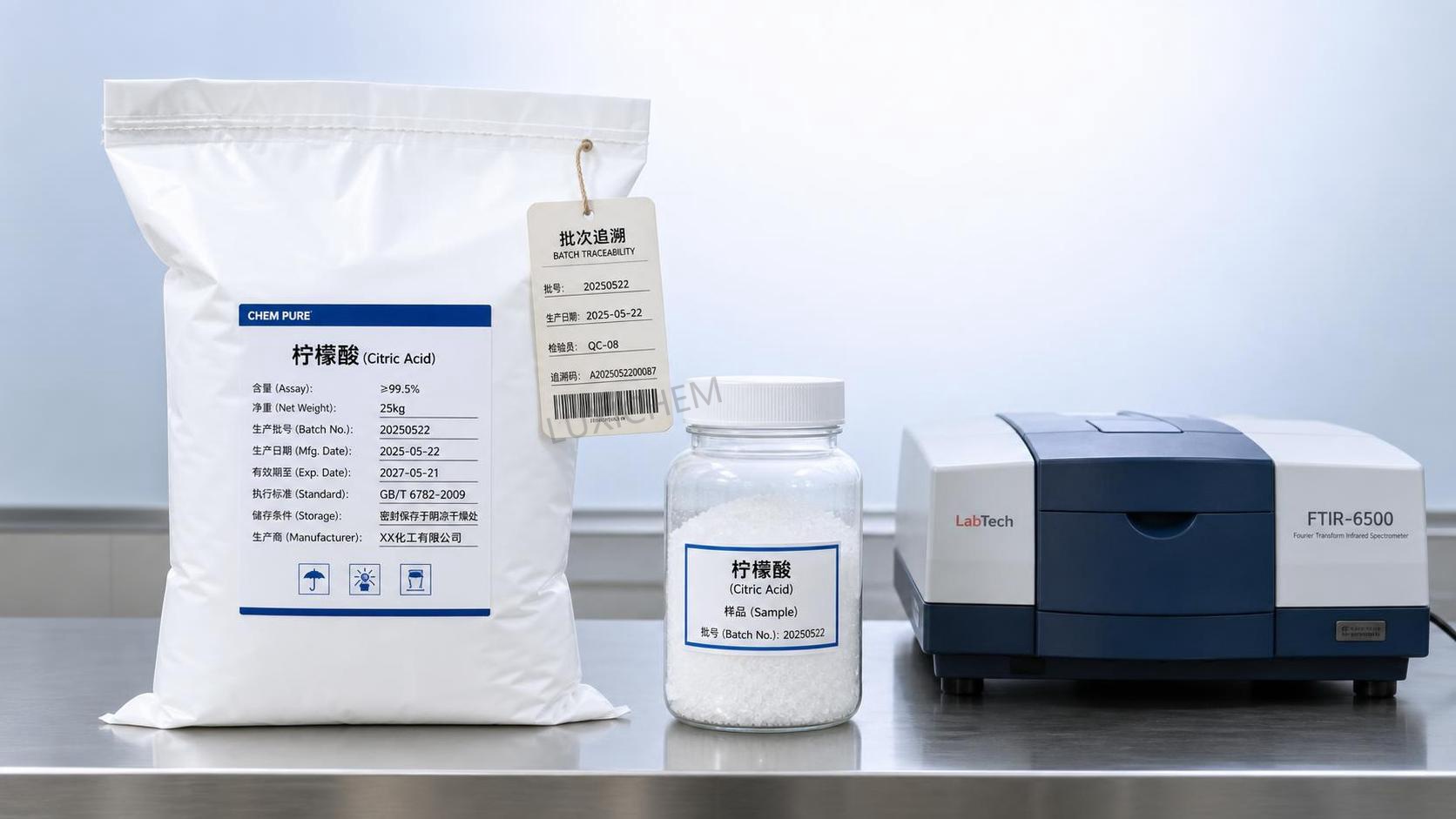
A receiving dock can look routine until one drum, bag, or pallet arrives with paperwork that does not line up cleanly. The label may say “citric acid,” the purchase order may show a familiar grade, and the container may appear intact. Yet a missing lot number, an unclear CAS reference, or an unexpected physical appearance can turn a simple release decision into a production and safety concern.
This is a common pressure point before using CAS 77 92 9. The substance identified by this number is citric acid, but confirming the name alone is not enough. Different grades, hydration states, packaging formats, and intended applications can affect whether a received material is suitable for a particular process. Releasing an incorrectly identified or poorly documented material can lead to formulation deviations, traceability gaps, incompatible storage, rejected finished goods, or difficult incident investigations later.
Start with the identity claim, not the container appearance
Citric acid is widely recognized as a white crystalline organic acid, but visual familiarity is not a reliable identity test. Several white crystalline powders may look similar during receiving, and an acceptable-looking package can still contain the wrong grade, a mixed batch, or material that has absorbed moisture during transport.
The first question should be precise: does every document and every physical marking support the same identity claim? For CAS 77 92 9, the core name should be citric acid. If the shipment is described as citric acid monohydrate, its CAS number is typically different from the anhydrous material. That distinction matters. A product name containing “citric acid” does not automatically prove that it corresponds to CAS 77 92 9.
Before opening the package, compare the following records side by side:
- Purchase order and approved material specification
- Supplier certificate of analysis (COA)
- Safety data sheet (SDS)
- Container label and any pallet label
- Bill of lading or packing list, where relevant
- Internal approved-supplier and incoming-material records
The material name, CAS number, lot or batch number, net weight, manufacturing or retest date, and grade designation should not conflict. Small inconsistencies deserve attention. For example, a COA may identify “anhydrous citric acid,” while the package label only says “citric acid.” That may be acceptable only if the supplier’s labeling convention, product code, and specification clearly link the package to the anhydrous grade.
Confirm which form your process actually requires
One of the most avoidable mistakes is treating anhydrous citric acid and citric acid monohydrate as interchangeable. They are closely related materials, but they differ in water content and may behave differently in mass-based formulations, drying operations, dissolution calculations, and some validation settings.
CAS 77 92 9 is generally associated with anhydrous citric acid. Citric acid monohydrate is commonly identified by CAS 5949-29-1. If an internal formulation, specification, or regulatory file identifies one form, do not substitute the other based only on a similar product name. Check the approved bill of materials, technical specification, and any process instruction that defines the intended form.
This distinction becomes especially important when an incoming material is used as an acidulant, chelating agent, processing aid, or pH-adjusting ingredient. A formulation may tolerate a controlled adjustment, but that decision should be made through the established change-control route rather than at receiving.
Use the SDS as a consistency document, not as final proof
An SDS helps verify the declared substance, hazards, recommended handling conditions, and transport information. It should identify citric acid and provide a CAS number consistent with the material purchased. However, an SDS is commonly prepared for a product family or grade range and may not be batch-specific. It should support, rather than replace, the COA and incoming inspection record.
Review whether the SDS revision is current within your document-control rules. Confirm that it describes the same physical form supplied: powder, granules, or crystals; anhydrous or monohydrate; and any stated impurities or additives. If the SDS lists a broader description than the product label, ask for clarification before release.
Read the COA as an identity trail
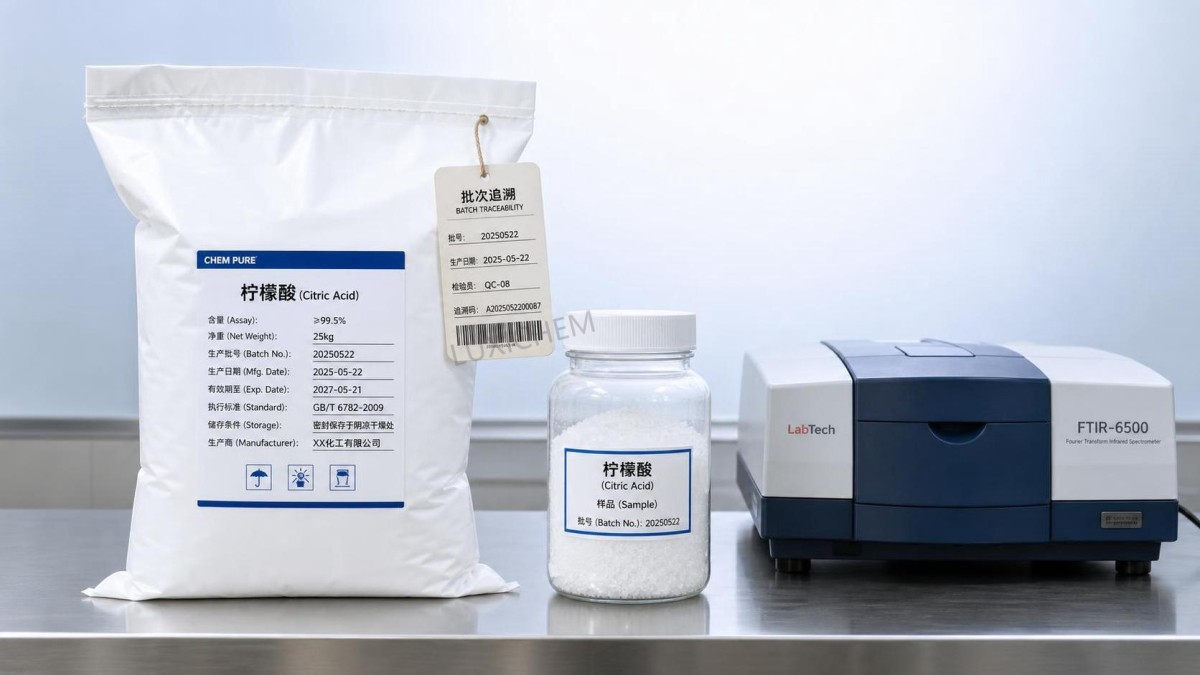
A COA is most useful when it connects a specific lot to a defined specification. It should show the supplier’s product identification, batch or lot number, test results, test methods or references where applicable, and release status. The lot number on the COA must match the lot number on the package. If a shipment contains several lots, each lot should be traceable to its own documentation.
For citric acid, commonly reviewed properties may include assay, water content or loss on drying, appearance, clarity or color of solution, insoluble matter, sulfate, oxalate, chloride, heavy-metal-related limits where applicable, and microbiological parameters for certain intended uses. The exact list depends on the agreed grade and application. Do not reject or release material simply because a familiar parameter is absent; compare the COA against the approved specification for that material and use.
Pay special attention to results that indirectly distinguish physical forms. An anhydrous grade and a monohydrate grade will have different moisture-related expectations. A result that is technically plausible but inconsistent with the ordered form should trigger an investigation. The same applies when the assay basis is unclear: “as is,” “dry basis,” and other reporting bases should not be treated as identical.
A COA alone is not enough if it is detached from the shipment. A reliable receiving record links the supplier lot, internal receiving number, storage location, sample number, and eventual release decision. That chain is what makes later traceability possible if a deviation is found.
Inspect packaging before sampling
Citric acid can absorb moisture under unsuitable storage conditions. Damaged inner liners, torn bags, wet cartons, broken seals, or powder deposits around closures may indicate exposure during transport or handling. Even if the laboratory result later appears acceptable, packaging damage should be documented and assessed because it can affect contamination control and shelf-life decisions.
During the external inspection, look for evidence of:
- Wet spots, caking, hardened lumps, or unusual odor around the package
- Missing or unreadable lot identification
- Relabeling that obscures original supplier information
- Mismatch between declared net weight and procurement records
- Broken tamper-evident features, compromised seals, or damaged liners
- Mixed lots on one pallet without clear segregation
Do not rely on odor as a positive identity confirmation. Citric acid may have little or no distinctive odor, and the absence of an unusual smell does not verify purity. Instead, treat smell as a screening observation: an unexpected chemical, musty, or packaging-related odor may justify holding the material for further review.
If a container is damaged, place it in the appropriate quarantine status according to site procedure. Avoid transferring material into a clean container merely to make it easier to use; that can remove evidence needed for investigation and complicate lot traceability.
Sample with identity protection in mind
Sampling is where a correct shipment can become a questionable one if tools, labels, or handling practices are weak. Use clean, suitable sampling tools and containers. Confirm that the sampling plan accounts for the packaging configuration, lot size, and risk level defined by your site procedures. A sample taken from one outer bag should not automatically represent every bag on a pallet.
Each sample label should preserve the relationship between the material and the original package: supplier name, received material name, supplier lot, internal lot or receipt number, date, sampler identification where required, and sample purpose. Retain samples according to the applicable quality system and product risk assessment.
Prevent cross-contact with other powders. This is particularly relevant in facilities that handle food ingredients, organic intermediates, fertilizer materials, or materials with different allergen, microbiological, or trace-impurity requirements. The risk is not limited to chemical incompatibility; it also includes accidental transfer caused by shared scoops, poorly cleaned sampling booths, or reused containers.
Choose confirmation methods that fit the risk
For routine incoming verification, a combination of document review, packaging inspection, and a defined identity test is often more defensible than any one check alone. The appropriate laboratory method depends on the intended application, internal specification, available equipment, and recognized method requirements.
Suitable identity-oriented techniques may include infrared spectroscopy, comparison with a qualified reference material, chromatographic analysis, or wet-chemical testing where appropriate. A melting-range observation can support evaluation, but it should not be used in isolation because decomposition behavior, instrument setup, and sample condition can affect the result. Water determination and assay testing may also help distinguish whether the material aligns with the declared physical form.
If tests are outsourced, ensure the laboratory scope and reporting format meet your organization’s requirements. The report should identify the received sample clearly and state the method used. A generic report for “citric acid” without a traceable sample identifier is weak evidence for a release decision.
Do not confuse a compliant grade with a universal approval
Citric acid may be supplied for different industrial, food-related, pharmaceutical-related, or technical uses. A material can meet one supplier specification while still being unsuitable for another application. Requirements for purity, contaminants, microbiological controls, packaging, traceability, and documentation vary by intended use and destination market.
Before accepting CAS 77 92 9 for a controlled application, compare the supplier documentation with the exact requirements that govern your product. This may include customer specifications, internal standards, contractual requirements, and applicable rules for the market in which the finished product will be sold. Do not assume that a statement such as “food grade” answers every question; the relevant specification and supporting records still need review.
The same discipline helps when purchasing adjacent hydrocolloid or ingredient materials. For example, a receiving process for CARRAGEENAN CAS#9000-07-1 should also distinguish product identity, approved grade, lot documentation, packaging integrity, and intended use rather than relying on the product name alone.
When a mismatch appears, hold first and investigate second
The pressure to keep production moving can make minor discrepancies seem harmless. A more reliable approach is to place the material in quarantine whenever the identity cannot be confirmed from the available evidence. This is not an automatic rejection; it is a controlled pause that protects both the process and the investigation.
Examples that justify a hold include a CAS number that does not match the ordered form, a missing COA, an unreadable batch number, a label that conflicts with the SDS, unexplained caking, a failed identity test, or paperwork that belongs to a different lot. Record the issue clearly, including photographs where allowed by procedure, package count, affected lot numbers, and the exact point at which the discrepancy was found.
Then request targeted clarification rather than a vague statement of assurance. Useful questions include: Is this anhydrous citric acid or monohydrate? Which lot does this COA cover? Was the material repacked? What test method supports the reported assay? Has the product code changed? Can the supplier provide an amended, traceable document? Written answers should be assessed against the original purchase requirement, not accepted simply because they resolve an immediate scheduling problem.
Build the release decision into the normal workflow
A robust verification process works best when it is routine rather than improvised. The receiving team needs a clear rule for labeling material as received, quarantined, sampled, released, or rejected. Storage locations should preserve that status physically and electronically. Production should be able to identify which lots are authorized without interpreting handwritten notes or relying on verbal confirmation.
For repeated purchases, retain a controlled reference file containing the approved product name, CAS number, accepted form, specification, standard packaging details, expected documents, and known supplier product codes. Review it whenever there is a supplier change, packaging change, grade change, route change, or unexpected analytical result.
Verification of CAS 77 92 9 is therefore not a single laboratory test. It is a connected decision: confirm the chemical form, connect the documents to the package, inspect the shipment condition, sample without losing traceability, and use an identity method suited to the material’s risk and intended use. When those elements agree, the release decision is easier to defend. When they do not, holding the material early is usually far less disruptive than correcting a mistake after it has entered production.
Related Picks
 Butylated Hydroxytoluene Price Drivers: Supply, Purity, and Purchasing Risk FactorsOct 21, 2026Butylated Hydroxytoluene price trends depend on supply stability, purity, logistics, and purchasing risk. Learn how to compare quotes wisely and reduce sourcing costs.
 Sodium Tripolyphosphate Price Trends: Raw Material and Energy ExposureOct 20, 2026Explore sodium tripolyphosphate price trends, from phosphate and soda ash costs to energy exposure. Learn how to compare quotes, manage sourcing risks, and make smarter purchasing decisions.
 Acetonitrile Shipment to Vietnam Successfully Dispatched; RCEP Benefits Boost Fine Chemical Trade with ASEANSep 16, 2026A shipment of industrial-grade acetonitrile from our company has recently been loaded and dispatched following the completion of standardized hazardous material packaging and container securing procedures.
 Nigerian Client’s Order of 4 Containers of Vinyl Acetate Successfully Loaded and Shipped to West AfricaSep 16, 2026We recently completed the loading of a vinyl acetate order for a Nigerian client; four containers of the product have been successfully packed and are ready for shipment to Nigeria.




Question Consultation
Send Us Your Inquiry Today

Luxi Chemical is a professional chemical product supplier with ample stock of all chemical categories and excellent quality, welcome your purchase inquiry.

