


What packaging best protects bulk citric acid powder from moisture?
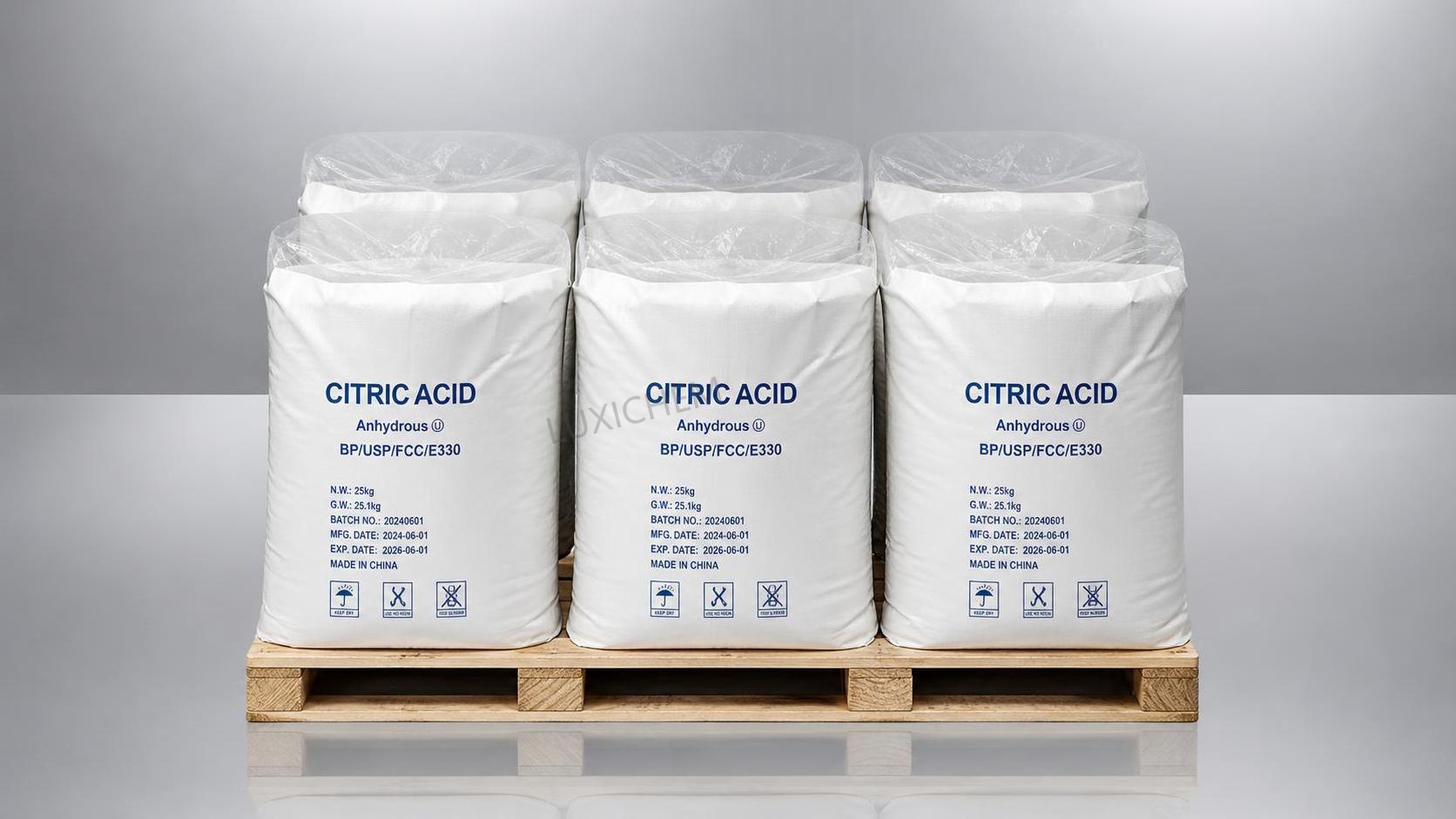
The best protection for bulk citric acid powder is a moisture-barrier inner liner sealed inside a durable outer bag, with the liner selected according to storage time, climate exposure, and handling method. In many dry, controlled supply chains, a multiwall paper bag with a properly sealed polyethylene liner can be suitable. Where humidity is variable, transit is prolonged, or caking would interrupt a critical process, a woven polypropylene outer bag with a high-barrier polyethylene liner, or a foil-laminate liner inside a rigid bulk container, offers a stronger moisture-defense system.
Citric acid powder is hygroscopic enough that packaging decisions cannot be based on outer-bag strength alone. Moisture entering through film, closures, punctures, or repeated opening can lead to local wetting, agglomeration, reduced flow through hoppers, and difficulty achieving consistent dosing. The packaging specification therefore needs to describe the complete containment system: outer pack, inner liner material and thickness, sealing method, pallet arrangement, and conditions permitted during warehousing and transport.
Start with the expected exposure, not the bag appearance
A package that performs well in a short domestic trip may be inadequate for containerized shipping, storage near loading doors, or transfer through humid regions. The relevant risk is cumulative moisture exposure. Even where the powder arrives dry, a small amount of water-vapor transmission over an extended period can affect free-flowing behavior, especially if packages remain on hand after delivery.
Three questions usually establish the required barrier level. First, determine whether the material will move directly from a dry production area to a climate-controlled store, or whether it will encounter uncontrolled docks, ports, cross-docking, or outdoor staging. Second, establish whether the powder is packed in smaller bags, flexible intermediate bulk containers, or drums. Third, identify whether the package will be opened once for immediate consumption or repeatedly accessed over several shifts.
Bulk citric acid powder should be protected from liquid water as well as water vapor. A strong woven outer bag can resist handling damage yet still allow humidity to reach the contents if its liner is thin, unsealed, or compromised around the fill opening. Conversely, a high-barrier liner offers limited value when placed in an outer package that tears during forklift contact or pallet movement. The two layers serve different purposes and must be specified together.
Packaging configurations and their practical limits
For standard bagged volumes, multiwall kraft paper bags with internal polyethylene liners are commonly considered where handling is careful and storage conditions remain dry. Kraft provides stiffness, printability, and reasonable stacking behavior. The liner provides the primary vapor barrier. The design should include a closure that does not leave a paper-only path into the bag; a sewn closure through an unsealed liner can create such a path.
A polyethylene-lined woven polypropylene bag is generally better suited to rougher logistics. The woven outer layer resists tearing and abrasion more effectively than paper in many handling environments. Its limitation is that woven fabric itself is not the moisture barrier. The liner must be continuous, appropriately thick, and heat-sealed or otherwise closed in a manner compatible with the expected transport stresses. An untied loose liner folded beneath a stitched mouth is a weaker choice for humid distribution routes.
For larger quantities, a flexible intermediate bulk container can be used when it incorporates a suitable inner liner. A standard woven bulk bag without a liner should not be assumed to protect citric acid powder from ambient moisture. Liner designs vary substantially: simple polyethylene liners, form-fit liners, and multilayer barrier films do not offer the same protection. Form-fit liners can reduce folds and unsupported film movement, which may lower the chance of liner damage during filling and discharge. However, they require compatible filling equipment and careful control of the liner position.
Rigid drums or similar closed containers lined with a moisture-resistant bag can be appropriate when exposure is severe, when smaller batch integrity matters, or when the package must remain closed for a long period after receipt. They add handling and disposal considerations, so their use is normally justified by the specific exposure profile rather than selected as a default. Fiber drums require attention to the lid seal and to the moisture resistance of the drum body; the liner remains necessary.
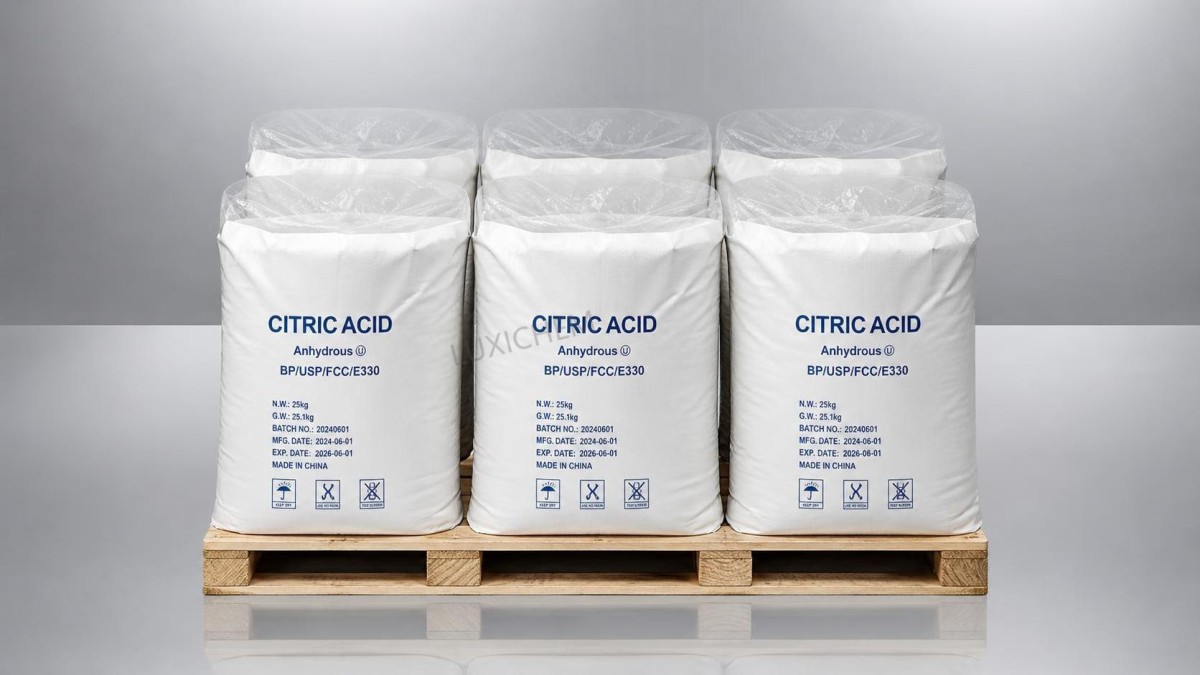
The liner is the main moisture-control component
Low-density polyethylene is widely used as a liner material because it is flexible, heat-sealable, and provides a useful moisture barrier for many applications. Linear low-density polyethylene may offer improved toughness and puncture resistance in some constructions. The right film thickness depends on bag size, powder mass, filling method, and anticipated abrasion. A thickness value without context is not enough: a thin film may survive in a small hand-carried bag but fail in a large package subject to compression against pallet corners.
When moisture exposure is demanding, multilayer films or foil-based laminates can provide lower water-vapor transmission than a conventional single-layer polyethylene liner. Such materials should be evaluated as part of a complete package, since barrier film can be more sensitive to flex cracking, sharp edges, or poorly adjusted sealing jaws. The added barrier only performs as intended if seals remain intact from filling through final use.
Film properties should be confirmed through the packaging supplier's technical documentation and, where appropriate, through trials using the actual fill weight and pallet pattern. Water-vapor transmission rate may be useful for comparing candidate films, but test conditions matter. Temperature and relative humidity affect measured values, and results from a flat sample do not represent leakage through package seals. Seal integrity, puncture resistance, and compatibility with the chosen closure deserve equal attention.
Citric acid may be supplied in different particle sizes, including crystalline granular grades and finer powders. Finer material can migrate into folds and sealing zones more readily, making consistent heat seals harder to achieve. Powder contamination in a seal area can produce channels that admit humid air even when the seam appears closed. Filling equipment should therefore control dust near the bag mouth, and sealed samples should be inspected for continuous, uniform seal formation.
Closure details often decide whether a good liner succeeds
A heat-sealed inner liner inside a stitched outer sack generally gives better moisture protection than an inner bag that is merely folded or tied. The heat seal should be wide enough for the film type and made using controlled time, temperature, and pressure. Excessive heat can weaken film; insufficient heat may create incomplete fusion. Seal validation should consider the actual powder dust load, not only clean-film samples.
For FIBCs, the filling and discharge sections need special scrutiny. A liner can be protected within the bag body while remaining vulnerable at an unsealed spout or at an attachment point. A design using a sealed liner with a controlled opening procedure is preferable where the contents are not consumed immediately. Once an FIBC is opened, the remaining powder becomes dependent on local humidity and the effectiveness of temporary resealing.
One useful specification distinction is between an outer closure intended to retain the package mechanically and an inner closure intended to exclude moisture. Both are needed, but they are not interchangeable. Sewing reinforces the outer bag. It does not, by itself, establish a vapor barrier.
Handling conditions can defeat the selected package
Packages should be kept off floors that may become damp and away from walls where condensation or temperature swings can occur. Pallets need to be dry, clean, and free of protruding nails, splinters, or damaged boards that can puncture liners from below. Stretch wrap can stabilize a pallet and reduce incidental dust or splash exposure, but ordinary stretch wrap should not be treated as the primary moisture barrier for the powder.
Container transport requires particular attention to condensation. Temperature changes can create moisture on container ceilings and sidewalls, followed by dripping or wet contact with packages. A sound liner reduces vapor entry but cannot fully protect an outer paper bag that is soaked by condensed water. Dry container condition, suitable dunnage, secure pallet spacing, and avoidance of direct contact with container walls are practical controls. Desiccant use may be considered for a route with a known humidity risk, but its quantity and placement should be designed for the full container environment rather than assumed to solve every packaging weakness.
Do not load warm packages into a cold or humid space without considering condensation risk. Likewise, packages arriving from a cold environment should remain closed until their surface temperature has equilibrated where condensation is possible. This is especially relevant when bags are moved from outdoor receiving areas into warmer processing spaces.
Specify the package as a procurement and quality document
An order description limited to “moisture-proof bag” leaves too much room for variation. The purchasing specification should identify the outer-bag substrate, liner construction, liner thickness or agreed performance basis, filling weight, closure method, pallet configuration, and any requirements for additional protective wrapping. It should also state whether bags are intended for food-contact applications or other controlled uses, where that distinction applies to the intended process.
Incoming inspection can focus on meaningful failure points rather than appearance alone. Examine several bags from accessible pallet positions for damaged seams, open liner mouths, pinholes, wet outer surfaces, abnormal clumping, and residue around closures. A bag that looks clean externally may still have a compromised inner seal. If a package has been punctured, transferring intact powder into a verified dry, sealed container is generally preferable to applying tape over a damaged outer layer and returning it to storage.
Where multiple hygroscopic powders are handled at the same site, packaging designs should remain material-specific. For example, a packaging review for Isomalt CAS#64519-82-0 may involve similar concerns about humidity and powder flow, yet particle behavior, filling conditions, storage duration, and process sensitivity can differ. Using one package format across materials without verifying these details can introduce avoidable quality variation.
Common selection errors
- Choosing a heavier outer sack while leaving the liner and closure unspecified. Physical strength does not establish water-vapor resistance.
- Using a liner that is adequate for a small bag in a large FIBC without reassessing puncture, fold stress, and the load applied during stacking.
- Assuming a sealed package remains protected after partial use. Once opened, headspace humidity and opening frequency become part of the storage condition.
- Storing moisture-sensitive powder directly on concrete, even when pallets are used inconsistently or are already damp.
- Accepting a package design based only on film data, without reviewing seals, fill spouts, pallet loads, and transport conditions.
For most bulk citric acid powder applications, the defensible baseline is a durable outer bag combined with a continuous, sealed polyethylene liner, dry palletized storage, and protected transport. Higher-barrier liner structures or rigid containment become justified as humidity exposure, storage duration, handling severity, or consequences of caking increase. The selected package should preserve both the powder and the operating conditions needed to keep that protection intact.
Related Picks
 Butylated Hydroxytoluene Price Drivers: Supply, Purity, and Purchasing Risk FactorsOct 21, 2026Butylated Hydroxytoluene price trends depend on supply stability, purity, logistics, and purchasing risk. Learn how to compare quotes wisely and reduce sourcing costs.
 Sodium Tripolyphosphate Price Trends: Raw Material and Energy ExposureOct 20, 2026Explore sodium tripolyphosphate price trends, from phosphate and soda ash costs to energy exposure. Learn how to compare quotes, manage sourcing risks, and make smarter purchasing decisions.
 Acetonitrile Shipment to Vietnam Successfully Dispatched; RCEP Benefits Boost Fine Chemical Trade with ASEANSep 16, 2026A shipment of industrial-grade acetonitrile from our company has recently been loaded and dispatched following the completion of standardized hazardous material packaging and container securing procedures.
 Nigerian Client’s Order of 4 Containers of Vinyl Acetate Successfully Loaded and Shipped to West AfricaSep 16, 2026We recently completed the loading of a vinyl acetate order for a Nigerian client; four containers of the product have been successfully packed and are ready for shipment to Nigeria.




Question Consultation
Send Us Your Inquiry Today

Luxi Chemical is a professional chemical product supplier with ample stock of all chemical categories and excellent quality, welcome your purchase inquiry.

