


Insecticides Compliance Checklist: Residue Limits, Registration, and Storage Risks
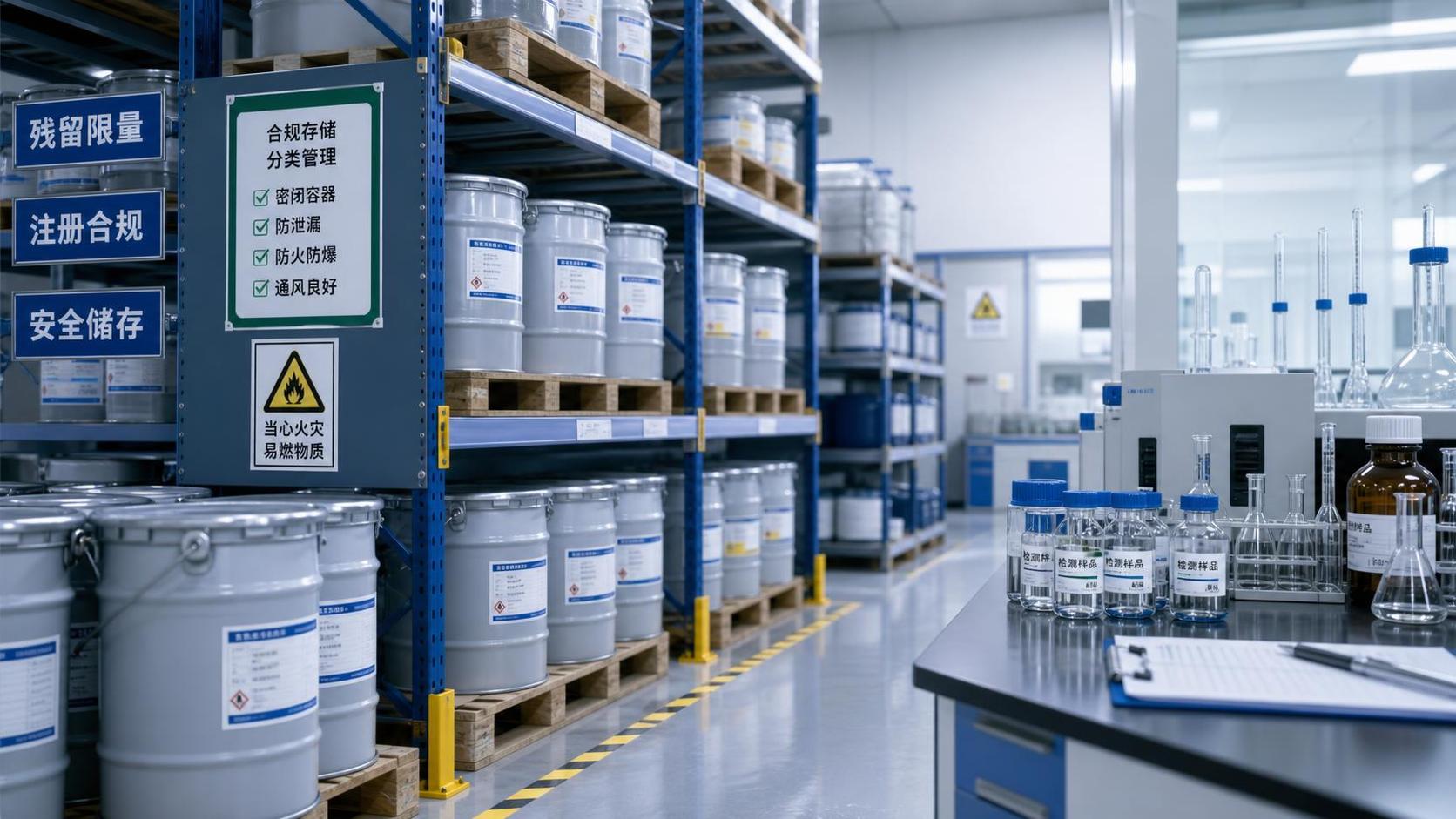
Insecticides compliance is rarely a single-department issue. For quality control and safety managers, it sits at the intersection of regulatory approval, residue management, packaging integrity, warehouse segregation, emergency response, and export documentation. The practical difficulty is that failures often do not begin with a lab nonconformity. They begin upstream: a product registered for one use is sold into another market, a warehouse applies generic chemical storage logic to a temperature-sensitive formulation, or procurement accepts a supplier specification that does not match local residue expectations.
That is why a checklist approach matters. Not because compliance can be reduced to paperwork, but because insecticides move through multiple control points where small gaps create large downstream exposure. In today’s market, stricter residue monitoring, more active border inspections, and tighter environmental scrutiny mean that quality and safety teams need a working framework that connects regulatory status with daily operations.
Why insecticides compliance has become harder to manage
The regulatory burden around insecticides has expanded in three directions at once. The first is product legality: whether the active ingredient, formulation, label claim, and intended application are actually registered or permitted in the destination market. The second is residue accountability: whether use patterns, pre-harvest intervals, and downstream handling can keep residues within applicable maximum residue limits. The third is operational control: whether storage, internal transfer, and transport conditions preserve product stability and prevent incidents.
Quality control teams often focus on specification conformance, while safety managers focus on storage class, incompatibility, and emergency procedures. In practice, these areas overlap. A degraded formulation is not only a quality problem; it may also create off-spec composition, pressure build-up, packaging failure, or altered hazard behavior. Likewise, a registration issue is not only a commercial problem; it can trigger product seizure, forced disposal, reputational damage, and regulatory attention across the entire supply chain.
For companies handling broad chemical portfolios, this challenge becomes more pronounced. A business may manage products ranging from food additives and intermediates to agricultural chemicals, each under different compliance frameworks. That makes internal classification discipline essential. Even where a supplier is experienced in global trade, each insecticide line still requires market-specific verification rather than a generic export assumption.
Checklist item 1: Confirm legal registration before discussing shipment
The most common and expensive mistake is treating a technically available product as a legally marketable one. For insecticides, registration is jurisdiction-specific and often use-specific. A product may be lawful in one country, restricted in another, and permitted only for certain crops, concentration ranges, or formulation types elsewhere.
QC and safety managers should verify at least these points before release approval or export coordination:
- Active ingredient status in the destination country or region
- Formulation registration status, not just raw material status
- Permitted end uses, crops, pests, and application methods
- Label language and content requirements
- Packaging approval requirements, including child-resistant or tamper-evident rules where applicable
- Restricted, banned, or phase-out status under local law
One point frequently missed in practice: registration documents and commercial specifications must align. If the registered concentration, impurity profile, or formulation type differs from what is supplied, the issue is not minor deviation; it may invalidate legal placement on the market. This is especially important when sourcing through traders or across multiple production sites.
For export-oriented firms, the right question is not “Can we supply this insecticide?” but “Can this exact product configuration enter and remain compliant in this destination market?”
Checklist item 2: Treat residue limits as a market access issue, not only an agronomy issue
Residue limits are often discussed as if they concern growers alone. In reality, they are a direct supply-chain risk for manufacturers, formulators, distributors, and importers. Maximum residue limits, or MRLs, determine whether agricultural produce can legally enter many markets. If an insecticide is used in a way that creates residues above the applicable limit, the problem can come back to the product supplier through claims, audits, and delisting.
What makes this difficult is that residue limits vary across jurisdictions and can change over time. In some cases, an active ingredient may be registered for use, but the relevant MRL for a specific crop-market combination may be absent, reduced, or under review. That creates a commercial risk even where product registration appears valid.
Quality and compliance teams should build a residue checklist around these questions:
- Which export markets are relevant for treated crops?
- What are the current MRLs in those markets? If unknown, mark as 【待核实】 rather than assuming alignment.
- Does the intended use pattern support compliance with the strictest relevant market?
- Are pre-harvest interval instructions clear and realistic under field conditions?
- Are tank-mix or repeat-application scenarios likely to increase residue risk?
- Is there a documented process for updating label or stewardship advice when residue rules change?
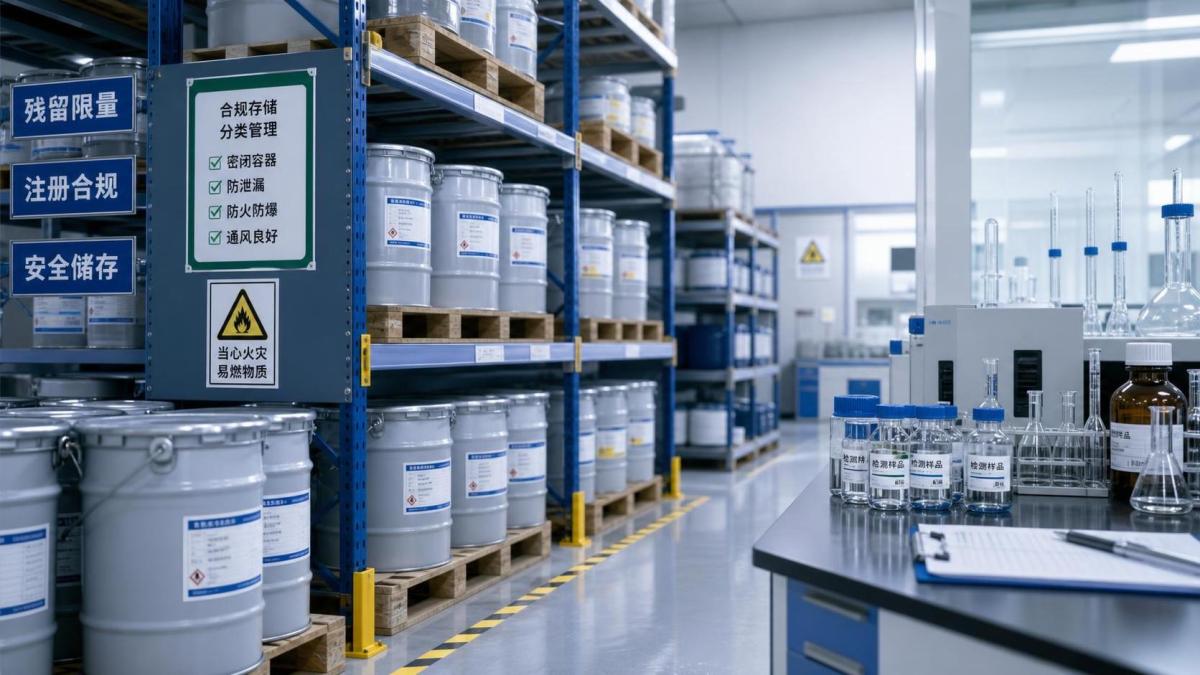
A practical warning: residue compliance should not be based solely on historical use. Border authorities and retail supply chains increasingly rely on updated analytical screens and lower reporting thresholds. “It has always passed before” is not a control measure.
Checklist item 3: Verify analytical capability, not just the certificate of analysis
Many companies maintain robust incoming and finished-product testing, but their methods are built around assay, moisture, pH, or standard formulation indicators. Insecticides compliance may require more than that. Depending on the product and market, you may need the ability to verify relevant impurities, degradation products, physical stability, and in some cases trace-level contamination linked to regulatory concern.
The certificate of analysis remains necessary, but it is not enough on its own when supplier qualification is weak, product age is long, or storage conditions are variable. QC managers should ask:
- Are test methods validated for the formulation matrix, not only the active ingredient?
- Can the lab detect degradation patterns after storage stress?
- Are impurity specifications aligned with registration and safety documentation?
- Is there a retain-sample program that supports investigation after complaints or border issues?
- Do internal release criteria reflect both quality performance and legal compliance thresholds?
Where testing capacity is limited, the risk is not merely analytical delay. It is false confidence. A compliant-looking product may still fail in the field or at customs if the wrong parameters are being monitored.
Checklist item 4: Check labels, SDS, and transport information as one integrated control set
Documentation failures are still one of the easiest ways to trigger avoidable noncompliance. For insecticides, label text, safety data sheets, product specifications, and transport declarations need to tell the same story. Inconsistency between these documents often exposes deeper process weaknesses.
Safety managers should confirm that:
- The SDS version is current and suitable for the destination language or legal format where required
- Hazard classification reflects the actual formulation and concentration
- First-aid, spill response, and firefighting guidance are compatible with warehouse practice
- UN classification and packing group information are correct where dangerous goods rules apply
- Label precautions do not contradict operational handling instructions
This is especially important for mixed chemical operations. A company that routinely ships industrial chemicals may already have strong document control systems, but insecticides often introduce additional end-use restrictions and stewardship statements that standard industrial templates do not cover. Even unrelated product lines can illustrate why document precision matters. For instance, materials such as Trichlorosilane CAS#10025-78-2 require highly disciplined handling and transport documentation because hazard misclassification has immediate operational consequences. The same discipline should be applied to agrochemical documentation, even when the risk profile is different.
Checklist item 5: Storage risk control is more than “keep in a cool, dry place”
Storage language in technical sheets is often too general to manage real warehouse risk. For insecticides, conditions such as heat exposure, freezing, humidity, poor ventilation, sunlight, pallet stacking pressure, and proximity to incompatible chemicals can change product behavior significantly. Emulsifiable concentrates, suspension concentrates, wettable powders, and water-dispersible granules do not respond to storage stress in the same way.
Safety managers should assess storage controls through operational detail:
- Is temperature monitored continuously or only checked manually?
- Are products segregated by hazard class and incompatibility, not only by SKU?
- Are oxidizers, acids, food-related materials, and agricultural chemicals physically separated?
- Is stock rotation based on manufacture date, retest date, and formulation sensitivity?
- Are damaged containers isolated immediately under a written procedure?
- Is repacking allowed, and if so, under what containment and labeling controls?
A frequent blind spot is assuming that sealed packaging equals stable product. In reality, long storage under uncontrolled temperature cycles can produce sedimentation, crystallization, viscosity shift, phase separation, or container deformation. Those changes may not always be visible from the outside at an early stage.
For sites handling multiple chemicals, warehouse managers should avoid using one universal storage rule across all categories. Products in a diversified portfolio may have entirely different sensitivity profiles. That is true whether the site stores insecticides, fertilizers, or reactive industrial materials such as Trichlorosilane CAS#10025-78-2. The lesson is not that the products are comparable, but that storage planning must be product-specific, not warehouse-generic.
Checklist item 6: Build traceability that survives a complaint or inspection
Traceability is often tested only when something goes wrong: an import hold, a field complaint, a residue exceedance, or a leakage incident in storage. At that point, partial records are functionally the same as no records. A usable traceability system should allow the company to connect batch origin, manufacturing records, packaging materials, test data, shipment destination, and warehouse movement without reconstruction from email chains.
For insecticides, strong traceability should include:
- Batch-level linkage between raw materials and finished goods
- Release records tied to analytical results and specification versions
- Packaging lot traceability for leak or compatibility investigations
- Warehouse location and movement history
- Shipment records by country, customer, and intended use where relevant
- Complaint handling files with CAPA follow-up
This is where quality and safety functions often need closer integration. A warehouse spill investigation may reveal a packaging compatibility issue that should trigger supplier requalification. A residue complaint may reveal that the wrong label revision was shipped. Traceability only delivers value if it connects these events across departments.
Checklist item 7: Audit the gaps between supplier compliance and your own compliance
Many nonconformities begin with an implicit assumption: if the supplier is compliant, the distributor or exporter is compliant too. That is not how enforcement usually works. Regulatory authorities evaluate the product placed on the market, the documentation presented, and the storage and distribution practices under the operator’s control.
For QC and safety managers, supplier approval should go beyond basic certificates. Review whether the supplier can provide:
- Current registration support documents where applicable
- Change notification procedures for formulation, site, or specification updates
- Stability data relevant to expected transport and storage conditions
- Packaging compatibility evidence
- Deviation and recall communication procedures
Supplier audits should also test practical consistency. A technically sound dossier is less reassuring if lot-to-lot packaging quality varies, if specification history is unclear, or if response time during deviations is poor. In cross-border trade, commercial reliability and compliance reliability are not always the same thing.
What a usable internal insecticides compliance checklist should accomplish
A good checklist is not a long list of generic reminders. It should force decisions at the points where companies usually rely on assumption. Before procurement, it should confirm that the product can legally be sold for the intended market and use. Before release, it should confirm that analytical and documentary controls match regulatory reality. Before storage and shipment, it should confirm that the product remains stable, correctly labeled, and safely managed.
The most resilient companies are not those with the thickest compliance binders. They are the ones that can quickly answer practical questions: Is this formulation registered for this destination? Which residue limit matters for the crop chain involved? What storage excursion has this batch experienced? Which document version went with that shipment? If a regulator or customer asks tomorrow, can we show evidence rather than explanation?
For quality control and safety managers, that is the real standard. Insecticides compliance is not achieved when the paperwork looks complete. It is achieved when registration status, residue risk, analytical control, and storage discipline remain aligned all the way from source to end market.
Related Picks
 Butylated Hydroxytoluene Price Drivers: Supply, Purity, and Purchasing Risk FactorsOct 21, 2026Butylated Hydroxytoluene price trends depend on supply stability, purity, logistics, and purchasing risk. Learn how to compare quotes wisely and reduce sourcing costs.
 Sodium Tripolyphosphate Price Trends: Raw Material and Energy ExposureOct 20, 2026Explore sodium tripolyphosphate price trends, from phosphate and soda ash costs to energy exposure. Learn how to compare quotes, manage sourcing risks, and make smarter purchasing decisions.
 Acetonitrile Shipment to Vietnam Successfully Dispatched; RCEP Benefits Boost Fine Chemical Trade with ASEANSep 16, 2026A shipment of industrial-grade acetonitrile from our company has recently been loaded and dispatched following the completion of standardized hazardous material packaging and container securing procedures.
 Nigerian Client’s Order of 4 Containers of Vinyl Acetate Successfully Loaded and Shipped to West AfricaSep 16, 2026We recently completed the loading of a vinyl acetate order for a Nigerian client; four containers of the product have been successfully packed and are ready for shipment to Nigeria.




Question Consultation
Send Us Your Inquiry Today

Luxi Chemical is a professional chemical product supplier with ample stock of all chemical categories and excellent quality, welcome your purchase inquiry.

