


PVC Granules Quality Standards: Key Tests for Color, Density, and Batch Consistency
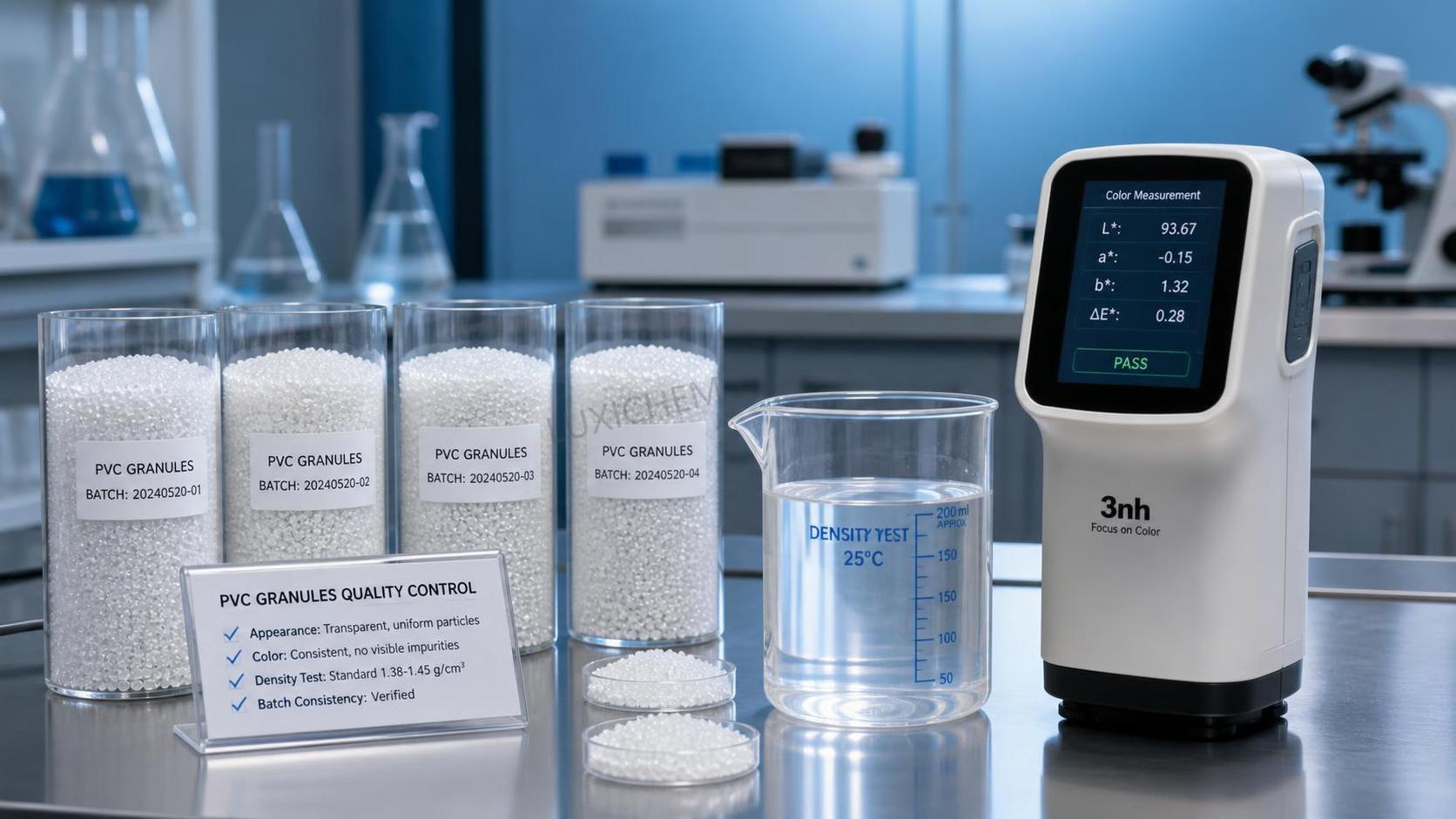
For quality control and safety managers, consistent pvc granules performance starts with clear, measurable standards. Color uniformity, density accuracy, and batch-to-batch consistency directly affect processing stability, product appearance, and compliance outcomes. This article outlines the key tests used to evaluate these critical indicators, helping buyers and plant teams reduce risk, improve traceability, and ensure reliable material quality across every production lot.
In practice, complaints about PVC compounds rarely begin with a dramatic test failure. More often, they begin with small shifts that were treated as acceptable variation: one lot runs slightly hotter in extrusion, another produces a duller surface, and a third shows unstable feeding because bulk density changed enough to affect dosing. For quality teams, that is the real challenge. The question is not whether a batch can pass a basic incoming check, but whether it can perform consistently in a downstream process where color, flow, fusion behavior, and appearance are tightly linked.
That is why quality standards for pvc granules should be built around process relevance, not only around broad specification sheets. Color, density, and batch consistency are often listed as routine parameters, yet their practical value depends on how they are defined, sampled, tested, and trended over time.
Why color control is not just an appearance issue
Color is usually the first attribute noticed by operators and customers, but in PVC compounding it is also an indicator of formulation control, thermal history, contamination risk, and mixing uniformity. A visible deviation may reflect pigment dispersion problems, resin variability, overheating during processing, or trace contamination from previous production campaigns.
For rigid and flexible applications alike, visual acceptance alone is not enough. A batch that “looks close enough” under warehouse lighting may still create rejection risk in high-visibility products such as profiles, sheets, cable compounds, flooring, or consumer goods. This becomes more critical in export supply chains, where the buyer’s approval standard may be tied to retained samples, instrument readings, or internal customer color windows.
The most common tests include visual comparison against an approved standard and instrumental color measurement using colorimeters or spectrophotometers. In many plants, the instrument result is expressed in L*, a*, b* values and sometimes as total color difference, typically ΔE. The exact acceptance limit should never be copied from another product family without validation. White, black, transparent, and highly filled formulations do not tolerate deviation in the same way.
For QC teams, three control points matter more than the instrument itself:
- Use a defined sample preparation method, since pellet surface condition, thickness, and background can affect readings.
- Control illumination and observation conditions for visual approval.
- Retain master reference samples under conditions that prevent aging, yellowing, or surface change.
A common mistake is to set a single color limit for all customers. In reality, acceptable color variation depends on end use. A concealed technical component and a decorative extrusion profile should not share the same risk threshold. Safety and quality managers should push commercial teams to connect color specifications to actual application sensitivity.
Density testing: simple on paper, high impact in production
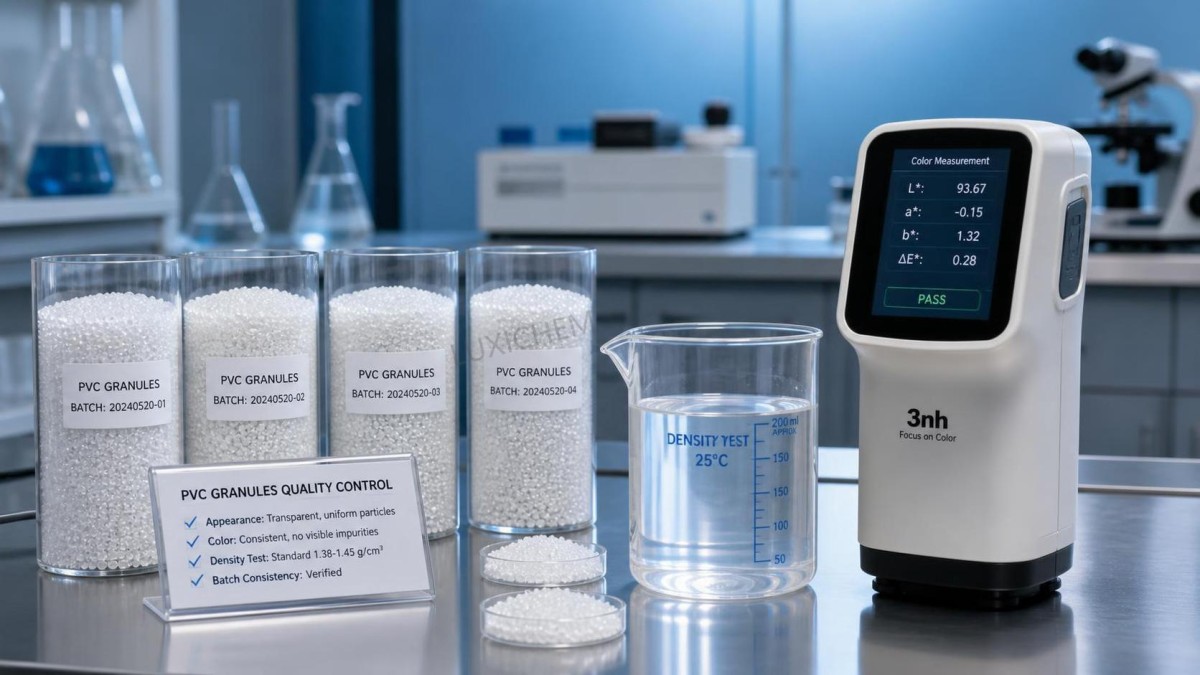
Density is one of the most underestimated controls for PVC granules. Yet it strongly influences material feeding, packaging weight consistency, storage behavior, and conversion performance. When density drifts, processors may see unstable screw loading, variable meter output, or inconsistent part weight even before any more advanced property is checked.
Two density concepts need to be separated clearly:
- Particle or apparent density, depending on the test method and product type
- Bulk density, which has direct relevance to handling, dosing, and hopper behavior
In quality discussions, these terms are sometimes mixed, and that creates avoidable disputes between suppliers and buyers. A batch can meet one density criterion while failing another operationally important one. For that reason, procurement contracts and COAs should state the exact property name and test method, not just “density.”
Bulk density is especially important for automated processing lines. Even modest shifts can alter residence time behavior in feeding systems or create variation in gravimetric and volumetric dosing performance. For safety managers, unstable bulk density also matters because it can change dusting tendency, sack filling consistency, and ergonomics during handling.
Testing methods vary depending on product specification and internal laboratory practice. What matters is repeatability: controlled sample volume, filling technique, vibration condition if applicable, and environmental consistency. If the test is operator-sensitive, then trend data become less useful, and false alarms increase.
For higher-value or tightly controlled applications, density data should be reviewed together with related indicators such as filler level, moisture, and granule geometry. Density rarely changes alone. It usually moves because something else in raw material ratio, compounding conditions, or pelletizing quality has shifted.
Batch consistency is broader than pass/fail results
Batch-to-batch consistency is where quality systems either create confidence or expose weakness. A supplier may meet nominal specification on every lot and still cause repeated processing complaints if variation inside the specification window is too wide. This is a familiar issue in international trade: the paperwork looks acceptable, but the production line tells a different story.
For PVC compounds, consistency should be judged through a combination of retained sample comparison, statistical trend review, and process-focused verification. In other words, QC should not only ask, “Did this batch pass?” but also, “Is this batch moving away from the historical centerline?”
Useful consistency checks often include:
- Color trend versus approved production standard
- Bulk density trend by lot and production date
- Granule size distribution or pellet appearance consistency
- Moisture or volatile-related control where relevant
- Melt or processing behavior checks used internally by the manufacturer
- Retention of complaint-linked lots for back comparison
Where possible, control charts are more valuable than isolated test reports. A single lot at the edge of tolerance may deserve more attention if the last five lots are drifting in the same direction. That kind of pattern often points to process instability, raw material changes, or maintenance issues rather than random variation.
Sampling is often the weakest part of the quality standard
Many disputes over pvc granules quality are actually sampling disputes. Pellets can segregate during conveying, storage, and bagging. Fine particles, pigment-rich fractions, or differently cooled granules may not be evenly distributed in the package or bulk shipment. If the sample is taken only from the top layer of a bag or from a non-representative silo point, the test result may not describe the lot at all.
That is why quality standards should define not only test items but also lot definition, sample size, sampling location, sample reduction method, and retention period. For imported material, this becomes even more important because transit vibration, humidity exposure, and repacking can change the condition of the delivered goods compared with the original production sample.
Quality managers usually get better results when they formalize three sampling stages:
- Pre-shipment supplier sampling for release
- Arrival sampling at the customer or port warehouse
- Production-use sampling when a lot is first introduced to the line
This layered approach does not eliminate all risk, but it improves traceability and reduces argument based on incomplete evidence.
How safety teams should read quality deviations
Not every quality deviation is a safety issue, but some are early warning signs of broader control failure. Unexpected color shift may indicate overheating or decomposition during processing. Abnormal density may point to off-ratio formulation, contamination, or changes in filler loading. If such deviations appear together, the issue should be escalated beyond routine QC release.
Safety managers should be especially cautious when deviations coincide with:
- Unusual odor during processing
- Excessive smoke or decomposition signs
- Increased dust or fines generation
- Packaging damage, caking, or moisture uptake
- Unexplained operator complaints related to handling conditions
These are not proof of a hazardous event by themselves, but they justify deeper review of manufacturing conditions, transport history, storage environment, and documentation completeness. In cross-border supply, the safest assumption is that a quality anomaly may also signal a traceability gap until proven otherwise.
Standards matter, but internal acceptance windows matter more
There is no single universal market standard that can fully define acceptable color, density, and consistency for all PVC granule grades. General test standards and customer-specific specifications can provide a framework, but internal acceptance windows should be based on actual process capability and end-use sensitivity.
This is where experienced quality teams separate specification compliance from practical control. If a buyer relies only on supplier certificates, they may miss recurring near-limit variation. If they set overly narrow limits without process evidence, they create unnecessary rejection and supply disruption. The more reliable approach is to build acceptance ranges from a combination of customer requirement, historical process data, and complaint analysis.
That same principle applies across chemical supply chains beyond PVC. In regulated or performance-sensitive products, measurable quality control works only when the test reflects use conditions. Even in a different product category such as Sodium Stearyl Fumarate CAS#4070-80-8, buyers do not gain much from a certificate unless the data points are linked to functional and compliance expectations.
What to ask suppliers when consistency problems keep recurring
When repeated deviations occur, asking for another COA is usually not enough. Quality and safety managers should look deeper into the supplier’s process discipline. Useful questions include:
- How is the production lot defined?
- Are color and density tested on every batch or by frequency plan?
- What reference standard is used for visual color approval?
- Has there been any recent change in resin source, additive package, filler, or pigment?
- Are trend charts reviewed before release?
- How are retained samples stored and for how long?
- What is the escalation procedure when a result is within specification but outside normal historical range?
These questions often reveal whether the supplier is managing quality statistically or simply checking boxes. For imported materials, it is also reasonable to ask how packaging, container loading, and transit conditions are controlled, since granule condition on arrival can be affected by more than production quality alone.
The practical benchmark: can the material run predictably?
For plant teams, the value of testing lies in predictability. Color should not drift enough to trigger visual rejection. Density should not move enough to disrupt feeding or output stability. Batch consistency should be tight enough that operators are not adjusting conditions lot by lot just to keep the process running.
That is the practical benchmark worth using. A quality standard for pvc granules is not strong because it lists many tests. It is strong when those tests detect the kind of variation that actually causes operational, appearance, compliance, or traceability risk.
In current trade conditions, where supply chains are longer and customer tolerance for inconsistency is lower, quality managers need more than pass/fail inspection. They need disciplined sampling, application-relevant acceptance criteria, trend-based review, and fast escalation when patterns begin to change. That is how color, density, and batch consistency move from routine lab data to real production control.
For companies buying across multiple product lines, the lesson is consistent: stable chemical supply depends less on broad promises and more on measurable, repeatable quality evidence. Whether the product is PVC compound or a specialty additive such as Sodium Stearyl Fumarate CAS#4070-80-8, the buyers who manage risk best are usually the ones who define in advance which test results matter, how they are sampled, and what level of variation is operationally acceptable.
Related Picks
 Butylated Hydroxytoluene Price Drivers: Supply, Purity, and Purchasing Risk FactorsOct 21, 2026Butylated Hydroxytoluene price trends depend on supply stability, purity, logistics, and purchasing risk. Learn how to compare quotes wisely and reduce sourcing costs.
 Sodium Tripolyphosphate Price Trends: Raw Material and Energy ExposureOct 20, 2026Explore sodium tripolyphosphate price trends, from phosphate and soda ash costs to energy exposure. Learn how to compare quotes, manage sourcing risks, and make smarter purchasing decisions.
 Acetonitrile Shipment to Vietnam Successfully Dispatched; RCEP Benefits Boost Fine Chemical Trade with ASEANSep 16, 2026A shipment of industrial-grade acetonitrile from our company has recently been loaded and dispatched following the completion of standardized hazardous material packaging and container securing procedures.
 Nigerian Client’s Order of 4 Containers of Vinyl Acetate Successfully Loaded and Shipped to West AfricaSep 16, 2026We recently completed the loading of a vinyl acetate order for a Nigerian client; four containers of the product have been successfully packed and are ready for shipment to Nigeria.




Question Consultation
Send Us Your Inquiry Today

Luxi Chemical is a professional chemical product supplier with ample stock of all chemical categories and excellent quality, welcome your purchase inquiry.

