


What PVC resin SG5 means for pipe strength and processing stability
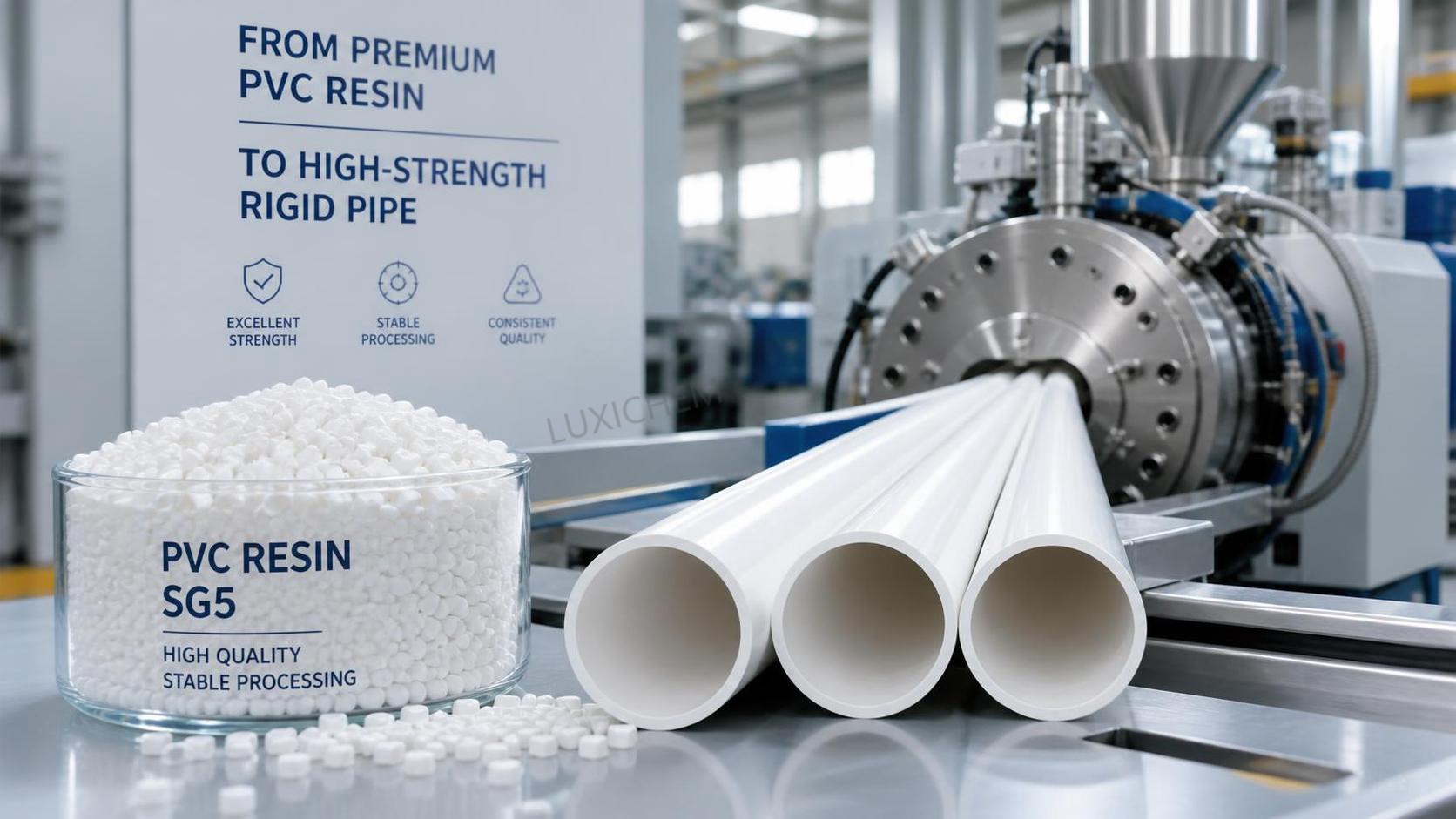
Core search intent: The reader wants to understand whether pvc resin sg5 is the right base resin for rigid pipe production, especially how it affects pipe strength, processing stability, consistency, and manufacturing risk.
Main concerns of technical evaluators: They typically focus on K-value implications, fusion behavior, melt processability, mechanical performance, batch-to-batch consistency, formulation compatibility, and whether supplier stability supports predictable pipe quality.
Most useful decision-support content: The article should explain the practical relationship between SG5 properties and pipe performance, show how SG5 behaves during extrusion, clarify selection criteria, and outline what to verify when qualifying a supplier.
Recommended emphasis: Prioritize real evaluation points such as strength, processing window, thermal stability, throughput, and quality consistency. Reduce broad PVC background, generic chemical company promotion, and textbook-level explanations that do not help material selection.
What PVC Resin SG5 Means for Pipe Strength and Processing Stability
For technical evaluators assessing pipe-grade materials, understanding what pvc resin sg5 means is essential to balancing mechanical strength, processing stability, and production efficiency. Widely used in rigid PVC pipe applications, this grade plays a key role in melt behavior, consistency, and final product performance. This article explores how SG5 characteristics influence pipe quality and why stable sourcing matters for reliable manufacturing outcomes.
Why SG5 is widely used in rigid PVC pipe production
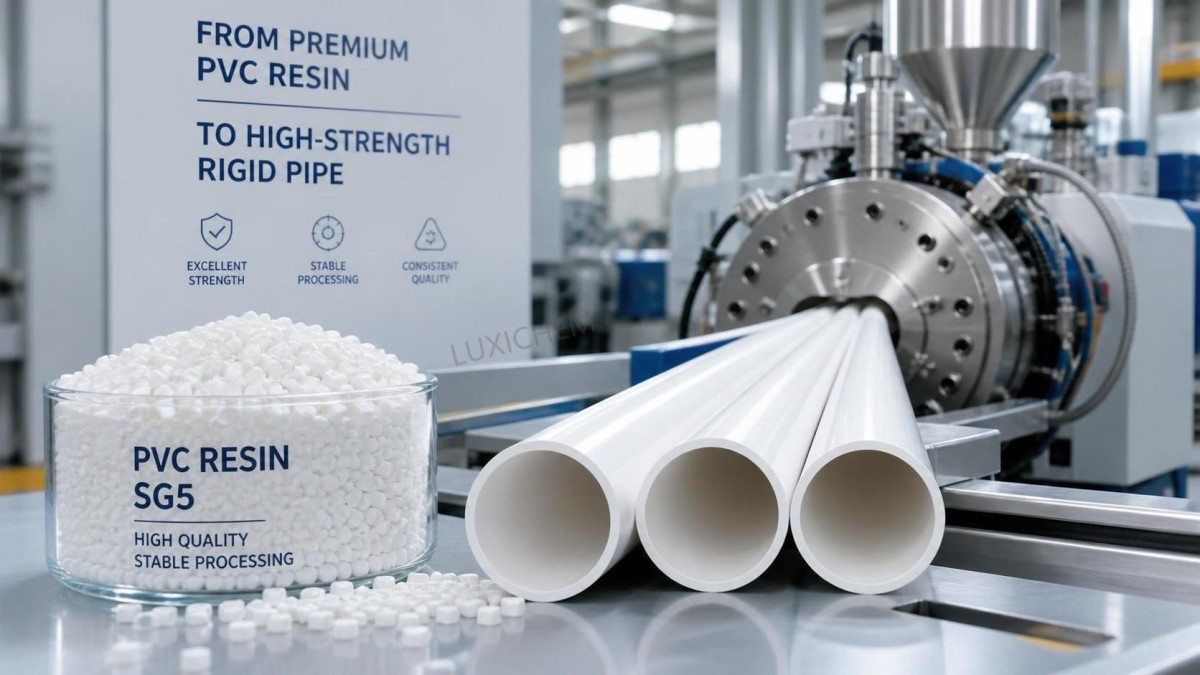
In practical pipe manufacturing, SG5 is generally recognized as a versatile suspension PVC resin grade suitable for rigid extrusion. Its value lies in balance rather than in any extreme property.
Technical teams often choose pvc resin sg5 because it can support acceptable hoop strength, stable fusion behavior, and manageable processing conditions across common pipe formulations and extrusion lines.
Compared with grades aimed at softer conversion or different viscosity ranges, SG5 usually fits the requirements of pressure pipes, drainage pipes, conduit, and many general rigid profiles.
That does not mean every SG5 performs identically. The designation points to a general resin class, but actual pipe performance still depends on polymerization control, particle morphology, porosity, impurity level, and batch consistency.
What technical evaluators should understand first about SG5
The first point is that SG5 is not a finished pipe material. It is the base resin, and its usefulness depends on how well it works with stabilizers, lubricants, fillers, impact modifiers, and processing conditions.
Second, pipe strength is not determined by resin viscosity alone. It emerges from the combination of molecular characteristics, gelation quality, dispersion of additives, die pressure stability, and cooling control.
Third, processing stability matters just as much as nominal physical properties. A resin that looks acceptable on paper but behaves inconsistently during extrusion can create more quality risk than a slightly less aggressive grade.
For this reason, technical evaluators should assess SG5 not only through specification sheets, but also through conversion behavior on the intended pipe formulation and equipment setup.
How SG5 influences pipe strength in real production conditions
Pipe strength is affected by molecular weight distribution, fusion degree, and the uniformity of the final extruded structure. A stable SG5 resin helps processors achieve dense and consistent pipe walls.
When resin particles absorb additives well and fuse uniformly, the pipe typically shows better circumferential strength, improved resistance to internal pressure, and more reliable long-term structural behavior.
If fusion is incomplete, the pipe may retain weak interfaces between particles. That can reduce mechanical reliability, especially under pressure, temperature cycling, or installation stress in demanding service environments.
On the other hand, over-fused material can lead to thermal history problems, local degradation, and surface defects. The best result comes from a resin that reaches proper fusion within a controllable process window.
This is where pvc resin sg5 often performs well. It is commonly selected because it can support the balance between adequate melt strength and acceptable processability required in rigid pipe extrusion.
Why processing stability matters as much as mechanical performance
For evaluators, stable extrusion is not a secondary issue. Processing instability directly affects dimensional tolerance, surface quality, output rate, energy consumption, and scrap generation.
A good SG5 resin should feed consistently, plasticize predictably, and maintain a workable torque profile. These characteristics reduce pressure fluctuation and support smoother operation across long production runs.
In pipe plants, even small variation in fusion speed or lubrication response can alter wall thickness control, vacuum sizing behavior, and final socket or cut-end quality.
That is why processors do not simply ask whether a resin can run. They ask whether it can run for hours with stable amperage, acceptable melt temperature, and repeatable appearance across multiple batches.
For technical qualification, this is often more meaningful than isolated lab data. A resin with a forgiving process window reduces operator dependence and lowers the risk of hidden inconsistency.
Which SG5 resin characteristics deserve close evaluation
Several parameters deserve focused attention when comparing pipe-grade materials. K-value or related viscosity indicators are important because they influence melt behavior, fusion tendency, and final stiffness potential.
Bulk density matters because it affects feeding behavior and output consistency. Higher and more stable bulk density can improve material handling and reduce fluctuation in extruder loading.
Porosity is another key indicator. Proper porosity helps the resin absorb stabilizers and processing aids more effectively, which supports even dry blend quality and more predictable gelation during extrusion.
Particle size distribution should also be monitored. Poorly controlled particle structure can cause feeding inconsistency, dusting issues, or irregular plasticization, all of which complicate stable pipe production.
Thermal stability and impurity control are equally relevant. Trace contamination, fish eyes, or unstable color development may indicate risks that become more obvious during long extrusion cycles.
How SG5 affects formulation flexibility and line efficiency
One reason SG5 remains common in pipe applications is that it often works across a practical range of formulations. This gives technical teams more room to optimize cost, stiffness, and processing behavior.
For example, an extrusion line may require different lubrication balance depending on screw design, filler loading, and target pipe diameter. A stable SG5 resin allows those adjustments without destabilizing the entire process.
In plants managing multiple product specifications, formulation flexibility can be commercially important. A resin that supports several rigid PVC products can reduce inventory complexity and simplify purchasing decisions.
Luxi Chemical (Shandong) Co., Ltd., as a comprehensive supplier of chemical raw materials and related products, serves customers who often value this kind of procurement efficiency across multiple industrial categories.
In broader sourcing programs, buyers may also evaluate unrelated supporting chemicals through one supplier network, including products such as Sodium Hydrosulfide CAS#16721-80-5, when managing diversified purchasing needs.
Common problems when SG5 quality or fit is not ideal
If the selected resin is not well matched to the formulation or line conditions, the first symptoms usually appear during processing rather than in final testing.
Typical warning signs include unstable extrusion pressure, rough pipe surfaces, inconsistent gloss, poor socket formation, variable density, and increased scrap during startup or grade changes.
In more serious cases, poor resin consistency can contribute to incomplete fusion, brittleness, reduced impact resistance, or premature failure in pressure testing and service simulation.
Some teams respond by adjusting stabilizers or lubricants aggressively, but excessive formulation correction can mask the real issue and create new variability elsewhere in the process.
For evaluators, repeated need for line compensation is often a sign that the resin itself should be reassessed instead of endlessly tuning downstream processing conditions.
How to evaluate whether a supplier’s SG5 is reliable for pipe applications
Material selection should include more than a typical certificate review. Technical evaluators should ask for consistent production data, recent batch history, and clarity on how key indicators are controlled.
It is useful to verify whether the supplier can provide stable resin from repeatable manufacturing systems, not merely occasional compliant batches prepared for approval samples.
Trial evaluation should cover dry blend behavior, fusion time, extrusion stability, pipe appearance, wall uniformity, density, impact performance, and relevant pressure or flattening tests.
Batch-to-batch comparison is critical. One successful trial does not prove long-term suitability if the supplier cannot maintain narrow variation in particle structure and processing response.
Technical support also matters. When deviations appear, the supplier should be able to discuss resin characteristics in practical processing terms rather than relying only on generic specification language.
Why stable sourcing reduces operational and quality risk
For pipe manufacturers, raw material instability creates hidden costs that go far beyond resin price. It can increase downtime, scrap, energy use, customer complaints, and uncertainty in production scheduling.
Stable sourcing helps technical teams standardize formulations, narrow operating windows, and reduce the frequency of corrective intervention on the extrusion floor.
That reliability is especially important for companies producing pipes for infrastructure, utilities, or industrial use, where dimensional consistency and long-term performance cannot be treated casually.
Luxi Chemical supports global customers with a broad chemical supply model and an emphasis on stable product delivery, which matters for buyers seeking dependable long-term procurement relationships.
When evaluators compare suppliers, they should consider not only current pricing but also the supplier’s ability to sustain quality consistency across ongoing shipments and different market cycles.
What is the overall judgment on pvc resin sg5 for pipe production
In most rigid PVC pipe contexts, SG5 remains a practical and proven resin class because it offers a workable balance of strength potential, process control, and formulation adaptability.
Its real value, however, does not come from the label alone. The performance of pvc resin sg5 depends on actual resin quality, compatibility with the selected additive package, and consistency from batch to batch.
For technical evaluators, the right conclusion is usually not simply that SG5 is suitable, but that a stable, well-controlled SG5 can support efficient extrusion and dependable pipe properties.
The best evaluation approach is evidence-based: verify fusion behavior, mechanical outcomes, process stability, and supplier consistency under realistic production conditions, then make the sourcing decision accordingly.
When those factors align, SG5 can be a strong foundation for reliable pipe manufacturing, lower process risk, and better long-term quality control.
Related Picks
 Butylated Hydroxytoluene Price Drivers: Supply, Purity, and Purchasing Risk FactorsOct 21, 2026Butylated Hydroxytoluene price trends depend on supply stability, purity, logistics, and purchasing risk. Learn how to compare quotes wisely and reduce sourcing costs.
 Sodium Tripolyphosphate Price Trends: Raw Material and Energy ExposureOct 20, 2026Explore sodium tripolyphosphate price trends, from phosphate and soda ash costs to energy exposure. Learn how to compare quotes, manage sourcing risks, and make smarter purchasing decisions.
 Acetonitrile Shipment to Vietnam Successfully Dispatched; RCEP Benefits Boost Fine Chemical Trade with ASEANSep 16, 2026A shipment of industrial-grade acetonitrile from our company has recently been loaded and dispatched following the completion of standardized hazardous material packaging and container securing procedures.
 Nigerian Client’s Order of 4 Containers of Vinyl Acetate Successfully Loaded and Shipped to West AfricaSep 16, 2026We recently completed the loading of a vinyl acetate order for a Nigerian client; four containers of the product have been successfully packed and are ready for shipment to Nigeria.




Question Consultation
Send Us Your Inquiry Today

Luxi Chemical is a professional chemical product supplier with ample stock of all chemical categories and excellent quality, welcome your purchase inquiry.

