


Polyglutamic Acid Serum Instability: Testing pH and Salt Compatibility
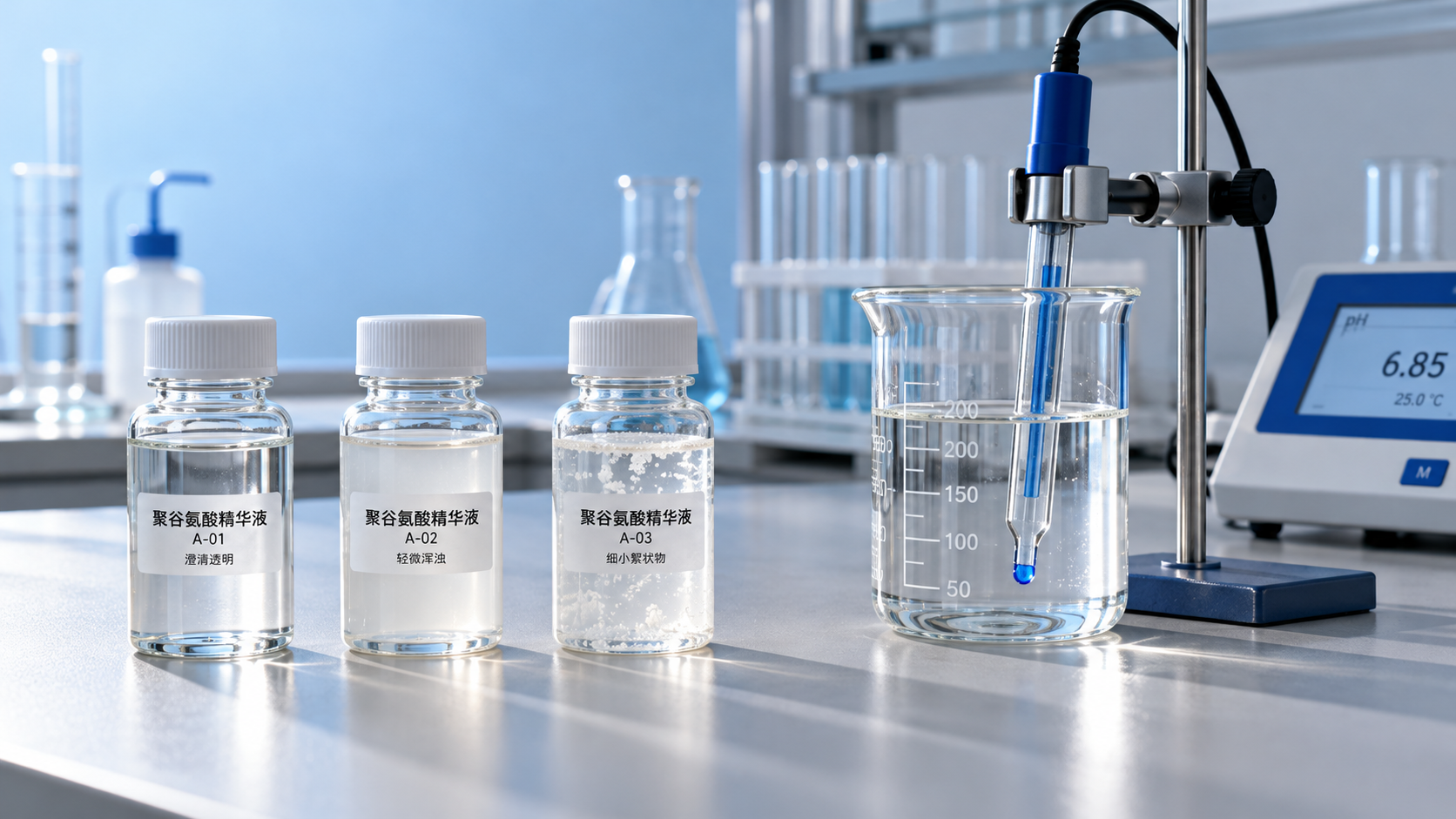
A Polyglutamic Acid serum looks clear after mixing, then loses body overnight. Another batch develops haze only after a mineral ingredient is added. These changes can look like raw material inconsistency, but pH, electrolyte loading, and processing history often explain more than the polymer’s certificate of analysis.
For technical evaluators, the useful question is not simply whether Polyglutamic Acid is “salt-compatible.” It is whether a defined grade, at a defined concentration, remains functional within the finished formula’s pH and electrolyte window. A controlled screening program can distinguish reversible changes in polymer conformation from precipitation, incomplete hydration, or genuine degradation—and prevent unnecessary raw material rejection.
Read the failure before changing the formula
Polyglutamic Acid, commonly supplied for cosmetic applications as gamma-polyglutamic acid or its sodium salt, is an anionic polymer with ionizable carboxyl groups. Its solution behavior depends on molecular weight distribution, neutralization state, concentration, and the surrounding formulation.
As pH changes, the degree of ionization changes. Added salts also screen electrostatic interactions along and between polymer chains. Consequently, a viscosity drop does not automatically mean that the polymer backbone has degraded. Multivalent ions introduce another variable: they may associate with carboxylate groups and, under some conditions, promote aggregation or network formation.
Several mechanisms can occur together. A clear appearance does not prove molecular stability, and haze alone does not establish polymer incompatibility.
Build a baseline that makes the results interpretable
Begin with a simplified aqueous system rather than the complete serum. Fragrance solubilizers, preservatives, botanical extracts, other thickeners, and mineral actives can obscure the source of instability.
Record the exact Polyglutamic Acid grade, supplied form, active content, molecular weight specification, and lot number. A concentration stated on an “as supplied” basis may differ substantially from the active polymer concentration. Use the same calculation basis throughout the study.
Prepare a master solution using controlled-quality water and the intended polymer concentration. Standardize addition rate, mixing equipment, temperature, and hydration time according to the supplier’s guidance. Avoid assuming that stronger mixing will solve every dispersion problem; excessive shear can complicate comparisons for high-molecular-weight materials.
At minimum, include these controls:
- Polymer baseline: water and polymer at the reference pH, without added test salt.
- Ingredient blank: water and the test salt, without polymer, adjusted to the same pH.
- Vehicle control: the serum base without Polyglutamic Acid, especially when another rheology modifier is present.
- Process control: the same formulation prepared with the established mixing and addition sequence.
Use independently prepared replicates for promising or borderline conditions. Repeated readings from one container reveal measurement repeatability, not batch-to-batch preparation variability.
Separate pH sensitivity from electrolyte sensitivity
Map the pH response without the test salt
Screen several pH points around the intended finished-product range. For a serum targeting mildly acidic conditions, an illustrative starting series might be pH 4.0, 4.5, 5.0, 5.5, 6.0, and 7.0. These are experimental screening points, not a universal recommended range for every grade or cosmetic formula.
Adjust separate aliquots with dilute acid or base under gentle mixing. Keep the adjuster chemistry consistent and record the amount added. Acid and base additions introduce ions, so a “pH-only” experiment is not entirely electrolyte-free. Avoid unnecessary buffering during the initial screen; if a buffer is essential, treat its composition and concentration as additional variables.
Measure pH after equilibration and again after storage. Compare appearance and viscosity at a fixed temperature. A sharp change near the edge of the intended operating range warrants closer testing with smaller pH increments.
Apply salt gradients at controlled pH
Next, hold pH near the proposed target and increase salt concentration stepwise. Start with a simple monovalent reference, such as sodium chloride, and then examine the actual electrolyte-containing ingredients in the formula.
Choose concentrations around realistic use levels, including a lower level, the intended dose, and a justified upper challenge level. Report both ingredient concentration and, where practical, molar ion concentration. Equal weight percentages of different salts do not represent equal ionic exposure.
Ionic strength provides a useful first comparison: I = ½ Σcizi2, where concentration is expressed in mol/L and charge is represented by z. Assuming complete dissociation, 10 mmol/L sodium chloride has an ionic strength of 10 mmol/L, while 10 mmol/L magnesium lactate has a nominal ionic strength of 30 mmol/L. Specific ion association and complexation mean that this calculation cannot predict compatibility by itself.
After each salt addition, verify pH again. Otherwise, an apparent electrolyte effect may actually include a substantial pH shift.
Check the interaction, not just the individual variables
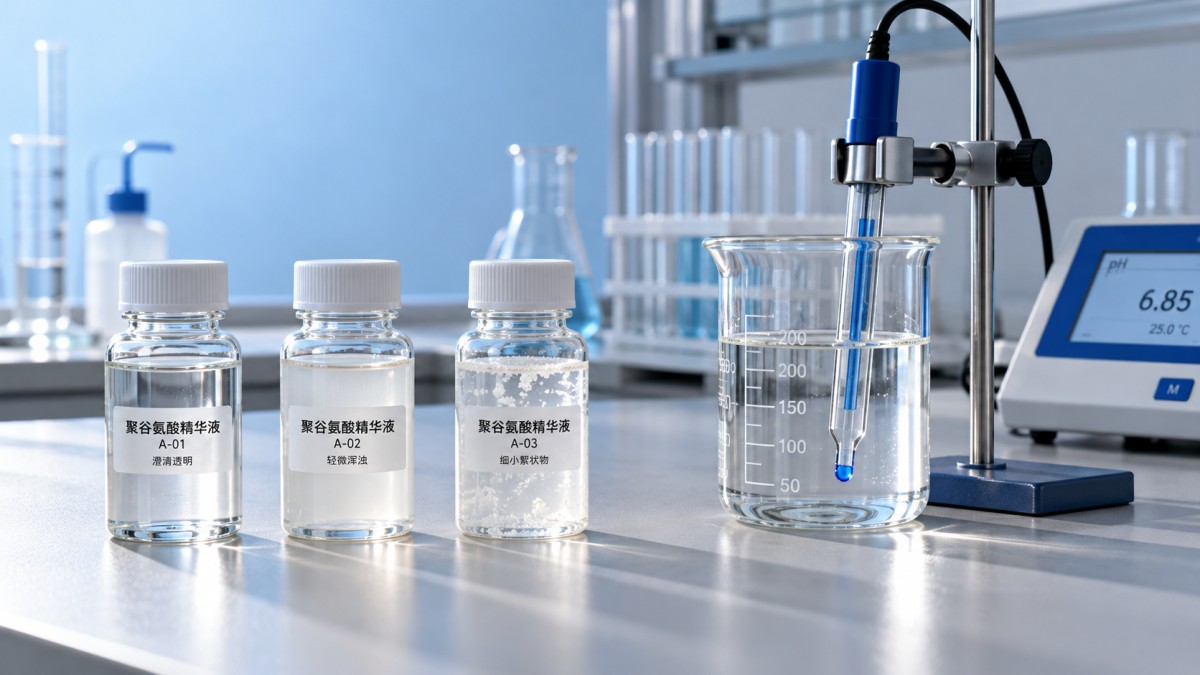
Once the separate screens identify sensitive regions, build a compact pH–salt matrix. Test low, target, and high pH against zero, intended, and upper-challenge salt levels. This reveals combinations that fail even when the individual variables appeared acceptable.
Keep final polymer concentration, batch mass, and dilution constant. When adding salt stocks, compensate with water in the controls. An unnoticed dilution difference can resemble electrolyte-induced viscosity loss.
Where magnesium lactate belongs in the study
If magnesium lactate is being considered for the serum, evaluate it as a formulation ingredient and a source of divalent ions—not simply as a generic water-soluble additive. The supplied Magnesium L-lactate trihydrate CAS#18917-93-6 is described as a white, odorless powder with an assay of at least 99%. Those attributes support material identification and procurement review, but they do not establish compatibility with Polyglutamic Acid.
Confirm the hydrate identity, assay basis, water content, and applicable cosmetic-use documentation before calculating the dose. Hydration state affects the magnesium delivered per gram. Determine dissolution behavior at the actual processing temperature and concentration, because material that dissolves during heating may crystallize after cooling.
A salt-only blank is particularly valuable here. Haze may originate from incomplete dissolution or interactions with other formula components rather than the polymer. Phosphate-containing buffers, for example, can introduce precipitation risks with magnesium under suitable conditions.
For raw material sourcing through Luxi Chemical (Shandong) Co., Ltd., request current specifications, lot-specific analytical documentation, and handling guidance for the intended application. A high assay is useful, but supplier qualification and finished-formula compatibility remain separate decisions.
Measure stability in a way that survives technical review
Visual inspection is necessary, but “looks acceptable” is too subjective for qualification. Establish a consistent observation and measurement protocol before comparing samples.
- Appearance: inspect against light and dark backgrounds; record haze, sediment, flocs, bubbles, and separation. Use consistent lighting and photographs.
- Viscosity or rheology: specify instrument, geometry or spindle, speed or shear rate, temperature, rest period, and measurement sequence.
- pH: use a calibrated meter suitable for the sample and report measurement temperature.
- Turbidity: where available, use a defined instrumental method rather than visual rankings alone.
- Conductivity: use as a supporting process check, not as a direct substitute for ionic strength or ion identification.
For shear-thinning serums, a single viscosity reading can hide meaningful changes in flow behavior. A flow curve may distinguish loss of low-shear structure from a smaller change under application-like shear.
Take measurements after a defined equilibration period, then at planned intervals during storage. A practical initial schedule might include 24 hours, one week, two weeks, and four weeks. Select ambient, refrigerated, and elevated-temperature conditions appropriate to the product and packaging. Accelerated testing identifies risks; it does not independently establish shelf life.
Keep containers sealed and monitor evaporation where relevant. Temperature exposure, headspace, and container interaction can otherwise confound the results. Physical stability testing also does not replace preservative efficacy or microbiological assessment.
Turn the pattern into a corrective action
If pH alone triggers the change, move the target away from the sensitive region and confirm that the revised range remains suitable for every ingredient. Review acid addition technique before replacing the polymer. Localized exposure to concentrated adjuster can cause problems that the final bulk pH does not reveal.
If salt causes thinning without haze, assess whether charge screening or the companion thickener is responsible. Consider reducing unnecessary electrolyte loading, adjusting the rheology system, or evaluating another polymer grade. Increasing Polyglutamic Acid concentration may restore body, but can also change tack, film formation, and sensory feel.
If divalent salts produce flocs or sediment, compare equal-molar and approximate equal-ionic-strength conditions with a monovalent reference. This helps distinguish general screening from more specific interactions. Consider dose reduction or ingredient substitution. Chelation is not an automatic solution: it can alter the intended availability of magnesium and affect other formulation functions.
If addition order changes the result, repeat the comparison at matched final composition. Prehydrating the polymer and adding diluted electrolyte gradually may avoid local concentration spikes. However, a favorable preparation sequence cannot guarantee that an intrinsically unstable final composition will remain stable during storage.
Where degradation is suspected, viscosity alone is insufficient evidence. Molecular weight analysis, such as a validated size-exclusion chromatography method, may be needed to distinguish chain scission from reversible conformational changes.
Define a usable compatibility window
Set acceptance criteria before selecting the preferred sample. Include an application-appropriate viscosity band, allowable pH drift, appearance limits, and absence of unacceptable sediment or separation. There is no universal percentage of viscosity retention that qualifies every serum.
The final confirmation should use the complete formulation, intended packaging, representative raw material lots, and realistic processing conditions. Include reasonable manufacturing variation: a formula that works only at one precise laboratory pH may be difficult to control commercially.
A defensible conclusion is therefore specific: the selected Polyglutamic Acid grade is compatible within a documented pH range, electrolyte composition, processing sequence, and storage program. That defined operating window is more useful than a blanket “compatible” claim—and gives formulators a practical basis for troubleshooting the next unexpected batch.
Related Picks
 Butylated Hydroxytoluene Price Drivers: Supply, Purity, and Purchasing Risk FactorsOct 21, 2026Butylated Hydroxytoluene price trends depend on supply stability, purity, logistics, and purchasing risk. Learn how to compare quotes wisely and reduce sourcing costs.
 Sodium Tripolyphosphate Price Trends: Raw Material and Energy ExposureOct 20, 2026Explore sodium tripolyphosphate price trends, from phosphate and soda ash costs to energy exposure. Learn how to compare quotes, manage sourcing risks, and make smarter purchasing decisions.
 Acetonitrile Shipment to Vietnam Successfully Dispatched; RCEP Benefits Boost Fine Chemical Trade with ASEANSep 16, 2026A shipment of industrial-grade acetonitrile from our company has recently been loaded and dispatched following the completion of standardized hazardous material packaging and container securing procedures.
 Nigerian Client’s Order of 4 Containers of Vinyl Acetate Successfully Loaded and Shipped to West AfricaSep 16, 2026We recently completed the loading of a vinyl acetate order for a Nigerian client; four containers of the product have been successfully packed and are ready for shipment to Nigeria.




Question Consultation
Send Us Your Inquiry Today

Luxi Chemical is a professional chemical product supplier with ample stock of all chemical categories and excellent quality, welcome your purchase inquiry.

