


Sodium Bicarb Purity and Particle Size: What QC Teams Should Check Before Use
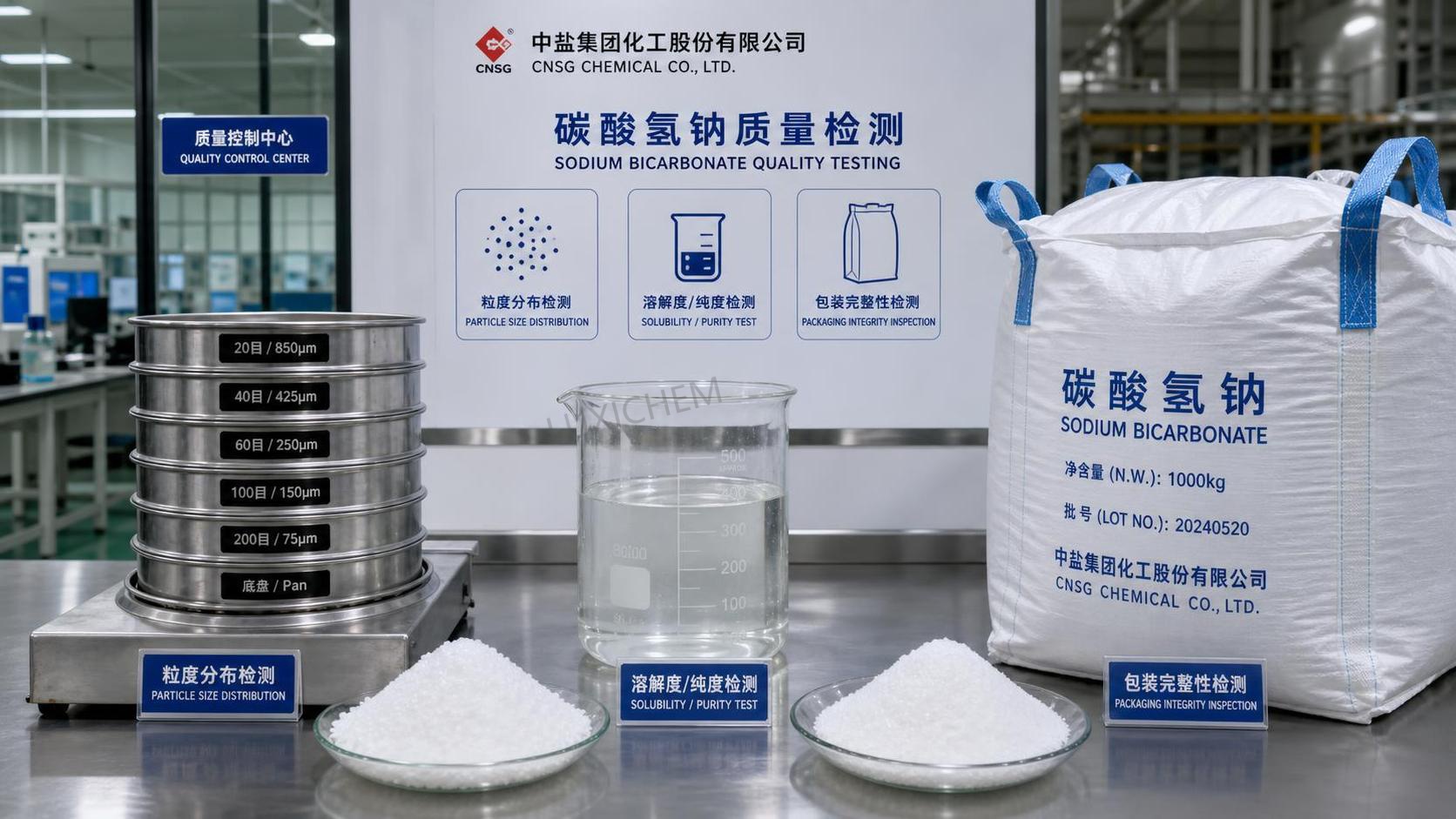
Sodium bicarb should not enter a production line on the strength of a passing COA alone. A material may meet a nominal assay range and still behave poorly if particle size is wrong for the dosing system, if residual moisture has shifted during storage, or if trace contamination creates incompatibility with the intended process. In food, chemical, and industrial settings, acceptance needs to connect the specification sheet to actual use conditions: feed rate, dissolution profile, blending behavior, dust generation, packaging integrity, and the risk of unintended reaction with nearby materials.
Purity is usually the first gate, but the useful question is narrower than “is it pure enough.” The more practical question is whether the measured composition matches the application window. Sodium bicarb with acceptable sodium hydrogen carbonate content may still carry carbonate, chloride, sulfate, insoluble matter, or metallic residues at levels that are tolerable in one process and disruptive in another. Where the material is used in buffered systems, leavening blends, neutralization, dry mixing, or gas-releasing reactions, small compositional differences can alter pH drift, residue load, reaction speed, or visual appearance of the final product.
Assay Should Be Read Together with Impurity Profile
A narrow purity result becomes meaningful only when paired with impurity limits and test method alignment. If one supplier reports sodium bicarb assay by one method and another uses a different basis, apparent equivalence may be misleading. The same issue appears when moisture is expressed as loss on drying but sampling conditions differ, or when insoluble matter is reported without describing filtration conditions. Incoming review should confirm that the analytical method used for release matches, or at least reasonably correlates with, the internal verification method.
Particular attention is needed where sodium bicarb is used in systems sensitive to taste, color, residue, or downstream catalyst performance. Chloride and sulfate may be unremarkable in some industrial formulations yet undesirable in more sensitive applications. Iron or other trace metals can matter when discoloration, oxidation side reactions, or deposit formation are possible. Insoluble particles are often overlooked until they appear as specks, filter loading, or sediment. When the intended use involves solution preparation, a quick beaker test under actual plant water conditions often reveals issues that a paper review does not.
Lot approval also benefits from checking whether the assay result is reported on an as-is basis or dry basis. Confusion here can distort comparison across lots, especially where warehouse humidity varies or packaging has been opened and resealed. A sodium bicarb lot stored near damp conditions may still look free-flowing at first inspection while carrying enough moisture shift to affect net active content, weigh-up accuracy, and the way fine particles adhere to transfer surfaces.
Particle Size Is a Process Variable, Not a Minor Physical Property
Many acceptance problems trace back to particle size distribution rather than chemistry. Coarse sodium bicarb may dissolve too slowly, segregate from finer ingredients in a dry blend, or feed unevenly through screw systems calibrated for a different bulk behavior. Very fine material may compact in hoppers, generate excess airborne dust, absorb moisture faster, or react more rapidly than the process expects. Median particle size alone is not enough; the spread matters because oversized particles and excess fines create different failure modes.
Sieve data remain useful when tied to the actual equipment. A lot that technically meets a broad mesh specification can still create rat-holing or inconsistent metering if the fine fraction has shifted upward. Laser diffraction can provide a more detailed view, but only if the method is controlled well enough to avoid misleading dispersion results. For routine release, many facilities rely on a practical combination: a defined sieve profile, bulk density, and a short performance test such as timed dissolution or feed simulation.
Where sodium bicarb is blended with acids, salts, flavors, fillers, or active ingredients, particle size compatibility across all components should be considered. Segregation risk increases when one component is substantially coarser or denser than the others. A formulation may pass lab mixing and then separate during conveying, tote transfer, or vibration in transport. In that context, an unrelated raw material review, such as documentation maintained for Diethyl benzylphosphonate CAS#1080-32-6, illustrates a broader control principle: physical properties can be as important as compositional ones when determining whether a material behaves predictably in storage and processing.
Moisture, Caking, and Packaging Condition Often Shift After Production
Sodium bicarb is not usually judged as highly hygroscopic, but that can create complacency. In practice, moisture pickup during storage and transport can change flow, increase lump formation, and reduce consistency in gravimetric or volumetric addition. Moisture excursions may also accelerate decomposition in unsuitable conditions, especially where heat exposure and long dwell times combine. A clean assay result from the original batch release does not confirm that the delivered lot still reflects the same condition.
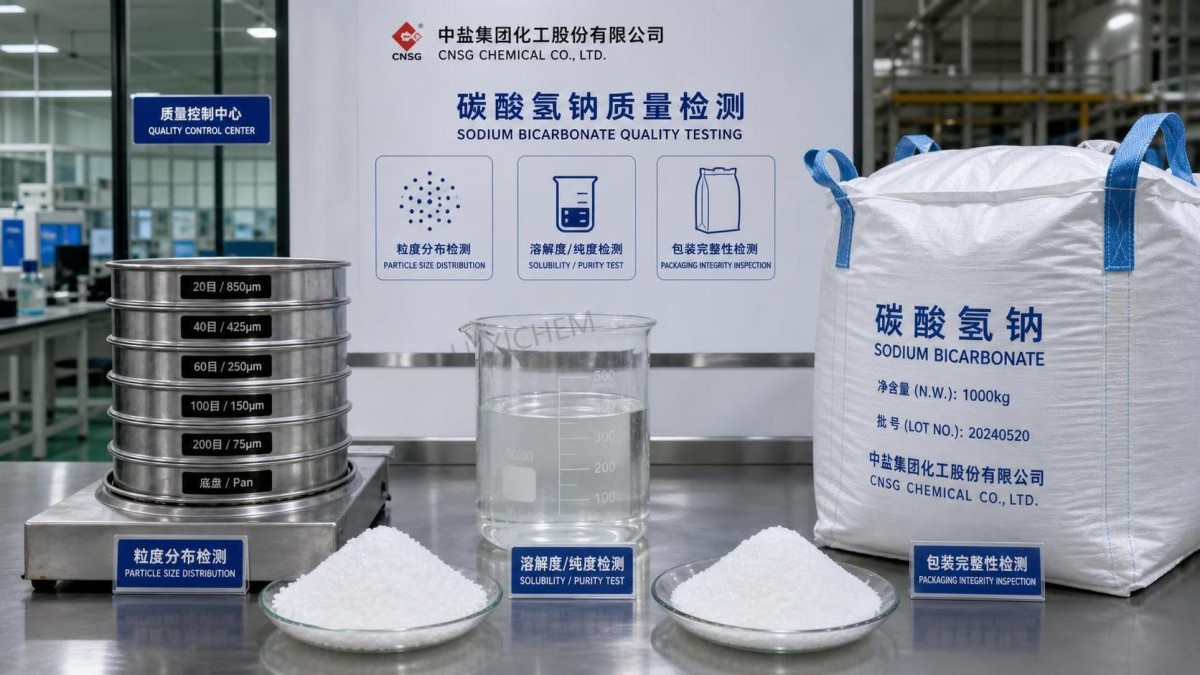
Packaging inspection therefore deserves more than a quick visual glance. Torn valve bags, compromised inner liners, softened pallets, condensation marks, broken seals, or evidence of rebagging all justify closer evaluation. If the outer packaging is intact but the product presents hard lumps, the question is not only whether the lumps can be broken apart, but whether local moisture concentration has already altered reactivity and blend uniformity. In some plants, sieve recovery from a representative sample tells more about practical usability than appearance alone.
Warehouse handling can also produce false signals. Material brought from a cold truck into a warm humid room may show surface condensation on packaging, which can later migrate inward if opened too early. A short equilibration period before sampling may prevent a misleading moisture result. Conversely, leaving samples exposed too long before testing can dry the outer fraction and understate the actual condition of the lot.
Contamination Risk Extends Beyond the Sodium Bicarb Specification
Contamination review should cover the route from manufacturing through unloading. Cross-contact can occur through shared packaging lines, reused containers, dusty warehouses, damaged pallets, or transport vehicles carrying incompatible goods in previous loads. Even when the sodium bicarb specification itself appears satisfactory, foreign odor, visible specks, off-color granules, or unexplained pH behavior may indicate external contamination rather than an intrinsic quality issue.
For food-adjacent or cleanliness-sensitive uses, sampling tools and sample containers matter more than many teams assume. Stainless tools that are not fully dry, plastic containers carrying residual detergent, or reused jars without proper blank verification can distort results at low levels. If insoluble matter or trace ions suddenly increase, the first investigation step should include the sampling path before assigning blame to the batch.
Another common blind spot is contamination from process aids or maintenance materials. Lubricants, gasket fragments, or cleaning chemical residues may enter during bulk transfer or silo charging. Where sodium bicarb is pneumatically conveyed, line condition and filter integrity deserve review because abrasion products or retained material from a previous campaign can contribute fines or foreign particles that are difficult to distinguish later.
Application Fit Matters More Than Generic Compliance Language
A specification that says “industrial grade” or “food grade” does not answer whether the lot is suitable for the exact operation. Sodium bicarb used for pH adjustment in a water-based system may need rapid dissolution and low insoluble residue. The same compound used in a dry reaction blend may need controlled particle size and low fines to maintain distribution during mixing and packaging. In effervescent or gas-generating systems, surface area strongly influences reaction onset and gas release profile, which means particle size variation can appear as a process timing issue rather than a raw material issue.
Thermal exposure should also be considered before approval. If the process includes drying, hot filling, heated premix holding, or proximity to steam lines, sodium bicarb stability under those conditions may need confirmation. Decomposition can release carbon dioxide and leave sodium carbonate, shifting alkalinity and performance. A lot that is chemically acceptable at receiving may become unsuitable if the plant’s thermal profile is close to its practical stability limit.
Water quality is another hidden variable. Dissolution behavior tested in deionized water may not predict behavior in hard process water or in systems containing calcium, magnesium, or dissolved salts. Precipitation, haze, or delayed dissolution can follow. When sodium bicarb is approved for solution use, a small-scale compatibility trial using the actual plant water and temperature range is often more informative than repeating a full assay.
Sampling and Release Decisions Need Representative Material
Sampling only from the bag top or the top layer of a drum can miss segregation and caking lower down. Where lot size and packaging format allow, composite sampling from several units gives a more defensible picture. If the lot contains visible variation in granulation, color, or lump frequency, separate retain portions from each sampled unit are worth keeping until the investigation closes. Homogenizing too early may erase the pattern needed to identify whether the issue came from manufacturing, storage, or transport.
Retest logic should be disciplined. Repeating the same test until one acceptable result appears is not a control system. A second test makes sense when there is a defined reason such as sample handling error, instrument suitability concern, or observed heterogeneity in the lot. The retest should then be tied to a revised sampling plan or a verified method check, not just another aliquot from the same questionable container.
Documents Matter, but They Are Secondary to Material Behavior
Certificates, declarations, and shipping papers are necessary, especially where traceability and restricted-use controls apply, but they do not substitute for receiving observations. A complete document set does not explain why sodium bicarb suddenly bridges in a feeder, leaves residue in a dissolution tank, or shows unexpected fines after unloading. Where discrepancies appear, the most useful path is often to compare the current lot against a known acceptable retain sample using a few targeted tests: sieve profile, bulk density, moisture, pH in solution, and visual insolubles.
Release decisions become more reliable when they connect written limits with actual plant performance history. Over time, internal acceptance bands may narrow around the process-sensitive properties that generic supplier specifications leave broad. That does not require inventing new claims about the material. It simply means treating sodium bicarb as a process input whose physical and chemical condition must match the use environment on the day it is consumed.
When purity, particle size, moisture condition, and contamination risk are reviewed together, fewer problems escape into production under the label of “compliant material.” That is usually where the strongest control begins: not at the point of paperwork, but at the point where the lot either behaves as expected or it does not.
Related Picks
 Butylated Hydroxytoluene Price Drivers: Supply, Purity, and Purchasing Risk FactorsOct 21, 2026Butylated Hydroxytoluene price trends depend on supply stability, purity, logistics, and purchasing risk. Learn how to compare quotes wisely and reduce sourcing costs.
 Sodium Tripolyphosphate Price Trends: Raw Material and Energy ExposureOct 20, 2026Explore sodium tripolyphosphate price trends, from phosphate and soda ash costs to energy exposure. Learn how to compare quotes, manage sourcing risks, and make smarter purchasing decisions.
 Acetonitrile Shipment to Vietnam Successfully Dispatched; RCEP Benefits Boost Fine Chemical Trade with ASEANSep 16, 2026A shipment of industrial-grade acetonitrile from our company has recently been loaded and dispatched following the completion of standardized hazardous material packaging and container securing procedures.
 Nigerian Client’s Order of 4 Containers of Vinyl Acetate Successfully Loaded and Shipped to West AfricaSep 16, 2026We recently completed the loading of a vinyl acetate order for a Nigerian client; four containers of the product have been successfully packed and are ready for shipment to Nigeria.




Question Consultation
Send Us Your Inquiry Today

Luxi Chemical is a professional chemical product supplier with ample stock of all chemical categories and excellent quality, welcome your purchase inquiry.

