


Sodium Tripolyphosphate CAS 7758-29-4: Identity Checks Before Approval
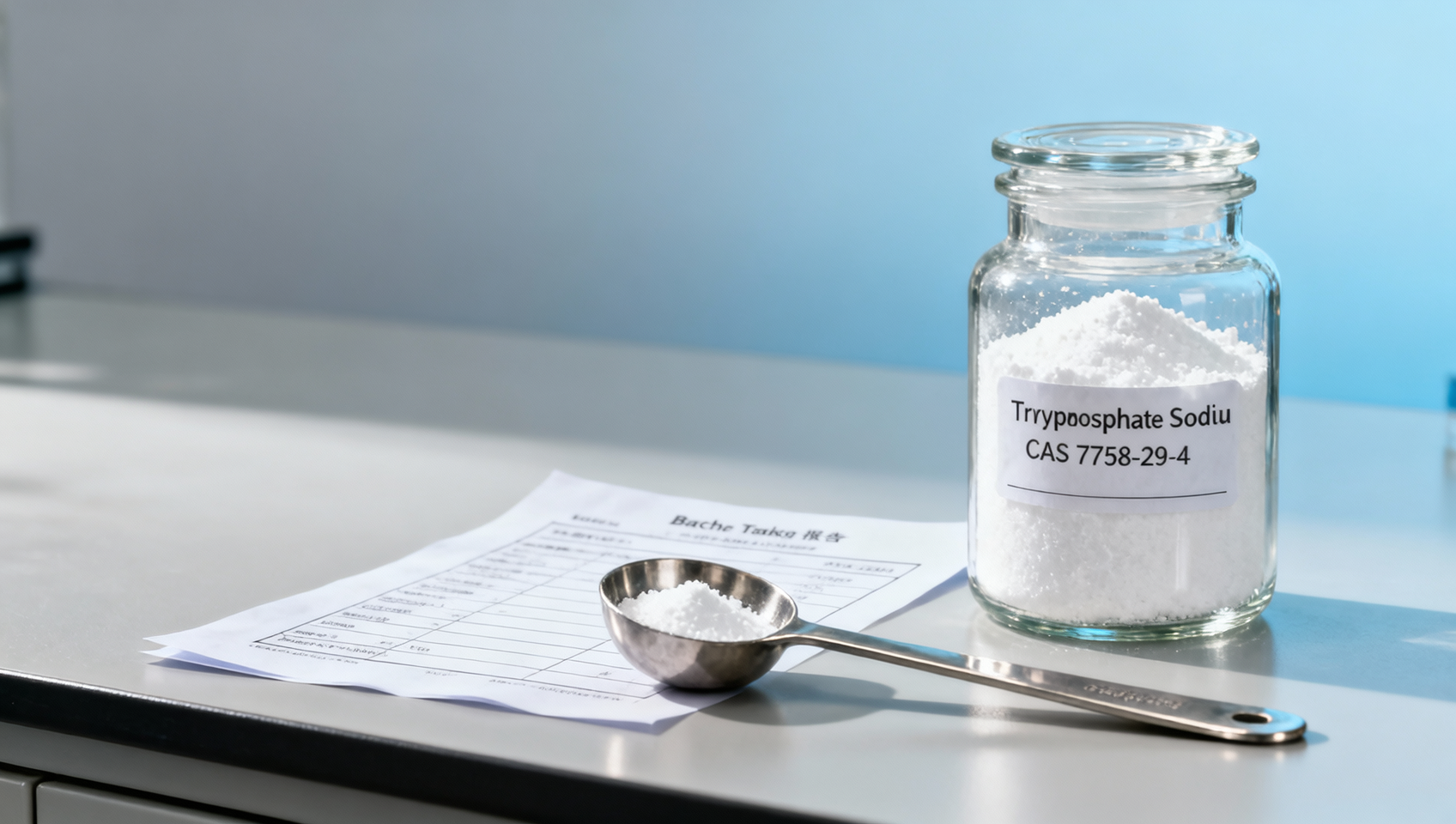
Approving sodium tripolyphosphate CAS 7758-29-4 requires more than matching a product name on a label. A shipment may arrive with intact bags and a reassuring certificate of analysis, yet still leave an important question unanswered: does the material meet the identity, grade, and traceability requirements for its intended use?
For quality control and safety teams, discrepancies between the certificate of analysis, safety data sheet, and purchasing specification deserve attention before production begins. The objective is not to collect more paperwork. It is to establish a defensible connection between the substance ordered, the batch delivered, and the requirements governing its release.
Establish the chemical identity before reviewing performance
Sodium tripolyphosphate, commonly abbreviated as STPP, is an inorganic condensed phosphate used in applications including detergent formulation, water treatment, and food processing where permitted. Its chemical identity should remain consistent throughout the approval package, even when suppliers use different commercial descriptions.
Tripolyphosphate is not interchangeable with trisodium phosphate, sodium pyrophosphate, or sodium hexametaphosphate. These materials may share a broad product category, but their chemistry and formulation behavior differ. A purchasing description that simply says “phosphate powder” creates an avoidable substitution risk.
Separate three decisions: confirming the chemical identity, establishing compliance with the required grade, and determining suitability for the production process. Passing one does not automatically satisfy the others.
Make the documents describe one traceable shipment
Place the purchase order, approved specification, certificate of analysis (CoA), safety data sheet (SDS), and packaging labels side by side. Their roles differ, so they need not contain identical information. They should, however, tell a consistent story.
The CoA must connect results to the delivered batch
A useful CoA identifies the product, grade, batch or lot, issuing organization, applicable specification, and test results. Manufacturing, testing, and expiry or retest dates should be available where required by the purchasing agreement or quality system. Confirm that the lot number corresponds to the bags or containers received.
Look beyond a column filled with “passes.” Quantitative results should normally be reported for quantitative acceptance criteria, unless an agreed reporting arrangement provides otherwise. Review the units, method references, reporting basis, and any footnotes. A value reported on a dry basis cannot be compared directly with an as-received limit without understanding the moisture correction.
The SDS supports safe handling, not batch release
The SDS should identify the substance consistently, provide the supplier’s contact details, and address handling, storage, exposure controls, and emergency measures under the applicable jurisdiction’s format. Check its revision status and whether its product identifier can be linked to the shipment.
An SDS is generally not batch-specific. It cannot establish that a particular delivery meets an assay limit or food-additive specification. Conversely, a satisfactory CoA does not replace the safety information needed for unloading, sampling, and use.
Mixed document packages also need a clear stop rule. If an attachment concerns Curcumin CAS#458-37-7, for example, it describes a different substance and cannot support STPP approval. Treat an unrelated product sheet as a document-control discrepancy, not as harmless background information.
Which standard actually governs sodium tripolyphosphate CAS 7758-29-4?
There is no single certificate that makes STPP suitable for every application and destination. Begin with the intended use, receiving market, and contractual requirements. Then identify the current specification or regulatory provisions against which the material must be assessed.
- Food applications: Check whether the use is permitted in the destination market, including relevant food categories, conditions of use, and applicable purity criteria. Review any referenced FCC, JECFA, or jurisdiction-specific specification against the current requirements.
- Detergent and industrial applications: Apply the agreed technical specification, including any functional characteristics needed by the formulation and any relevant restrictions on phosphate use.
- Customer-controlled applications: Include additional contractual requirements, such as restricted-substance declarations, approved manufacturing sites, or change-notification obligations.
For EU food-additive assessment, sodium triphosphate is identified as E 451(i). That designation does not make every STPP shipment food grade, nor does it authorize every proposed use. The material’s specification and the conditions governing the finished food require separate review.
Similarly, an ISO 9001 certificate concerns a management system within its stated scope. It is not evidence that an individual batch meets a chemical purity specification. Check certificate validity, site coverage, and scope without treating certification as a substitute for product testing.
Choose tests that answer the approval question
Testing should follow the governing specification and a documented risk assessment. A new supplier, changed manufacturing site, inconsistent shipment history, or unexplained analytical shift may justify more extensive verification than a routine delivery from an established source.
The practical sequence is straightforward: verify documents and labels, sample representatively, confirm identity, assess specification compliance, and record the disposition. Keep the lot under controlled status until the required checks are complete.
Identity testing must distinguish relevant alternatives
Compendial identification reactions may support confirmation of sodium and phosphate where prescribed. However, detecting these ions alone may not distinguish tripolyphosphate from other sodium phosphates. Where substitution, degradation, or mixed-phosphate composition is a credible concern, use an appropriate validated method capable of resolving the question.
Depending on the specification and laboratory capability, phosphate-speciation chromatography, infrared analysis, or other suitable techniques may contribute to confirmation. Do not add a sophisticated test merely for reassurance: establish what it detects, what interferences matter, and how acceptance will be judged.
Assay and total phosphate are not necessarily equivalent
A result expressed as phosphorus pentoxide, or P2O5, may describe total phosphate content without independently proving the proportion present as tripolyphosphate. Orthophosphate and pyrophosphate can contribute phosphorus to such a measurement.
Read the analytical method before interpreting the number. If the approved specification requires STPP content, make sure the reported measurement and calculation establish that characteristic rather than a different phosphorus-related parameter.
Supporting tests define grade and process suitability
Common specification items include solution pH, moisture or loss on drying, water-insoluble matter, and specified elemental impurities. Their limits and methods depend on the applicable grade and standard. A statement such as “heavy metals compliant” may be insufficient if the receiving specification requires individual limits for named elements.
For pH, confirm solution concentration and measurement conditions. For moisture, distinguish the specified test from an alternative drying procedure that may produce a different result. Particle size, bulk density, dissolution behavior, and crystalline phase distribution may also matter operationally, even when chemical purity is acceptable.
STPP phase I and phase II proportions can affect hydration and formulation behavior. Where these characteristics are important, define them in the purchasing specification rather than assuming that the CAS number guarantees consistent performance.
Sampling and handling can change the evidence
A reliable method cannot rescue an unrepresentative sample. Define how containers are selected, which sampling tools are used, how contamination is prevented, and whether testing is performed on individual or composite samples. A composite can obscure variation between containers, so its use should be justified.
Inspect packaging for broken seals, water staining, contamination, and inconsistent labels. Caking alone does not prove chemical failure, but it warrants investigation of moisture exposure and handling conditions. Retain samples and record the sampling date, operator, container references, and storage conditions.
STPP can undergo hydrolysis in aqueous solution, with behavior influenced by conditions such as temperature and pH. Laboratories should therefore control sample preparation and analysis timing when phosphate composition is being evaluated.
For safety review, assess dust generation during bag opening, transfer, and sampling. Apply the current SDS and workplace risk assessment to select ventilation, eye protection, gloves, and any necessary respiratory controls. Do not infer handling requirements solely from a transport classification or an abbreviated hazard statement.
Set clear release, hold, and rejection boundaries
The most useful approval procedure tells staff what to do when information is incomplete. Production urgency should not turn an unexplained discrepancy into an accepted specification.
A corrected CoA should retain a transparent revision trail and explain the correction. Repeated testing until a passing result appears is not a defensible response to an initial failure. Investigate sampling, method performance, calculations, and material variability under the established out-of-specification procedure.
Build an approval file that remains useful after release
For procurement through Luxi Chemical (Shandong) Co., Ltd., define the required grade, destination market, specification revision, documentation package, and notification expectations before ordering. In international chemical trade, confirming the manufacturing site and the relationship between supplier and manufacturer helps prevent gaps in accountability.
The final approval record should connect the purchase requirement, delivered lot, supplier evidence, internal inspection or testing, and authorized decision. Retain the specification version used, investigation records where relevant, and any restrictions on use.
Ultimately, sodium tripolyphosphate CAS 7758-29-4 approval is an evidence-based decision, not a label check. When identity, grade, traceability, and handling requirements align, quality and safety teams can release material with a clear rationale—and with records that explain that decision long after the shipment has entered production.
Related Picks
 Butylated Hydroxytoluene Price Drivers: Supply, Purity, and Purchasing Risk FactorsOct 21, 2026Butylated Hydroxytoluene price trends depend on supply stability, purity, logistics, and purchasing risk. Learn how to compare quotes wisely and reduce sourcing costs.
 Sodium Tripolyphosphate Price Trends: Raw Material and Energy ExposureOct 20, 2026Explore sodium tripolyphosphate price trends, from phosphate and soda ash costs to energy exposure. Learn how to compare quotes, manage sourcing risks, and make smarter purchasing decisions.
 Acetonitrile Shipment to Vietnam Successfully Dispatched; RCEP Benefits Boost Fine Chemical Trade with ASEANSep 16, 2026A shipment of industrial-grade acetonitrile from our company has recently been loaded and dispatched following the completion of standardized hazardous material packaging and container securing procedures.
 Nigerian Client’s Order of 4 Containers of Vinyl Acetate Successfully Loaded and Shipped to West AfricaSep 16, 2026We recently completed the loading of a vinyl acetate order for a Nigerian client; four containers of the product have been successfully packed and are ready for shipment to Nigeria.




Question Consultation
Send Us Your Inquiry Today

Luxi Chemical is a professional chemical product supplier with ample stock of all chemical categories and excellent quality, welcome your purchase inquiry.

