


Taurine Powder CAS 107-35-7: Matching Identity, Grade, and COA Results
Taurine Powder CAS 107-35-7: Matching Identity, Grade, and COA Results
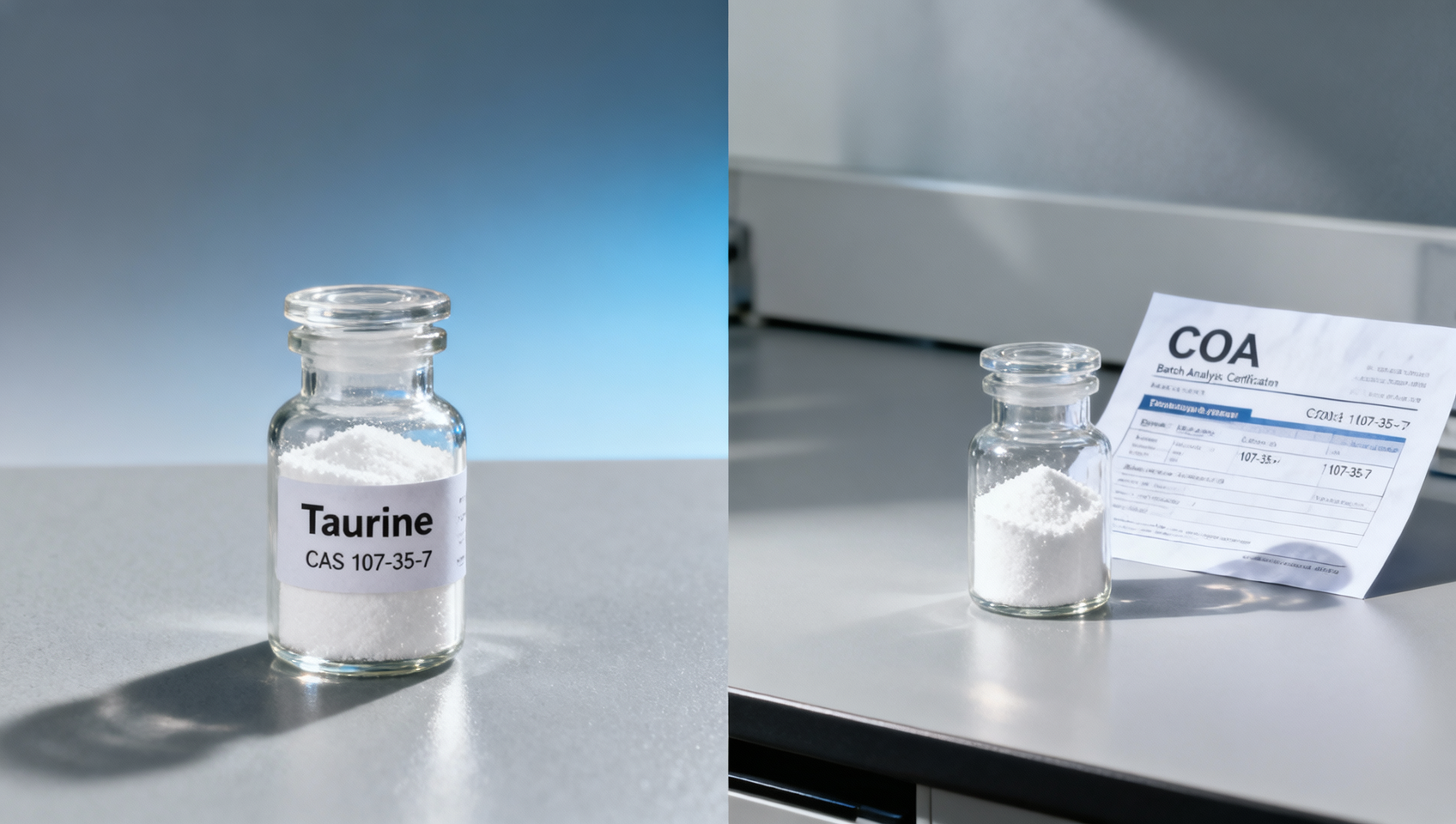
For quality control and safety teams, approving taurine powder CAS 107-35-7 requires more than matching a product name to a certificate of analysis (COA). Chemical identity, intended-use grade, and batch-specific test results must align with purchasing specifications and applicable requirements. This guide explains how to review identification data, assay values, impurity limits, and supporting safety documentation—and recognize gaps that warrant supplier clarification.
The difficult shipments are not always those with an obvious failed result. A COA can show “conforms” throughout and still leave the receiving laboratory unable to release the material. The missing piece may be an assay basis, a referenced specification edition, or a traceable link between the tested batch and the bags delivered.
A CAS number establishes identity—not suitability
Taurine, also called 2-aminoethanesulfonic acid, is identified by CAS 107-35-7 and molecular formula C2H7NO3S. These details should agree across the purchase specification, container label, COA, and safety data sheet (SDS). A different synonym is not necessarily a problem; an unexplained difference in chemical identity is.
However, the CAS number says nothing about manufacturing controls, impurity limits, microbial quality, or suitability for a food or pharmaceutical application. Materials carrying the same identifier can have different release specifications. A high assay result cannot fill those gaps.
An identification test provides analytical evidence beyond the paperwork. Depending on the applicable specification, this may involve infrared spectroscopy or other prescribed identification procedures. Check that the reported method is the required method, or that an alternative has been appropriately justified. Appearance alone—such as a white crystalline powder—is not sufficient identification.
Define the grade before reviewing the numbers
“Food grade,” “pharmaceutical grade,” and “high purity” are not interchangeable descriptions. The purchasing specification should state the intended use, destination market, governing standard where applicable, and any additional customer requirements. Otherwise, the supplier and buyer may each be working to a different definition of acceptable material.
If a supplier claims compliance with the Food Chemicals Codex (FCC) or a pharmacopoeial monograph, ask which edition or supplement applies. Confirm the current requirements from the official publication rather than copying limits from an older online specification. A named compendial reference is meaningful only when the applicable requirements are actually met; it is not, by itself, evidence of certification by the publisher.
Food-use approval also requires more than chemical conformity. The buyer needs to establish whether the ingredient is permitted for the particular product category and use conditions in the destination market. Likewise, a compendial assay does not independently demonstrate pharmaceutical manufacturing suitability or satisfy every qualification obligation.
A useful distinction is between a material specification and a supplier qualification package. The former defines what the batch must meet. The latter supports confidence in the manufacturing site, quality system, traceability, and change controls. Neither replaces the other.
Read the COA as a batch record, not a sales sheet
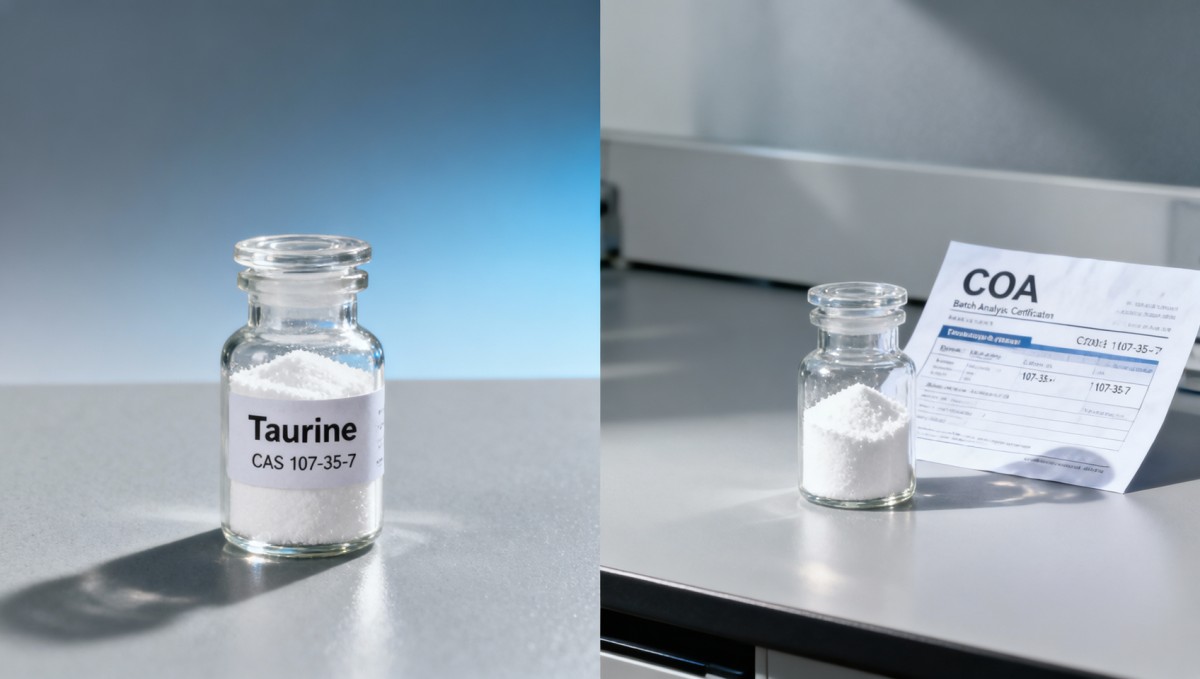
Before examining purity, match the batch number to the physical containers and delivery documents. Where a distributor assigns its own lot number, obtain a clear mapping to the manufacturer's batch. Multiple manufacturing lots under one shipment require separate review unless an approved procedure establishes otherwise.
The document should identify the issuing organization, material, batch, applicable specification, results, and authorized release. Manufacturing, testing, and expiry or retest dates should be understandable and internally consistent. A retest date is not automatically an expiry date; the permitted next step depends on the manufacturer's instructions and the buyer's quality procedures.
“Conforms” can be appropriate for a qualitative identification test. For quantitative release characteristics, actual numerical results generally make review and trend analysis more useful. If an entry is supplied through a periodic testing program rather than direct batch testing, that arrangement should be disclosed and acceptable under the applicable requirements and quality agreement.
A specification sheet with typical values is not a batch COA. It describes an expected product, not necessarily the material sitting in the receiving area.
Why an acceptable assay may still need investigation
An assay is a measurement made by a defined procedure. It should not automatically be interpreted as a complete inventory of everything in the powder. Its selectivity, calculation basis, and sample preparation all affect what the result means.
For example, a supplier's dried-basis result and a receiving laboratory's as-received result are not directly comparable without accounting for the relevant moisture or drying measurement. Loss on drying is itself method-dependent and should not be assumed to measure water exclusively. Reconcile the methods and calculations before concluding that the batch has changed.
The same caution applies to chromatographic area percentages. An area-normalized result is not automatically equivalent to mass purity unless the method supports that interpretation. For a disputed result, request the procedure, calculation details, reference-standard information, and relevant raw data. A repeat test alone may reproduce the discrepancy without explaining it.
Impurity review should follow the applicable standard and manufacturing risk assessment. Process-related substances, inorganic residues, elemental contaminants, and residual solvents may require different methods and controls. Residual-solvent testing should reflect process knowledge; the presence or absence of a generic panel on a COA is not enough to establish adequacy.
An unspecified “heavy metals” result also deserves attention when the buyer requires limits for individual elements. A nonspecific test and an element-specific determination do not necessarily answer the same question. Similarly, “not detected” is meaningful only when the detection or reporting limit is suitable for the acceptance criterion.
Separate handling safety from product release
The SDS supports safe handling, storage, emergency response, and transport assessment. It does not prove batch purity or establish food-use suitability. Review its revision date, supplier details, substance identity, and applicability to the relevant jurisdiction.
Powder handling still warrants attention even where the SDS does not classify the material as hazardous. Opening bags, charging mixers, and collecting samples can generate airborne dust. Ventilation, housekeeping, eye protection, and any respiratory protection should follow the actual exposure assessment. Do not infer combustible-dust behavior from appearance or from a generic powder description; assess that risk using appropriate material and process information.
Storage controls must remain substance-specific. In a mixed chemical portfolio, a plant-derived polyphenol such as Resveratrol CAS#501-36-0 needs its own identity, solubility, and storage review. Its product instructions should never be copied into a taurine receiving specification simply because both arrive as powders.
Inspect packaging condition separately from laboratory results. Wet liners, damaged seals, unexplained relabeling, or unusual agglomeration warrant investigation even when the COA passes. Sample using a documented plan that controls contamination and preserves lot identity. Testing a poorly collected sample can create false confidence just as easily as an unnecessary rejection.
Close documentation gaps before releasing the shipment
For an import/export supplier such as Luxi Chemical (Shandong) Co., Ltd., whose portfolio spans food additives, organic intermediates, and fertilizers, consolidated sourcing makes clear document separation especially important. Each material needs its own approved specification and traceable quality records. A broad supply relationship should not lead to a single generic acceptance standard.
Supplier approval should also identify who manufactures, tests, releases, repacks, and exports the material. These may be different organizations. Where repacking occurs, examine how batch identity, packaging suitability, contamination prevention, and labeling are controlled. Agree in advance which changes require notification, particularly changes in manufacturing site, process, specification, or test method.
When reviewing taurine powder CAS 107-35-7, use a clear disposition rather than an informal judgment: release when requirements are met, hold while a defined gap is investigated, or reject when nonconformity is established. A new supplier or an unexplained analytical discrepancy may justify additional independent testing, with its extent determined by risk and applicable obligations.
Ask precise questions: “Which assay basis was used?” is more useful than “Please confirm quality.” “Does this result come from this batch?” is better than requesting another generic certificate. Release becomes defensible when the approved use, chemical identity, test results, and delivered lot all point to the same material—not merely when every box on the COA says “pass.”
Related Picks
 Butylated Hydroxytoluene Price Drivers: Supply, Purity, and Purchasing Risk FactorsOct 21, 2026Butylated Hydroxytoluene price trends depend on supply stability, purity, logistics, and purchasing risk. Learn how to compare quotes wisely and reduce sourcing costs.
 Sodium Tripolyphosphate Price Trends: Raw Material and Energy ExposureOct 20, 2026Explore sodium tripolyphosphate price trends, from phosphate and soda ash costs to energy exposure. Learn how to compare quotes, manage sourcing risks, and make smarter purchasing decisions.
 Acetonitrile Shipment to Vietnam Successfully Dispatched; RCEP Benefits Boost Fine Chemical Trade with ASEANSep 16, 2026A shipment of industrial-grade acetonitrile from our company has recently been loaded and dispatched following the completion of standardized hazardous material packaging and container securing procedures.
 Nigerian Client’s Order of 4 Containers of Vinyl Acetate Successfully Loaded and Shipped to West AfricaSep 16, 2026We recently completed the loading of a vinyl acetate order for a Nigerian client; four containers of the product have been successfully packed and are ready for shipment to Nigeria.




Question Consultation
Send Us Your Inquiry Today

Luxi Chemical is a professional chemical product supplier with ample stock of all chemical categories and excellent quality, welcome your purchase inquiry.

