


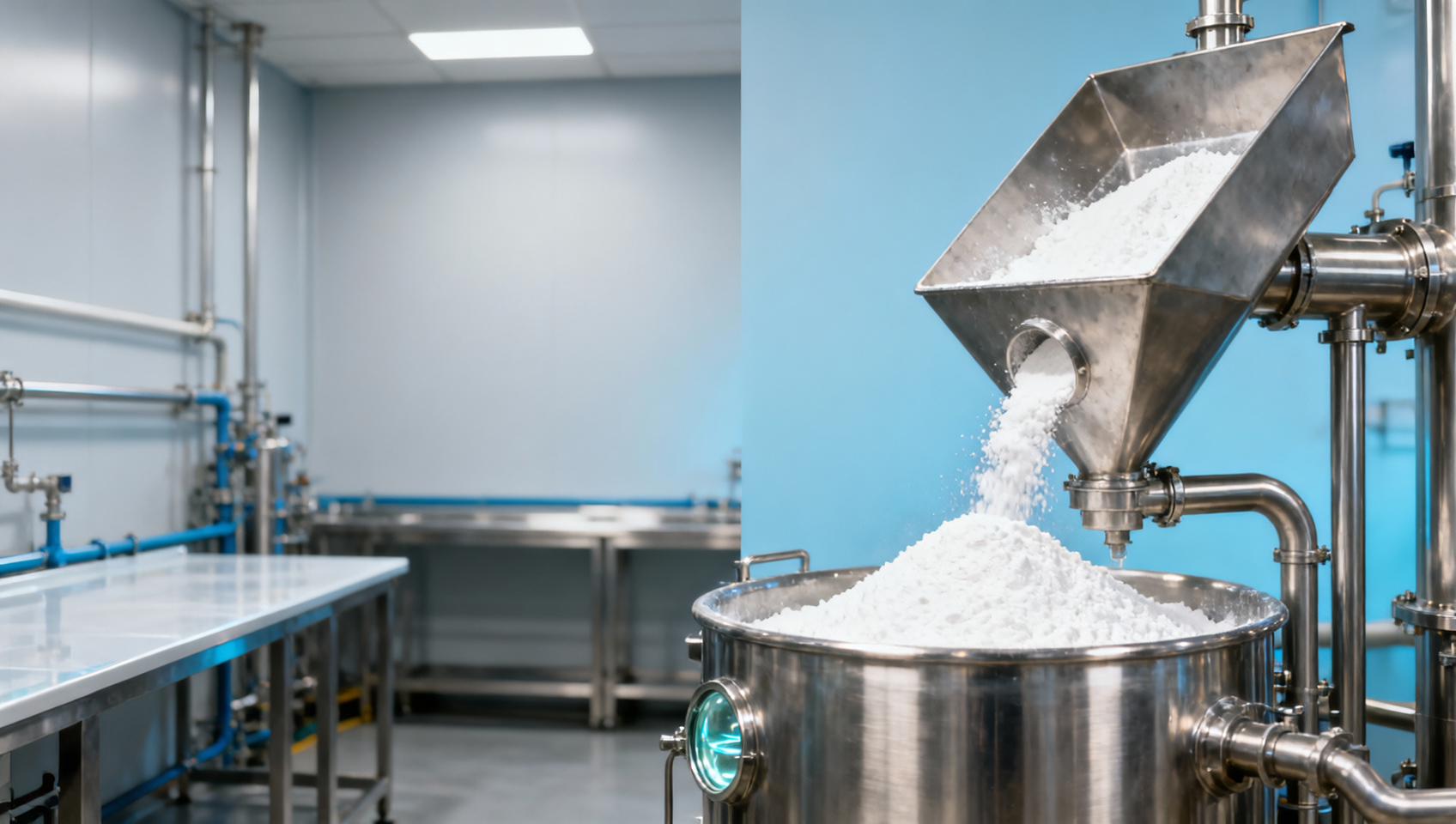
Slow dissolution can turn a routine energy drink batch into a production bottleneck, leaving operators with visible particles, extended mixing, and delayed transfers.
When handling taurine powder for energy drinks, control how the powder meets the liquid. Increasing mixer speed alone rarely addresses the underlying cause.
Start with adequate available water, effective circulation, and controlled addition. Use only temperatures, mixing conditions, and ingredient sequences allowed by your approved manufacturing instructions.
If particles persist, identify whether they are undissolved taurine, another ingredient, or foreign material before adjusting the batch. Appearance alone cannot establish their identity.
The practical goal is a repeatable dissolution endpoint within an established processing window, supported by representative checks and accurate batch records before transfer begins.
What Should You Check Before Adding Taurine?
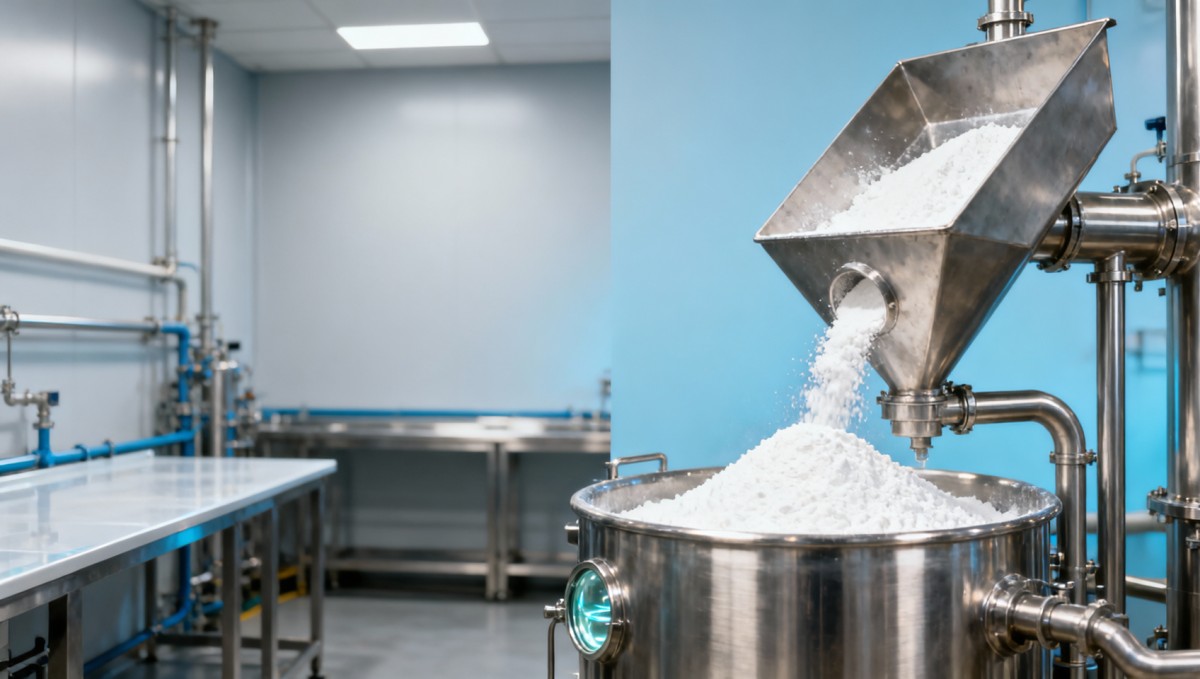
Confirm the material identity, lot number, released status, and required weight against the batch sheet. Use taurine approved for the intended beverage application.
Inspect the packaging and powder condition before charging. Unexpected discoloration, damaged liners, wet material, or unusual clumps require assessment under your site's material handling procedure.
Check the actual water charge rather than relying on the tank's apparent level. Too little initial water can make an otherwise workable recipe difficult to dissolve.
Verify that the impeller is adequately submerged and the vessel is operating within its qualified working volume. A running mixer does not guarantee complete circulation.
Review the preceding batch's actual dissolution time, water temperature, addition duration, and any deviations. These records often reveal a developing problem before production starts.
Keep the distinction between dissolution and dispersion clear: particles can circulate throughout the tank while remaining solid. Uniform movement is not proof of complete dissolution.
Is There Enough Water at the Point of Addition?
Operators often assess taurine concentration using final batch volume. However, dissolution initially depends on the smaller liquid volume present when the powder enters the vessel.
For example, adding 4 kilograms to 200 liters creates a nominal initial concentration of 20 grams per liter, before accounting for other dissolved ingredients.
The same amount in a finished 1,000-liter batch represents 4 grams per liter. That final concentration does not describe conditions during the initial mixing stage.
Neither calculation establishes an acceptable solubility limit. Use supplier information and formulation trials covering the actual temperature, water composition, and ingredient mixture to establish operating limits.
Where the approved process allows, reserve sufficient water for taurine dissolution before adding ingredients that increase viscosity. Include all premix water in the batch balance.
A separate premix can help when the main tank has limited circulation, but an overly concentrated premix can simply move the bottleneck into another vessel.
How Should Operators Add Taurine Powder?
Establish stable liquid circulation before opening the powder container. Identify the approved addition point where incoming material is quickly drawn into the moving liquid.
Add powder gradually enough for the surface to clear continuously. A growing floating layer or accumulating pile indicates that addition is outpacing wetting and circulation.
Avoid dumping an entire bag into one location. Large additions can form compact deposits, especially around poorly swept areas or beneath the powder entry point.
Keep powder away from wet vessel walls and fittings where it can adhere above the liquid line. Follow the approved procedure for recovering any deposits.
If buildup starts, pause addition and allow circulation to recover. Continuing to feed powder usually increases the amount that requires additional mixing or investigation.
After charging, inspect accessible surfaces through approved viewing points. Do not reach into operating equipment or open guarded areas to remove adhering material.
For enclosed powder induction systems, follow established feed and circulation settings. Excessive powder loading can still overwhelm wetting capacity even when dust control is effective.
Which Temperature and Mixer Settings Actually Help?
Warmer water generally supports faster taurine dissolution, but the appropriate temperature depends on the formulation, equipment, and validated process. Avoid adopting a universal heating target.
Measure actual liquid temperature at the relevant processing stage. A heater setpoint or jacket reading may differ from the temperature experienced by incoming powder.
Account for cooling when colder water or other ingredients enter the vessel. A satisfactory starting temperature does not guarantee consistent conditions throughout the addition.
Use agitation that moves liquid through the full working volume. Persistent deposits may indicate insufficient circulation near the bottom, outlet, or other poorly swept locations.
Increasing speed can deepen the vortex and entrain air without correcting those areas. Foam and bubbles can also make visual assessment more difficult during sampling.
If routine settings fail repeatedly, request an equipment review covering impeller position, fill level, baffles, and recirculation layout. Operators should not improvise mechanical changes.
When Should Taurine Enter the Ingredient Sequence?
Where formulation trials support it, dissolving taurine in an early water phase can simplify processing. The liquid is usually easier to circulate before substantial solids accumulate.
Concentrated syrups and viscosity-building ingredients can slow mass transfer and circulation. Their presence may extend dissolution time even when the finished taurine concentration remains acceptable.
Acids, mineral salts, and other soluble ingredients change the liquid environment. Their combined effects should be checked in the actual formulation rather than assumed.
Do not use acid or alkali as an improvised dissolution aid. Unapproved pH adjustments can affect flavor, ingredient stability, and compliance with the product specification.
If the recipe requires a different sequence, follow that sequence and investigate problems within its established limits. Successful practice from another beverage may not transfer directly.
For carbonated products, complete dissolution and required checks before carbonation where the approved process specifies this sequence. Pressurized processing makes corrective handling more complicated.
What Should You Do When Particles Remain?
First determine when the particles appeared: during charging, after another ingredient entered, or following cooling. The timing helps distinguish incomplete dissolution from other causes.
Check the batch record for actual water volume, temperature, addition rate, and mixer operation. Compare these observations with a previously successful batch using the same formulation.
Take samples using the site's approved method and sampling locations. A clear sample from the upper liquid layer can miss settled material elsewhere in the tank.
Do not assume that every white particle is taurine. Other powdered ingredients, packaging fragments, or deposits may require different investigation and corrective action.
Laboratory evaluation can help distinguish soluble residue from insoluble matter. Any warming or dilution of samples should follow an agreed method and be documented.
Never filter unexplained solids away simply to obtain visual clarity. Removing undissolved taurine can change the delivered concentration and conceal the original processing problem.
How Do You Confirm Dissolution Before Transfer?
Use the release criteria defined for the product and processing stage. These may include visual assessment, representative sampling, and analytical checks where required by the specification.
Visual clarity is useful for a clear base, but it cannot confirm taurine concentration. Colored, cloudy, or emulsified beverages may require other established assessment methods.
Likewise, a stable refractometer reading does not independently prove taurine dissolution. Other dissolved ingredients contribute to the reading and can obscure an incomplete addition.
Where cooling follows dissolution, confirm performance under the relevant downstream conditions. A warm sample can appear satisfactory while later cooling reveals a formulation limitation.
Record the endpoint time and the observations supporting release to the next stage. Avoid replacing a defined endpoint with an arbitrary extra mixing period.
If the endpoint is not achieved within the approved window, follow the deviation procedure. Any additional heating, water, or processing requires the appropriate technical authorization.
What Should Purchasing and Quality Teams Check?
Recurring delays may involve raw material consistency as well as processing. Compare affected lots for powder condition, storage history, and supplier information before assigning a cause.
Particle size can influence dissolution behavior: finer material offers more surface area but may also create dust or wet poorly if it forms agglomerates.
Ask suppliers for applicable identity, assay, impurity, and food-use documentation, plus available particle characteristics. Do not treat a purity result as a dissolution performance guarantee.
Store taurine according to its approved specification, keeping packaging protected from moisture and contamination. Apply the site's resealing, stock rotation, and opened-container identification procedures consistently.
For procurement discussions with Luxi Chemical (Shandong) Co., Ltd., specify the intended beverage use, destination market, documentation requirements, and any established processing acceptance criteria.
When botanical ingredients are also being considered, review Sinsenoside Rb1 CAS#41753-43-9 separately for identity, permitted use, and suitability for the proposed beverage formulation.
Its supplied methanol solubility information does not establish water solubility or beverage compatibility. Botanical ingredient data should not guide taurine processing or finished drink claims.
How Can You Prevent the Same Delay Next Shift?
Build a short operating record around the variables that influence dissolution: initial water charge, measured temperature, mixer setting, addition duration, ingredient sequence, and endpoint.
Record when charging finishes separately from when dissolution is confirmed. This distinguishes slow powder handling from slow dissolution and helps target the appropriate improvement.
When investigating variation, change one approved variable at a time under a controlled trial plan. Several simultaneous adjustments make the result difficult to interpret.
Use successful trials to define practical operating ranges and escalation points. Include observable instructions, such as pausing addition when powder accumulates, in operator training.
Consistent dissolution of taurine powder for energy drinks depends on sufficient available water, effective circulation, controlled charging, and verification under the actual processing conditions.
When a batch slows down, check those fundamentals before extending mixing. A defined endpoint and documented response keep troubleshooting focused and support reliable production handovers.






