


Taurine Powder for Pet Food: Accounting for Processing Losses in Cat Diets
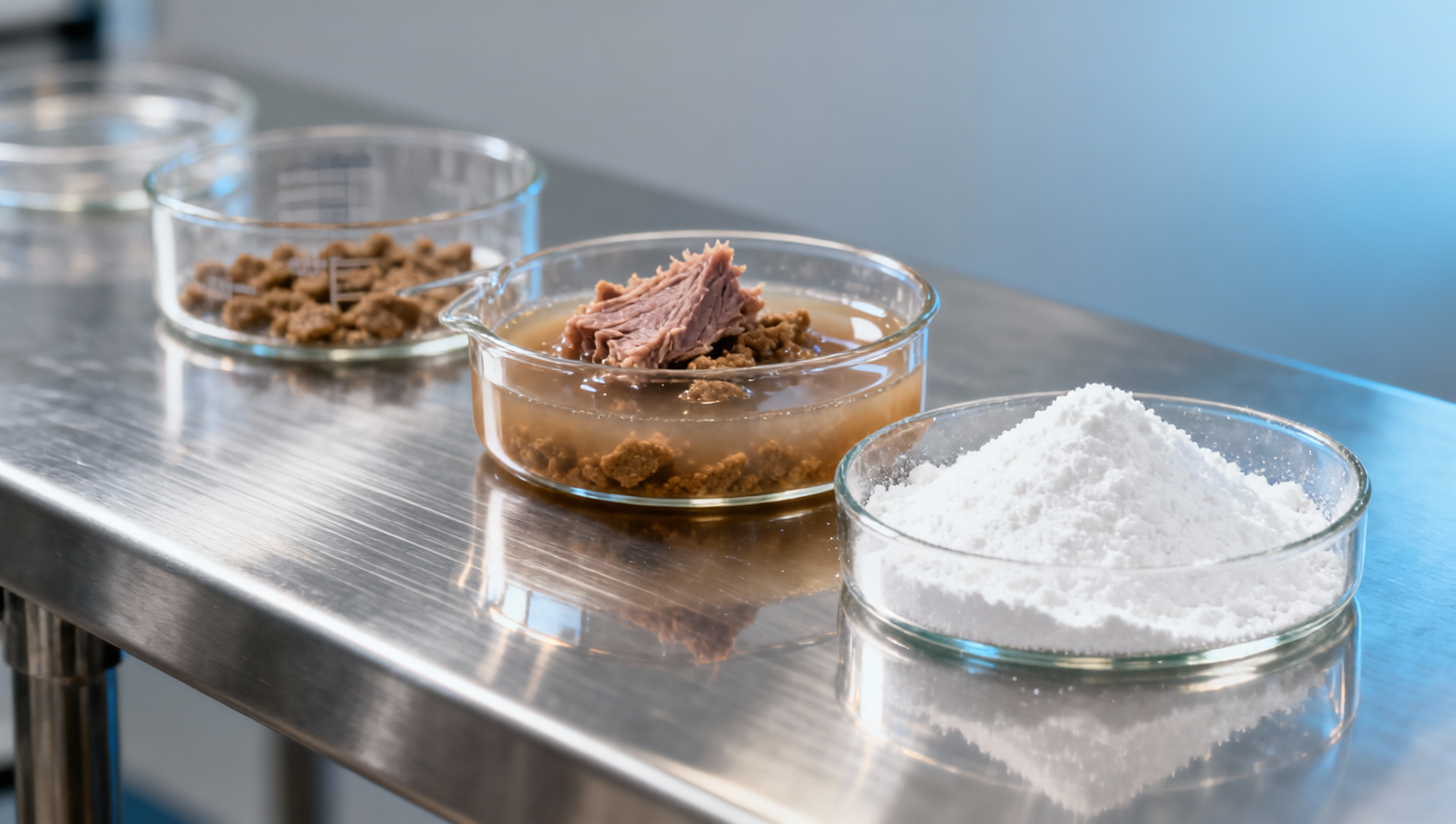
Choosing taurine powder for pet food starts with the amount the finished cat diet must deliver, after manufacturing and during storage. The quantity added at the mixer is only one part of that calculation. A workable formulation also accounts for ingredient contributions, processing conditions, liquid handling, mixing consistency, and the nutritional characteristics of the complete diet.
A blanket allowance for “heat loss” is a weak basis for setting the dose. Taurine is relatively heat stable, and a lower measured concentration does not automatically mean thermal destruction. Physical removal, changes in moisture, sampling variation, and diet-related differences in taurine availability can each require a different response. Separating those effects makes formulation margins more defensible and helps avoid unnecessary supplementation.
Separate processing losses from changes in nutritional availability
Cats depend on dietary taurine because their ability to synthesize enough to meet their needs is limited. However, the taurine concentration measured in a laboratory and the amount that supports the animal’s needs are related but distinct questions.
For formulation purposes, three mechanisms deserve separate attention:
- Physical loss: Taurine leaves the product in discarded cooking water, meat juices, separated liquid, dust, or material retained in equipment.
- Chemical loss: Processing or storage changes taurine so that it is no longer measured as intact taurine. This should be demonstrated under relevant conditions rather than assumed from temperature alone.
- Reduced effective availability: The diet affects taurine utilization or increases taurine losses within the animal, even when the finished food contains the expected analytical concentration.
Taurine participates in bile acid conjugation in cats. Diet composition and intestinal microbial activity can influence the recycling and loss of these compounds. Consequently, two foods with similar measured taurine concentrations may not provide equivalent nutritional support. An assay establishes composition; it does not, by itself, establish nutritional adequacy.
This distinction also explains why the same supplementation rule should not automatically transfer between dry and wet foods. Recognized feline nutritional guidelines distinguish food formats, and the relevant target depends on the framework, life stage, and basis of expression being used.
Set the finished-food target before calculating the addition
Start with the applicable feline nutritional framework, such as AAFCO nutrient profiles or FEDIAF nutritional guidelines, and identify the provisions relevant to the intended food. Record the life stage, food format, energy basis, and whether concentrations are expressed on an as-fed or dry-matter basis. A target without these details is easy to misapply.
Moisture conversion deserves particular attention. A wet food can appear to contain much less taurine than kibble when both are compared as fed, simply because it contains more water. Conversely, drying can increase taurine concentration per kilogram without increasing the total amount present.
Dry-matter taurine concentration = as-fed taurine concentration ÷ dry-matter fraction.
Use matching units throughout the calculation. Where a guideline expresses a requirement relative to dietary energy, include the food’s energy density as well. A dry-matter comparison alone may not describe how much taurine a cat receives at its expected food intake.
The internal release target should leave room for justified manufacturing, analytical, and storage variation. Keep that operating target distinct from the nutritional minimum so the purpose of each allowance remains visible.
Follow taurine through the actual production route
The most useful process assessment follows material movement from receiving to packaging. Mark where taurine enters, where liquids or solids leave, and where the product changes moisture content. This often reveals more than a list of processing temperatures.
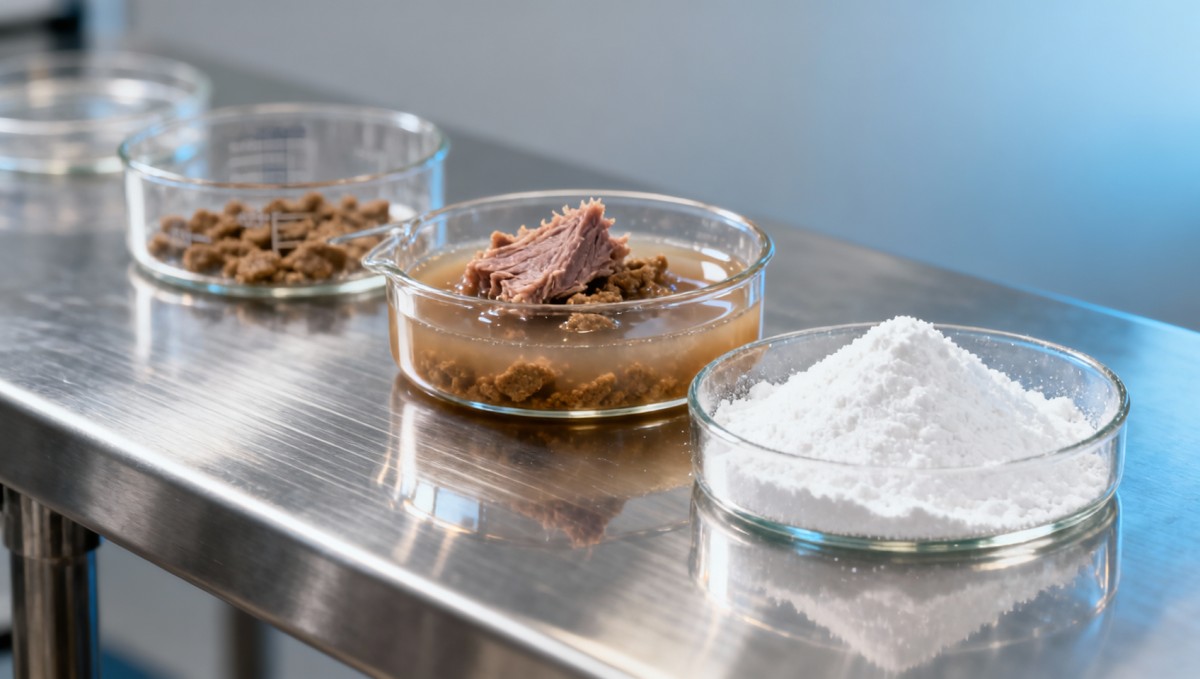
Dry food: distinguish concentration from recovery
For extruded cat food, document taurine addition, preconditioning, extrusion, drying, coating, and fines handling. Temperature alone cannot predict recovery because exposure time, moisture, formulation, and material losses also matter.
A comparison of milligrams per kilogram before and after drying can be misleading. As water leaves, taurine concentration may rise even if some taurine has been lost. Estimate recovery using total taurine mass across a defined production boundary:
Apparent process recovery = taurine mass in the recovered product ÷ taurine mass entering the process.
Calculate both masses from representative concentrations and corresponding material weights. Account separately for rework, fines, and other outgoing streams. If recovery appears greater than complete recovery, investigate sampling, moisture measurements, ingredient estimates, and analytical uncertainty before drawing a formulation conclusion.
Wet food: retained liquid is part of the diet
Taurine is water soluble, so liquid handling matters. Cooking meat and discarding the broth can remove taurine. Cooking the same material while retaining the liquid within a sealed package presents a different situation: movement from meat into gravy is redistribution within the food.
Laboratory preparation must reflect that distinction. Testing drained chunks alone can misrepresent a product intended to be fed with its gravy. Homogenize the complete package contents, including liquid and suspended material, before taking the analytical portion.
Retort severity still belongs in the process record, but a wet food’s higher supplementation requirement should not be attributed entirely to destruction during sterilization. Diet-related availability and taurine turnover also affect the nutritional assessment.
Build the addition rate from a transparent mass balance
A formulation calculation should distinguish native taurine from supplemental taurine. Meat and other animal-derived ingredients can contribute taurine, but their contribution varies with tissue type, sourcing, and preparation. A generic database value is less useful when the production process removes juices that the database sample retained.
On a consistent finished-product basis, a practical calculation is:
Required powder addition = (finished-food target − expected retained native taurine) ÷ (powder assay fraction × supplemental taurine retention fraction).
This expression assumes that all terms have been converted to the same finished-food mass basis. If purchasing or dosing is calculated per kilogram of incoming mix, include the expected finished-product yield. Otherwise, drying or water addition can create a dosing error even when the retention assumption is reasonable.
The powder assay fraction describes how much taurine the supplied material contains. The retention fraction describes how much of the added taurine reaches the finished food. Neither term measures nutritional availability in the animal; that consideration belongs in the selection and substantiation of the dietary target.
Establish a process allowance from representative production data. A single favorable batch does not describe normal variation, and an unusually poor result should trigger investigation before becoming the permanent basis for a larger dose.
Avoid counting the same uncertainty twice. If the finished-food target already includes an allowance for storage, applying another equivalent shelf-life multiplier inflates the addition without adding evidence. Keep each margin attached to a defined source of variation.
Evaluate taurine powder for pet food beyond the assay value
A high assay is useful, but the ingredient must also be suitable for the intended animal-feed application and production system. Supplier documentation should connect the delivered batch to its identity, composition, handling characteristics, and traceability.
A useful procurement review covers:
- Identity and assay: Taurine identification, the assay method, and whether results are reported as supplied or on a dry basis.
- Moisture and physical properties: Water content, particle-size information, flow behavior, and the tendency to form lumps under expected handling conditions.
- Impurity controls: Specifications for relevant contaminants and microbiological quality appropriate to the intended use.
- Batch documentation: Lot identification, certificate of analysis, packaging, storage conditions, and shelf life.
- Supply consistency: Manufacturing traceability and notification procedures for changes that could affect formulation or handling.
A certificate of analysis supports incoming-material control; it cannot demonstrate distribution in a finished feed. Fine powder can segregate when its physical properties differ from those of the surrounding ingredients. A suitable carrier premix may improve distribution, provided the premix and mixing sequence are validated.
Liquid addition can suit some processes, but the solution must remain suitable throughout preparation, holding, and dosing. Include tank residues, line hold-up, transfer completeness, and any additional water in the assessment. Changing the addition route moves the control points rather than removing them.
Use finished-feed testing to locate the problem
A useful verification plan connects incoming taurine, production records, and finished-food results. Where practical, analyze samples from before and after the suspected loss stage. This helps distinguish inadequate dosing from poor mixing, physical removal, or an unreliable estimate of native taurine.
Sampling deserves as much attention as the assay. For dry food, collect increments across the production run and relevant discharge locations. A composite can estimate the batch average, while selected individual samples help reveal uneven distribution that an average could conceal.
For wet food, include packages from different points in filling and homogenize each complete sample appropriately. Differences in the solids-to-gravy ratio can affect results even when the taurine solution was prepared correctly.
Use a laboratory method suitable for the feed matrix, with adequate extraction and analytical recovery. When results depart unexpectedly from formulation predictions, review sample preparation, moisture basis, batch yield, and reporting units before changing the recipe. An apparent shortfall caused by inconsistent measurement will not be solved reliably by adding more powder.
Interpret patterns across batches. A low average suggests a different problem from a satisfactory average with large variation. The former may require a revised addition rate or retention assumption; the latter often calls for better dosing, mixing, or sampling control.
Define what must remain true through shelf life
Release testing shows the product’s condition at manufacture. Shelf-life support requires retained samples stored in the intended packaging under relevant conditions. Follow taurine alongside moisture and other product attributes that help explain any change.
Accelerated storage can help screen formulations and packaging, but its relationship to normal storage must be understood. It should not automatically determine the taurine allowance for the full commercial shelf life.
Reassess the formulation when changes affect the original evidence: a new animal-protein source, altered liquid handling, a different fiber system, a new addition point, or a substantially different thermal process can change the basis of the calculation. A familiar finished-food assay does not automatically resolve every question about availability in a changed diet.
Before approving an addition rate, establish a consistent chain from the nutritional target to ingredient contributions, powder assay, process recovery, finished-feed distribution, and storage performance. That chain gives each allowance a reason and makes later troubleshooting considerably more precise.
Related Picks
 Butylated Hydroxytoluene Price Drivers: Supply, Purity, and Purchasing Risk FactorsOct 21, 2026Butylated Hydroxytoluene price trends depend on supply stability, purity, logistics, and purchasing risk. Learn how to compare quotes wisely and reduce sourcing costs.
 Sodium Tripolyphosphate Price Trends: Raw Material and Energy ExposureOct 20, 2026Explore sodium tripolyphosphate price trends, from phosphate and soda ash costs to energy exposure. Learn how to compare quotes, manage sourcing risks, and make smarter purchasing decisions.
 Acetonitrile Shipment to Vietnam Successfully Dispatched; RCEP Benefits Boost Fine Chemical Trade with ASEANSep 16, 2026A shipment of industrial-grade acetonitrile from our company has recently been loaded and dispatched following the completion of standardized hazardous material packaging and container securing procedures.
 Nigerian Client’s Order of 4 Containers of Vinyl Acetate Successfully Loaded and Shipped to West AfricaSep 16, 2026We recently completed the loading of a vinyl acetate order for a Nigerian client; four containers of the product have been successfully packed and are ready for shipment to Nigeria.




Question Consultation
Send Us Your Inquiry Today

Luxi Chemical is a professional chemical product supplier with ample stock of all chemical categories and excellent quality, welcome your purchase inquiry.

