


What purity data matters when selecting organic intermediates?
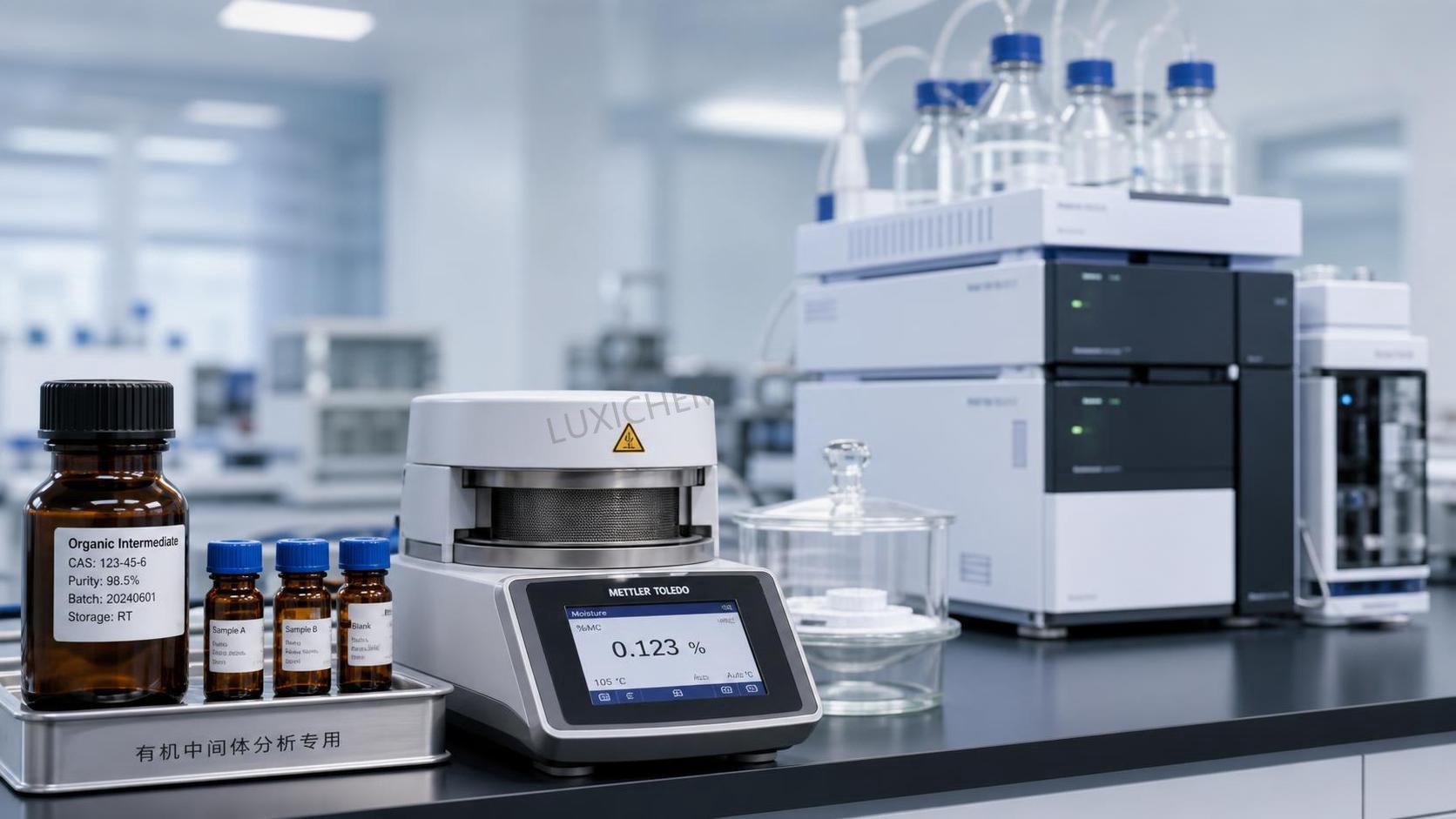
A high assay value is necessary when selecting organic intermediates, but it is rarely sufficient. A material reported as 99.0% pure can perform reliably in one synthesis route and create unacceptable yield loss, discoloration, difficult purification, or impurity carryover in another. The difference lies in what makes up the remaining 1.0%, how the result was measured, and whether that composition remains stable through storage, transport, and repeated supply.
For technical evaluation, purity should be treated as a set of linked data: assay basis, impurity identity and concentration, water content, residual solvents, inorganic residues, physical quality indicators, and batch-to-batch variation. The critical dataset is determined by the downstream chemistry rather than by a universal “highest purity” requirement.
Assay is the starting point, not the final decision
The assay describes the proportion of the intended compound in a sample, usually determined by GC, HPLC, titration, or another validated analytical technique. It answers an important but narrow question: how much target substance is present under the stated test method? It does not independently establish that the material is suitable for a particular reaction, formulation, or regulated end use.
Technical reviewers should read every assay figure together with four qualifiers:
- Analytical method: GC area percentage, HPLC area percentage, quantitative NMR, titration, and mass-balance methods can produce values with different practical meanings.
- Reporting basis: Assay may be reported “as is,” on a dry basis, or on an anhydrous basis. For hygroscopic materials, the distinction directly affects charge calculations.
- Reference standard and calibration: A result is more useful when the method identifies the reference material, calibration approach, and relevant detection limits.
- Specification range: A single certificate result does not show normal manufacturing variability. The accepted range and historical batch data are more informative for process planning.
A common misunderstanding is to equate chromatographic area percentage with true weight purity. Area normalization may be appropriate for routine control where response factors are similar or understood, but detector responses differ among compounds. A trace impurity with a strong detector response can appear disproportionately large, while an impurity with a weak response may be understated. Where assay accuracy affects stoichiometry, release decisions, or impurity accounting, the method should be fit for that intended use rather than simply convenient for supplier testing.
For reaction intermediates used close to the final product, it is often more valuable to know whether the assay is stable across lots than whether one sample exceeds a nominal threshold. A narrow, demonstrated operating range can reduce the need to reoptimize reaction equivalents, crystallization conditions, or purification cycles after each delivery.
Impurity identity matters more than total impurity
The impurity profile is the most decision-relevant purity data when an intermediate enters a selective reaction sequence. Two lots may both meet a 98.0% assay specification, yet their process risk can be completely different. One may contain a benign positional isomer that is purged during crystallization. The other may contain a reactive aldehyde, residual catalyst ligand, starting material, or over-reacted by-product that survives downstream steps.
Evaluation should focus on impurities that can alter reaction pathways or complicate isolation. These commonly include unreacted starting materials, regioisomers, stereoisomers, homologues, oxidation products, hydrolysis products, dimeric or polymeric species, and process-specific side products. The importance of each depends on the chemistry involved.
For example, an electrophilic intermediate containing residual nucleophilic starting material may consume an activating reagent or create a competing substitution product. An oxidizable amine intermediate may develop colored degradation products that do not materially change the assay but affect final-product appearance. A low-level isomer can be unimportant in a non-selective bulk application but unacceptable when the next step does not distinguish between the desired structure and the isomer.
Impurity limits should therefore be linked to a purge argument. A technically credible assessment asks:
- Can the impurity react under the next processing conditions?
- Will it partition into the desired phase, distillate, mother liquor, or crystal fraction?
- Can existing purification remove it without lowering yield or increasing solvent use?
- Does it share structural, polarity, volatility, or solubility characteristics with the desired product?
- Could it become a known or suspected impurity in the downstream material?
“Unspecified impurities” deserve particular attention. A total unknown-impurity limit may be acceptable for an early-stage reagent if there is strong downstream purification. It is less acceptable for a late-stage intermediate, a material used at high loading, or a reaction with limited selectivity. The absence of identified impurities on a certificate does not necessarily mean they are absent; it can also mean that the method is not designed to separate or identify them.
Water content is often a process variable disguised as a quality parameter
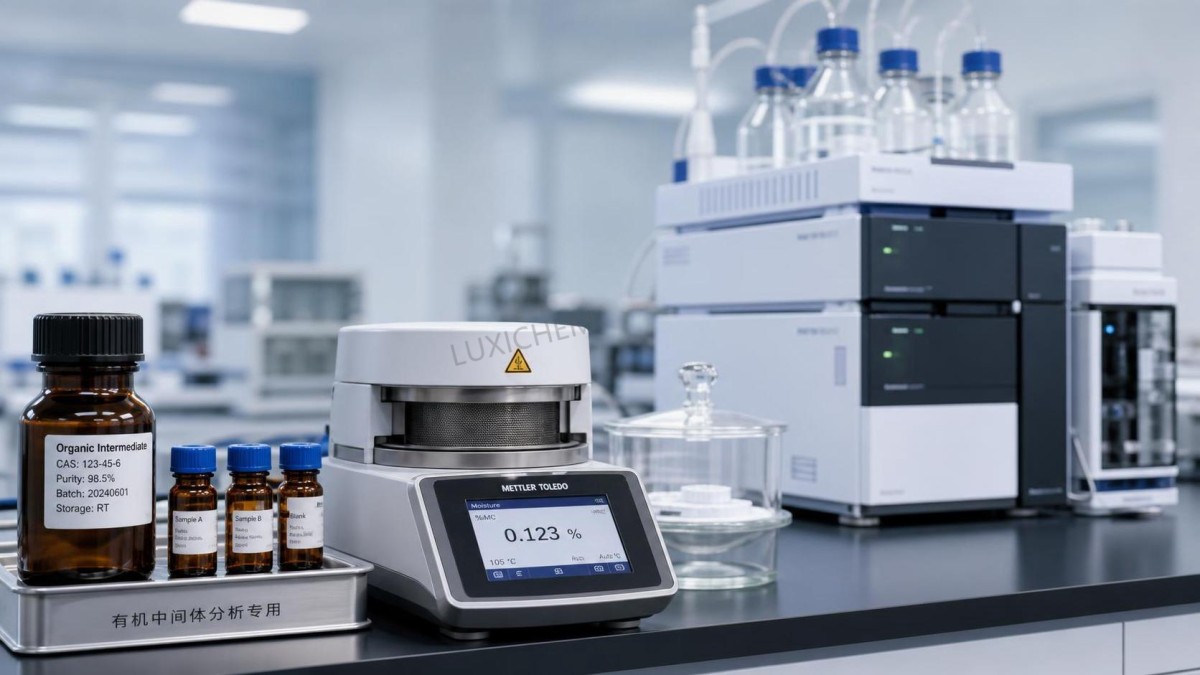
Water is among the most underestimated data points for organic intermediates. It affects actual active content, reaction stoichiometry, phase behavior, hydrolysis, salt formation, viscosity, powder flow, and storage stability. For moisture-sensitive chemistries, a material meeting its assay specification can still be unsuitable because its water level exceeds the process tolerance.
Karl Fischer titration is generally more informative than loss on drying when the distinction between water and volatile organic matter matters. Loss on drying can include residual solvent or low-boiling degradation products, which may lead to an inflated estimate of moisture. Conversely, Karl Fischer methods must be appropriate for the matrix, particularly where side reactions or poor dissolution can interfere with the measurement.
The relevant question is not whether a material is described as “dry,” but whether the measured water content is compatible with the process. Acid chlorides, anhydrides, reactive esters, organometallic reagents, certain coupling systems, and moisture-sensitive catalytic transformations may have very low water tolerance. In other cases, moderate moisture may be manageable if charge weights are corrected and the reaction is designed around an aqueous or biphasic condition.
Packaging and storage conditions are part of the water-content assessment. A supplier may test a freshly packed sample at release, while the receiving site uses the material after international shipment, warehouse storage, and repeated drum opening. Hygroscopic solids and water-reactive liquids require a realistic evaluation of package integrity, headspace control where relevant, resealing practice, and retest conditions after opening.
Residual solvents require both technical and compliance review
Residual solvents influence far more than odor or drying time. They may change assay basis, alter crystallization behavior, affect reaction concentration, introduce incompatible solvent systems, create flammability concerns, or remain associated with a downstream product after purification. Their significance depends on solvent identity, concentration, the intended application, and the ability of the receiving process to remove them.
For intermediates used in pharmaceutical supply chains, residual-solvent evaluation is often aligned with the applicable requirements and risk concepts of ICH Q3C, subject to the specific product status and market obligations. That framework should not be applied mechanically to every industrial chemical. In non-pharmaceutical applications, solvent selection may instead be governed by worker exposure requirements, emissions controls, customer restrictions, process safety, or formulation performance.
A meaningful certificate should identify relevant residual solvents individually rather than provide only a generic volatile-content result. Headspace GC is commonly used, but technical assessment should clarify which solvents the method is capable of detecting. If a synthesis uses several extraction, reaction, and recrystallization solvents, a method targeting only one expected solvent gives incomplete information.
Particular care is needed where solvent residues influence subsequent chemistry. Residual amines can disrupt acid-catalyzed reactions; water-miscible polar solvents may change phase separation; high-boiling solvents can persist through concentration; and certain solvent traces can affect catalyst behavior. The correct limit is process-specific, not simply the lowest commercially available number.
Inorganic residues can be decisive even in an “organic” intermediate
Organic intermediates may retain inorganic contaminants from catalysts, bases, acids, salts, filtration aids, or equipment contact. These residues are frequently overlooked when routine release testing concentrates on chromatographic assay. Yet they can influence color, corrosion, catalyst poisoning, electrochemical performance, combustion ash, or final-product trace-metal limits.
Metals are especially relevant when the manufacturing route uses palladium, platinum, nickel, copper, iron, chromium, zinc, or other metal-containing catalysts and reagents. The appropriate analytical approach depends on expected contaminants and required detection limits. ICP-OES or ICP-MS may be appropriate where trace-metal information is needed; a generic sulfated ash or residue-on-ignition result may indicate overall inorganic content but cannot identify the source of risk.
Acid or base residues also matter. They can change the apparent stability of sensitive intermediates, alter pH after dissolution, drive hydrolysis, or influence salt-forming operations. Chloride, sulfate, sodium, potassium, and other ionic residues should be considered when they have a plausible route-specific or application-specific impact.
This is also where reagent quality becomes part of intermediate selection. In organic synthesis using strong base, the relevant control is not only nominal concentration or assay but also carbonate uptake, water content, metal contamination, and compatibility with the substrate. A hygroscopic base such as Potassium Hydroxide CAS#1310-58-3 readily absorbs both moisture and carbon dioxide from air. Its effective alkalinity and carbonate content can therefore change during handling, making a fresh assay value alone inadequate for tightly controlled reactions. The same principle applies when reviewing any base-treated organic intermediate: process history and exposure conditions can leave a compositional signature that the headline purity number does not reveal.
Physical appearance is supporting evidence, not a substitute for analysis
Color, clarity, melting range, particle size, solution appearance, and odor can reveal changes that are not immediately captured by a single assay test. A darkened liquid may indicate oxidation or thermal stress. An unusual melting range can suggest polymorphic change, residual solvent, or contamination. Insoluble matter may point to polymerization, salt formation, packaging contamination, or incomplete filtration.
These observations should not be used as informal proxies for purity, but they can be valuable release and incoming-inspection signals. Their main value is comparative: a material that differs visibly from qualified reference lots warrants investigation even if its assay is within specification.
For solids, particle characteristics can also affect reproducibility without changing chemical purity. Fine powders may dissolve faster but cause handling losses or dusting. Coarse or agglomerated material may slow dissolution and create local concentration gradients. Where reaction rate depends on dissolution or slurry behavior, physical form belongs in the material specification or receiving control plan.
Batch consistency should be evaluated with trend data
One compliant certificate of analysis demonstrates only that one lot met its stated acceptance criteria. Selection decisions are stronger when supported by representative data from multiple batches, particularly for materials manufactured through multistep chemistry, recovered-solvent operations, variable feedstocks, or processes with several potential impurity pathways.
Useful trend information includes assay distribution, water-content range, key individual impurities, residual-solvent patterns, color, and relevant inorganic markers. The objective is not to demand unnecessary data from every supplier; it is to establish whether the proposed specification captures the variables that affect the receiving process.
Changes in analytical method, production route, manufacturing site, raw-material source, crystallization solvent, packaging configuration, or storage condition can alter impurity behavior even when the formal specification remains unchanged. Change notification requirements should therefore distinguish between changes that affect administrative documentation and changes that could affect process performance. For critical Organic Intermediates, a retained sample comparison or laboratory confirmation may be justified before accepting a significant change.
Match the purity package to the material’s position in the process
The closer an intermediate is to a quality-critical final material, the less useful a broad “minimum assay” specification becomes. Early-stage bulk intermediates may tolerate broader impurity profiles when later transformations and isolation provide robust purge. Late-stage intermediates, chiral materials, highly colored compounds, reactive monomers, and materials used without extensive purification require more detailed controls.
A practical selection file should connect each requested test to a known process risk. Assay controls dose accuracy. Water controls reactivity and dry-basis content. Individual related substances control selectivity and downstream impurity burden. Residual solvents control process compatibility and applicable restrictions. Metals and ions control catalyst performance, color, corrosion, or end-use requirements. Appearance and physical form support handling consistency. Stability data establish how long these attributes remain meaningful outside the supplier’s laboratory.
The most defensible choice is not automatically the material with the highest advertised purity. It is the intermediate for which the available analytical data explain what is present, what may change, and why the defined limits are compatible with the intended process. When purity data are interpreted in that way, specifications become a tool for controlling chemical risk rather than a single number on a certificate.
Related Picks
 Butylated Hydroxytoluene Price Drivers: Supply, Purity, and Purchasing Risk FactorsOct 21, 2026Butylated Hydroxytoluene price trends depend on supply stability, purity, logistics, and purchasing risk. Learn how to compare quotes wisely and reduce sourcing costs.
 Sodium Tripolyphosphate Price Trends: Raw Material and Energy ExposureOct 20, 2026Explore sodium tripolyphosphate price trends, from phosphate and soda ash costs to energy exposure. Learn how to compare quotes, manage sourcing risks, and make smarter purchasing decisions.
 Acetonitrile Shipment to Vietnam Successfully Dispatched; RCEP Benefits Boost Fine Chemical Trade with ASEANSep 16, 2026A shipment of industrial-grade acetonitrile from our company has recently been loaded and dispatched following the completion of standardized hazardous material packaging and container securing procedures.
 Nigerian Client’s Order of 4 Containers of Vinyl Acetate Successfully Loaded and Shipped to West AfricaSep 16, 2026We recently completed the loading of a vinyl acetate order for a Nigerian client; four containers of the product have been successfully packed and are ready for shipment to Nigeria.




Question Consultation
Send Us Your Inquiry Today

Luxi Chemical is a professional chemical product supplier with ample stock of all chemical categories and excellent quality, welcome your purchase inquiry.

