


What reactivity level suits polyester polyol for spray foam systems?
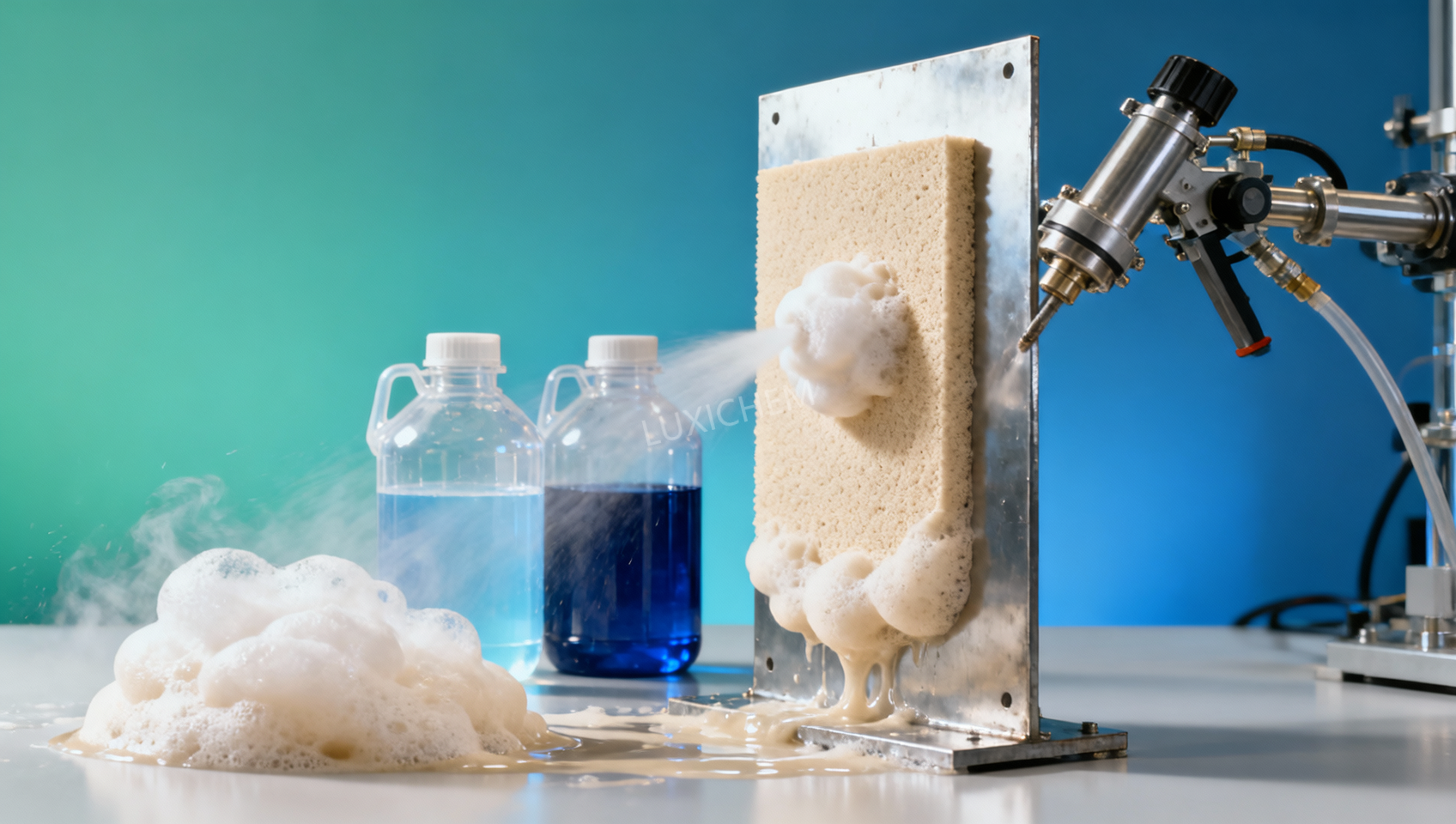
The suitable reactivity level for a polyester polyol in a spray foam system is the level that gives reliable mixing, wetting, rise, and cure within the available spray window. A highly reactive polyester polyol is not automatically preferable, and a slower material is not automatically safer. The correct selection has to match the isocyanate index, catalyst balance, blowing approach, substrate temperature, hose temperature, and required film build.
For most spray polyurethane foam formulations, the practical target is controlled medium-to-high reactivity: enough hydroxyl functionality and accessible reactive sites to build strength promptly after application, while retaining sufficient flow before gelation. This balance allows the spray pattern to coalesce on the substrate instead of forming dry, poorly fused layers or collapsing before the polymer network develops.
Reactivity should be treated as a formulation behavior rather than a single number on a specification sheet. Hydroxyl number, functionality, acid value, water content, viscosity, molecular architecture, and compatibility with other polyols all affect how a polyester polyol behaves after it meets the isocyanate stream. Two products with a similar hydroxyl number can still produce noticeably different cream time, gel time, surface texture, adhesion, and dimensional stability.
What Reactivity Means in a Spray Foam Formulation
Polyester polyols usually contribute a relatively polar backbone and often provide stronger adhesion, rigidity, chemical resistance, or flame-retardant formulation potential than many polyether-rich systems. Their hydroxyl groups react with isocyanates to form urethane linkages. The rate and pattern of that reaction influence whether the material stays mobile long enough to wet the surface, then gains enough internal strength to support gas expansion and final foam structure.
A faster-reacting polyester polyol generally promotes earlier network formation. In a well-balanced system, this can reduce tack-free time and improve early handling strength. In an over-reactive system, the material can gel before it spreads evenly, especially at the edges of the spray fan or on a cold substrate. The result may be a rough surface, uneven layer fusion, reduced adhesion, or trapped voids between passes.
Lower reactivity extends the open period. This can be useful when a formulation needs more flow, when the substrate has a complicated profile, or when spray conditions are warm enough to accelerate the reaction. However, excessive delay in gel formation can permit cell opening, sagging on vertical surfaces, density variation, and loss of surface integrity. A slow system may look workable at the gun but fail to develop a stable foam profile once the blowing reaction progresses.
Start with the Required Spray Profile
The desired application behavior is a better starting point than a general label such as “fast cure.” A spray foam intended for thin, controlled passes on a vertical or overhead surface needs prompt set and resistance to slump. A system intended to bridge irregular surfaces or maintain wetting over a larger fan pattern needs a longer effective flow period before the network becomes rigid.
The table describes a direction, not a complete formulation prescription. A polyester polyol with a higher hydroxyl number may provide faster network development, but catalyst selection can reverse the observed processing behavior. Likewise, a more reactive material with high viscosity can appear sluggish because poor atomization or incomplete mixing limits the reaction actually occurring across the spray pattern.
Do Not Read Hydroxyl Number in Isolation
Hydroxyl number is central to stoichiometric calculation because it indicates the hydroxyl content used to determine the isocyanate requirement. It also provides clues about potential crosslink density and molecular weight. Yet it is not a direct measurement of spray reactivity. A high hydroxyl number can correspond to a low-molecular-weight, highly functional polyester that builds a rigid network quickly, but the result still depends on hydroxyl type, branching, steric accessibility, catalyst response, and the co-reactants present.
Functionality deserves similar caution. Increasing average functionality often raises the probability of early network formation and can improve rigidity or compression resistance. The same change can narrow the spray window. If the foam begins to gel before it has fully leveled or penetrated the substrate texture, adhesion may deteriorate even though laboratory cup tests show a rapid cure.
Acid value is another parameter that should be considered alongside reactivity. Residual acidity can affect catalyst efficiency, storage behavior, corrosion risk, and reaction consistency. A batch with an unexpected acid value change may appear to have a reactivity problem when the underlying issue is catalyst neutralization or altered compatibility. Water content must be controlled for the same reason. Water reacts with isocyanate, generating carbon dioxide and urea structures; small changes can alter rise, cell structure, pressure development, and apparent gel behavior.
Separate the Polyol Effect from the Catalyst Effect
A common selection error is to evaluate a polyester polyol in a catalyst package developed for a different polyol blend. Amine catalysts can accelerate urethane and blowing reactions, while organometallic catalysts often affect gel development more strongly. Their relative balance determines whether the foam expands before it can support itself, or gels so early that expansion becomes constrained.
When a trial foam rises too quickly, the polyester polyol is not necessarily too reactive. The temperature of the A-side and B-side, catalyst loading, water level, surfactant choice, and recirculation condition should be reviewed before changing the polyol. Conversely, reducing catalyst to compensate for an overly reactive polyol can create delayed through-cure or poor interlayer adhesion. The more stable route is to select a base polyol whose intrinsic behavior sits near the desired process window, then fine-tune with catalyst chemistry.
This distinction matters during raw-material review. An organic intermediate such as Dimethyl 1,3-acetonedicarboxylate CAS#1830-54-2 may be relevant to separate synthesis programs, but it is not a substitute for a qualified polyester polyol in a spray foam formulation. Its listed physical data, handling profile, and synthetic applications do not establish hydroxyl functionality, polyol compatibility, or polyurethane spray performance. Materials with superficially similar liquid appearance should therefore remain segregated in formulation documentation and incoming-material controls.
Temperature Changes the Acceptable Reactivity Range
Spray foam is highly sensitive to temperature because both viscosity and chemical reaction rate shift with heat. At lower temperatures, a polyester polyol may become more viscous, reducing pump performance and changing the ratio delivered by the equipment. The chemical reaction also slows. Selecting a somewhat more reactive polyol may restore cure development, but only after confirming that the material can still be heated, circulated, and atomized within its handling limits.
At elevated ambient or substrate temperatures, the opposite pattern appears. A formulation that performs cleanly under controlled conditions may cream rapidly, develop a coarse surface, or lose the ability to merge with the previous pass. Here, a slightly slower polyester polyol or a revised catalyst balance can widen the usable application window. Lowering reactivity too far, however, can expose another problem: the foam may remain soft while expansion continues, which encourages shrinkage, collapse, or cell irregularity.
Substrate temperature deserves separate attention. The hose temperature indicates the condition of the chemical streams, while the substrate controls initial wetting and heat loss from the applied foam. Cold metal, concrete, or damp surfaces can remove heat rapidly and interfere with adhesion. A faster-reacting formulation may form a skin before achieving contact with the surface. Apparent “slow cure” and poor adhesion can coexist because the local interface is cold even while the bulk foam rises normally.
Use Observable Failure Modes to Refine the Choice
Reaction timing should be assessed together with the appearance and internal structure of the foam. A single gel-time result is insufficient because it cannot show whether the foam was fully mixed, evenly distributed, or mechanically supported during expansion.
- Dry spray, poor pass fusion, or a grainy surface often points to gel occurring too early, inadequate stream temperature control, poor atomization, or an excessive gel catalyst contribution.
- Sagging, excessive flow, or soft material below the surface suggests that the network is developing too slowly for the deposited thickness, though a high blowing rate can create the same visual result.
- Large or irregular cells may arise from mismatched blowing and gelling rates, surfactant imbalance, moisture variation, or poor mixing. It should not be attributed to polyester polyol reactivity without checking those factors.
- Weak adhesion with otherwise acceptable density can result from a short wetting window, substrate contamination, condensation, or temperature mismatch. Increasing polyol reactivity alone may worsen the condition.
- Internal cracking or brittle foam can indicate excessive crosslink density, high local exotherm, an unsuitable index, or rapid gel formation that prevents stress relaxation during rise.
These observations are most useful when recorded across more than one spray thickness and substrate condition. A formulation may perform well in a thin laboratory panel yet behave differently in a thicker field pass because internal heat accumulation changes the reaction rate after the first few seconds.
Build the Selection Around a Small Comparative Trial
When comparing polyester polyols, keep the isocyanate grade, nominal index, blowing level, surfactant, and baseline catalysts fixed at first. This exposes the real change in process behavior. Record component temperature, viscosity at the chosen processing temperature, cream time, rise profile, tack-free behavior, density, surface quality, cut-cell appearance, and adhesion after the foam has stabilized. Testing only immediately after application can favor a fast formulation that later shows shrinkage or poor dimensional retention.
Then adjust the catalyst package only enough to place each candidate within a comparable operating window. This second stage answers a more useful question: whether the polyester polyol remains stable and controllable when tuned for the required spray profile. A material that works only within a very narrow catalyst range may create unnecessary variability during normal equipment or seasonal temperature changes.
For systems combining polyester and polyether polyols, compatibility should be observed before interpreting reactivity data. Phase separation, haze, viscosity drift, or inconsistent recirculation can produce variable foam even when the chemical calculation is correct. The selected polyester polyol should remain homogeneous with the full B-side blend over the expected storage and operating temperature range.
Where the Practical Balance Usually Lies
A medium-to-high reactivity polyester polyol is often appropriate when the foam must set promptly, adhere to vertical substrates, and develop a rigid structure. The preferred material still needs enough open time for spray fan overlap, substrate wetting, and interlayer knitting. Fast response becomes a liability when it shortens these events below the real operating time of the equipment and application method.
Moderate reactivity is usually the stronger choice when surface geometry is complex, working temperatures are elevated, or the formulation already contains an active catalyst package. Lower-reactivity materials are better reserved for systems that genuinely need extended flow or are chemically accelerated elsewhere. They should not be chosen merely to make a difficult formulation easier to spray, because delayed gel can transfer the problem into density control, foam stability, and curing.
The final selection should therefore be based on a repeatable spray window rather than the shortest possible cure time. A polyester polyol that gives consistent wetting, controlled rise, uniform cells, sound adhesion, and stable cure across realistic temperature conditions is more suitable than one that performs impressively only in a narrowly controlled trial.
Related Picks
 Butylated Hydroxytoluene Price Drivers: Supply, Purity, and Purchasing Risk FactorsOct 21, 2026Butylated Hydroxytoluene price trends depend on supply stability, purity, logistics, and purchasing risk. Learn how to compare quotes wisely and reduce sourcing costs.
 Sodium Tripolyphosphate Price Trends: Raw Material and Energy ExposureOct 20, 2026Explore sodium tripolyphosphate price trends, from phosphate and soda ash costs to energy exposure. Learn how to compare quotes, manage sourcing risks, and make smarter purchasing decisions.
 Acetonitrile Shipment to Vietnam Successfully Dispatched; RCEP Benefits Boost Fine Chemical Trade with ASEANSep 16, 2026A shipment of industrial-grade acetonitrile from our company has recently been loaded and dispatched following the completion of standardized hazardous material packaging and container securing procedures.
 Nigerian Client’s Order of 4 Containers of Vinyl Acetate Successfully Loaded and Shipped to West AfricaSep 16, 2026We recently completed the loading of a vinyl acetate order for a Nigerian client; four containers of the product have been successfully packed and are ready for shipment to Nigeria.




Question Consultation
Send Us Your Inquiry Today

Luxi Chemical is a professional chemical product supplier with ample stock of all chemical categories and excellent quality, welcome your purchase inquiry.

