


How to prevent foam shrinkage with polyester polyol for spray foam
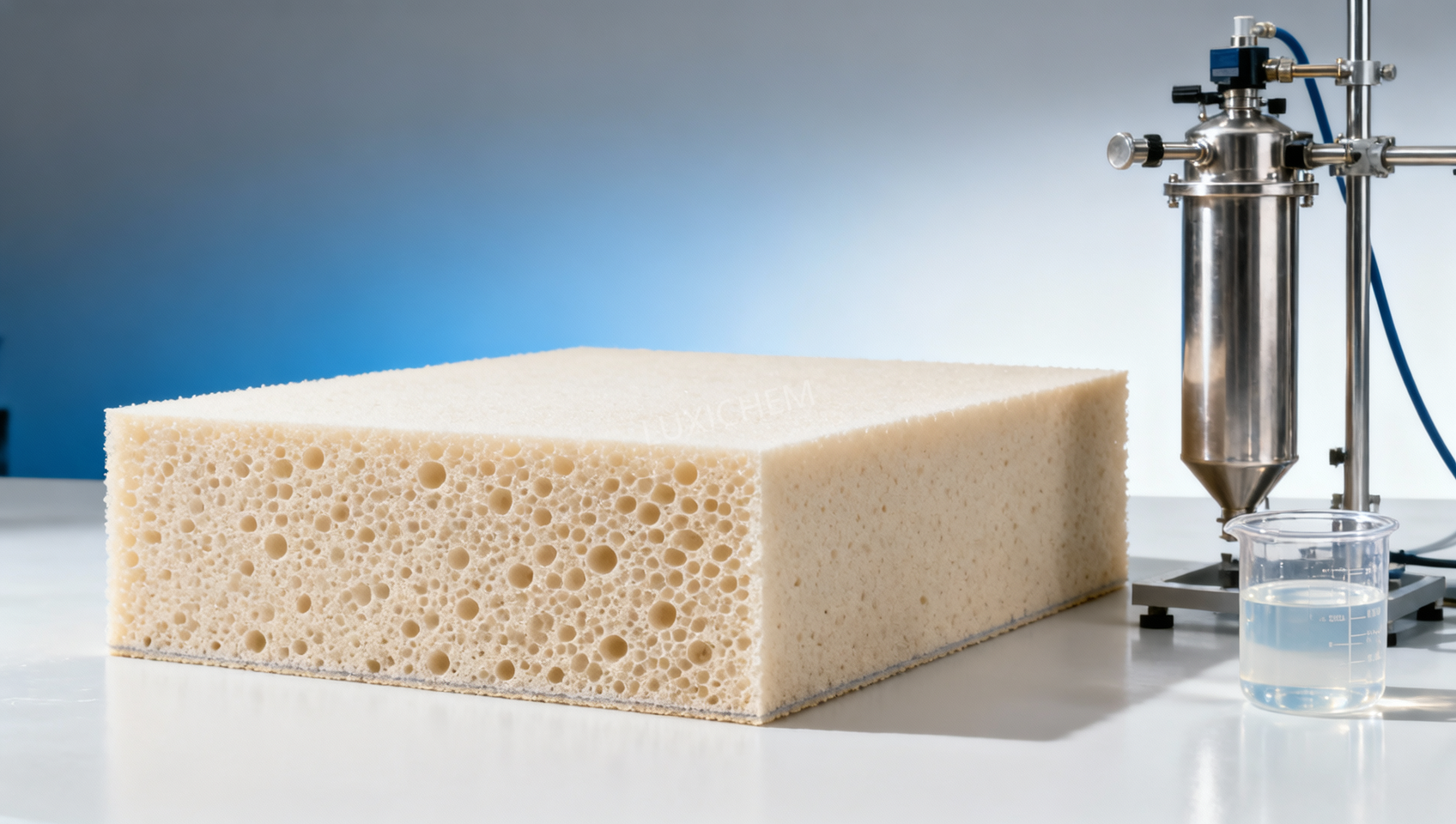
Foam shrinkage is not a single defect with a single cure. In spray polyurethane foam, it occurs when the developing cellular structure cannot resist the internal stresses created during cooling, gas loss, cure, or adhesion to the substrate. A polyester polyol for spray foam can improve dimensional stability, but only when its functionality, hydroxyl value, viscosity, compatibility, and reactivity are matched to the isocyanate side, blowing system, catalyst package, and processing conditions.
The most useful operating rule is simple: do not treat shrinkage as an isocyanate-index problem until the foam has been examined as a complete system. Raising index may strengthen the polymer network, but it can also make the reaction less forgiving, increase brittleness, alter adhesion, and create other defects. The right correction depends on when the foam shrinks, where it occurs, and whether the cells were underbuilt, over-pressurized, poorly cured, or exposed to unsuitable site conditions.
Recognize the shrinkage pattern before changing the formulation
Fresh foam that appears acceptable and then pulls inward within minutes commonly indicates insufficient early strength, excessive gas loss, or a poor balance between blowing and gel reactions. Foam that remains stable at first but shrinks after cooling can point to closed-cell pressure loss, low polymer modulus, or an insulation system applied beyond the recommended lift thickness. Localized shrinkage around edges, corners, or transitions often has a different origin: cold substrate conditions, uneven spray pattern, poor pass overlap, or restricted heat dissipation.
The appearance of the failed foam provides useful clues:
- Fine, collapsed, or wrinkled cells: the foam may have lacked enough gel strength when the blowing reaction expanded the structure.
- Large irregular cells or voids: mixing, atomization, moisture contamination, or an imbalanced blowing system should be investigated.
- Surface skin pulling inward while the interior remains soft: cure may be incomplete through the lift, particularly in cold or thick applications.
- Shrinkage accompanied by poor substrate adhesion: inspect substrate temperature, surface moisture, contamination, and excessive internal stress.
- Uniform contraction in a closed-cell foam: examine cell gas retention, density, polymer network strength, and post-cure temperature history.
These distinctions matter because two foams can show the same visible contraction while requiring opposite adjustments. A foam with weak early gel may benefit from greater network development. A foam with an overly rapid, highly exothermic reaction may require a slower and more balanced profile rather than additional reactivity.
What polyester polyol changes in a spray foam system
Polyester polyols are often selected where a formulation requires stronger cohesive properties, rigidity, flame-performance support, or improved compatibility with particular additive packages. Compared with many polyether polyols, they generally introduce ester groups and can provide a different balance of functionality, hydroxyl value, aromatic content, viscosity, and crosslink density. These characteristics influence both the rate at which the foam develops strength and the final resistance of the cell walls to collapse.
For dimensional stability, the important question is not whether polyester polyol is “better” in general. It is whether the selected grade provides enough polymer strength without making the formulation too viscous, too fast, too brittle, or difficult to mix consistently under field conditions.
A polyester polyol for spray foam can contribute to shrinkage control when it helps the foam reach an adequate gel state before internal cell pressure falls. However, this benefit can disappear if the polyol blend has poor component compatibility, if the resin-side viscosity prevents proper proportioning, or if the catalyst package causes the foam to set before it has completed uniform expansion.
Important polyester polyol attributes to review include:
- Hydroxyl value and functionality: These affect crosslink density and the amount of isocyanate required for the intended index. A higher-functionality component can strengthen the network, but excessive rigidity may increase stress sensitivity.
- Viscosity at actual processing temperature: A drum that meters normally in a warm warehouse may behave very differently at the spray rig during low-temperature operation. High viscosity can compromise transfer, recirculation, and impingement mixing.
- Water content: Moisture reacts with isocyanate to generate carbon dioxide. Small uncontrolled changes can alter rise, density, cell structure, and pressure balance.
- Acid value and storage stability: These should remain within the supplier’s specified limits. Variability can affect catalyst demand, compatibility, and long-term resin-side consistency.
- Compatibility with flame retardants, surfactants, blowing agents, and other polyols: Separation or haze in the resin blend is not merely a storage issue; it can become a foam uniformity problem at the gun.
Using a polyester polyol does not eliminate the need to control density. Low-density foam is structurally less tolerant of an imbalance between polymer strength and blowing pressure. If a density reduction is achieved by pushing blowing efficiency beyond what the polymer network can support, shrinkage may be the delayed cost of that decision.
Keep blowing and gel reactions in balance
Shrinkage often begins with an imbalance between expansion and structure formation. The blowing reaction generates gas and creates the cellular architecture. The gel reaction builds urethane and, where applicable, urea linkages that give the cell walls and struts their strength. If blowing outpaces gel excessively, cells can expand before they are able to hold their shape. If gel develops too rapidly, the foam may lock in uneven pressure, show poor flow, or develop internal stress and brittleness.
Polyester polyol selection influences this balance, but catalyst adjustment is usually required whenever the resin-side composition changes. A common mistake is to replace part of a polyol blend, retain the original catalyst package, and interpret the resulting defect as proof that the new polyol is unsuitable. The real issue may be that cream time, rise profile, tack-free time, and internal cure no longer occur in the correct sequence.
Evaluate the reaction profile under the same conditions used in production. Observe not only rise time but also the foam’s ability to retain height after the initial peak, the timing of skin formation, and the condition of the core after cooling. A stable foam should not depend on a visually impressive rise rate; it should maintain its geometry after the reaction heat dissipates.
When shrinkage is linked to weak early structure, possible formulation directions include increasing effective crosslinking, adjusting the gel catalyst contribution, reducing excessive blowing intensity, or selecting a polyester polyol grade that provides a more supportive network. Each change should be evaluated separately where possible. Simultaneously changing index, catalyst level, surfactant, and polyol ratio may remove the visible defect but leaves no reliable explanation for why the correction worked.
Do not overlook the surfactant and cell-gas system
Silicone surfactants do more than create a smooth surface. They regulate cell nucleation, cell opening, cell size distribution, and the stability of the expanding foam. A surfactant suited to one polyol blend may not provide the same cell control after introducing a polyester polyol with different polarity or viscosity. If the cells are coarse, nonuniform, or partly ruptured, the foam can lose gas faster than the polymer network can withstand.
Closed-cell foam is especially sensitive to the relationship between cell gas and external conditions. As foam cools, internal pressure decreases. If the cells are not sufficiently strong or if gas diffusion is rapid, the foam may contract. Changes in physical blowing agent, water level, cell-opening tendency, or foam temperature can therefore alter shrinkage behavior even when the isocyanate index remains unchanged.
Do not assume that a more closed-cell structure always solves the problem. Excessively closed cells may retain pressure during early cure, then experience a sharper pressure drop as the system cools. The target is a cell structure with sufficient integrity and an appropriate pressure profile for the particular foam type, density, and installation environment.
Processing conditions can defeat a sound formulation
A stable laboratory cup foam does not guarantee stable sprayed foam. Spray application introduces high-pressure mixing, temperature loss through hoses, substrate heat transfer, variable lift thickness, and operator-dependent spray pattern. Before reformulating, confirm that the actual process is delivering the designed ratio and temperature.
Check proportioner calibration with the materials at operating temperature, not only with a generic calibration fluid. Confirm that A-side and B-side pressures are stable, filters are clean, hoses are heated uniformly, and recirculation has brought both components to the required temperature. Off-ratio application can create shrinkage even when the drum labels and machine settings appear correct.
Cold materials increase viscosity and may reduce mixing quality. Cold substrates remove heat from the rising foam, slowing cure at the interface and increasing the risk of poor adhesion or local collapse. Very hot substrates or excessive ambient temperature can have the opposite effect: the foam may react so quickly that expansion, wetting, and internal heat release become difficult to control.
Lift thickness is equally important. Applying too much material in one pass can trap reaction heat in the core. The outer surface may appear firm while the interior remains hot and incompletely cured. As the thick lift cools, internal stress and gas-pressure changes can produce shrinkage, cracking, scorching, or separation from the substrate. Follow the system supplier’s recommended pass thickness and recoat interval rather than using output rate as the only productivity measure.
Control moisture as a formulation variable, not a housekeeping detail
Moisture enters spray foam systems through polyols, additives, contaminated transfer equipment, humid air exposure, wet substrates, and poorly sealed containers. Because water reacts with isocyanate, it changes both gas generation and urea formation. The result may be altered density, faster rise, coarse cells, excessive pressure, or a cured structure that does not match the intended formulation.
Resin-side handling should therefore prevent unnecessary moisture uptake. Keep containers sealed when not in use, use dry transfer connections, avoid returning uncertain material to clean stock, and verify the condition of opened drums before extended use. Hygroscopic materials require particular care. For example, powders such as Boron nitride CAS#10043-11-5 are used in unrelated high-temperature and lubrication applications, but no powder or specialty additive should be introduced into a spray foam resin stream unless its dispersion, moisture condition, compatibility, and effect on the complete formulation have been validated. Uncontrolled additives can create settling, abrasive wear, blocked filters, and unpredictable cells rather than solving a shrinkage issue.
A practical correction sequence
When shrinkage appears, isolate the cause in a disciplined order. Start by retaining a sample of the failed foam and recording ambient temperature, substrate temperature, material temperature, machine pressures, set ratio, pass thickness, and elapsed time before contraction. These observations are more useful than a general statement that the foam “looked weak.”
Then verify material identity and condition: correct drums, batch traceability, storage history, component temperature, resin blend homogeneity, and evidence of contamination or phase separation. Confirm machine ratio and spray pattern before changing chemistry. If equipment delivery is stable, compare a controlled small-scale spray or panel trial with the production condition. The difference between those outcomes often indicates whether the dominant cause is formulation-related or process-related.
Only after these checks should formulation adjustments be made. Change one variable at a time and allow the foam to cool fully before judging dimensional stability. Record rise behavior, density, cell appearance, adhesion, and post-cure geometry. A correction that prevents immediate shrinkage but causes brittle foam, poor bonding, or abnormal surface friability is not a durable solution.
The role of polyester polyol is best understood as part of a stability balance: enough network strength to support the cells, enough flow for proper spraying and substrate wetting, controlled reactivity, compatible surfactant behavior, and repeatable material handling. Foam shrinkage becomes manageable when those conditions are checked together rather than when one raw material is expected to compensate for every defect.
Related Picks
 Butylated Hydroxytoluene Price Drivers: Supply, Purity, and Purchasing Risk FactorsOct 21, 2026Butylated Hydroxytoluene price trends depend on supply stability, purity, logistics, and purchasing risk. Learn how to compare quotes wisely and reduce sourcing costs.
 Sodium Tripolyphosphate Price Trends: Raw Material and Energy ExposureOct 20, 2026Explore sodium tripolyphosphate price trends, from phosphate and soda ash costs to energy exposure. Learn how to compare quotes, manage sourcing risks, and make smarter purchasing decisions.
 Acetonitrile Shipment to Vietnam Successfully Dispatched; RCEP Benefits Boost Fine Chemical Trade with ASEANSep 16, 2026A shipment of industrial-grade acetonitrile from our company has recently been loaded and dispatched following the completion of standardized hazardous material packaging and container securing procedures.
 Nigerian Client’s Order of 4 Containers of Vinyl Acetate Successfully Loaded and Shipped to West AfricaSep 16, 2026We recently completed the loading of a vinyl acetate order for a Nigerian client; four containers of the product have been successfully packed and are ready for shipment to Nigeria.




Question Consultation
Send Us Your Inquiry Today

Luxi Chemical is a professional chemical product supplier with ample stock of all chemical categories and excellent quality, welcome your purchase inquiry.

