


When polyester polyol for spray foam helps meet insulation targets
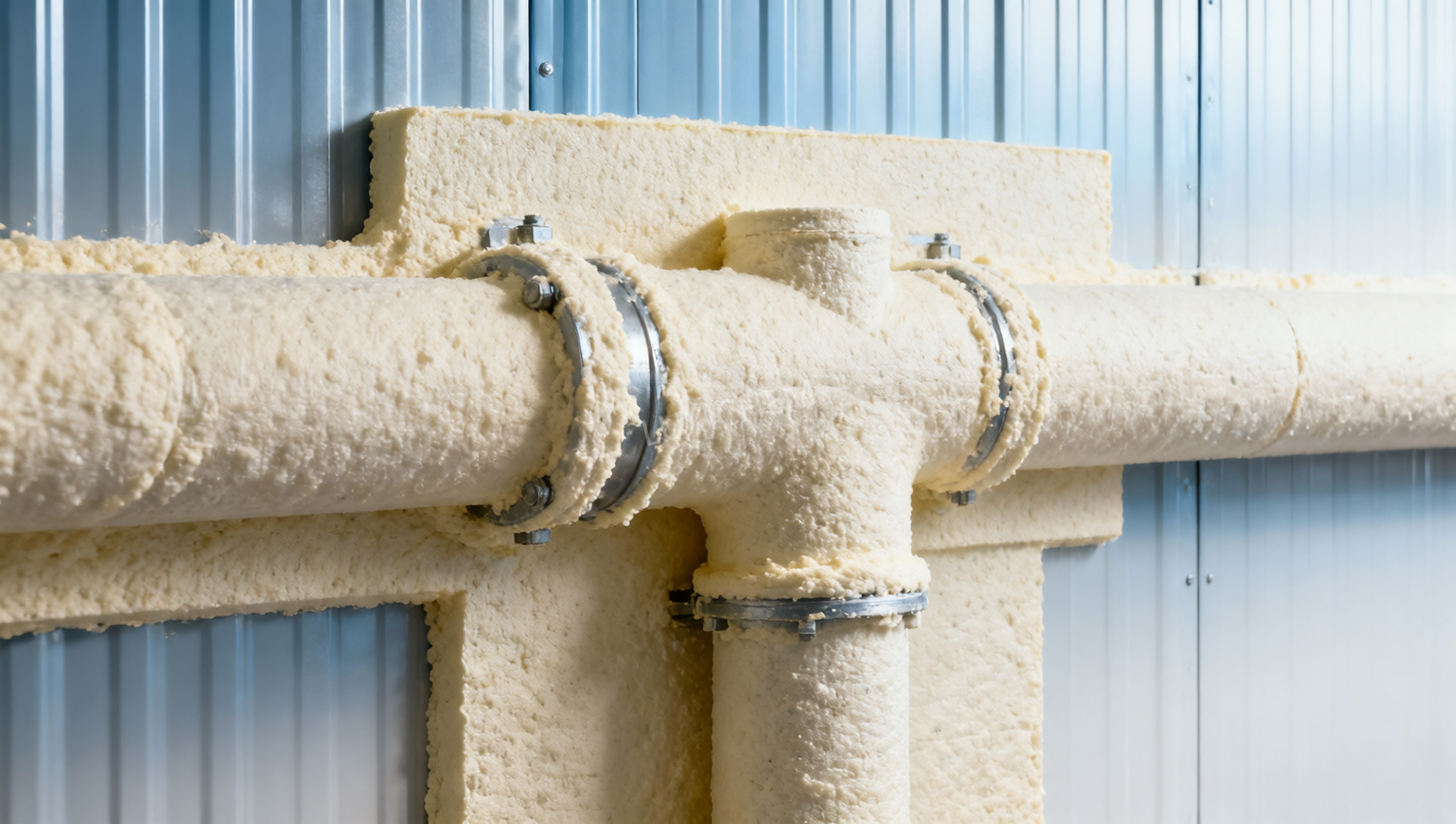
Spray foam insulation can help a project meet demanding thermal targets when the foam system is selected for the assembly, climate exposure, application method, and required service life rather than for a single laboratory R-value. In many roof, wall, cold-storage, and industrial-envelope applications, a polyester polyol for spray foam is worth considering when the design needs a rigid foam with low thermal conductivity, strong dimensional stability, and the ability to maintain performance under moisture or temperature stress.
For a project manager, the decision is rarely as simple as choosing “higher insulation value.” The foam has to be sprayed reliably by the installation team, adhere to the intended substrate, achieve the specified thickness without excessive shrinkage or voids, and remain compatible with the vapor-control and fire-protection strategy. Polyester-polyol-based systems can be a good fit for these requirements, especially in rigid polyurethane or polyisocyanurate-type insulation formulations, but their value depends on how the formulation is engineered and controlled.
Start with the insulation target, then define the foam's job
A stated insulation target may refer to nominal thermal resistance, whole-assembly performance, condensation control, energy-code compliance, or process-temperature control. Those are related objectives, but they do not always lead to the same foam specification.
For example, an exterior wall retrofit may have limited cavity depth and need high thermal performance per unit thickness. A cold-room panel or tank insulation project may place greater weight on moisture resistance, closed-cell integrity, and dimensional stability over repeated temperature cycling. A roof assembly may need insulation, water-shedding behavior, substrate adhesion, and compatibility with the roof coating or membrane. The project should identify which of these functions is essential before choosing the resin platform.
Polyester polyols are commonly used in rigid foam systems because their chemical structure can support a firm, crosslinked polymer network. Depending on the formulation, they can contribute to compressive strength, heat resistance, adhesion, and foam-cell structure. These characteristics can be helpful where insulation must also resist handling loads, maintain shape in a panel, or perform in more severe service conditions.
That does not mean every polyester-polyol formulation will automatically give the best insulating result. Thermal performance is influenced by foam density, closed-cell content, cell size, blowing-agent behavior, cure profile, installed thickness, and the condition of the sprayed surface. The resin is a central part of the system, but it is not a substitute for proper formulation design or field process control.
Where polyester-polyol-based spray foam is most likely to help
The material is often most relevant when a project has a combination of space constraints and durability requirements. Rigid spray foam can form a continuous insulating layer around irregular geometry, penetrations, structural transitions, and equipment supports that would be difficult to cover with board insulation alone. This ability to reduce gaps can materially improve the real performance of the assembly, provided the installation is well detailed.
Typical decision conditions include:
- Limited available thickness, where the required thermal resistance must be achieved within a constrained wall, roof, or equipment envelope.
- Complex substrates or irregular shapes where cut-and-fit insulation would create many joints and thermal weak points.
- Industrial or refrigerated environments where moisture exposure, temperature variation, and mechanical durability affect insulation life.
- Prefabricated panels or composite assemblies that need a rigid core with predictable expansion, bonding, and dimensional behavior.
- Retrofit work where uninterrupted insulation is needed around existing framing, piping, or building-service penetrations.
These applications should still be separated by service condition. A formulation intended for a protected interior cavity may not be appropriate for exposed equipment, humid processing areas, or exterior roof work. The project specification needs to state the operating temperature range, exposure to water or vapor, expected loading, substrate type, and protective layers. Without those details, a “spray foam” selection remains too broad to manage responsibly.
Thermal performance is an assembly issue
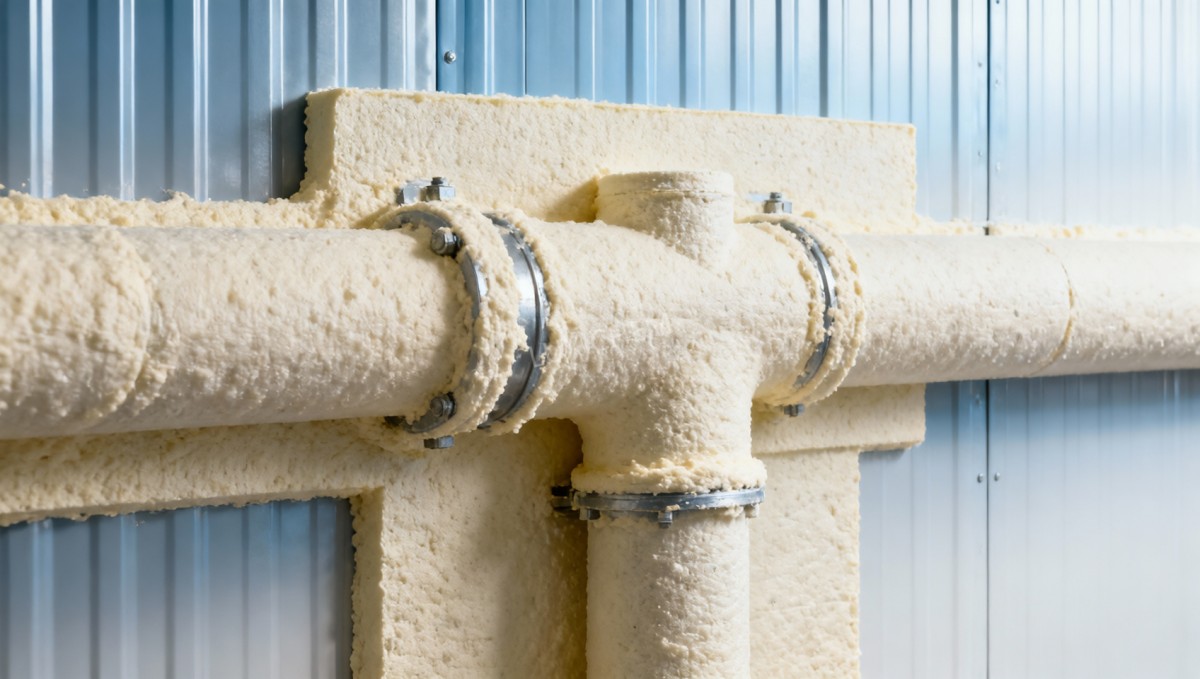
It is easy to compare foam products using a declared thermal value. That comparison is useful at an early stage, but it should not become the only selection criterion. The installed assembly may underperform its modeled value when the foam is thinner than specified, poorly bonded at edges, interrupted by framing, penetrated by fasteners, or exposed to conditions that change its thermal behavior over time.
Project teams should therefore ask for values that match the design basis: thickness, density range, conditioning method, and intended service temperature. If the installation will operate at low temperatures, for example, performance should be evaluated for that temperature range rather than assumed from room-temperature data. If the insulation is used in a roof or external enclosure, the specification should distinguish between core foam behavior and the performance of the entire protected system.
Closed-cell foam can support both insulation and air-control functions, but it should not be treated as an automatic answer to every moisture question. Water vapor movement, air leakage, substrate moisture, drainage paths, and the position of other layers all affect condensation risk. A foam layer that is thermally effective can still create problems if it traps construction moisture or shifts the dew point into a moisture-sensitive component without a compatible assembly design.
Specify installed thickness, not just theoretical yield
For sprayed insulation, the thickness on the substrate is the result that matters. The purchase order may state resin quantities or expected yield, while the design documents state thermal resistance. Those two measures only align when density, expansion, overspray, trimming, waste, and site conditions are controlled.
Thickness verification should be planned before application begins. The team needs a grid or inspection method for confirming coverage at corners, transitions, penetrations, and areas that are difficult to reach after cladding or membrane installation. A small average thickness shortfall can be significant where the insulation target has little design margin.
This is one reason a polyester polyol for spray foam may help a project only when the supplier, formulator, and applicator have aligned processing expectations. Resin viscosity, reactivity, storage condition, component ratio, ambient temperature, substrate temperature, and spray equipment settings influence expansion and cure. Procurement cannot fully separate material quality from installation capability.
Processing reliability deserves the same attention as resin chemistry
A high-performing foam formula can fail in application if the components are outside their usable temperature range, the proportioning equipment is not calibrated, or the substrate has dust, oil, frost, or excess moisture. The visible result may be poor adhesion, uneven cell structure, friable foam, surface defects, shrinkage, or inconsistent density. Some defects are obvious during application; others become evident only after panels move, coatings are applied, or the system experiences temperature change.
Before approving a material for full-scale work, it is useful to define a representative trial area. The trial should reflect the actual substrate, expected ambient conditions, target pass thickness, and intended protective coating or covering. Its purpose is not to create a marketing demonstration. It is to establish whether the specified process can produce a stable installed foam in the project environment.
A practical pre-application review can include:
- Confirmation of substrate condition, including dryness, surface preparation, compatibility, and any primer requirement.
- Storage and conditioning requirements for polyol and isocyanate components before use.
- Equipment settings, hose temperatures, pressure balance, mixing ratio, and the applicator's procedure for checking them.
- Maximum pass thickness and required cooling time between lifts, particularly where excessive exotherm or internal stress is a concern.
- Required foam density, thickness tolerance, adhesion checks, and the method for recording inspection results.
- Protection requirements during and after installation, including weather exposure, ultraviolet protection, and fire-performance layers where applicable.
These points may look operational, but they strongly affect whether the insulation target survives from design intent to completed work. A project that selects foam only on technical data sheets can still face schedule disruption if the field team cannot maintain consistent processing conditions.
Do not assume higher density solves every performance concern
Density is often used as a quick indicator of rigid foam quality. It can be relevant to mechanical strength, cell structure, yield, and dimensional stability, but it is not a universal performance ranking. Increasing density may affect material consumption and cost without delivering a proportional improvement in the property that matters most to the assembly.
The better question is whether the specified density range supports the required thermal, mechanical, and dimensional performance under the actual service conditions. A floor-underlay application, a metal panel core, and a roof insulation layer may each require different priorities. Where load-bearing capacity matters, compressive behavior and creep should be assessed. Where temperature cycling matters, dimensional change after conditioning is more informative than a density figure alone. Where thermal efficiency is the driver, cell structure and aged thermal performance may be more relevant.
Polyester polyols can be formulated across a wide range of rigid foam applications. This flexibility is useful, but it also means the generic label “polyester polyol” says little about suitability by itself. Project documents should request system-specific technical information rather than assuming that one polyester polyol grade will perform equivalently in every spray foam formulation.
Manage compatibility at the interfaces
Insulation projects often fail at interfaces rather than in the middle of the foam field. Spray foam may contact concrete, masonry, steel, timber, galvanized surfaces, membranes, coatings, sealants, pipe insulation, and mechanical fasteners. Each contact can affect adhesion, chemical compatibility, moisture movement, or fire-protection detailing.
For metal substrates, surface contamination and temperature can be as important as the selected foam system. For roofing work, compatibility with membranes and coatings should be confirmed for the complete assembly, including primers and repair materials. For interior construction, the fire-protection layer, lining, or thermal barrier should be identified in the design package rather than left for later coordination. A foam that meets thermal requirements does not by itself establish compliance for the finished building element.
Detailing around penetrations also requires discipline. Pipes, conduits, supports, expansion joints, and service openings move differently from the surrounding construction. Foam can fill irregular voids effectively, but it should not be expected to replace joints or sealants designed to accommodate movement, drainage, or fire stopping.
Procurement questions that prevent avoidable changes on site
Project managers often need a material decision before every field condition is fully known. The most useful procurement approach is to turn unknowns into explicit supplier and applicator questions. This reduces the chance that an apparently comparable alternative changes the foam behavior, installation window, or compliance path after delivery.
Supply continuity is particularly important when work is phased. A change in component source or formulation during the project can require renewed trials or approvals, even when the replacement appears similar on paper. For critical work, establish lot identification, documentation requirements, storage limits, and a process for handling substitutions before the first delivery arrives.
A sound decision is conditional, not generic
Polyester-polyol-based spray foam can be a strong route to meeting insulation targets when the project needs rigid, continuous insulation with reliable dimensional behavior and the application conditions can be controlled. It is less suitable as a simple material swap where the assembly, moisture strategy, protective layers, and spray process have not been defined.
The most productive next step is to convert the thermal target into an installed-system brief: required thickness, substrates, operating conditions, interface details, inspection method, and protection requirements. That brief gives the formulator and applicator enough information to determine whether the selected foam system can deliver the intended result, rather than merely promising an attractive property on a data sheet.
Related Picks
 Butylated Hydroxytoluene Price Drivers: Supply, Purity, and Purchasing Risk FactorsOct 21, 2026Butylated Hydroxytoluene price trends depend on supply stability, purity, logistics, and purchasing risk. Learn how to compare quotes wisely and reduce sourcing costs.
 Sodium Tripolyphosphate Price Trends: Raw Material and Energy ExposureOct 20, 2026Explore sodium tripolyphosphate price trends, from phosphate and soda ash costs to energy exposure. Learn how to compare quotes, manage sourcing risks, and make smarter purchasing decisions.
 Acetonitrile Shipment to Vietnam Successfully Dispatched; RCEP Benefits Boost Fine Chemical Trade with ASEANSep 16, 2026A shipment of industrial-grade acetonitrile from our company has recently been loaded and dispatched following the completion of standardized hazardous material packaging and container securing procedures.
 Nigerian Client’s Order of 4 Containers of Vinyl Acetate Successfully Loaded and Shipped to West AfricaSep 16, 2026We recently completed the loading of a vinyl acetate order for a Nigerian client; four containers of the product have been successfully packed and are ready for shipment to Nigeria.




Question Consultation
Send Us Your Inquiry Today

Luxi Chemical is a professional chemical product supplier with ample stock of all chemical categories and excellent quality, welcome your purchase inquiry.

