


Where polyester polyols fit in polyurethane foam formulations
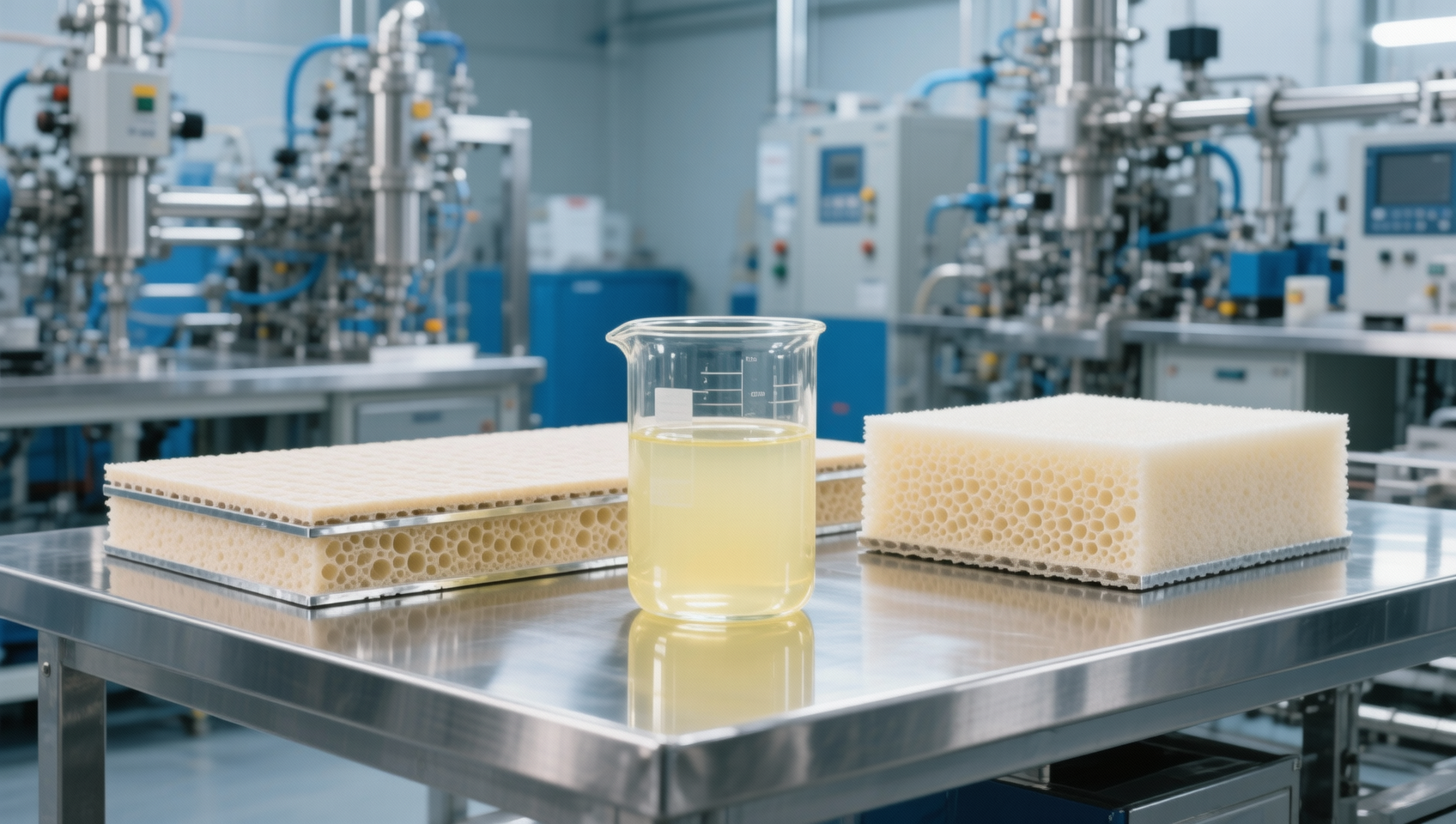
A polyester polyol for polyurethane foam is worth considering when the formulation needs a particular balance of stiffness, adhesion, mechanical strength, or resistance to oils and solvents. Its strongest applications include rigid insulation formulations and selected flexible or specialty foams. Suitability depends on the polyester’s structure and the rest of the formulation: an aromatic polyester used in a rigid panel and an aliphatic polyester used in a flexible technical foam serve different purposes.
For an initial decision, separate the application into two questions. What must the finished foam withstand, and what must the liquid formulation do during production? Polyester chemistry may help meet the first requirement while making the second more demanding through viscosity, compatibility, or reaction balance. A useful comparison therefore follows the material from mixing and rise through curing and service, rather than judging it by a single property on a supplier’s data sheet.
Where polyester polyols earn their place
Polyester polyols contain ester linkages and hydroxyl groups that react with isocyanates. Their acid and alcohol building blocks, molecular size, and functionality influence how they behave. The distinction between aromatic and aliphatic grades provides a useful starting point, although neither category describes a complete foam formulation.
Rigid polyurethane and polyisocyanurate insulation
Aromatic polyester polyols have an established role in rigid polyurethane and polyisocyanurate, or PIR, insulation systems. They can contribute to stiffness, adhesion, and formulation strategies intended to improve fire performance. Their usefulness is especially relevant in applications where the foam must form a stable insulating structure and bond adequately to a facing or substrate.
However, aromatic content alone does not establish a fire rating. Isocyanate chemistry, the extent of isocyanurate formation, flame retardants, foam density, facings, and the finished construction all affect fire behavior. A polyol should be assessed within the complete system and the applicable end-use test. Describing a raw material as suitable for a flame-retardant formulation is different from demonstrating that a finished panel meets a particular requirement.
Rigid formulations may combine polyester and polyether polyols. A polyester can contribute selected structural and adhesion properties, while other polyols help adjust functionality, processing, or compatibility. The blend gives formulators more control, but the result cannot be predicted by averaging the properties of its ingredients.
PIR also requires a separate interpretation of the formulation. At elevated isocyanate levels, suitable catalysts promote isocyanate trimerization alongside urethane formation. Consequently, the polyester’s contribution sits within a network that differs from a conventional polyurethane foam. Changing the polyol without reconsidering catalyst balance and isocyanate demand can alter cure, friability, and dimensional stability.
Flexible and specialty technical foams
Flexible polyester foams generally use different polyol designs from rigid insulation systems. Longer, predominantly difunctional polyester chains can support flexible structures, with crosslinking and hardness adjusted through the wider formulation. Selected polyester foams are useful where tensile strength, tear resistance, or resistance to particular oils and solvents matters, such as technical padding, seals, and industrial foam components.
These advantages are conditional. Chemical resistance depends on the actual fluid, concentration, temperature, and contact time. A foam that tolerates one oil may swell or deteriorate in another environment. The cell structure also matters: an open-cell foam can absorb and retain fluids even when its polymer has useful chemical resistance.
For cushioning exposed to repeated washing, humidity, or warm moisture, hydrolytic durability may outweigh the mechanical benefits of a polyester system. Polyether foams often provide a more favorable starting point for such conditions. Polyester chemistry still offers options, but the grade and finished foam need evaluation against the intended exposure.
Neither “polyester” nor “polyether” guarantees a particular feel, resilience, or load-bearing response. Those outcomes also depend on density, molecular architecture, crosslinking, cell openness, and processing. Flexible-foam comparisons should therefore use equivalent performance targets rather than simply comparing two materials carrying different chemical labels.
The polyester–polyether comparison that matters in service
The most useful distinction is the balance between mechanical or chemical performance and environmental durability. Polyester segments can provide strong intermolecular interactions that support useful strength and resistance to selected chemicals. Polyether segments generally offer better resistance to hydrolysis because they lack the ester bonds susceptible to hydrolytic cleavage.
Moisture exposure deserves particular attention because degradation may develop gradually. Water, temperature, exposure duration, and acidic or alkaline conditions influence ester hydrolysis. A foam may initially meet strength requirements yet lose properties after prolonged exposure. Dry-room measurements alone are therefore insufficient for components intended for humid buildings, wet industrial environments, or repeated cleaning.
Polyester structure can change this behavior substantially. The choice of acid and alcohol components, hydrophobicity, network structure, and stabilization all influence durability. It would be too broad to reject every polyester foam for moisture exposure, just as it would be too broad to assume that every polyether foam meets a demanding aging requirement.
Thermal insulation presents another common misunderstanding. Selecting a polyester polyol does not by itself deliver lower thermal conductivity. Insulating performance depends heavily on cell size, closed-cell content, cell gas, density, and aging. A chemistry change that improves adhesion but disrupts cell formation may reduce the value of the finished insulation.
Adhesion also needs application-specific testing. The polyol can influence wetting and the cured polymer, but surface cleanliness, facing treatments, substrate temperature, and cure conditions may dominate the bond. For laminated insulation, evaluate both initial adhesion and adhesion after relevant conditioning. A strong fresh bond does not establish durability through temperature and humidity cycles.
These comparisons work best when density and test conditions are controlled. Higher-density foam can appear stronger simply because it contains more polymer per unit volume. Comparing different densities, conditioning periods, or specimen orientations can obscure whether the polyol chemistry delivered the improvement.
Which polyol properties actually change the formulation?
A technical data sheet is a starting point for understanding formulation behavior. The most informative properties are those that connect the liquid ingredient to reaction balance, mixing, and the resulting network.
Hydroxyl number and functionality answer different questions. Hydroxyl number indicates the concentration of hydroxyl groups by mass and is used to calculate hydroxyl equivalent weight and isocyanate demand. Functionality describes the number of reactive hydroxyl groups per molecule on an average basis. Both affect network formation, but a higher hydroxyl number does not automatically mean higher functionality.
This distinction matters when replacing one polyol with another. Two grades with similar hydroxyl numbers can differ in molecular architecture, viscosity, and the network they produce. Conversely, a replacement with a different hydroxyl number changes the reactive balance even if the same mass is added. The isocyanate calculation must account for all relevant reactive components, including water and other active-hydrogen ingredients.
Viscosity affects whether the chemistry can be processed consistently. A viscous polyol may be harder to meter and mix, particularly at lower temperatures. Poor mixing can produce uneven reaction, coarse cells, or local defects. Temperature can improve flow, but it also changes reaction rates and may affect blowing-agent behavior. Compare viscosity at the actual handling temperature, rather than relying only on a value measured under convenient laboratory conditions.
Water content influences both blowing and stoichiometry. Water reacts with isocyanate, generating carbon dioxide and contributing to urea formation. Unaccounted moisture can therefore alter density, rise, hardness, and isocyanate demand. In a formulation using water deliberately, the moisture carried by the raw materials belongs in the calculation. In a physically blown formulation, unexpected water can still disturb the designed gas balance.
Acid value can affect catalyst behavior. Residual acidity may interact with basic catalysts and change the reaction profile. The significance depends on the grade, catalyst package, and formulation. A change in acid value should be evaluated alongside cream, rise, gel, and cure behavior rather than treated as a cosmetic specification difference.
Compatibility determines whether the formulation stays usable. The polyester must work with the other polyols, surfactants, catalysts, flame retardants, and blowing agents. A freshly mixed blend can look satisfactory yet separate during storage or after a temperature change. Physical blowing agents make this assessment particularly important because their solubility and behavior vary with the liquid blend.
For a formulated polyol component stored before use, check stability over the intended storage conditions. Phase separation can create different compositions at different points in a container, leading to inconsistent metering and foam properties. Mixing immediately before a laboratory trial may conceal a problem that becomes significant in production.
How to evaluate a change without misreading the results
A polyester substitution is best treated as a formulation change with a defined purpose. Start with a specific target: stronger adhesion to a facing, improved resistance to a named fluid, better tear performance, or a suitable rigid-foam structure. “Better foam” is too broad to guide either material selection or testing.
Establish a baseline using the existing formulation and consistent processing conditions. Then compare candidate grades or blends while accounting for hydroxyl content, water, and isocyanate demand. A direct weight-for-weight replacement can be useful as an exploratory observation, but it is rarely enough to establish whether the candidate chemistry is suitable.
The reaction profile should be read together with the foam structure. If gas generation progresses faster than the polymer develops sufficient strength, cells may collapse or coalesce. If the structure becomes too rigid too early, expansion may be restricted or internal stresses may develop. Catalysts and surfactants influence this balance, so an unfavorable first trial may indicate a formulation mismatch rather than an inherent limitation of polyester chemistry.
A focused evaluation can cover three connected stages:
- Liquid handling: assess blend stability, viscosity at processing temperature, metering consistency, and mixing quality.
- Foam formation: observe reaction timing, rise, cure, density distribution, cell structure, and visible defects.
- End-use performance: measure the properties relevant to the application, including dimensional stability, adhesion, compression behavior, or durability after defined exposure.
For rigid insulation, early screening should connect cell structure and density with dimensional stability and insulating performance. For flexible technical foam, tensile and tear results may need to be paired with compression behavior and aging. Testing should reflect the way the component will actually be loaded or exposed.
Production scale introduces further constraints. A formulation that rises well in a small laboratory sample may behave differently in a thick section, enclosed mold, or continuous line because heat retention, flow, and cure conditions change. Equipment capability and substrate conditions belong in the assessment before a material change is accepted.
The decision becomes clearer when a polyester grade delivers the required property at an acceptable density, survives the relevant exposure, and can be processed within the available operating conditions. If its apparent advantage disappears after moisture aging or depends on a mixing temperature the plant cannot maintain, another polyol chemistry or a different blend deserves attention. A credible selection is one that carries its benefit through to the finished foam under the conditions that matter.
Related Picks
 Butylated Hydroxytoluene Price Drivers: Supply, Purity, and Purchasing Risk FactorsOct 21, 2026Butylated Hydroxytoluene price trends depend on supply stability, purity, logistics, and purchasing risk. Learn how to compare quotes wisely and reduce sourcing costs.
 Sodium Tripolyphosphate Price Trends: Raw Material and Energy ExposureOct 20, 2026Explore sodium tripolyphosphate price trends, from phosphate and soda ash costs to energy exposure. Learn how to compare quotes, manage sourcing risks, and make smarter purchasing decisions.
 Acetonitrile Shipment to Vietnam Successfully Dispatched; RCEP Benefits Boost Fine Chemical Trade with ASEANSep 16, 2026A shipment of industrial-grade acetonitrile from our company has recently been loaded and dispatched following the completion of standardized hazardous material packaging and container securing procedures.
 Nigerian Client’s Order of 4 Containers of Vinyl Acetate Successfully Loaded and Shipped to West AfricaSep 16, 2026We recently completed the loading of a vinyl acetate order for a Nigerian client; four containers of the product have been successfully packed and are ready for shipment to Nigeria.




Question Consultation
Send Us Your Inquiry Today

Luxi Chemical is a professional chemical product supplier with ample stock of all chemical categories and excellent quality, welcome your purchase inquiry.

