


How aromatic polyester polyol structure affects foam rigidity
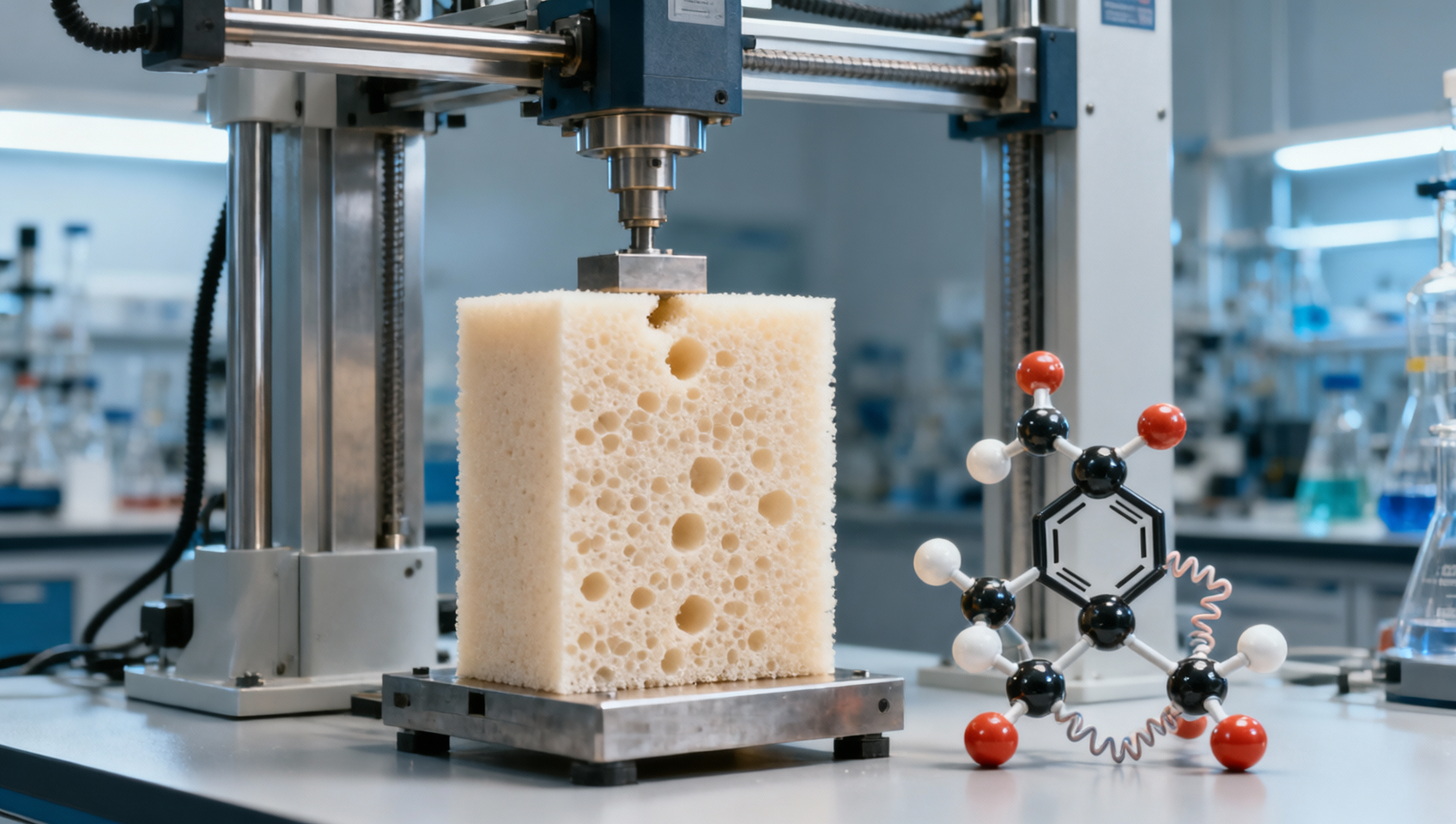
Two rigid foam formulations can have similar polyol hydroxyl values and still deliver noticeably different stiffness. One foam may resist compression cleanly, while another deforms more readily or becomes brittle after conditioning. The difference often lies in aromatic polyester polyol structure: aromatic ring content, hydroxyl functionality, and molecular architecture influence segment mobility, network formation, and the way the cellular structure develops.
For technical evaluators, the important distinction is between the rigidity of the polymer forming the cell walls and the mechanical response of the finished foam. These are connected, but they are not interchangeable. A structurally rigid polymer can produce disappointing foam if density, cell morphology, or cure quality is poorly controlled. Understanding both levels makes polyol comparisons more useful than a simple ranking by hydroxyl value.
What hydroxyl value tells you—and what it leaves out
Hydroxyl value measures the concentration of hydroxyl groups, normally expressed as milligrams of potassium hydroxide equivalent per gram of material. It is essential for calculating reactive equivalents and establishing the isocyanate requirement. However, it does not directly describe how those hydroxyl groups are distributed among molecules.
The approximate hydroxyl equivalent weight is:
Hydroxyl equivalent weight, g/eq = 56,100 ÷ hydroxyl value, mg KOH/g
For an idealized hydroxyl-terminated material, number-average molecular weight can also be related to hydroxyl value and average hydroxyl functionality:
Mn ≈ 56,100 × average hydroxyl functionality ÷ hydroxyl value
This second relationship requires caution. Commercial polyester polyols contain molecular distributions rather than a single defined molecule. Residual glycols, branching, non-hydroxyl end groups, and measurement methods complicate interpretation. A calculated molecular weight is therefore not a substitute for characterization.
Two polyols with matching hydroxyl values may differ in average functionality, aromatic concentration, flexible spacer length, and hydroxyl accessibility. Those differences can change both network development and processing behavior, even when the nominal hydroxyl equivalents are identical.
How aromatic polyester polyol structure changes the polymer network
Aromatic rings restrict movement, but their placement matters
Aromatic polyester polyols commonly incorporate residues derived from phthalic, isophthalic, or terephthalic feedstocks, including suitable recycled polyester streams. Aromatic rings are relatively rigid structural units. Compared with long aliphatic sequences, they restrict local chain motion and can increase the stiffness of the cured polymer matrix.
The relevant variable is not simply whether a polyol contains aromatic rings. Evaluators should ask how much aromatic material is present, how closely the rings are spaced, and what flexible segments separate them. A high aromatic concentration combined with short spacers generally favors reduced segmental mobility. Longer glycol-derived sequences can introduce flexibility even within an aromatic polyester backbone.
Ring substitution geometry also changes molecular shape and packing tendencies. Nevertheless, there is no universal ranking in which one aromatic feedstock always produces the stiffest foam. Branching, glycol selection, compatibility, and the final network may outweigh the effect of ring geometry alone.
Functionality governs connectivity—not just reactivity
Hydroxyl functionality describes the average number of hydroxyl groups per molecule. A predominantly difunctional polyester mainly extends chains through its hydroxyl groups, whereas higher-functionality components introduce additional branching opportunities. In rigid polyurethane formulations, the overall network also depends on the functionality of the isocyanate and other polyols in the blend.
Higher average functionality can support greater network connectivity and lower chain mobility. Yet nominal functionality is not the same as effective crosslink density. Incomplete reaction, steric restrictions, network loops, and uneven mixing can prevent some functional groups from contributing to useful load-bearing connections.
Excessive connectivity can also create a trade-off: a foam may become stiff but more friable or less tolerant of local strain. The best structure is therefore application-dependent. An insulation board requiring dimensional stability does not necessarily need the same balance as a foam component exposed to repeated mechanical loading.
Spacer length and hydroxyl environment shape the result
Shorter flexible segments between network junctions generally reduce the distance over which chains can deform. Longer aliphatic or ether-containing segments provide more opportunities for rotation and relaxation. Glycol selection therefore affects rigidity through both segment flexibility and the distribution of reactive groups.
Hydroxyl groups also differ in accessibility and reaction rate. Primary and secondary hydroxyl environments can respond differently to a given catalyst package. A slower-reacting polyol may still reach adequate conversion, but its gel development may not align with gas generation. That mismatch can affect cell-wall formation before the foam has developed sufficient strength.
Ester groups contribute polarity and intermolecular interactions, while the cured material contains additional interactions associated with urethane and, where present, urea groups. These effects support cohesion, but they cannot be isolated from the overall formulation by looking at ester content alone.
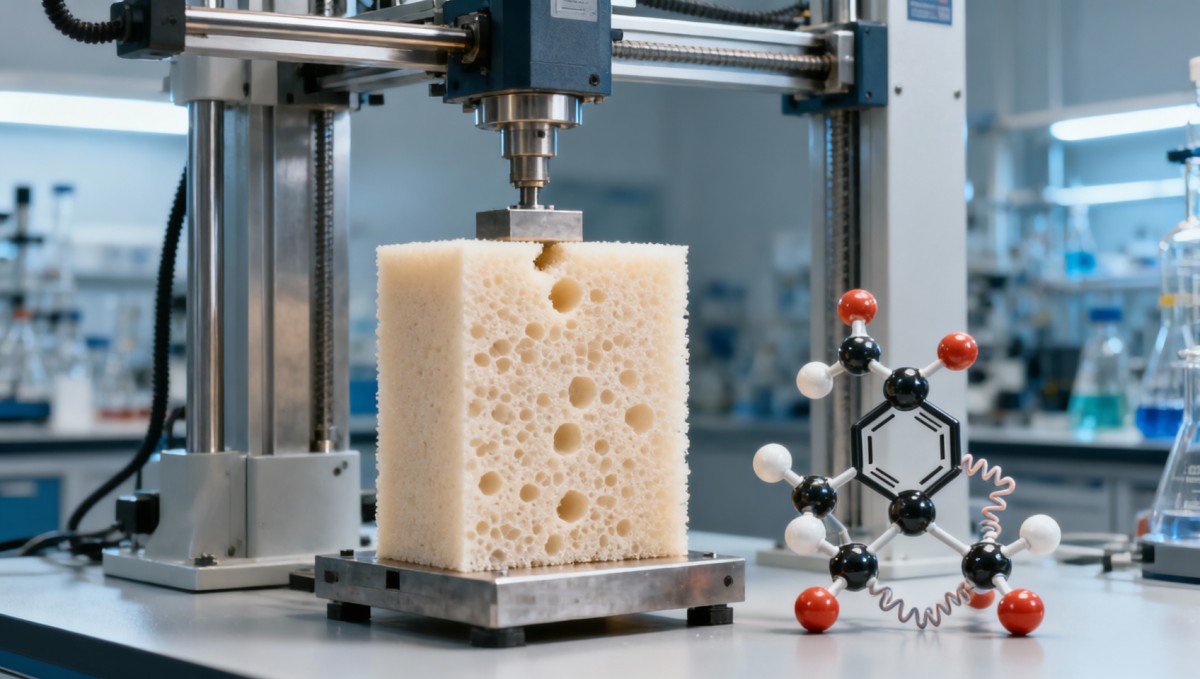
A useful structural diagram would compare aromatic units, flexible spacers, and branch points side by side. The purpose is to visualize segment mobility and network connectivity—not to imply that a schematic molecule fully represents a commercial polyol distribution.
Why a stiffer polymer does not always produce a stiffer foam
Rigid foam is a cellular material. During compression, cell edges bend, cell faces deform, and gas pressure may contribute to the response. Consequently, apparent stiffness depends strongly on density, cell geometry, defects, and loading direction, as well as on the polymer itself.
This explains a common laboratory frustration: the more aromatic candidate may show lower compressive performance because it produces coarser cells or poorer flow. Its polymer matrix might be intrinsically stiffer, but the cellular structure has lost more strength than the matrix has gained.
Viscosity deserves particular attention. Structural changes can affect viscosity, but aromatic content alone does not predict it reliably. Molecular weight distribution, residual glycol content, branching, and temperature all matter. Poor mixing or unsuitable viscosity can introduce defects that obscure the intended structural benefit.
Separate polyurethane effects from polyisocyanurate effects
In polyurethane-rich systems, the polyol structure strongly influences segment mobility and the urethane network. In polyisocyanurate systems, isocyanate trimerization introduces rigid isocyanurate rings, adding another major source of network stiffness and thermal resistance.
Aromatic polyester polyols are widely used in rigid PUR and PIR formulations, but their contribution must be assessed alongside isocyanate index and catalyst selection. Increasing the index in a formulation designed for trimerization can change the network substantially. It does not merely amplify the effect of aromatic content.
The index calculation should include relevant active-hydrogen contributions, especially water. Water reacts with isocyanate, generates carbon dioxide, and contributes to urea formation. Uncontrolled moisture can therefore alter blowing, stoichiometry, and polymer structure simultaneously.
For a meaningful polyol comparison, keep the intended index calculation consistent and document the trimerization catalyst package. Equal nominal index does not guarantee equal reaction pathways if catalyst balance, moisture, or reaction temperatures differ.
A comparison protocol that reveals structural differences
The most useful screening program separates material characterization from foam performance, then reconnects them through controlled trials.
- Characterize the incoming polyols. Measure hydroxyl value, acid value, water content, and viscosity at a specified temperature. Request available information on functionality, glycol composition, aromatic feedstock, and molecular weight distribution.
- Build a controlled baseline. Hold the isocyanate system, index basis, blowing package, surfactant, processing temperature, and target density consistent. Account for measured water rather than relying only on nominal specifications.
- Record reaction and flow behavior. Track cream, gel, rise, and tack-free times using a consistent procedure. Note mixing quality, collapse, shrinkage, surface defects, and mold filling where applicable.
- Measure the cellular structure. Determine density, examine cell morphology, and assess open-cell content when relevant. Sample equivalent positions because foam properties can vary across a block or panel.
- Test conditioned specimens. Measure compressive behavior in defined directions and assess dimensional stability. Add friability, thermal conductivity, or adhesion testing according to the end use.
A fixed catalyst package is useful for initial screening because it exposes differences in inherent behavior. However, it should not be the only comparison. A second stage with carefully optimized catalyst balance can show whether a candidate’s initial weakness reflects unsuitable processing rather than an unsuitable backbone.
Report both stages clearly. Otherwise, an optimized formulation may be mistaken for evidence that one polyol structure is inherently superior.
Use standards to define the measurement, not to explain the chemistry
Relevant methods include ASTM D1621 or ISO 844 for compressive properties of rigid cellular plastics, ASTM D1622 or ISO 845 for apparent density, and ASTM D2126 for thermal and humid aging dimensional stability. Hydroxyl number can be evaluated using an applicable method within ASTM D4274. Check the current edition, scope, and suitability for the material.
Do not use “rigidity” as an undefined acceptance criterion. Specify whether the requirement concerns compressive modulus, compressive strength, stress at a defined deformation, or dimensional stability. These properties are related, but a formulation can improve one while compromising another.
Reading supplier data without overinterpreting it
A technical data sheet is a starting point, not a complete structural description. Narrow hydroxyl-value and viscosity ranges support production consistency, but they do not prove identical molecular architecture. Acid value can signal residual carboxylic groups and influence formulation behavior; water content can materially affect foaming even when the remaining specifications appear unchanged.
For recycled-feedstock polyester polyols, ask how feedstock variability and finished-product consistency are controlled. Recycled origin alone predicts neither poor performance nor equivalence to another grade. The useful evidence is batch characterization and performance under a representative formulation.
Procurement documents should also distinguish foam reactants from unrelated industrial chemicals. Luxi Chemical (Shandong) Co., Ltd. supplies chemical raw materials and supports international procurement across multiple categories. Its listed Tetrachloroethylene CAS#127-18-4, for example, is a chlorinated industrial solvent used in applications such as dry cleaning and metal degreasing—not an aromatic polyester polyol or a recommended foam formulation ingredient. Solvent specifications and safety documentation belong in a separate qualification stream, with current regulatory requirements checked for the intended market.
The selection decision: stiffness with usable processing latitude
The strongest candidate is rarely identified by maximizing aromatic content or hydroxyl value in isolation. A useful aromatic polyester polyol combines suitable segment rigidity and network connectivity with compatibility, manageable viscosity, controlled reaction behavior, and consistent foam morphology.
When two grades produce different results, work backward from the foam: confirm density and test direction, inspect the cells, review cure and stoichiometry, then examine functionality and backbone structure. This sequence avoids attributing every performance difference to aromatic chemistry.
Ultimately, select against a defined application window. The goal is not simply the hardest laboratory specimen, but a foam that meets mechanical and dimensional requirements without becoming unnecessarily brittle or difficult to manufacture. That is where structural understanding becomes a practical qualification tool.
Related Picks
 Butylated Hydroxytoluene Price Drivers: Supply, Purity, and Purchasing Risk FactorsOct 21, 2026Butylated Hydroxytoluene price trends depend on supply stability, purity, logistics, and purchasing risk. Learn how to compare quotes wisely and reduce sourcing costs.
 Sodium Tripolyphosphate Price Trends: Raw Material and Energy ExposureOct 20, 2026Explore sodium tripolyphosphate price trends, from phosphate and soda ash costs to energy exposure. Learn how to compare quotes, manage sourcing risks, and make smarter purchasing decisions.
 Acetonitrile Shipment to Vietnam Successfully Dispatched; RCEP Benefits Boost Fine Chemical Trade with ASEANSep 16, 2026A shipment of industrial-grade acetonitrile from our company has recently been loaded and dispatched following the completion of standardized hazardous material packaging and container securing procedures.
 Nigerian Client’s Order of 4 Containers of Vinyl Acetate Successfully Loaded and Shipped to West AfricaSep 16, 2026We recently completed the loading of a vinyl acetate order for a Nigerian client; four containers of the product have been successfully packed and are ready for shipment to Nigeria.




Question Consultation
Send Us Your Inquiry Today

Luxi Chemical is a professional chemical product supplier with ample stock of all chemical categories and excellent quality, welcome your purchase inquiry.

