


Which sodium tripolyphosphate grade suits detergent formulation?
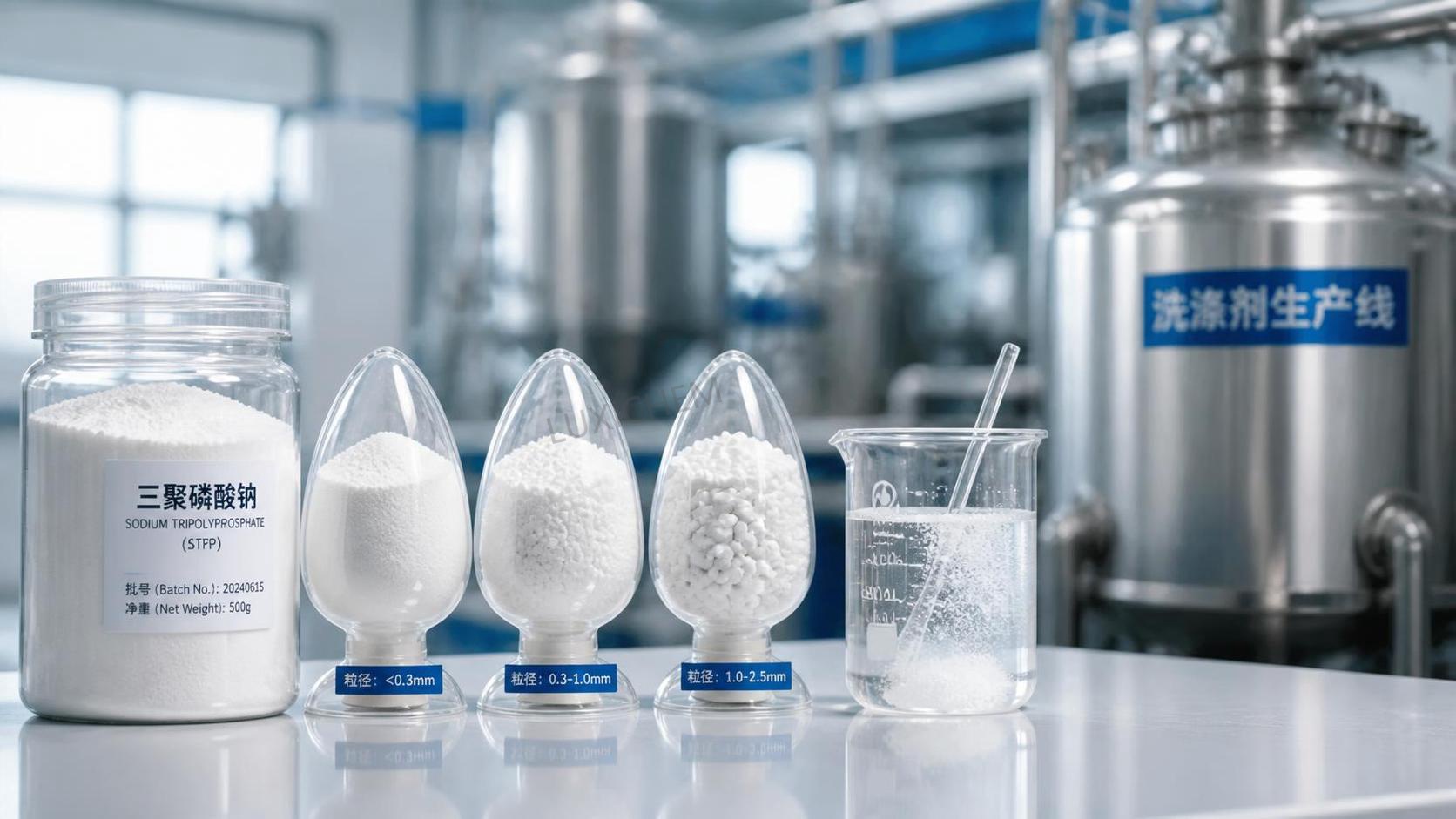
Selecting the right Sodium tripolyphosphate grade is critical for detergent formulators evaluating cleaning performance, water softening efficiency, solubility, and batch consistency.
Technical teams must compare purity, particle size, bulk density, and application compatibility to balance product quality with manufacturing cost across detergent formats.
This guide explains how to choose a suitable grade for powder, liquid, and institutional detergent formulations while controlling process risks and supply variability.
Start With the Detergent System, Not the STPP Specification
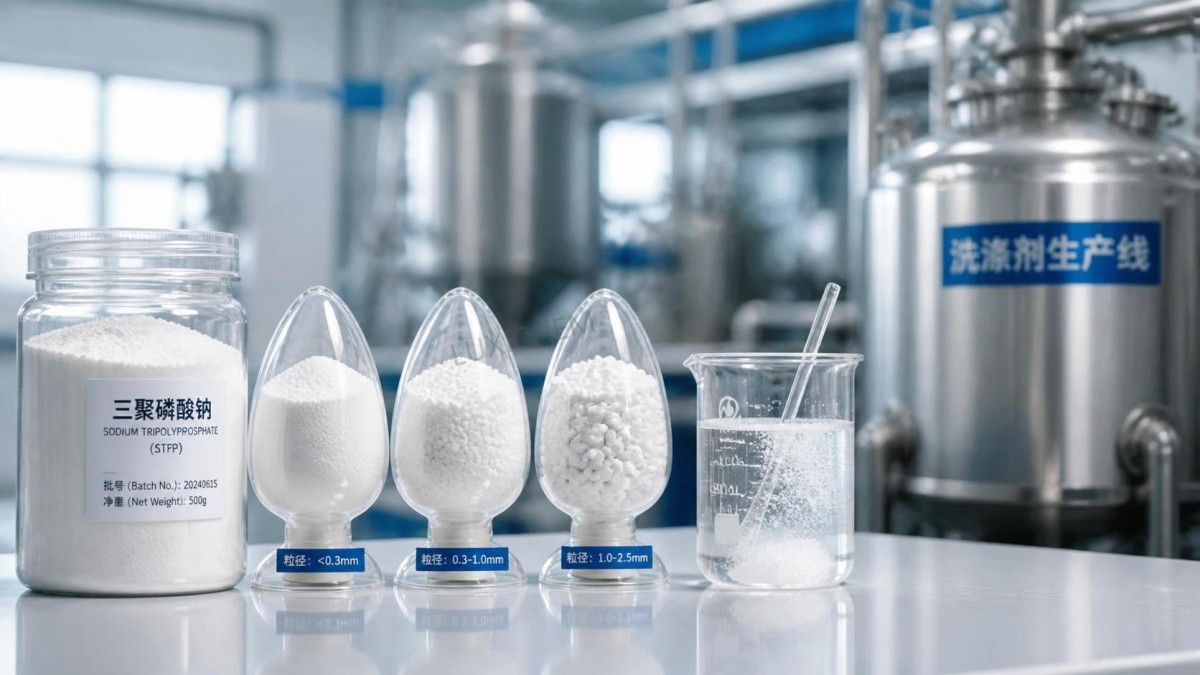
The best Sodium tripolyphosphate grade depends first on the finished detergent format, manufacturing route, target wash conditions, and local water hardness profile.
There is no universally superior grade because a powder detergent, automatic dishwashing product, and liquid cleaner impose different technical requirements on the builder.
For most detergent applications, sodium tripolyphosphate functions primarily as a builder, sequestrant, alkalinity contributor, dispersant, and processing aid.
Its ability to bind calcium and magnesium ions helps surfactants work more effectively in hard water and limits insoluble soil redeposition.
Technical evaluators should therefore begin with a formulation performance brief instead of selecting material solely by assay or purchase price.
Define the expected detergent dosage, wash temperature, water hardness range, target foam profile, storage environment, and production equipment before comparing grades.
This approach identifies whether rapid dissolution, controlled hydration, high bulk density, low dust generation, or phosphate content is the decisive purchasing criterion.
For heavy-duty laundry powders, a detergent-grade product with reliable granulation behavior and stable bulk density is often more valuable than maximum chemical purity.
For compact powders, the priority may shift toward high active content and predictable density, allowing formulators to fit required builder performance into less package volume.
For institutional cleaners, rapid dissolution and dependable sequestration can outweigh appearance because products may be mixed or diluted on site.
Assess Chemical Quality Through Functional Performance
Sodium tripolyphosphate is commonly evaluated through total phosphate content, active STPP content, pH, water-insoluble matter, iron level, and phase composition.
High assay alone does not guarantee equivalent detergent performance because hydration state, crystal form, impurities, and physical properties also affect manufacturing behavior.
A detergent formulator should request a current certificate of analysis and compare its limits with actual batch values over multiple deliveries.
Stable active content supports accurate dosing, especially when the builder level is tightly linked to surfactant efficiency, alkalinity, and cost control.
Water-insoluble matter deserves particular attention in products intended for cool-water washing, spray application, transparent solutions, or residue-sensitive end uses.
Excess insolubles can cause haze, nozzle blockage, visible deposits, poor dissolution, and inconsistent cleaning results under low-temperature conditions.
Iron and other trace metals may be important where formulations contain bleach systems, optical brighteners, fragrances, or oxidation-sensitive components.
Even low levels of metal contamination can influence color stability, perfume quality, or long-term storage behavior in demanding detergent systems.
Ask suppliers how they control raw materials, production conditions, sampling, retained samples, and out-of-specification investigations rather than relying on one test report.
For qualification, test at least several production lots to distinguish a representative grade profile from a favorable but isolated sample result.
Choose Particle Size for the Actual Manufacturing Route
Particle size distribution determines more than handling convenience; it can influence blend uniformity, dissolution speed, dust exposure, segregation, and downstream granulation performance.
Fine Sodium tripolyphosphate powders generally dissolve more quickly because they provide greater surface area in the wash liquor or manufacturing slurry.
However, overly fine material may increase dusting, create difficult conveying conditions, and separate from larger detergent granules during transport or packaging.
Coarser grades can improve flowability and reduce airborne dust, but they may dissolve more slowly in short wash cycles or cold water.
For dry-blended detergent powder, a particle-size range compatible with other major ingredients is essential to prevent segregation after mixing.
Compare the STPP distribution with that of sodium sulfate, zeolite, carbonate, surfactant granules, enzymes, and fragrance carriers used in the formula.
If particle densities and sizes differ excessively, the blend may look uniform at the mixer outlet but separate during pneumatic transfer, storage, or packing.
For spray-dried powders, particle size affects slurry preparation, hydration behavior, atomization stability, and the consistency of the resulting base powder.
For post-dosed compact detergents, granular or controlled-size grades may offer better flow and easier incorporation into dense finished products.
A practical evaluation should include sieve analysis, angle of repose, dust observations, blender uniformity testing, and dissolution testing in representative wash water.
Bulk Density Affects Both Packaging Economics and Dose Accuracy
Bulk density is a commercial and process parameter because it affects storage capacity, packaging volume, dosing calibration, transport efficiency, and product appearance.
A low-density grade may be suitable for some loose powders, yet it can complicate volumetric feeding and increase package size requirements.
A high-density Sodium tripolyphosphate grade can support compact detergent designs where manufacturers seek more active cleaning ingredients per unit volume.
Density must nevertheless be considered alongside particle strength, dissolution rate, and blend compatibility because compacting a formulation can introduce new processing constraints.
When ingredients differ substantially in density, blend segregation may occur even if their particle-size distributions appear reasonably well matched.
Technical teams should measure both loose and tapped bulk density, especially when the material passes through hoppers, screw feeders, or automatic filling lines.
Lot-to-lot density variation can alter feeder settings and lead to active-content drift in the finished detergent without any change to the stated formula.
This risk becomes significant for plants using volumetric rather than gravimetric dosing, where feeder calibration may not be continuously corrected.
During supplier approval, record density data across lots and determine whether the stated tolerance fits the operating window of the production line.
A slightly higher material price may be justified when consistent density reduces downtime, manual adjustment, packaging losses, and finished-product variability.
Solubility and Hydration Matter Most in Cold Water and Liquids
Solubility is often treated as a simple pass-or-fail property, but detergent formulators should evaluate dissolution speed, clarity, residue, and temperature sensitivity.
A grade that performs adequately in warm laboratory water may still leave particles or haze during rapid dissolution in cold, hard water.
For laundry powders marketed for short cycles, cold washes, or quick dissolving claims, use application-specific dissolution testing rather than generic water-solubility data.
Test the planned dose in realistic water hardness, temperature, agitation, and wash volume conditions, then inspect both initial dispersion and final residue.
Hydration behavior is equally important during slurry production because STPP can affect viscosity development, mixing demand, and pumping characteristics.
A fast-reacting grade can be helpful when processing time is limited, but uncontrolled hydration may create localized thickening or difficult slurry handling.
Liquid detergent formulators should confirm whether their chosen system can maintain phosphate stability and clarity throughout the intended shelf-life period.
Many conventional liquid detergents use alternative builder approaches because high electrolyte loading and phosphate interactions can challenge viscosity and visual stability.
Where sodium tripolyphosphate is used in a liquid or gel product, pilot-scale storage testing should include hot-cold cycling and package compatibility evaluation.
Do not assume that a grade qualified for free-flowing powder will automatically meet clarity, settling, or viscosity requirements in a liquid detergent system.
Match STPP Grade to Powder, Tablet, and Institutional Applications
Standard laundry powders generally need a detergent-grade Sodium tripolyphosphate with stable assay, controlled particle size, acceptable bulk density, and low insoluble content.
The ideal specification should support uniform blending, fast enough wash dissolution, reliable calcium sequestration, and consistent production feeding under normal plant conditions.
Compact laundry powders require closer examination of active content and density because each ingredient must deliver performance within a smaller package and dosage volume.
Automatic dishwashing powders and tablets may prioritize low insolubles, rapid water interaction, low metal contamination, and compatibility with bleach and enzyme systems.
For tablets, assess compressibility and moisture sensitivity because the STPP grade can influence tablet hardness, friability, disintegration, and storage durability.
Institutional laundry and warewashing products often operate under harder water, higher soil loads, and controlled dosing systems, increasing the importance of sequestration capacity.
In these applications, technical teams should test performance against the target water profile instead of relying only on standard laboratory hardness conditions.
Industrial cleaning powders may tolerate a wider particle-size range when dissolved in tanks, but low residue remains essential where nozzles and filters are present.
Household hand-wash detergents may require a balanced builder approach because user perception can be affected by dissolution behavior, residue, and powder appearance.
The appropriate grade is therefore defined by the formula and use conditions, not by a generic label such as standard, dense, or technical grade.
Build a Qualification Protocol Before Approving a Supplier
A robust qualification process combines document review, laboratory testing, pilot production, and commercial evaluation across a sufficient number of representative batches.
Begin by confirming the material identity, chemical specification, regulatory status, origin, packaging format, storage recommendation, and transport controls.
Then compare supplier certificates of analysis against incoming quality limits that reflect actual formulation needs rather than unnecessarily broad market specifications.
Laboratory testing should include assay, pH, moisture, insoluble matter, particle-size distribution, bulk density, dissolution behavior, and relevant impurity checks.
Next, produce a pilot detergent batch using normal equipment settings to identify flow, mixing, feeding, spray-drying, granulation, or tableting issues.
Evaluate wash performance in soft and hard water, including soil removal, whiteness maintenance, anti-redeposition behavior, residue, and foam performance where relevant.
Finished-product stability testing should cover moisture pickup, caking, color change, fragrance retention, package integrity, and performance after storage.
For multinational sourcing programs, evaluate supply reliability, export documentation, port handling, lead time, minimum order quantities, and contingency arrangements.
A supplier with consistent production controls and responsive technical documentation can reduce total formulation risk even when its quoted price is not the lowest.
Luxi Chemical (Shandong) Co., Ltd. supports global chemical sourcing with a broad product portfolio, allowing procurement teams to consolidate suitable material categories where practical.
Do Not Confuse Food-Grade Requirements With Detergent-Grade Needs
Technical evaluators sometimes assume that a higher-purity or food-oriented specification automatically creates a better detergent raw material. That assumption can increase cost unnecessarily.
Detergent formulations require performance-driven controls, while food applications require different regulatory, sensory, and safety standards that may not improve cleaning outcomes.
The correct procurement question is whether the grade meets detergent functional requirements consistently, not whether it carries specifications irrelevant to the application.
Conversely, detergent-grade material should never be substituted into food or feed applications without confirming the applicable regulatory and quality requirements.
For organizations purchasing multiple chemical categories, supplier portfolio breadth can simplify sourcing, but each product must remain qualified for its intended end use.
For example, Aspartame CAS#22839-47-0 is an amino acid-derived sweetener for food-related formulations, not a detergent builder or substitute for STPP.
This distinction matters when procurement platforms present many chemical products together and technical teams need to prevent specification or application mismatches.
Clear material naming, CAS verification, application approval, and controlled purchasing codes help prevent an inappropriate raw material from entering detergent production.
Cross-functional approval should involve formulation, quality, regulatory, procurement, and production personnel when a new grade or supplier is introduced.
Such discipline protects product quality while allowing purchasing teams to realize the benefits of one-stop sourcing for appropriately matched materials.
Use Total Cost Rather Than Price per Metric Ton
The lowest quoted price for Sodium tripolyphosphate may create a higher total cost when variable quality causes poor flow, extra dosing, rejected batches, or customer complaints.
Technical purchasers should calculate cost per unit of effective builder performance, not simply compare the purchase price listed on supplier quotations.
Include assay variation, required dosage, production yield, handling losses, storage stability, freight, packaging, testing burden, and potential reformulation work in the comparison.
A higher-density grade may lower package and transport costs, while a cleaner low-insoluble grade may reduce filtration, rework, and complaint-related expenses.
Consistent particle size can reduce segregation risk and lessen the need for extended blending, screening, or frequent equipment adjustments.
Long-term agreements can be valuable when they define critical quality parameters, change-notification procedures, documentation expectations, and actions for nonconforming deliveries.
Specifications should include test methods where possible because different analytical methods can produce values that are not directly comparable between suppliers.
It is also useful to establish reference samples and retain samples for investigation when finished detergent performance changes unexpectedly over time.
For strategic materials, maintain approved alternatives where practical, but qualify them before a supply disruption forces an unplanned production change.
This discipline turns STPP procurement from a commodity purchase into a controlled input decision with measurable effects on product consistency and margin.
Key Questions to Ask Before Selecting a Grade
Ask whether the grade has demonstrated calcium and magnesium sequestration performance under the water hardness and temperature conditions relevant to the detergent market.
Confirm whether the particle-size distribution is compatible with the formula’s major solid ingredients and with the plant’s conveyors, feeders, mixers, and packaging equipment.
Determine whether loose and tapped bulk density remain sufficiently stable to support accurate dosing, predictable package fill, and a consistent consumer product appearance.
Review insoluble content and dissolution behavior using realistic wash conditions, particularly for cold-water, short-cycle, tablet, and residue-sensitive detergent applications.
Check the material’s compatibility with bleach, enzymes, optical brighteners, polymers, fragrances, surfactants, and other components in the proposed formulation.
Ask for batch history, specification limits, quality-control methods, change-management procedures, and investigation support before moving from samples to commercial volumes.
Evaluate packaging strength, moisture protection, pallet configuration, container loading, and storage conditions because phosphate materials can be affected by poor handling environments.
Finally, verify that the selected grade has been tested in the finished detergent rather than approved only through standalone raw-material analysis.
Conclusion: Select the Grade That Controls Formulation Risk
The right Sodium tripolyphosphate grade is the one that delivers required builder performance while remaining stable, processable, and economically suitable within the actual detergent system.
For most powder detergents, prioritize consistent assay, low insolubles, suitable particle size, predictable bulk density, and reliable lot-to-lot quality control.
For compact products, tablets, cold-water systems, and institutional applications, broaden evaluation to include density, dissolution kinetics, compatibility, and end-use wash performance.
Technical evaluators should resist choosing solely by nominal grade name or price because physical variation can materially affect detergent manufacturing and customer results.
A structured qualification process, realistic pilot testing, and clear supplier controls provide the most reliable path to selecting STPP that supports durable detergent performance.
Related Picks
 Butylated Hydroxytoluene Price Drivers: Supply, Purity, and Purchasing Risk FactorsOct 21, 2026Butylated Hydroxytoluene price trends depend on supply stability, purity, logistics, and purchasing risk. Learn how to compare quotes wisely and reduce sourcing costs.
 Sodium Tripolyphosphate Price Trends: Raw Material and Energy ExposureOct 20, 2026Explore sodium tripolyphosphate price trends, from phosphate and soda ash costs to energy exposure. Learn how to compare quotes, manage sourcing risks, and make smarter purchasing decisions.
 Acetonitrile Shipment to Vietnam Successfully Dispatched; RCEP Benefits Boost Fine Chemical Trade with ASEANSep 16, 2026A shipment of industrial-grade acetonitrile from our company has recently been loaded and dispatched following the completion of standardized hazardous material packaging and container securing procedures.
 Nigerian Client’s Order of 4 Containers of Vinyl Acetate Successfully Loaded and Shipped to West AfricaSep 16, 2026We recently completed the loading of a vinyl acetate order for a Nigerian client; four containers of the product have been successfully packed and are ready for shipment to Nigeria.




Question Consultation
Send Us Your Inquiry Today

Luxi Chemical is a professional chemical product supplier with ample stock of all chemical categories and excellent quality, welcome your purchase inquiry.

