


Why Broad-Spectrum Insecticides Can Harm Beneficial Insects — And What Alternatives Offer Better IPM Integration
2026.09.16
Broad-spectrum insecticides deliver rapid mortality across a wide range of arthropods — including pests, pollinators, predatory mites, parasitoid wasps, and soil-dwelling beneficials. For project managers overseeing large-scale agricultural infrastructure, greenhouse operations, or industrial pest control systems, this apparent efficacy is often the primary justification for selection. But speed masks operational fragility. Field-level evidence consistently shows that repeated use of compounds like organophosphates, carbamates, and synthetic pyrethroids erodes the functional redundancy built into natural enemy communities — triggering secondary pest outbreaks, accelerating resistance development, and increasing long-term intervention frequency.
The core issue isn’t chemical potency — it’s selectivity failure. Broad-spectrum insecticides act on conserved neurophysiological targets (e.g., acetylcholinesterase, voltage-gated sodium channels) shared across insect orders. A single application may reduce aphid populations by 90%, but also eliminate 70–95% of lacewing larvae, hoverfly eggs, and *Trichogramma* parasitoids present in the same zone. Unlike targeted interventions, these agents do not distinguish between species based on ecological role, life stage, or spatial niche. Their residual activity further extends non-target exposure beyond the application window — especially in low-ventilation environments like enclosed greenhouses or storage facilities where vapor pressure and surface persistence become critical variables.
This lack of discrimination directly undermines Integrated Pest Management (IPM) frameworks at the implementation level. IPM relies on three interdependent pillars: monitoring, biological control, and threshold-based intervention. When broad-spectrum tools are deployed without regard to predator-prey phenology or habitat connectivity, they collapse the biological control pillar before thresholds are even assessed. The result is not reduced labor — it’s shifted labor: more frequent scouting, earlier reapplication cycles, and reactive escalation to higher-risk chemistries when secondary pests like spider mites or thrips rebound unchecked.
Regulatory shifts reflect this operational reality. The EU’s Sustainable Use Directive restricts outdoor use of several broad-spectrum actives where alternatives exist; Japan’s Positive List System imposes increasingly stringent MRLs for residues in export commodities; and the U.S. EPA now requires pollinator risk assessments as part of new active ingredient registration — with enforcement tightening for legacy compounds used in export-oriented production. These are not abstract compliance hurdles — they translate into real-world constraints on project timelines, third-party audit outcomes, and buyer acceptance criteria. A single non-compliant residue finding can delay shipment for weeks, trigger costly retesting, or void contracts entirely.
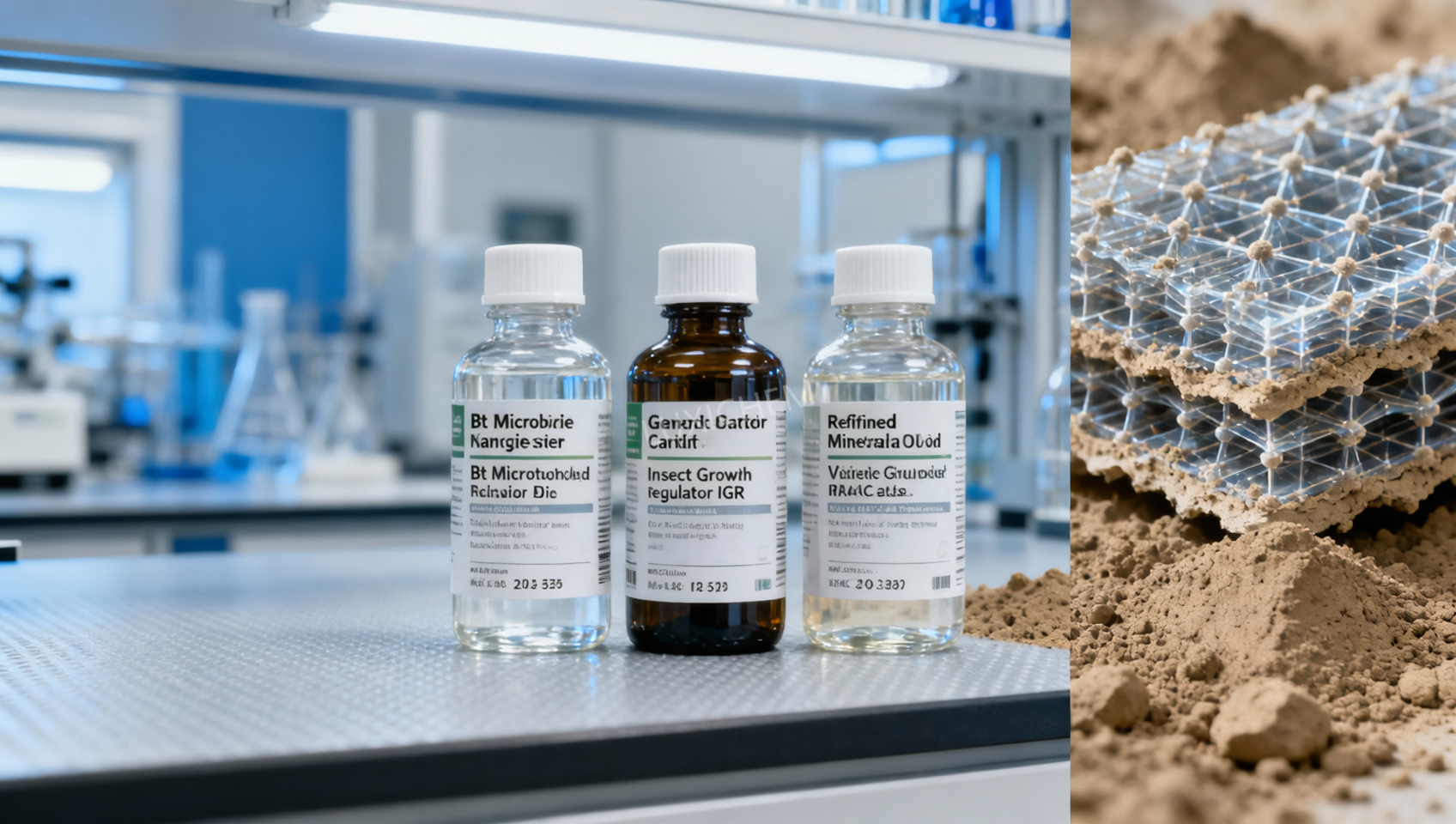
Targeted alternatives avoid this trade-off by narrowing the physiological or behavioral window of action. Microbial insecticides like *Bacillus thuringiensis* subsp. *kurstaki* (Btk) bind specifically to receptors in lepidopteran midguts — leaving coleopterans, hymenopterans, and dipterans functionally unaffected. Insect growth regulators (IGRs) such as diflubenzuron inhibit chitin synthesis only during molting, making them harmless to adults and non-arthropod organisms. Botanical oils (e.g., refined narrow-range mineral oils) disrupt cuticular integrity through physical mode of action — effective against soft-bodied pests but rapidly dissipating, with minimal impact on predators that spend less time on treated surfaces.
Crucially, integration success depends less on the active ingredient alone and more on formulation chemistry and delivery precision. Emulsifiable concentrates with high solvent loads increase phytotoxicity and reduce compatibility with biocontrol agents. Conversely, aqueous suspensions with low surfactant content and pH-stabilized matrices maintain efficacy while preserving beneficial insect mobility and feeding behavior. This is where material science intersects with field execution: carrier systems influence droplet size distribution, surface adhesion, UV stability, and residue longevity — all of which determine whether an otherwise selective active behaves selectively *in situ*.
 For projects requiring consistent, repeatable outcomes across seasons or geographies, inert carriers and adsorbents play a quiet but decisive role. Montmorillonite-based materials — naturally occurring 2:1 phyllosilicates with high cation-exchange capacity and layered structural integrity — serve as effective carriers for controlled-release formulations. Their platelet morphology allows uniform dispersion of actives, while surface acidity (pH 2.8–3.8) stabilizes acid-labile compounds without catalytic degradation. In industrial chromatography applications, K-CATALYST CAS#1318-93-0 demonstrates how montmorillonite’s structural consistency supports reproducible elution profiles for sensitive biomolecules — a property directly transferable to pesticide formulation design where batch-to-batch uniformity affects field performance predictability.
Such carriers also support residue management strategies. Unlike synthetic polymers, montmorillonite is insoluble in water and thermally stable above 300°C — minimizing leaching risk in irrigation-heavy systems and preventing premature breakdown under field heat stress. Its natural abundance and TSCA compliance reduce supply chain volatility compared to proprietary silica gels or engineered nanocarriers subject to evolving nano-regulation. For project managers evaluating long-term procurement reliability, this translates to fewer formulation reformulations, lower validation overhead, and greater alignment with global residue monitoring programs.
However, no alternative eliminates the need for precise application discipline. Even selective tools fail when misapplied. Spraying during peak pollinator foraging hours, using excessive spray volume that causes runoff into soil habitats, or applying IGRs outside larval emergence windows all negate selectivity advantages. Operational protocols — not just product choice — define IPM integrity. Monitoring must shift from “pest count only” to “pest + key beneficial density” tracking. Thresholds must incorporate predator:prey ratios, not just absolute pest numbers. And intervention timing must align with life-cycle vulnerabilities — not calendar dates or convenience schedules.
Resistance management adds another layer of complexity. Broad-spectrum insecticides exert intense selection pressure across multiple pest species simultaneously, promoting cross-resistance mechanisms. Targeted tools reduce this pressure, but only if rotation is enforced at the biochemical level — not just by swapping brand names. Rotating modes of action (MoA) groups — confirmed via IRAC classification — remains essential, even with selective agents. Project-level recordkeeping must capture not just what was applied, but *why*, *when*, and *against which life stage*, to enable meaningful MoA cycling over multi-season cycles.
Ultimately, the decision to move away from broad-spectrum insecticides isn’t about abandoning chemical control — it’s about recalibrating intervention logic. Speed of kill matters less than durability of suppression. Immediate reduction matters less than sustained ecosystem function. Procurement decisions must weigh not only cost per liter, but cost per season of stable pest suppression, cost per avoided regulatory incident, and cost per retained beneficial population. These are measurable project KPIs — not theoretical sustainability metrics.
For infrastructure-scale pest management, the operational ceiling isn’t defined by what kills fastest. It’s defined by what sustains longest — ecologically, logistically, and commercially.
Related Picks
 Butylated Hydroxytoluene Price Drivers: Supply, Purity, and Purchasing Risk FactorsOct 21, 2026Butylated Hydroxytoluene price trends depend on supply stability, purity, logistics, and purchasing risk. Learn how to compare quotes wisely and reduce sourcing costs.
 Sodium Tripolyphosphate Price Trends: Raw Material and Energy ExposureOct 20, 2026Explore sodium tripolyphosphate price trends, from phosphate and soda ash costs to energy exposure. Learn how to compare quotes, manage sourcing risks, and make smarter purchasing decisions.
 Acetonitrile Shipment to Vietnam Successfully Dispatched; RCEP Benefits Boost Fine Chemical Trade with ASEANSep 16, 2026A shipment of industrial-grade acetonitrile from our company has recently been loaded and dispatched following the completion of standardized hazardous material packaging and container securing procedures.
 Nigerian Client’s Order of 4 Containers of Vinyl Acetate Successfully Loaded and Shipped to West AfricaSep 16, 2026We recently completed the loading of a vinyl acetate order for a Nigerian client; four containers of the product have been successfully packed and are ready for shipment to Nigeria.




Question Consultation
Send Us Your Inquiry Today

Luxi Chemical is a professional chemical product supplier with ample stock of all chemical categories and excellent quality, welcome your purchase inquiry.

